
Compound hub · MOTS-c
What have MOTS-c studies measured alongside retatrutide or tirzepatide?
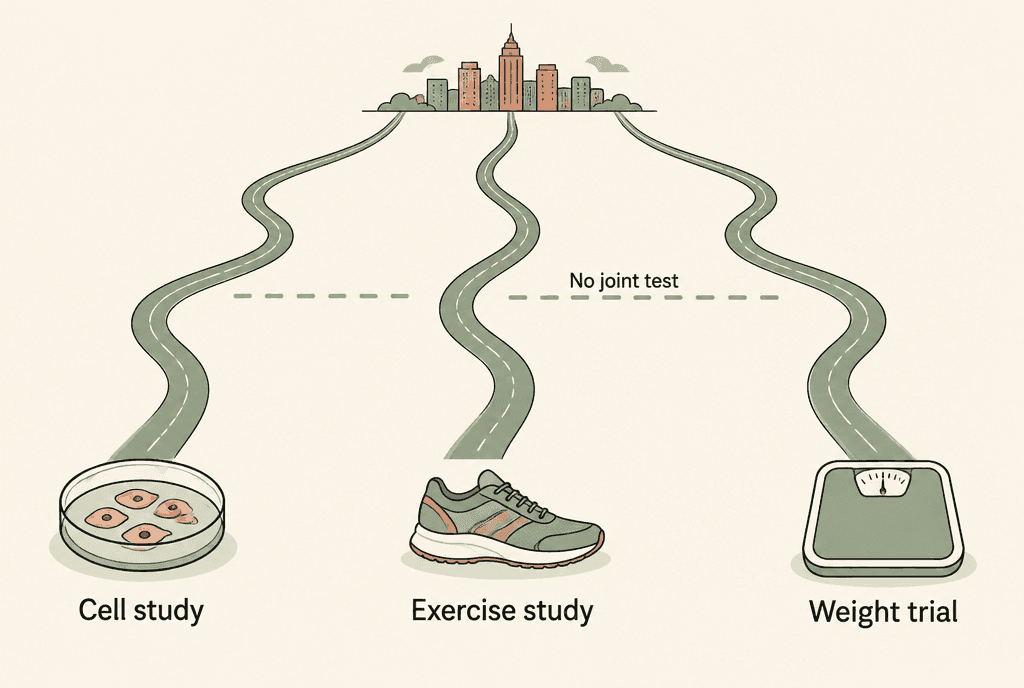
Searches for this page on 16 October 2026 found no peer-reviewed study that tested MOTS-c together with retatrutide or tirzepatide. Each compound has its own, separate papers. MOTS-c papers measured the body's own MOTS-c around exercise, or worked with cells and mice. The retatrutide and tirzepatide trials measured body weight and unwanted health events in people. Separate papers cannot show what either pair does together, or whether it is safe.
01Evidence for each pairContents
Picture two weather stations in towns far apart. Each one keeps careful records, yet neither can say what the weather did on the road between them. Research papers work the same way. A study can only report on the things it actually put side by side. The MOTS-c research guide and the MOTS-c hub cover MOTS-c on its own.
MOTS-c is a short chain of 16 amino acids, the small units that build proteins. Its code sits in the DNA of mitochondria, the parts of a cell that release energy. Retatrutide and tirzepatide were tested in large weight trials. This page asks one question first: did any study test MOTS-c with either of them? Then it walks through what each set of papers did measure, and what is still unknown.
Key facts
| MOTS-c length | 16 amino acids (Lee et al., Cell Metabolism, 2015) |
|---|---|
| MOTS-c origin | Mitochondrial DNA (Lee et al., Cell Metabolism, 2015) |
| Retatrutide study record | NCT04881760; Phase 2 (Jastreboff et al., 2023) |
| Tirzepatide study record | NCT04184622; Phase 3 (Jastreboff et al., 2022) |
| Search date | 16 October 2026 |
Evidence limits
Have MOTS-c and retatrutide or tirzepatide been studied together?
No. The searches for this page found no peer-reviewed experiment that tested MOTS-c with retatrutide, or MOTS-c with tirzepatide. On 16 October 2026, the searches used Europe PMC, a large free library of science papers. They paired MOTS-c with each name in paper titles and summaries. Wider searches also looked for papers that mention both names anywhere in the full text. A review that mentions two names is not a test of the two together. These searches cover only the names, records and date checked. Unpublished work, or papers that use other names, could be missed. Not finding a study does not show that a pair has no effect, or that it is safe.
To answer a question about two compounds, a paper must say what it tested, which groups it compared and what it measured. Two separate papers can each explain their own compound. Joining their conclusions does not create a new experiment. It is like reading two recipes and guessing how the mixed dish tastes: the guess is not a taste test. The MOTS-c overview explains what the name MOTS-c refers to.
What have MOTS-c studies measured on their own?
MOTS-c papers come in two kinds. Some measure the MOTS-c that people's bodies already make. Others test MOTS-c in cells and mice. A 2021 study by Reynolds and colleagues measured MOTS-c in the blood and muscle of healthy young men around exercise. That human part did not give anyone MOTS-c. A 2015 study by Lee and colleagues looked at how cells use fuel, and how mice responded to insulin, the hormone that helps control blood sugar. That lab work involved AMPK, an enzyme that acts like a cell's fuel gauge. Neither paper tested MOTS-c with retatrutide or tirzepatide. So neither one shows how those compounds interact.
In the human part of the Reynolds paper, natural MOTS-c levels changed with exercise. That is a change in a signal the body already makes. It is a different observation from how a body responds when MOTS-c is supplied from outside. The MOTS-c study findings keep those two kinds of evidence apart.
What did the retatrutide trial measure instead of a MOTS-c pair?
The retatrutide trial compared retatrutide with a placebo, not with MOTS-c. A placebo is a dummy treatment with no active compound in it. In a trial published in 2023, Jastreboff and colleagues enrolled 338 adults with obesity. The main thing they measured was weight change at 24 weeks. They also checked weight at later times, and safety. A trial's outcome is simply what it records. It is not a promise about anyone outside the trial. This trial had no MOTS-c group. So it cannot show whether MOTS-c changes how people respond to retatrutide, or adds a new risk. Those questions need a study that tests them directly.
Random assignment means chance, like a coin toss, decides who gets which treatment. That keeps the groups fair to compare within one trial. The retatrutide study findings explain retatrutide's own research record.
What did tirzepatide research measure about MOTS-c?
The tirzepatide trial did not test MOTS-c, and it did not measure natural MOTS-c as a main outcome. The trial is called SURMOUNT-1. In a paper published in 2022, Jastreboff and colleagues studied 2,539 adults without diabetes for 72 weeks. The main outcomes were weight change and how many people reached a set amount of weight reduction. The trial also recorded adverse events, meaning unwanted health events during the study. That design answers questions about tirzepatide compared with a placebo, in the people who took part. It leaves open what happens with MOTS-c and tirzepatide together, including any interaction or change in safety.
A bigger trial does not answer a wider question. It answers the same question with more people. The tirzepatide study findings describe what tirzepatide's own trials measured.
Do shared metabolic measurements establish how the compounds interact?
No. Sharing a topic such as blood sugar or body weight does not show how MOTS-c interacts with retatrutide or tirzepatide. Metabolism is the body's chemical work of using and storing fuel. Many signals take part in that work. So two studies that land on the same outcome may not work the same way, just as many roads can lead into one city. A cell result, a blood test around exercise and a human weight trial also differ in setting and purpose. Evidence about a pair needs a study that tested that pair. The separate papers leave combined effects, long-term outcomes and joint safety unconfirmed.
A safety record belongs to the study that produced it. The MOTS-c side-effects evidence explains the limits of that record. An unknown interaction stays unknown, even when separate studies look at similar parts of the body.
Comparison
How each cited study was set up and what it measured. Each row is a separate study. The table does not rank the studies or draw any conclusion about either pair.
| Study record | Setting | Measurements | Limit for the pair question |
|---|---|---|---|
| MOTS-c: Lee et al., Cell Metabolism, 2015 | Cells and mice | How cells use fuel; insulin responses in mice | Did not test retatrutide or tirzepatide |
| MOTS-c: Reynolds et al., Nature Communications, 2021 | People exercising, plus separate lab work | Natural MOTS-c in blood and muscle; mouse and cell measures | The human part did not give anyone MOTS-c |
| Retatrutide: Jastreboff et al., New England Journal of Medicine, 2023 | Human trial with groups decided by chance | Body weight and unwanted health events | No MOTS-c group |
| Tirzepatide: Jastreboff et al., New England Journal of Medicine, 2022 | Human trial with groups decided by chance | Weight outcomes and unwanted health events | Did not test MOTS-c with tirzepatide |
FAQ
What does research show about MOTS-c with retatrutide?
The searches for this page on 16 October 2026 found no peer-reviewed experiment that tested this pair. Separate papers about MOTS-c and about retatrutide cannot show how the two act together.
Has MOTS-c with tirzepatide been measured in SURMOUNT-1?
No. SURMOUNT-1 compared tirzepatide with a placebo. It did not test MOTS-c with tirzepatide. Its weight records and its records of unwanted health events are not evidence about that pair.
Are natural MOTS-c measurements the same as testing supplied MOTS-c?
No. Measuring natural MOTS-c tracks a signal the body already makes. The 2021 exercise study in people by Reynolds and colleagues did not show how people respond to MOTS-c given from outside.
Does a missing combination study establish safety?
No. A missing study leaves the question open. Safety results from separate studies do not show that a pair is safe. The searches for this page found no safety result for either pair.
More in this hub
Citations
4 sourcesLee C, Zeng J, Drew BG, et al. Cell Metabolism. 2015;21(3):443-454.
doi:10.1016/j.cmet.2015.02.009Reynolds JC, Lai RW, Woodhead JST, et al. Nature Communications. 2021;12:470.
doi:10.1038/s41467-020-20790-0Jastreboff AM, Kaplan LM, Frias JP, et al. New England Journal of Medicine. 2023;389:514-526.
doi:10.1056/NEJMoa2301972Jastreboff AM, Aronne LJ, Ahmad NN, et al. New England Journal of Medicine. 2022;387:205-216.
doi:10.1056/NEJMoa2206038
Form Laboratories supplies research-use-only reference material. This article is an educational summary of published third-party literature. It is not medical advice, not a use instruction, and research material is not for human or animal use.