
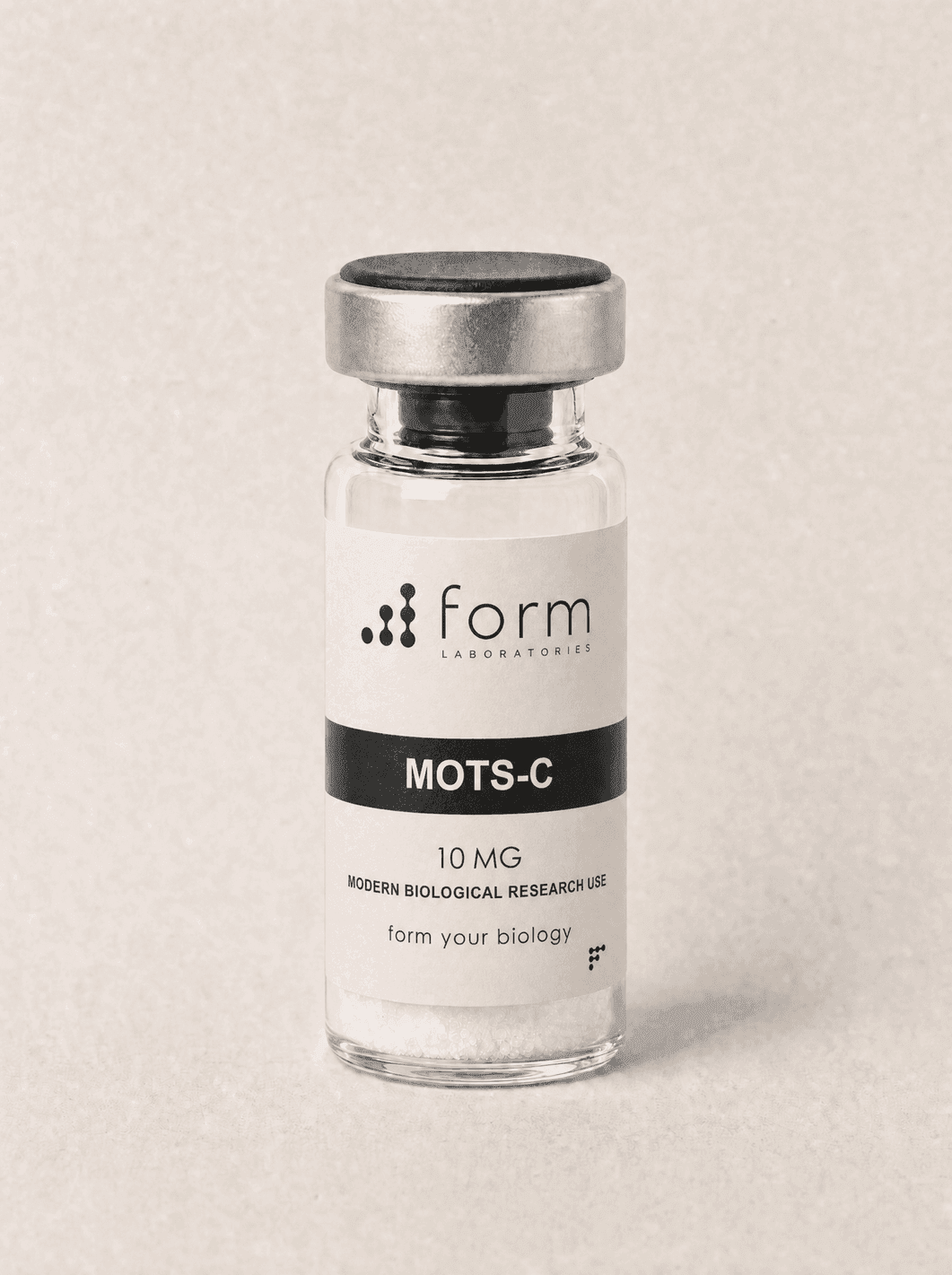
MOTS-C is a chain of 16 amino acids (sequence MRWQEMGYIFYPRKLR). An identity fact, not a product claim.
Lee et al., Cell Metabolism, 2015Plain-English research guideMOTS-C / MT-RNR1 sORF
MOTS-C research guide
Everything worth knowing, without the jargon.
MOTS-C is a 16-amino-acid mitochondrial-derived peptide (MDP) - one of a small family of peptides encoded inside mitochondrial DNA, in the 12S rRNA (MT-RNR1) region. First described in 2015, it's studied in cell and animal research for mitochondrial biology and the AMPK energy pathway.
REV 2026-07 · 7 Aug 20265 peer-reviewed studiesResearch-use-only context
What the papers reportThird-party literature - not product claims
The year MOTS-C was first described, as one of a small family of peptides encoded inside mitochondrial DNA. Research context, not a product claim.
Lee et al., Cell Metabolism, 2015The cell's main energy-sensing pathway (AMP-activated protein kinase) - the pathway MOTS-C is most associated with across the research. Research context, not a product claim.
Lee et al., Cell Metabolism, 2015Why it matters
A peptide written in mitochondrial DNA.
Nearly every protein the body makes is encoded in the DNA inside the cell's nucleus. MOTS-C is unusual because its gene sits inside mitochondrial DNA - the small, separate genome of the mitochondria themselves, the energy-handling structures inside the cell. That's what first drew researchers to it.
It was first described in 2015 by Lee and colleagues, who identified it from a short open reading frame in the mitochondrial 12S rRNA gene (the MT-RNR1 region). That made it one of a small, newly recognised family of mitochondrial-derived peptides - humanin is another - and the field is still young.
Most of what's been published since is cell-culture and rodent research into mitochondrial biology and the AMPK energy pathway. There are no large human trials of the native peptide, so this guide treats all of it as research context - not as anything the vial will do for a person.
How it works
A peptide written inside mitochondrial DNA.
A plain-English look at each pathway, kept at a summary level.
Encoded inside mitochondria
MOTS-C's short gene sits in mitochondrial DNA, in the 12S rRNA (MT-RNR1) region - which is why it's called a mitochondrial-derived peptide rather than a nucleus-encoded one.
The AMPK energy pathway
In the research literature MOTS-C is most associated with AMPK (AMP-activated protein kinase), the cell's central energy-sensing pathway, and with how cells handle glucose under metabolic stress. Lee and colleagues (2015) linked it to the folate/one-carbon (AICAR) pathway that activates AMPK, in cell and mouse studies.
Moves to the nucleus under stress
Kim and colleagues (2018) reported that under glucose restriction MOTS-C moves from the cytoplasm into the cell nucleus and helps regulate stress- and antioxidant-response genes (via NRF2/AMPK). A finding in human cell cultures - not a product effect.
Pharmacology at a glance
- Research code
- MOTS-C / MT-RNR1 sORF
- Class
- Mitochondrial-derived peptide (MDP) - a small peptide encoded inside mitochondrial DNA rather than the cell nucleus.
- Molecule
- A 16-amino-acid peptide, sequence MRWQEMGYIFYPRKLR, supplied as a freeze-dried powder.
- Route studied
- No route guidance. This guide provides no route, preparation, or use guidance of any kind.
- Reported half-life
- Not established in the cited literature for this consumer entry - MOTS-C isn't characterised as a dosed medicine, so there's no clinical half-life to quote.
- Originator
- First described by Lee and colleagues in 2015, from a short open reading frame in the mitochondrial 12S rRNA gene. Form Labs did not run the cited studies.
- Approval status
- Laboratory research material only - not an approved medicine, and not evaluated by the TGA or any regulator for human use.
What it has been studied for
Study areas from the published literature.
Metabolic homeostasis & AMPK
Activation of the AMPK energy-sensing pathway via folate/one-carbon metabolism, and insulin sensitivity in mice.
Lee et al., Cell Metabolism, 2015 (cells + mice)Mitonuclear stress signalling
Movement of MOTS-C into the nucleus under glucose restriction to regulate stress-response genes.
Kim et al., Cell Metabolism, 2018 (cells)Exercise & age-related physical decline
Running capacity and physical performance in aged mice; one cycling bout raised endogenous MOTS-C in 10 healthy men.
Reynolds et al., Nature Communications, 2021 (mice + human exercise)Muscle function & CK2 (genetic association)
Binding and activation of CK2 in mice and cells, and a natural gene variant linked to sarcopenia and type-2-diabetes risk across three human cohorts.
Kumagai et al., iScience, 2024 (mice + cells + human genetic)Circulating MOTS-C as a biomarker
Blood levels of MOTS-C measured against obesity and insulin-resistance markers in young people.
Du et al., Pediatric Diabetes, 2018 (human observational)The studies
The evidence, study by study.
Open any study for a plain summary, what it measured, the finding, and a link to the paper.
The paper that first identified MOTS-C, from a short open reading frame in mitochondrial DNA, and linked it to the AMPK energy pathway and insulin sensitivity in mice.
- Studied in
- Human cell lines (HEK293, HeLa, L6) and mice.
- Design
- A discovery paper - lab cell work plus animal experiments that established the peptide and its main pathway.
- Measured
- AMPK pathway activation, folate/one-carbon metabolism, and markers of insulin sensitivity in mice.
In cell and mouse studies, MOTS-C activated the AMPK energy-sensing pathway via the folate/one-carbon (AICAR) pathway and was associated with improved insulin sensitivity in mice. The paper included no human data - a cell and rodent finding, not an effect in people.
DOI 10.1016/j.cmet.2015.02.009This paper showed that under glucose restriction MOTS-C moves into the cell nucleus and helps regulate stress-response genes.
- Studied in
- Human cell lines (HEK293, HepG2) in culture.
- Design
- A cell-culture study of where MOTS-C sits in the cell and which genes it touches under metabolic stress.
- Measured
- Movement of MOTS-C into the nucleus and changes in stress- and antioxidant-response gene activity (NRF2/AMPK).
Under glucose restriction, MOTS-C moved from the cytoplasm into the nucleus of the cultured cells and helped regulate antioxidant and stress-response genes. A cell-culture finding only - no animals or humans - describing how the peptide behaves in cells, not a product effect.
DOI 10.1016/j.cmet.2018.06.008This paper reported that aged mice given MOTS-C had better physical performance, and that one bout of cycling raised the body's own MOTS-C in 10 healthy men.
- Studied in
- Aged mice, plus 10 healthy men for an endogenous (body's-own) measurement.
- Design
- Animal experiments on running capacity, grip and stride, plus a small human exercise observation. No MOTS-C was given to the men.
- Measured
- Running capacity, grip strength and stride in aged mice; endogenous MOTS-C levels after exercise in the men; and lifespan in mice.
Aged mice given MOTS-C showed better running capacity, grip and stride. In a separate small measurement, one cycling bout raised the body's own MOTS-C in 10 healthy men - no MOTS-C was given to the men. The study noted only a non-significant trend (P=0.05) toward longer lifespan in mice, so any aging finding is early and mostly rodent-based, not evidence of an effect in people.
DOI 10.1038/s41467-020-20790-0This paper reported that MOTS-C binds and activates a protein called CK2, and that a natural gene variant with weaker CK2 binding was linked to certain muscle and metabolic traits in large human cohorts.
- Studied in
- Mice and cell cultures, plus three human cohort datasets analysed for a genetic association.
- Design
- Lab mechanistic work on CK2 binding plus a genetic-association analysis of a natural MOTS-C variant. Not a trial that gave MOTS-C to people.
- Measured
- CK2 binding and activation in mice and cells; and statistical association of the K14Q variant with sarcopenia and type-2-diabetes risk across the cohorts.
MOTS-C bound and activated CK2 in mice and cells. A natural MOTS-C gene variant (K14Q) with weaker CK2 binding was associated, across three human cohorts, with higher sarcopenia and type-2-diabetes risk. That's a genetic association - not a trial that administered MOTS-C, so it doesn't show what the peptide does to a person.
DOI 10.1016/j.isci.2024.111212This paper measured MOTS-C in the blood of young people and compared the levels across obesity and insulin-resistance groups.
- Studied in
- Children and adolescents, grouped by obesity status.
- Design
- An observational biomarker study - measuring circulating MOTS-C and comparing it across groups. No MOTS-C was given to anyone.
- Measured
- Blood levels of MOTS-C alongside insulin-resistance and related metabolic markers.
Circulating MOTS-C was lower in obese than non-obese children and adolescents (a human observational measurement), and tracked with insulin-resistance markers. It's an observational study in people, not a trial that gave MOTS-C to anyone - a correlation in a population, not evidence of what the peptide does to a person.
DOI 10.1111/pedi.12685Where evidence stops
Groups and questions not established.
- Large human clinical trials - there is no peer-reviewed trial giving native MOTS-C to people for any outcome.
- Any use in or on people or animals - none of the research on this page is a use direction.
- Human dosing, efficacy, or before-and-after numbers - none are established in the cited literature.
- What a specific batch does - the studies are about the molecule in general, not this vial.
Development and status
Where the research record sits.
MOTS-C is first described by Lee and colleagues, from a short open reading frame in mitochondrial DNA (Cell Metabolism).
Kim and colleagues report MOTS-C moving into the nucleus under glucose restriction to regulate stress-response genes (Cell Metabolism).
Du and colleagues measure circulating MOTS-C against obesity and insulin-resistance markers in young people (Pediatric Diabetes).
Reynolds and colleagues report better physical performance in aged mice given MOTS-C, and that exercise raises the body's own MOTS-C in 10 healthy men (Nature Communications).
Kumagai and colleagues map CK2 binding and activation, and a linked natural gene variant associated with muscle and metabolic traits (iScience).
Approval status: Laboratory research material only - not an approved medicine, and not evaluated by the TGA or any regulator for human use.Whatever the molecule’s status elsewhere, what Form Labs supplies is research-use-only reference material - for laboratory work, not for people or animals.
Evidence and limitations
What this means, and what it does not.
It's a young field
MOTS-C was first described in 2015, and mitochondrial-derived peptides as a family are still new. The evidence base is growing but small compared with longer-studied peptides.
Most evidence is cells and rodents
The published work is predominantly cell cultures and mice. Useful for understanding the molecule, but it doesn't translate into claims about people.
The human evidence is observational only
The human-linked findings are observational or endogenous - exercise raises the body's own MOTS-C (Reynolds), a gene variant is associated with traits (Kumagai), and blood levels track markers (Du). None gave MOTS-C to people as a treatment.
No use instructions
This guide doesn't provide preparation, dosing, or human-use guidance. It's a plain summary of published research.
The lab report is the authority for a batch
Identity, purity, appearance, and storage for the material we ship come from the lab report (COA) and label - not from these papers.
Lab handling
Reference-material handling context.
Research-use boundary
MOTS-C is supplied strictly for laboratory research. It's not for human consumption, veterinary, medical, or cosmetic use, and no directions for use are given.
COA and label
The certificate of analysis (COA) and vial label are the authority for the batch you receive. The report on file for MOTS-C is an independent lab assessment measuring peptide content at 11.15 mg; it prints no purity percentage. The matching lab report is saved to your account after purchase - not in the box.
Storage
Supplied freeze-dried. Store cold at 2-8 C (fridge-cold) and out of light, following the vial label, the matching lab report for the batch, and the receiving lab's own written procedures.
Educational boundary
This guide is a plain summary of third-party research that Form Labs did not run. It isn't medical advice or a product claim.
Glossary
Plain-English definitions.
- Mitochondrial-derived peptide (MDP)
- A small peptide encoded inside mitochondrial DNA rather than the cell's nuclear DNA. MOTS-C and humanin are examples.
- MT-RNR1
- The mitochondrial gene region that codes for the 12S rRNA, where MOTS-C's short gene sits.
- 12S rRNA
- A type of ribosomal RNA encoded by mitochondrial DNA; produced by the MT-RNR1 gene.
- sORF
- Short open reading frame - a short genetic section that can code for a small peptide, like MOTS-C.
- AMPK
- AMP-activated protein kinase - the cell's central energy-sensing pathway, and the one MOTS-C is most associated with.
- Folate / one-carbon (AICAR) pathway
- A metabolic route the 2015 paper linked to MOTS-C's activation of AMPK.
- Mitonuclear
- Describing communication between the mitochondria and the cell nucleus - relevant to MOTS-C's move into the nucleus under stress.
- CK2
- A protein kinase (enzyme) that MOTS-C binds and activates, as reported in 2024 lab work.
- GLUT4
- A transport protein that moves glucose across cell membranes; named in MOTS-C study context.
- RUO
- Research use only - a lab-only boundary, not for human consumption, veterinary, medical, or cosmetic use.
- COA
- Certificate of analysis - the batch paperwork controlling identity, purity, appearance, and release.
FAQ
Questions answered plainly.
MOTS-C is a 16-amino-acid mitochondrial-derived peptide (sequence MRWQEMGYIFYPRKLR) encoded within the 12S rRNA (MT-RNR1) region of mitochondrial DNA, studied in cell and animal research for mitochondrial biology and the AMPK energy pathway.
A mitochondrial-derived peptide (MDP) is a small peptide encoded inside mitochondrial DNA rather than the cell nucleus. MOTS-C was first described in 2015 by Lee and colleagues in Cell Metabolism, from a short open reading frame in the mitochondrial 12S rRNA gene; it's one of a small MDP family that also includes humanin.
Lee and colleagues (2015) reported, in cell and mouse studies, that MOTS-C activates the AMPK energy-sensing pathway via folate/one-carbon metabolism and was associated with improved insulin sensitivity in mice. These were cell and rodent findings - the paper included no human data - so they describe research observations, not effects in people.
No peer-reviewed clinical trial has tested giving native MOTS-C to people for any outcome. The human-linked research is observational: exercise raises the body's own MOTS-C (Reynolds et al., 2021, in 10 healthy men), a natural MOTS-C gene variant has been associated with muscle and metabolic traits (Kumagai et al., 2024), and circulating MOTS-C has been measured against metabolic markers (Du et al., 2018). None involved administering MOTS-C as a treatment, and any claim of a proven human effect would go beyond the evidence.
MOTS-C is most closely associated in the research with AMPK (AMP-activated protein kinase), the cell's central energy-sensing pathway. Lee and colleagues (2015) linked it to the folate/one-carbon (AICAR) pathway that activates AMPK, and later reviews (e.g. Wan et al., 2023) summarise this across the rodent and observational literature. This is mechanism described in cells and animals, not a product effect.
MOTS-C has been described as an exercise-responsive peptide. In aged mice given MOTS-C, Reynolds and colleagues (2021) reported better running capacity and physical performance; in the same work, one bout of cycling raised the body's own MOTS-C in 10 healthy men. The study noted only a non-significant trend toward longer lifespan in mice, so aging findings are early and mostly rodent-based - not evidence of an effect in people taking a product.
Kim and colleagues (2018) reported that, under glucose restriction, MOTS-C moves from the cytoplasm into the cell nucleus and helps regulate stress- and antioxidant-response genes (via NRF2/AMPK). This was a cell-culture study in human cell lines, describing how the peptide behaves in cells under stress - not a human or animal outcome.
No. MOTS-C and humanin are both mitochondrial-derived peptides, but they're different molecules encoded by different parts of mitochondrial DNA (MOTS-C from the 12S rRNA / MT-RNR1 region) and studied for overlapping but distinct roles in metabolism and stress signalling. MOTS-C is a 16-amino-acid peptide, sequence MRWQEMGYIFYPRKLR.
"For research use only" means MOTS-C is supplied strictly for laboratory research and is not for human or veterinary consumption, medical use, or cosmetic use. This guide is an educational summary of third-party published research that Form Labs did not conduct - not medical advice or a product claim.
MOTS-C acts on the AMPK pathway, and the World Anti-Doping Agency (WADA) prohibits AMPK activators as metabolic modulators (category S4) at all times in sport. Athletes subject to anti-doping rules should confirm MOTS-C's current status directly with WADA. Form Labs supplies MOTS-C for laboratory research only, not for human use.
References
Every figure, sourced.
Educational references to third-party literature. Form Labs is unaffiliated with the study authors.
The 2015 discovery paper identifying MOTS-C and linking it to the AMPK pathway and insulin sensitivity in mice. Lee C, Zeng J, Drew BG, et al. Cell Metabolism, 2015.
DOICell-culture study of MOTS-C moving into the nucleus under glucose restriction to regulate stress-response genes. Kim KH, Son JM, Benayoun BA, Lee C. Cell Metabolism, 2018.
DOIMouse and small human exercise study of MOTS-C, physical performance and aging. Reynolds JC, Lai RW, Woodhead JST, et al. Nature Communications, 2021; 12: 470.
DOIMouse, cell and human genetic-association study linking MOTS-C to CK2 binding and to muscle and metabolic traits. Kumagai H, Kim SJ, Miller B, et al. iScience, 2024; 27: 111212.
DOIHuman observational study of circulating MOTS-C against obesity and insulin-resistance markers in young people. Du C, Zhang C, Wu W, et al. Pediatric Diabetes, 2018.
DOIReview of MOTS-C as a mitochondrial-derived peptide regulating muscle and fat metabolism. Lee C, Kim KH, Cohen P. Free Radical Biology and Medicine, 2016.
DOIReview of mitochondrial-derived peptides in aging and age-related disease. Kim et al. The Journal of Physiology, 2017.
DOIReview of MOTS-C as a candidate for metabolic disorders. Wan et al. Journal of Translational Medicine, 2023.
DOIReview of MOTS-C in metabolic homeostasis and longevity. Mohtashami et al. International Journal of Molecular Sciences, 2022.
DOIReview of the role of MOTS-C in metabolic diseases. Zheng et al. Frontiers in Endocrinology, 2023.
DOICitations are provided for education only. No therapeutic, weight-loss, or efficacy claims are made.
How we produce these guides
- Who writes them
- These guides are written and maintained in-house by the Form Laboratories research team. They are not authored by a named clinician, and nothing in them is medical advice. Where a guide is short, that is because the published research is thin - we would rather say so than fill the space.
- What they are built from
- Each guide summarises published, peer-reviewed literature. Every study we describe is listed in full at the bottom of the page with a link to the original paper, so you can open it and check what it actually says. Form Laboratories did not run any of the cited studies.
- What they deliberately leave out
- These guides describe how the biology works and what the published research measured. They do not contain dosing, preparation, reconstitution or administration instructions, and they make no claim about what any compound would do for a person. Everything we supply is research-use-only reference material.
- How we handle uncertainty
- Where the evidence is limited to cell cultures or animals, we say so in the study entry rather than implying a human result. Where a compound has no completed human trial, the guide states that plainly.
The product
Form Laboratories - MOTS-C
Ready to see MOTS-C?
- Independently tested - purity printed on the lab report.
- A batch number on every vial, matched to its report.
- Ships from Perth via Australia Post or CouriersPlease in plain packaging.
Build your stack
Compare nearby catalogue records.
These nearby records stay inside the research-only catalogue.

Research-use-only catalogue
Continue to the product record.
Review lot-facing product details, pricing, and checkout boundaries on the matching product page.
View MOTS-C - from $99.00 AUD