
Literature context: three NAD+-using enzyme groups are named here - sirtuins, PARPs, and CD38. This count is not a product result.
NAD+ enzyme-family literature contextPlain-English research guideNAD+
NAD+ research guide
Everything worth knowing, without the jargon.
NAD+ is a coenzyme - a small helper molecule every living cell needs to run its chemistry. It is not a peptide and not an approved medicine. This guide walks through what the research actually says about it, and what it does not.
REV 2026-07 · 7 Aug 20263 peer-reviewed studiesResearch-use-only context
What the papers reportThird-party literature - not product claims
Identity context: NAD+ and NADH are the paired redox forms named in the guide. This is chemistry context, not a product result.
NAD+ and NADH redox-pair identityWhy it matters
Cell-chemistry literature, not a use guide.
NAD+ is a coenzyme - a small helper molecule every living cell needs to run its chemistry. It is not a peptide and not an approved medicine. This guide walks through what the research actually says about it, and what it does not.
Research use only means this material is sold for in-vitro laboratory work - controlled experiments outside a living body. It is not tested, packaged or approved as a medicine, supplement or food, and it must not be used in or on people or animals.
A few words that come up constantly. A coenzyme is a small molecule that helps enzymes do their work. Redox is chemistry involving the transfer of electrons - NAD+ and NADH are the same molecule in two states, NAD+ before it takes electrons on and NADH after, cycling back and forth. Sirtuins, PARPs and CD38 are three families of enzymes that consume NAD+ outright rather than borrowing it.
The source guide keeps study context separate from Form Labs product claims and does not provide preparation, administration, or use directions.
How it works
One coenzyme, cycling through the cell.
A plain-English look at each pathway, kept at a summary level.
The courier
NAD+ picks up the electrons freed when a cell breaks down food and carries them to where energy actually gets made, becoming NADH while it holds them. The cell converts it back, so the same molecule cycles round and round - which is why papers write the pair as NAD+/NADH. This is cell chemistry in the literature, not a product effect.
The enzymes that spend it
Sirtuins, PARPs and CD38 do not borrow NAD+ - they use it up. PARPs are called in when DNA is damaged; sirtuins are studied around how genes get switched on and off. Because they consume the same NAD+ the energy system depends on, researchers ask what gives when they get busy. These are research topics, not product effects.
Why NMN and NR keep coming up
NMN and NR are precursors - molecules the body converts into NAD+. Most of the human work in this field used those rather than NAD+ itself, so findings about them should not be read as findings about NAD+. This is the single easiest mistake to make when reading around the subject.
Pharmacology at a glance
- Research code
- NAD+
- Class
- NAD+ identity, redox-pair chemistry, and NAD+-using enzyme literature. Class wording here means the research category named by the source guide.
- Molecule
- NAD+ / nicotinamide adenine dinucleotide; identity wording comes from the source guide and matching product record.
- Route studied
- No route guidance is provided by this consumer guide. Any route wording in the source literature is not product-use guidance.
- Reported half-life
- Not listed in the source guide for this consumer entry; half-life means the time for a measured amount to fall by half.
- Originator
- Not listed in the source guide; Form Labs did not run the cited studies.
- Approval status
- Laboratory research material only. This guide gives no human-use, veterinary-use, preparation, or administration direction.
What it has been studied for
Study areas from the published literature.
NAD+ redox and enzyme-substrate biology
Study topic: how NAD+ sits in redox chemistry and in enzyme systems that consume it.
Belenky et al., Trends Biochem Sci, 2007Sirtuin co-substrate record
Study topic: Sir2 and sirtuin enzymes using NAD+ as a co-substrate during deacetylase reactions.
Imai et al., Nature, 2000NAD+ pathway overview
Study topic: cellular pathways where NAD+ is discussed across metabolism, DNA repair, chromatin, senescence, and immune-cell literature.
Covarrubias et al., Nat Rev Mol Cell Biol, 2021The studies
The evidence, study by study.
Open any study for a plain summary, what it measured, the finding, and a link to the paper.
A survey of how cells make NAD+, how they recycle it, and which enzymes use it up.
- Studied in
- Published cell-biology literature spanning yeast, bacterial and mammalian cell studies.
- Design
- The authors read the existing experimental literature on NAD+ and organised it into the routes cells use to build the molecule and the routes that consume it.
- Measured
- Nothing new was measured here. The value of the paper is the map it draws: which reactions produce NAD+, and which spend it.
Cells do not make NAD+ once and keep it. They run a constant recycling loop, because enzymes such as sirtuins, PARPs and CD38 break NAD+ apart when they act. That is why the same molecule turns up in papers on energy metabolism and in papers on DNA repair - it is being spent in both places.
DOI 10.1016/j.tibs.2006.11.006The experiment that showed the sirtuin enzyme Sir2 cannot do its job without NAD+.
- Studied in
- Purified yeast Sir2 protein and yeast cell extracts, in vitro.
- Design
- The researchers gave the Sir2 enzyme its target and watched whether it acted - once with NAD+ present, once with NAD+ absent.
- Measured
- Whether Sir2 stripped acetyl groups from histones, the spool proteins DNA winds around, and whether NAD+ was consumed while it did so.
Sir2 only worked when NAD+ was present, and it used the NAD+ up as it went. That tied a gene-regulating enzyme directly to the cell's energy chemistry: how much NAD+ is around becomes a signal the enzyme can read. Most later research linking NAD+ to ageing traces back to this connection.
DOI 10.1038/35001622A survey of where NAD+ research had reached, and of how much of the evidence comes from animals rather than people.
- Studied in
- Published literature spanning cell culture, mouse studies, and a smaller number of human trials.
- Design
- The authors reviewed the accumulated research on NAD+ across metabolism, DNA repair, cell ageing and immune signalling.
- Measured
- No new measurement. The review's contribution is stating plainly which claims rest on mouse data and which have human evidence behind them.
NAD+ levels were reported to fall with age in several tissues, while the enzymes that consume NAD+ grow busier at the same time. The review is careful about what that does and does not establish: most of the intervention evidence comes from animals, and from the precursors NMN and NR rather than NAD+ itself, so the human picture remained open.
DOI 10.1038/s41580-020-00313-xEvidence and limitations
What this means, and what it does not.
The source guide is a literature map, not a product claim
The cited papers are used for identity, pathway, marker, model, or analytical context. They do not become Form Labs results or promises.
Study details are limited to the source record
Where the source guide does not list participant counts, model details, study amounts, or study-stage labels, this page does not invent them.
No use instructions are included
This guide does not provide preparation, administration, human-use, veterinary-use, medical, cosmetic, or dosing guidance.
COA and label stay authoritative
Storage and batch decisions should follow the product label and matching COA. Source storage note: 2-8 C, dry and protected from light.
Lab handling
Reference-material handling context.
COA and label
Use the product label and matching COA, meaning certificate of analysis, as the authority for storage, appearance, purity, and release state.
Educational boundary
This guide is educational context only. It does not include preparation, administration, human-use, or veterinary-use directions.
Research-use boundary
For laboratory research use only. 21+ only. Not for human consumption or veterinary use.
Glossary
Plain-English definitions.
- NAD+
- Nicotinamide adenine dinucleotide; a coenzyme named in redox and enzyme-substrate papers.
- NADH
- The paired reduced form that cycles with NAD+ in redox chemistry.
- Electron transfer
- Movement of electrons from one molecule to another during a chemical reaction.
- Coenzyme
- A small molecule that helps enzymes carry out chemical reactions.
- Sirtuin
- An NAD+-dependent enzyme-family name in papers on protein deacetylation and cell signalling.
- PARP
- Poly(ADP-ribose) polymerase; an enzyme-family name in DNA-repair literature.
- CD38
- A cell-surface enzyme named in immune-cell signalling and NAD+-consuming enzyme literature.
- COA
- Certificate of analysis; the batch paperwork that controls identity, purity, appearance, and release checks.
- Research use only
- A lab-only boundary. It means not for human consumption, veterinary use, medical use, or cosmetic use.
- Literature context
- A plain summary of what cited papers discuss, not a product result.
FAQ
Questions answered plainly.
NAD+ is a coenzyme - a small helper molecule every living cell needs to run its chemistry. It is not a peptide, and it is not an approved medicine. Form Labs supplies it strictly as laboratory reference material.
NAD+ and NADH are the same molecule in two states: NAD+ before it takes electrons on, NADH after. The cell cycles it back and forth all day, which is why papers write the pair as NAD+/NADH rather than treating them as two separate things.
No. NMN and NR are precursors - molecules the body converts into NAD+. This distinction matters when reading the literature: most human work in this field used those precursors rather than NAD+ itself, so a finding about NMN or NR should not be read as a finding about NAD+.
Three enzyme families consume NAD+ outright rather than borrowing it: sirtuins, PARPs and CD38. PARPs are called in when DNA is damaged; sirtuins are studied around how genes get switched on and off. Because these families consume it, researchers describe NAD+ as something the cell has to keep replacing.
Reviews report NAD+ levels falling with age in several tissues while the enzymes that consume it grow busier at the same time. The review authors are careful about what that establishes: most of the intervention evidence comes from animals, and from the precursors NMN and NR rather than NAD+ itself. The human picture remains open.
Sir2 only worked when NAD+ was present, and used the NAD+ up as it went - tying a gene-regulating enzyme directly to the cell's energy chemistry. That was a laboratory experiment on purified yeast protein: no animals and no people.
No. NAD+ is not an approved medicine and is not on the Australian Register of Therapeutic Goods. Form Labs supplies it as laboratory reference material only, not for human or veterinary use.
References
Every figure, sourced.
Educational references to third-party literature. Form Labs is unaffiliated with the study authors.
Plain note: NAD+ redox and enzyme-substrate overview. Citation: Belenky et al., Trends Biochem Sci, 2007.. DOI means a permanent article link code; DOI: 10.1016/j.tibs.2006.11.006.
DOIPlain note: Sir2/sirtuin NAD+ co-substrate paper. Citation: Imai et al., Nature, 2000.. DOI means a permanent article link code; DOI: 10.1038/35001622.
DOIPlain note: Cellular NAD+ pathway review. Citation: Covarrubias et al., Nat Rev Mol Cell Biol, 2021.. DOI means a permanent article link code; DOI: 10.1038/s41580-020-00313-x.
DOICitations are provided for education only. No therapeutic, weight-loss, or efficacy claims are made.
How we produce these guides
- Who writes them
- These guides are written and maintained in-house by the Form Laboratories research team. They are not authored by a named clinician, and nothing in them is medical advice. Where a guide is short, that is because the published research is thin - we would rather say so than fill the space.
- What they are built from
- Each guide summarises published, peer-reviewed literature. Every study we describe is listed in full at the bottom of the page with a link to the original paper, so you can open it and check what it actually says. Form Laboratories did not run any of the cited studies.
- What they deliberately leave out
- These guides describe how the biology works and what the published research measured. They do not contain dosing, preparation, reconstitution or administration instructions, and they make no claim about what any compound would do for a person. Everything we supply is research-use-only reference material.
- How we handle uncertainty
- Where the evidence is limited to cell cultures or animals, we say so in the study entry rather than implying a human result. Where a compound has no completed human trial, the guide states that plainly.
The product
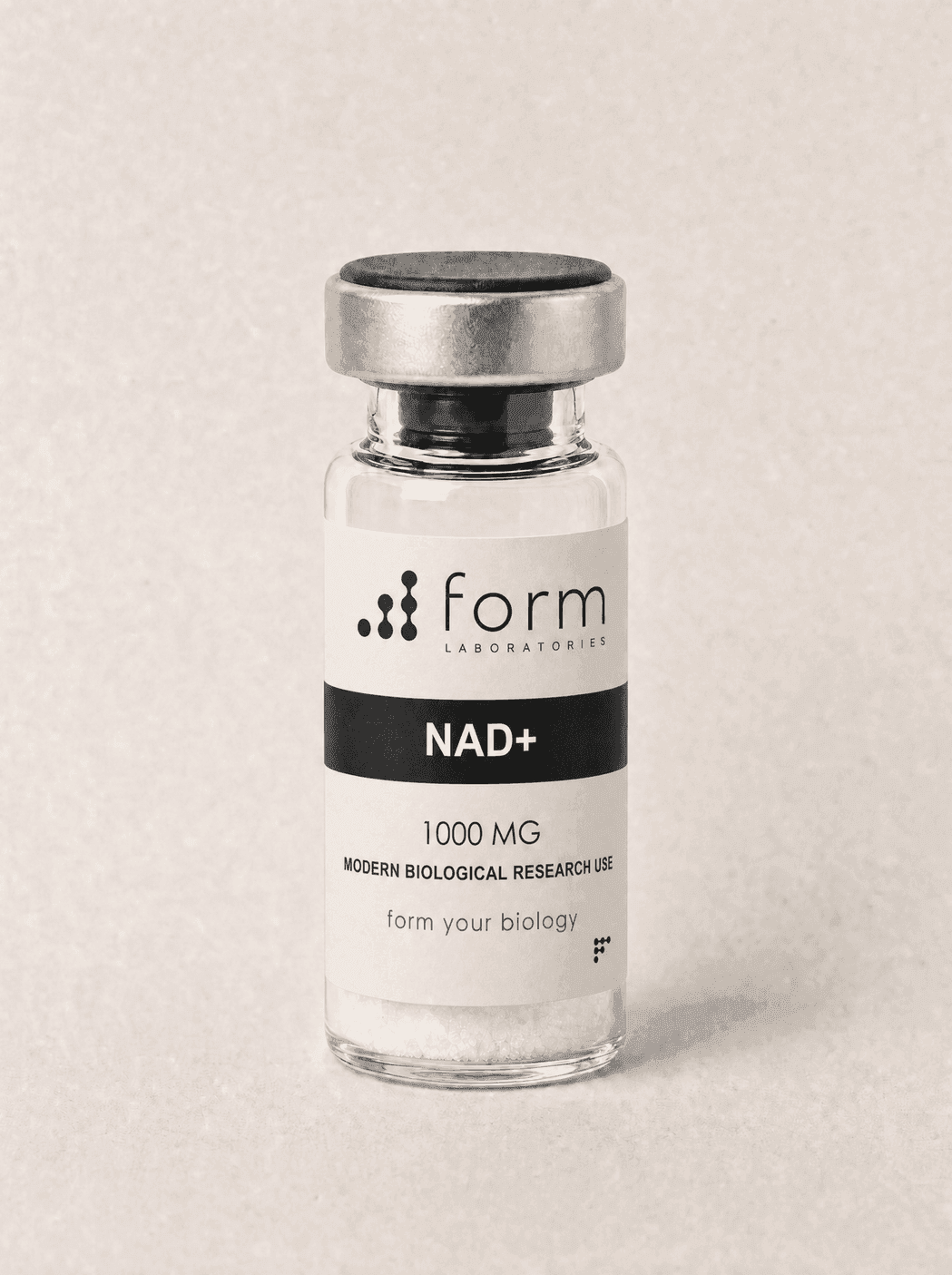
Form Laboratories - NAD+
Ready to see NAD+?
- Independently tested - purity printed on the lab report.
- A batch number on every vial, matched to its report.
- Ships from Perth via Australia Post or CouriersPlease in plain packaging.
Build your stack
Compare nearby catalogue records.
These nearby records stay inside the research-only catalogue.
Research-use-only catalogue
Continue to the product record.
Review lot-facing product details, pricing, and checkout boundaries on the matching product page.
View NAD+ - from $79.00 AUD