
Amino acids in the GHRH sequence tesamorelin copies - it keeps the full GHRH(1-44) sequence. An identity fact, not a product claim.
Published tesamorelin researchPlain-English research guideTH9507
Tesamorelin research guide
Everything worth knowing, without the jargon.
Tesamorelin (research code TH9507) is a lab-made peptide - a stabilised analog of growth-hormone-releasing hormone (GHRH), keeping the full 44-amino-acid GHRH sequence with a small chemical cap added so it breaks down more slowly. It's studied in research for its role in the growth-hormone axis and in visceral (abdominal) fat. The same molecule is an approved prescription medicine in some countries (Egrifta) - what's sold here is research-use-only reference material of the molecule, not the medicine, and not for human use.
REV 2026-07 · 7 Aug 20265 peer-reviewed studiesResearch-use-only context
What the papers reportThird-party literature - not product claims
Average visceral-fat change after 26 weeks in the pivotal HIV-lipodystrophy trial, versus +5.0% on placebo. A published trial result, not a product claim.
Falutz et al., NEJM, 2007Average visceral-fat change after 6 months in the second pivotal HIV-lipodystrophy trial (Falutz 2010), versus -0.6% on placebo. A published trial result for the molecule, not a Form Labs product claim.
Falutz et al., JAIDS, 2010The year the US FDA approved the same molecule as the prescription medicine Egrifta, for a specific HIV-related condition - a regulatory fact about the molecule, not a product claim.
US FDA / TheratechnologiesWhy it matters
A GHRH analog with two real human trials - in a specific patient group.
Tesamorelin belongs to the growth-hormone-releasing-hormone (GHRH) family. In the literature it acts on the GHRH receptor, which prompts the body to release its own growth hormone (GH), which in turn raises IGF-1. Researchers study it to understand that growth-hormone axis and its effects on body composition - particularly visceral fat, the fat stored deep around the organs.
Unlike many peptides in this catalogue, tesamorelin has been tested in two large, pivotal human trials. But those trials studied a specific medical condition - excess visceral fat in people living with HIV-associated lipodystrophy - and the results belong to that population. They are scientific context about the molecule, not claims about what this research material does, and they can't be stretched into weight-loss or bodybuilding use. The same molecule is an approved prescription medicine in some countries (Egrifta); what Form Labs supplies is research-use-only reference material of the molecule - not that medicine, and not for human use.
How it works
A stabilised copy of one hormone message.
A plain-English look at each pathway, kept at a summary level.
The GHRH receptor
Tesamorelin acts on the GHRH receptor - the same receptor the body's own growth-hormone-releasing hormone uses. That's the switch the research focuses on.
The body's own growth hormone
Through that receptor it's studied for prompting the body's own (endogenous) growth hormone release. It doesn't supply GH directly - the research is about signalling the body, not adding hormone.
IGF-1
IGF-1 (insulin-like growth factor 1) is the downstream marker researchers track in this pathway - a measured study signal, not a benefit claim for this vial.
Pharmacology at a glance
- Research code
- TH9507
- Class
- A GHRH-receptor agonist - a lab-made analog (a stabilised copy) of growth-hormone-releasing hormone (GHRH).
- Molecule
- A lab-made, stabilised analog of GHRH(1-44) - the full 44-amino-acid growth-hormone-releasing hormone sequence - with a trans-3-hexenoic acid ('hexenoyl') chemical cap on one end that helps it resist breakdown.
- Route studied
- In the pivotal trials it was given as a daily under-the-skin (subcutaneous) injection. That's the research record, not use guidance - Form Labs gives no instructions for any human use.
- Reported half-life
- Short-acting, but resistant to DPP-4, the enzyme that normally breaks down GHRH within minutes - which is why the trials used daily dosing. No half-life number is printed here, to avoid inventing one.
- Originator
- Developed by Theratechnologies, the approved-medicine sponsor.
- Approval status
- FDA-approved as Egrifta (2010) for HIV-associated lipodystrophy; not TGA-registered in Australia; EMA application withdrawn. Supplied here as research reference material only.
What it has been studied for
Study areas from the published literature.
Growth-hormone axis (GHRH receptor)
How tesamorelin acts on the GHRH receptor as a stabilised GHRH analog - identity and mechanism work.
Ferdinandi et al., Basic Clin Pharmacol Toxicol, 2007Visceral fat / body composition
Visceral (abdominal) fat measured by CT scan in people with HIV-associated lipodystrophy - the pivotal human trials.
Falutz et al., NEJM, 2007; JAIDS, 2010IGF-1 and GH markers
IGF-1 and growth-hormone markers tracked as study signals - measured endpoints, not product claims.
Falutz et al., JAIDS, 2010Development & regulatory history
The molecule's development path and approved-medicine history (Egrifta) - background context only.
Dhillon, Drugs, 2011Gene-message (transcriptomic) context
Gene-message measurements in the research map - study records, not a product result.
Fourman et al., JCI Insight, 2020The studies
The evidence, study by study.
Open any study for a plain summary, what it measured, the finding, and a link to the paper.
This is the larger of the two pivotal trials. It studied tesamorelin in 412 HIV-positive patients with excess abdominal fat over 26 weeks, against placebo. The trial record lists a 2 mg daily under-the-skin injection - that is what the clinicians in the study did, not a method this guide sets out for anyone.
- Studied in
- Adults with HIV-associated lipodystrophy (a specific medical condition).
- Design
- A randomised, placebo-controlled trial - one of the two that supported the medicine's approval.
- Measured
- Visceral adipose tissue (VAT) by CT scan at the L4-L5 level, plus other body-composition measures.
Visceral fat fell by about 15.2% in the tesamorelin group versus a rise of about 5.0% on placebo (p<0.001). This is a published finding about the molecule in a specific patient group - not a result expected from this research material or a reason to use it.
DOI 10.1056/NEJMoa072375The second pivotal trial again studied tesamorelin in people with HIV-associated lipodystrophy over 6 months, measuring visceral fat by CT scan.
- Studied in
- Adults with HIV-associated lipodystrophy.
- Design
- A randomised, placebo-controlled trial.
- Measured
- Change in visceral adipose tissue, IGF-1, and metabolic markers.
Visceral fat fell by about 10.9% with tesamorelin versus about 0.6% on placebo at 6 months (p<0.0001); IGF-1 rose significantly, with no significant change in glucose. Again, a published finding about the molecule in a specific patient group - not a product claim.
DOI 10.1097/QAI.0b013e3181cbdaffThis paper describes the molecule itself: a stabilised analog of the full GHRH(1-44) sequence, with the chemical cap that makes it resist the DPP-4 enzyme that normally breaks GHRH down within minutes.
- Studied in
- Laboratory chemistry and pharmacology work.
- Design
- A characterisation / pharmacology study of the molecule.
- Measured
- The molecule's structure, GHRH-receptor activity, and resistance to breakdown.
It sets out why tesamorelin lasts long enough to study with daily dosing - the chemical cap blocks DPP-4. This is identity and chemistry about the molecule, not an effect claim for this vial.
DOI 10.1111/j.1742-7843.2007.00008.xA review paper covering tesamorelin's development path and its approved-medicine use (as Egrifta) for reducing excess visceral abdominal fat in people with HIV-associated lipodystrophy.
- Studied in
- A narrative review of the trials and regulatory record.
- Design
- A literature review, not a new experiment.
- Measured
- What the development programme reported.
It summarises the molecule's approved-medicine history in a specific medical condition. It's background context about the molecule - not a claim about this research material.
DOI 10.2165/11202240-000000000-00000This work appears in the tesamorelin literature as gene-message (transcriptomic) context - measuring which gene messages change - rather than a measure of body composition.
- Studied in
- Laboratory gene-message measurement work.
- Design
- A transcriptomic study, not a clinical trial.
- Measured
- Gene-message patterns in the relevant research map.
It adds gene-message context to the tesamorelin literature. These are study records, not a product result or a reason to use the material.
DOI 10.1172/jci.insight.140134Compare
Placed beside familiar research names.
This table describes literature and approval status only.
| Tesamorelin (TH9507) | CJC-1295 | |
|---|---|---|
| Relationship to GHRH | An analog of growth-hormone-releasing hormone (GHRH) | An analog of growth-hormone-releasing hormone (GHRH) |
| GHRH sequence length | Full 44-amino-acid GHRH(1-44) | Short 29-amino-acid fragment (modified GRF 1-29) |
| How it's made to last | A chemical cap (trans-3-hexenoic acid) on one end | Amino-acid substitutions, sometimes a 'DAC' carrier group |
| How long it lasts | Short-acting (daily in the trials) | Longer-acting (designed to last longer between doses) |
| Approved-medicine history | Yes - same molecule is Egrifta (FDA, 2010) | No approved medicine |
| Supplied by Form Labs as | Research reference material only | Research reference material only |
Comparison is for context from published records. It is not product-use guidance.
Development and status
Where the research record sits.
The first pivotal human trial of tesamorelin is published (Falutz et al., NEJM) - visceral fat in HIV-associated lipodystrophy.
The US FDA approves the same molecule as Egrifta, and the second pivotal trial is published (Falutz et al., JAIDS).
The European application for Egrifta is withdrawn after a negative CHMP assessment - never approved in the EU.
Approval status: FDA-approved as Egrifta (2010) for HIV-associated lipodystrophy; not TGA-registered in Australia; EMA application withdrawn. Supplied here as research reference material only.Whatever the molecule’s status elsewhere, what Form Labs supplies is research-use-only reference material - for laboratory work, not for people or animals.
Evidence and limitations
What this means, and what it does not.
The visceral-fat evidence is HIV-lipodystrophy-specific
Both pivotal trials studied a specific medical condition - excess visceral fat in people with HIV-associated lipodystrophy. The results belong to that population and can't be generalised to weight loss, body composition in the general population, or athletic or bodybuilding use.
It's an approved medicine elsewhere - but not what's sold here
The same molecule is the prescription medicine Egrifta in some countries. What Form Labs supplies is research-use-only reference material of the molecule - not Egrifta, not a pharmacy product, and not for human use. We don't imply the buyer can obtain or use the medicine.
Not for weight loss, muscle, or anti-aging use
The approved label states the molecule is weight-neutral (not a weight-loss drug). On this research material we make no claim around weight loss, fat-burning, muscle-building or anabolic effects, athletic performance, anti-aging, or cognitive enhancement. Those uses aren't supported here.
Where Form Labs fits
This guide is a plain-English summary of published research Form Labs did not run. It's not medical advice, not a product claim, and not use guidance. We supply tesamorelin strictly as reference material of the molecule, with a batch number you can match to its lab report.
Lab handling
Reference-material handling context.
Research-use boundary
Tesamorelin is supplied strictly for laboratory research. It is not for human consumption, veterinary, medical, or cosmetic use, and no directions for use are given.
Storage
Supplied freeze-dried. Keep it at 2-8 C (fridge-cold) and out of light, following the vial label, the matching lab report for the batch, and your lab's own written procedures. This is a storage fact, not a cold-chain shipping claim.
Reconstitution
Reconstitution means mixing the dry powder back into liquid for handling. This guide doesn't set a method - that's down to the receiving lab's written protocol and the batch paperwork.
Stability
How long a freeze-dried peptide stays within spec depends on how it's stored, and is tracked through the batch paperwork. Any working window after it's mixed belongs in the lab's own protocol, not this guide.
Glossary
Plain-English definitions.
- Peptide
- A short chain of amino acids - the building blocks of proteins.
- GHRH
- Growth-hormone-releasing hormone - the natural hormone tesamorelin is modelled on.
- Analog
- A lab-made molecule designed to resemble another molecule in a defined way.
- GHRH(1-44)
- The full 44-amino-acid sequence of human growth-hormone-releasing hormone, which tesamorelin copies.
- Hexenoyl cap
- A small chemical group (trans-3-hexenoic acid) added to one end of tesamorelin to block the DPP-4 enzyme.
- DPP-4
- An enzyme that normally breaks down GHRH within minutes; tesamorelin is made to resist it.
- GH
- Growth hormone - a hormone named in the cited literature as a study signal in this pathway.
- IGF-1
- Insulin-like growth factor 1 - a downstream marker researchers track after GHRH-receptor activity.
- Visceral fat (VAT)
- Fat stored deep around the organs; measured by CT scan in the trials.
- HIV-associated lipodystrophy
- A specific medical condition involving changes in body-fat distribution, seen in some people living with HIV.
- Half-life
- The time for the amount in the blood to fall by half.
- Research use only
- Supplied for laboratory research - not for human or animal use, and not a medicine.
FAQ
Questions answered plainly.
Tesamorelin is a lab-made peptide - a short chain of amino acids - known in research by its code name TH9507. It's a stabilised analog of growth-hormone-releasing hormone (GHRH): the full 44-amino-acid GHRH sequence with a chemical cap added so it breaks down more slowly. We supply it freeze-dried, as reference material for laboratory research.
Tesamorelin is the active molecule in Egrifta, a prescription medicine approved by the US Food and Drug Administration (FDA). Egrifta is a pharmacy product a doctor prescribes and monitors for a specific medical condition; Form Labs does not sell Egrifta or any medicine. What we supply is research-use-only reference material of the tesamorelin molecule - not the approved drug, not a pharmacy product, and not for human use.
Tesamorelin is approved by the US FDA under the brand name Egrifta (2010) to reduce excess visceral abdominal fat in people with HIV-associated lipodystrophy - a specific medical condition. It is not registered with Australia's Therapeutic Goods Administration (TGA), and its European approval application was withdrawn. The material sold here is not that approved medicine: it is research-use-only reference material of the molecule, with no approval for any human use.
The approved medicine Egrifta (tesamorelin) is not registered with Australia's Therapeutic Goods Administration (TGA); where it's used in Australia at all, that's only through a doctor's Special Access Scheme application. Form Labs supplies tesamorelin strictly as research-use-only reference material - for laboratory research only, not for human use, and not as a medicine.
In published research, tesamorelin acts on the GHRH receptor - the same receptor the body's own growth-hormone-releasing hormone uses - and is studied for prompting the body to release its own growth hormone (GH), which in turn raises IGF-1. It does not supply growth hormone directly. These describe the scientific literature, not effects claimed for this vial.
Tesamorelin and CJC-1295 are both lab-made analogs of growth-hormone-releasing hormone (GHRH), but they're different molecules. Tesamorelin keeps the full 44-amino-acid GHRH sequence with a chemical cap that slows its breakdown; CJC-1295 uses a shorter 29-amino-acid fragment, sometimes attached to a carrier that greatly extends how long it lasts. Tesamorelin also has an approved-medicine history (Egrifta) that CJC-1295 doesn't; both are supplied here only as research reference material.
No. Tesamorelin from Form Labs is supplied strictly as reference material for laboratory research - not a medicine, supplement, or food, and not for people or animals to take. The same molecule is an approved prescription medicine in some countries (Egrifta), but what's sold here is not that medicine and is not for human use.
Native growth-hormone-releasing hormone (GHRH) is broken down within minutes by an enzyme called DPP-4. Tesamorelin adds a small chemical group (a trans-3-hexenoic acid cap) to one end of the GHRH sequence, which blocks that enzyme and lets the peptide last long enough to be studied with once-daily dosing. This describes the molecule's chemistry in the research, not an effect for anyone to use.
The two pivotal human trials studied tesamorelin in people with HIV-associated lipodystrophy - a specific medical condition where fat builds up around the organs. They measured visceral (abdominal) fat by CT scan and reported reductions versus placebo over 26 weeks and 6 months. These are published findings about the molecule in a specific patient group, not results expected from this research material or reasons to use it.
'For research use only' means Form Labs supplies tesamorelin strictly as reference material for laboratory research - not as a medicine, supplement, or food, and not for people or animals to take. Even though the same molecule is an approved medicine elsewhere (Egrifta), this material is not that product and carries no approval for human use. It is intended for in-vitro laboratory work only.
References
Every figure, sourced.
Educational references to third-party literature. Form Labs is unaffiliated with the study authors.
First pivotal trial: tesamorelin for visceral fat in HIV-associated lipodystrophy (VAT change vs placebo). Falutz, et al. New England Journal of Medicine, 2007; 357(23): 2359-2370.
DOISecond pivotal trial: visceral-fat change and IGF-1 over 6 months vs placebo. Falutz, et al. Journal of Acquired Immune Deficiency Syndromes, 2010.
DOIChemistry and pharmacology of tesamorelin as a stabilised GHRH analog. Ferdinandi, et al. Basic & Clinical Pharmacology & Toxicology, 2007.
DOIReview of tesamorelin's development and approved-medicine use. Dhillon. Drugs, 2011.
DOIGene-message (transcriptomic) context in the tesamorelin research map. Fourman, et al. JCI Insight, 2020.
DOICitations are provided for education only. No therapeutic, weight-loss, or efficacy claims are made.
How we produce these guides
- Who writes them
- These guides are written and maintained in-house by the Form Laboratories research team. They are not authored by a named clinician, and nothing in them is medical advice. Where a guide is short, that is because the published research is thin - we would rather say so than fill the space.
- What they are built from
- Each guide summarises published, peer-reviewed literature. Every study we describe is listed in full at the bottom of the page with a link to the original paper, so you can open it and check what it actually says. Form Laboratories did not run any of the cited studies.
- What they deliberately leave out
- These guides describe how the biology works and what the published research measured. They do not contain dosing, preparation, reconstitution or administration instructions, and they make no claim about what any compound would do for a person. Everything we supply is research-use-only reference material.
- How we handle uncertainty
- Where the evidence is limited to cell cultures or animals, we say so in the study entry rather than implying a human result. Where a compound has no completed human trial, the guide states that plainly.
The product
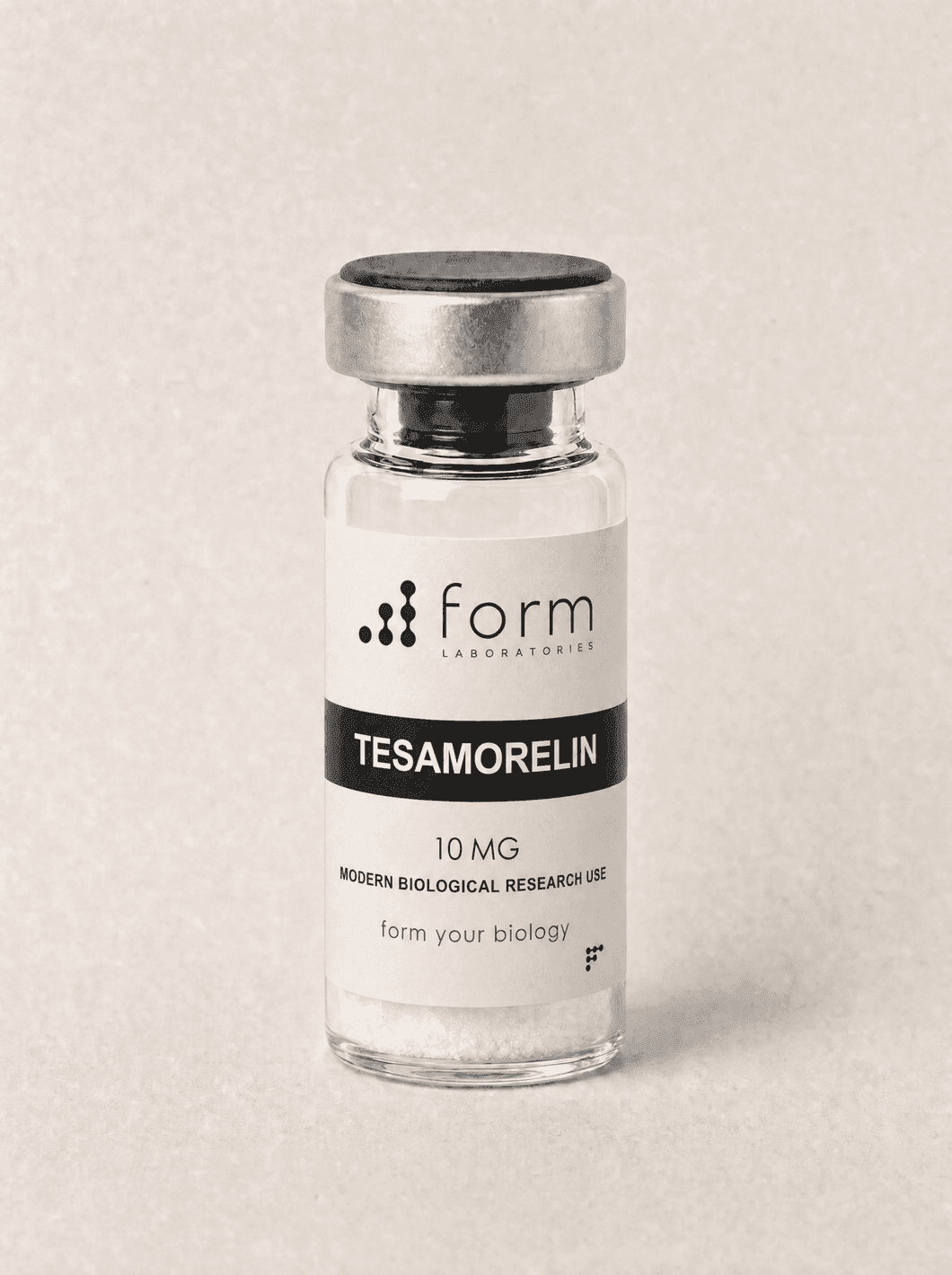
Form Laboratories - Tesamorelin
Ready to see Tesamorelin?
- Independently tested - purity printed on the lab report.
- A batch number on every vial, matched to its report.
- Ships from Perth via Australia Post or CouriersPlease in plain packaging.
Build your stack
Compare nearby catalogue records.
These nearby records stay inside the research-only catalogue.
Research-use-only catalogue
Continue to the product record.
Review lot-facing product details, pricing, and checkout boundaries on the matching product page.
View Tesamorelin - from $249.00 AUD