
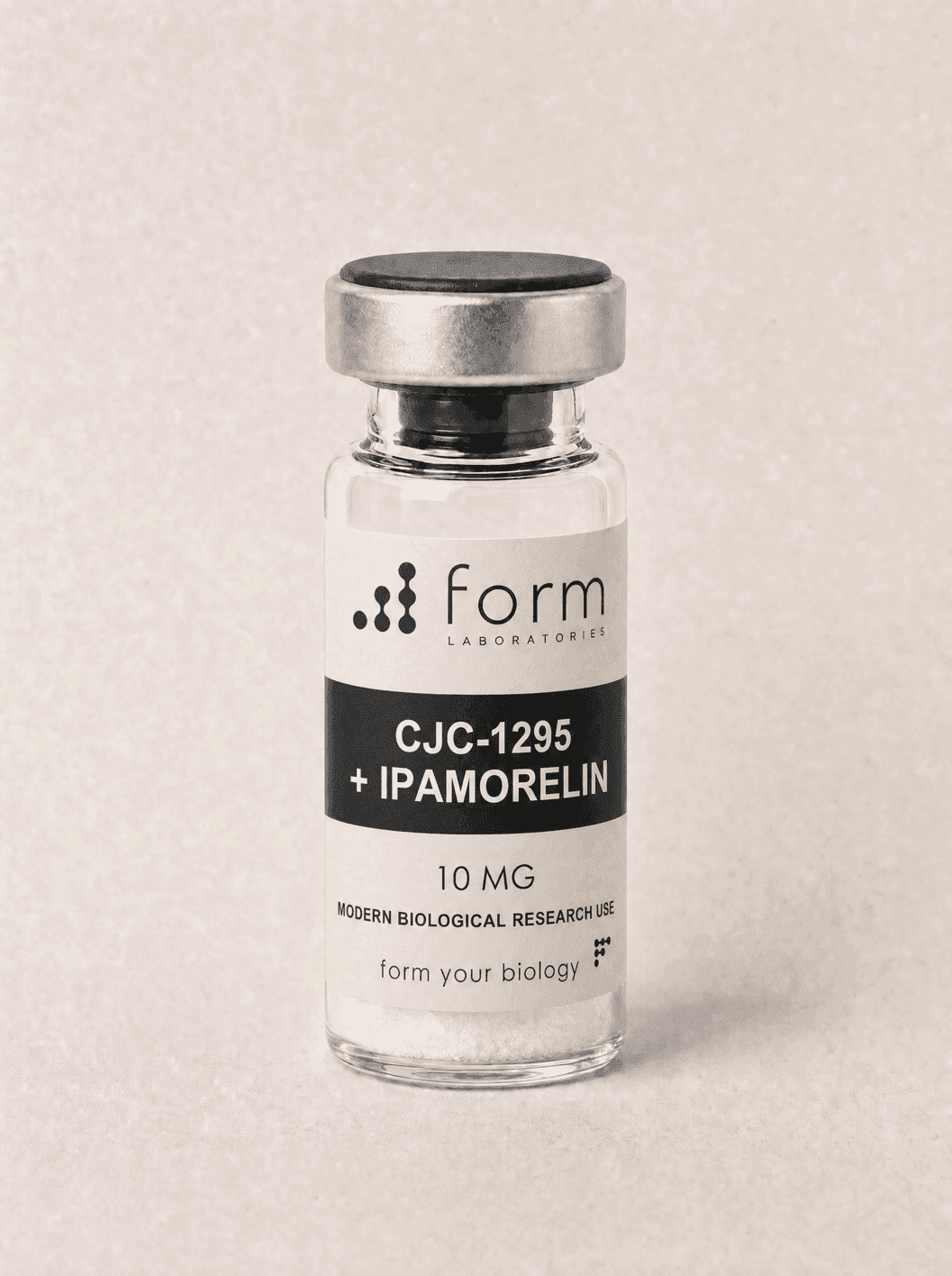
Two distinct peptides in this set: CJC-1295 (No DAC), also called Modified GRF(1-29), and Ipamorelin (NNC 26-0161). An identity fact, not a product claim.
Form Labs research guidePlain-English research guideModified GRF (1-29) / NNC 26-0161
CJC-1295 No DAC and Ipamorelin research guide
Everything worth knowing, without the jargon.
CJC-1295 (No DAC) and Ipamorelin are two research peptides studied together because both act on the system the body uses to release its own growth hormone - by pressing two different buttons on the way in. Neither is growth hormone, neither supplies any, and neither is an approved medicine. Both are laboratory research materials.
REV 2026-07 · 7 Aug 20263 peer-reviewed studiesResearch-use-only context
What the papers reportThird-party literature - not product claims
The year Ipamorelin was first described (Raun and colleagues). A research-history fact, not a product claim.
Raun et al., European Journal of Endocrinology, 1998Ipamorelin is a five-amino-acid (pentapeptide) agonist at the ghrelin receptor (GHS-R1a). An identity fact, not a product claim.
Raun et al., 1998; Howard et al., Science, 1996Why it matters
Two peptides, two parts of the GH axis.
CJC-1295 (No DAC) and Ipamorelin are two research peptides studied together because both act on the system the body uses to release its own growth hormone - by pressing two different buttons on the way in. Neither is growth hormone, neither supplies any, and neither is an approved medicine. Both are laboratory research materials.
CJC-1295 (No DAC) and Ipamorelin are studied together because they act on two different parts of the growth-hormone axis: one is a GHRH analog and the other is a ghrelin-receptor agonist. The research asks how those two pathways interact in the body's own GH release. This page lists the no-DAC form of CJC-1295, which is short-acting - not the long-acting 'with DAC' form.
The growth-hormone axis is the chain researchers study here: the brain sends a hormone called GHRH to the pituitary gland, the gland releases growth hormone, and growth hormone prompts the liver to make IGF-1. A GHRH analog is a lab-made copy of that first message. A growth-hormone secretagogue is a compound studied for prompting the body's own release rather than supplying the hormone. GHS-R1a is the receptor that normally listens for ghrelin - the hormone an empty stomach releases, which also, as it happens, prompts growth-hormone release. All of these are named as research pathways, not as effects a product has.
The source guide keeps study context separate from Form Labs product claims and does not provide preparation, administration, or use directions.
How it works
Two peptides, two buttons on one gland.
A plain-English look at each pathway, kept at a summary level.
CJC-1295 (No DAC) = Modified GRF(1-29)
The CJC-1295 on this page is the no-DAC form, also called Modified GRF(1-29) - a short-acting lab-made analog of growth-hormone-releasing hormone (GHRH). 'No DAC' means it lacks the Drug Affinity Complex that makes the other form long-acting, so it clears quickly. It is studied in the laboratory for the GHRH signalling pathway.
'With DAC' versus 'no DAC'
CJC-1295 comes in two forms. The 'with DAC' form carries a Drug Affinity Complex that binds albumin in the blood to extend its half-life; the 'no DAC' form (Modified GRF(1-29)) does not, so it is short-acting. The limited human pharmacokinetic data reported by Teichman and colleagues (2006) were for the DAC form - not the no-DAC material listed here.
Ipamorelin = NNC 26-0161
Ipamorelin presses a different button on the same gland - the receptor that normally listens for ghrelin, the hormone an empty stomach releases. It is described as selective, meaning in the study that first described it, the amounts that released growth hormone did not significantly move the stress-axis hormones that earlier compounds in its class disturbed. First described by Raun and colleagues in 1998; its clinical development was later discontinued, and it is not an approved medicine.
Pharmacology at a glance
- Research code
- Modified GRF (1-29) / NNC 26-0161
- Class
- two distinct peptides - a short-acting GHRH analog (CJC-1295 No DAC / Modified GRF(1-29)) and a ghrelin-receptor agonist (Ipamorelin / NNC 26-0161). Class wording here means the research category named by the source guide.
- Molecule
- Two-material research record. CJC-1295 (No DAC), also called Modified GRF(1-29), is a short-acting lab-made analog of growth-hormone-releasing hormone. Ipamorelin, also called NNC 26-0161, is a five-amino-acid ghrelin-receptor (GHS-R1a) agonist listed separately. Neither supplies growth hormone directly.
- Route studied
- No route guidance is provided by this consumer guide. Any route wording in the source literature is not product-use guidance.
- Reported half-life
- Not listed in the source guide for this consumer entry; half-life means the time for a measured amount to fall by half.
- Originator
- Not listed in the source guide; Form Labs did not run the cited studies.
- Approval status
- Neither CJC-1295 (No DAC) nor Ipamorelin is an approved medicine - neither is on the Australian Register of Therapeutic Goods, and the TGA has not evaluated either for safety, quality or effectiveness. Ipamorelin's clinical development was discontinued. Both are on the World Anti-Doping Agency (WADA) Prohibited List. Supplied strictly as laboratory research materials, not for human use.
What it has been studied for
Study areas from the published literature.
CJC-1295 'with DAC' background
Study topic: the long-acting 'with DAC' form of CJC-1295 and its albumin-binding, included as context for the no-DAC material on this page - not direct no-DAC evidence.
Jette et al., Endocrinology, 2005Ipamorelin receptor context
Study topic: the ghrelin receptor (GHS-R1a) that Ipamorelin acts at; receptor means a cell-signal receiver. Pathway context only, not a product effect.
Howard et al., Science, 1996Ipamorelin identity
Study topic: the first description of Ipamorelin as a selective growth-hormone secretagogue; an identity record, not a use instruction.
Raun et al., European Journal of Endocrinology, 1998The studies
The evidence, study by study.
Open any study for a plain summary, what it measured, the finding, and a link to the paper.
The paper describing how the long-acting 'with DAC' form of CJC-1295 was built to survive in the bloodstream. Background for this page, not evidence about the short-acting no-DAC material listed here.
- Studied in
- Laboratory binding experiments and animal studies.
- Design
- The researchers attached a chemical group - the DAC - to a GHRH analog so it would latch onto albumin, a carrier protein circulating in blood, then compared how long the modified peptide persisted against the unmodified version.
- Measured
- How long the peptide stayed detectable in the bloodstream, and whether growth-hormone release followed.
The DAC-modified version lasted dramatically longer than the plain GHRH analog, because riding on albumin let it escape the rapid breakdown that normally clears these peptides within minutes. This is precisely why the distinction matters here: the material listed on this page is the short-acting no-DAC form, so this paper's durability results do not describe it.
DOI 10.1210/en.2004-1286The paper that found the receptor Ipamorelin acts on - before anyone knew what the body's own signal for it was.
- Studied in
- Pituitary tissue, with the receptor then expressed in cultured cells.
- Design
- The researchers worked backwards from compounds already known to trigger growth-hormone release, hunting for the cell-surface receptor those compounds bound to, then cloned it.
- Measured
- Whether the cloned receptor responded when those compounds were applied to cells carrying it.
They identified a distinct receptor, later named GHS-R1a, separate from the already-known GHRH receptor. At the time it was an orphan receptor - a lock with no known key, since ghrelin, the body's own molecule that fits it, was not discovered until 1999. Ipamorelin acts at this receptor, which is what makes it a fundamentally different kind of compound from CJC-1295.
DOI 10.1126/science.273.5277.974The paper that first described Ipamorelin, and made the case that it was unusually selective.
- Studied in
- Cultured pituitary cells plus animal studies.
- Design
- Ipamorelin was compared against other growth-hormone secretagogues, looking not only at whether growth hormone was released but at which other hormones moved at the same time.
- Measured
- Growth-hormone release, alongside ACTH and cortisol - two stress-axis hormones that the earlier secretagogues tended to disturb.
At the amounts that released growth hormone, Ipamorelin did not produce a significant rise in ACTH or cortisol - the two stress-axis hormones the earlier secretagogues tended to move. That is a reduced response in this study, not an abolished one. That selectivity is why it kept appearing in later research. Its clinical development was nonetheless discontinued, and it is not an approved medicine.
DOI 10.1530/eje.0.1390552Evidence and limitations
What this means, and what it does not.
The source guide is a literature map, not a product claim
The cited papers are used for identity, pathway, marker, model, or analytical context. They do not become Form Labs results or promises.
Study details are limited to the source record
Where the source guide does not list participant counts, model details, study amounts, or study-stage labels, this page does not invent them.
No use instructions are included
This guide does not provide preparation, administration, human-use, veterinary-use, medical, cosmetic, or dosing guidance.
COA and label stay authoritative
Storage and batch decisions should follow the product label and matching COA. Source storage note: Use the product label and matching COA..
Lab handling
Reference-material handling context.
COA and label
Use the product label and matching COA, meaning certificate of analysis, as the authority for storage, appearance, purity, and release state.
Educational boundary
This guide is educational context only. It does not include preparation, administration, human-use, or veterinary-use directions.
Research-use boundary
For laboratory research use only. 21+ only. Not for human consumption or veterinary use.
Glossary
Plain-English definitions.
- GHRH
- Growth-hormone-releasing hormone; the natural hormone a GHRH analog is built to resemble. A research-pathway name, not a product effect.
- GHRH analog
- A lab-made molecule built to resemble growth-hormone-releasing hormone. CJC-1295 (No DAC) / Modified GRF(1-29) is one example.
- Modified GRF(1-29)
- The research name for the no-DAC form of CJC-1295 - a short-acting lab-made GHRH analog covering amino-acid positions 1 through 29.
- DAC
- Drug Affinity Complex - a binding tag on the 'with DAC' form of CJC-1295 that attaches to albumin in the blood and extends its half-life. The no-DAC form on this page does not have it.
- Growth-hormone secretagogue
- A compound studied for prompting the body's own release of growth hormone. Ipamorelin is one example. Such compounds do not supply growth hormone themselves.
- GHS-R1a
- The ghrelin receptor - a cell-signal receiver - at which Ipamorelin acts.
- Ghrelin
- A hormone that acts at the GHS-R1a receptor; named here only to identify the research pathway Ipamorelin acts on.
- IGF-1
- Insulin-like growth factor 1; a marker linked to GH in endocrine research. Named here as a research pathway, not a product effect.
- Pentapeptide
- A peptide made from five amino acids. Ipamorelin is a pentapeptide.
- COA
- Certificate of analysis; the batch paperwork that controls identity, purity, appearance, and release checks.
- Research use only
- A lab-only boundary. It means not for human consumption, veterinary use, medical use, or cosmetic use.
- Literature context
- A plain summary of what cited papers discuss, not a product result.
FAQ
Questions answered plainly.
CJC-1295 (No DAC) is a synthetic analog of growth-hormone-releasing hormone (GHRH), also called Modified GRF(1-29). It is a short-acting peptide studied in the laboratory for the GHRH signalling pathway. It is a research-use-only reference material, not an approved medicine.
'With DAC' and 'no DAC' are two forms of CJC-1295. The 'with DAC' form carries a Drug Affinity Complex that binds albumin in the blood to make it long-acting, while the 'no DAC' form (Modified GRF(1-29)) is short-acting and clears quickly. This page lists the no-DAC form; the limited human pharmacokinetic data reported by Teichman and colleagues (2006) were for the DAC form.
Ipamorelin is a selective growth-hormone secretagogue - a five-amino-acid peptide that acts as an agonist at the ghrelin receptor (GHS-R1a). It was first described by Raun and colleagues in 1998 and studied in the laboratory for the ghrelin-receptor pathway. Its clinical development was later discontinued, and it is not an approved medicine.
A growth-hormone secretagogue is a compound studied for its ability to prompt the body's own release of growth hormone (GH). Ipamorelin is one example, acting at the ghrelin receptor (GHS-R1a). Such compounds are research pathways of study; they do not supply GH themselves.
CJC-1295 (No DAC) and Ipamorelin are studied together because they act on two different parts of the growth-hormone axis: CJC-1295 is a GHRH analog and Ipamorelin is a ghrelin-receptor agonist. In research, a GHRH analog combined with a growth-hormone secretagogue is examined for how the two pathways interact. Neither supplies growth hormone; both are research-use-only reference materials.
In research, CJC-1295 (No DAC) and Ipamorelin are studied for their role in the body's own growth-hormone (GH) release, which is in turn linked to insulin-like growth factor 1 (IGF-1). Neither peptide contains or supplies GH or IGF-1 directly. These are descriptions of research pathways, not effects the product is claimed to have in people.
No. Neither CJC-1295 (No DAC) nor Ipamorelin is an approved medicine in Australia - neither is on the Australian Register of Therapeutic Goods, and the TGA has not evaluated either for safety, quality or effectiveness. Ipamorelin's clinical development was discontinued, and CJC-1295 has only limited early human data. Form Labs supplies both strictly as laboratory research materials.
Yes. Growth-hormone-releasing hormone (GHRH) analogs and growth-hormone secretagogues - including CJC-1295 and Ipamorelin - are on the World Anti-Doping Agency (WADA) Prohibited List and are banned in and out of competition. Athletes subject to anti-doping rules should confirm current status directly with WADA. Form Labs supplies both for laboratory research only, not for human use.
CJC-1295 (No DAC) and Ipamorelin are supplied in Australia as research-use-only reference materials, not for human or veterinary use. They are not approved medicines and are not on the Australian Register of Therapeutic Goods. Orders are limited to laboratory and research customers aged 21 or over.
'For research use only' means CJC-1295 (No DAC) and Ipamorelin are supplied strictly as laboratory reference materials - for in-vitro research, not for use in or on humans or animals. They are not medicines, supplements, or food. Everything on this page describes published research and the identity of this batch, not instructions for use.
References
Every figure, sourced.
Educational references to third-party literature. Form Labs is unaffiliated with the study authors.
Plain note: CJC-1295 'with DAC' albumin-binding record. Citation: Jette et al., Endocrinology, 2005.. DOI means a permanent article link code; DOI: 10.1210/en.2004-1286.
DOIPlain note: Ipamorelin ghrelin-receptor context record. Citation: Howard et al., Science, 1996.. DOI means a permanent article link code; DOI: 10.1126/science.273.5277.974.
DOIPlain note: Ipamorelin identity and class record. Citation: Raun et al., European Journal of Endocrinology, 1998.. DOI means a permanent article link code; DOI: 10.1530/eje.0.1390552.
DOICitations are provided for education only. No therapeutic, weight-loss, or efficacy claims are made.
How we produce these guides
- Who writes them
- These guides are written and maintained in-house by the Form Laboratories research team. They are not authored by a named clinician, and nothing in them is medical advice. Where a guide is short, that is because the published research is thin - we would rather say so than fill the space.
- What they are built from
- Each guide summarises published, peer-reviewed literature. Every study we describe is listed in full at the bottom of the page with a link to the original paper, so you can open it and check what it actually says. Form Laboratories did not run any of the cited studies.
- What they deliberately leave out
- These guides describe how the biology works and what the published research measured. They do not contain dosing, preparation, reconstitution or administration instructions, and they make no claim about what any compound would do for a person. Everything we supply is research-use-only reference material.
- How we handle uncertainty
- Where the evidence is limited to cell cultures or animals, we say so in the study entry rather than implying a human result. Where a compound has no completed human trial, the guide states that plainly.
The product
Form Laboratories - CJC-1295 (No DAC) & Ipamorelin
Ready to see CJC-1295 (No DAC) & Ipamorelin?
- Independently tested - purity printed on the lab report.
- A batch number on every vial, matched to its report.
- Ships from Perth via Australia Post or CouriersPlease in plain packaging.
From
$80.00 AUD
10 mg - 2-8 C
Reference material for laboratory research only.
Build your stack
Compare nearby catalogue records.
These nearby records stay inside the research-only catalogue.
Research-use-only catalogue
Continue to the product record.
Review lot-facing product details, pricing, and checkout boundaries on the matching product page.
View CJC-1295 (No DAC) & Ipamorelin - from $80.00 AUD