
Two separate lab-made peptides in this set - BPC-157 and TB-500 - each with its own research story. A product-record fact, not a use direction.
Form Labs catalog record for BPC-157 and TB-500Two-peptide research set
BPC-157 & TB-500
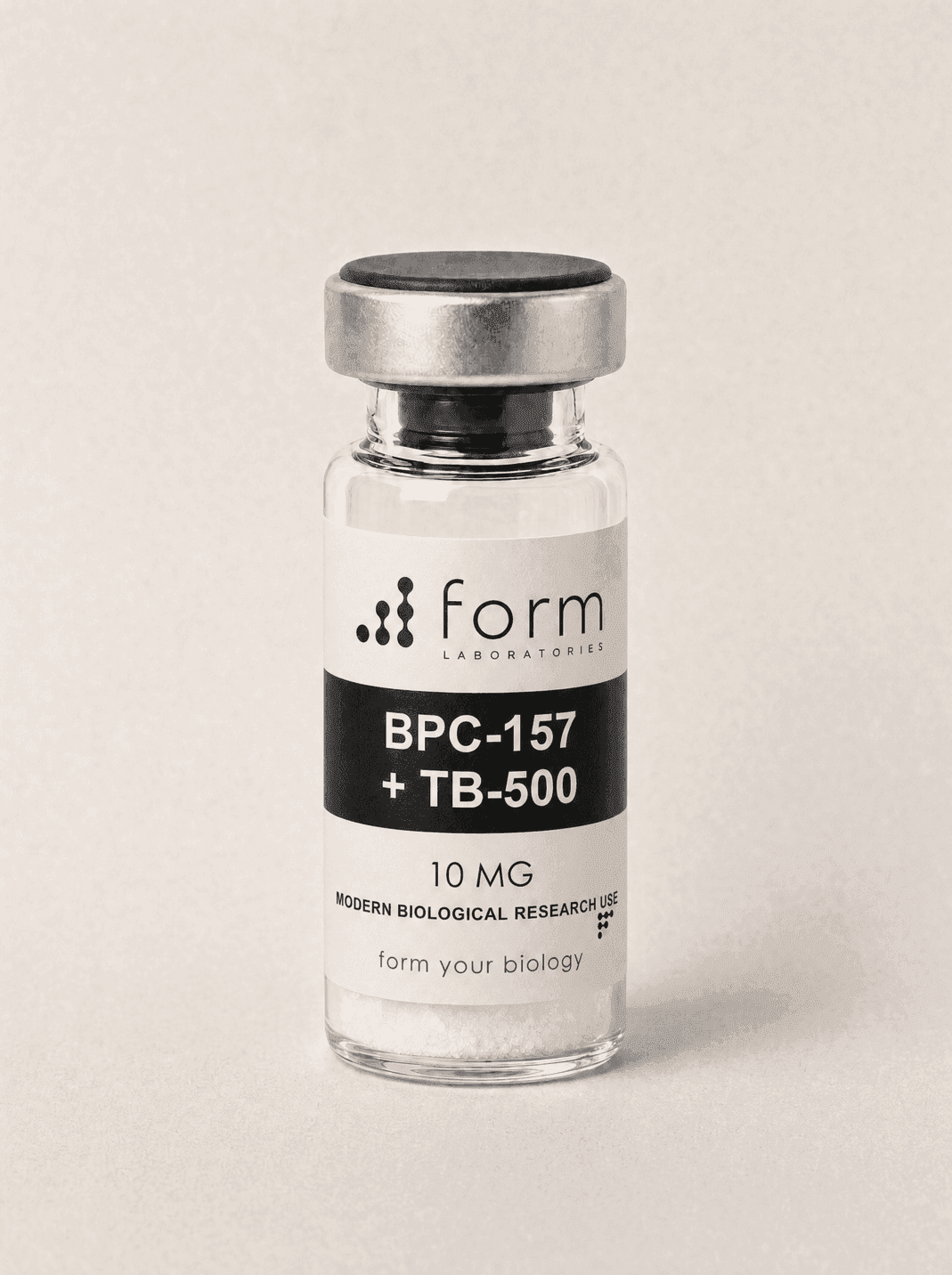
Two research peptides - BPC-157 and TB-500 - studied in tissue-repair research and supplied together as one set. For laboratory research only.
Two separate peptides in one set, sold together because they turn up in the same corner of the repair literature - not because they work together. Supplied freeze-dried, for laboratory research only.
Current lot pricing
$119.00 AUD
Base vial price: $119.00 AUD
Vial size10 mg
Ships from Perth, Australia Post or CouriersPleaseFree standard shipping over $250Plain, discreet packagingStore at 2-8 C
Supplied strictly as reference material for in-vitro laboratory research. Not a medicine, supplement, or food. Not for human or veterinary use.
 Research use only
Why this molecule is studied
Why researchers study these two.
Start with the most important thing on this page: there is no published research showing a combined or synergistic effect between BPC-157 and TB-500. They are studied separately. Buying the set is buying two compounds, not a blend.
BPC-157 comes out of gut-protection research. Your stomach runs on acid strong enough to break down a meal and somehow does not digest itself; in the early 1990s researchers described a protective substance in gastric juice, and BPC-157 is the synthetic peptide modelled on part of it. The studies since have asked whether that protective signalling does anything outside the stomach.
TB-500 comes from somewhere else entirely. Cells have to take their own internal scaffolding apart and rebuild it in order to move - and moving is how a cell crawls into a wound to close it. TB-500 copies the part of a protein called thymosin beta-4 that grips actin, the material that scaffolding is built from.
Both records are almost entirely cell-culture and animal work, and neither compound is an approved medicine. This page is about that research and the batch you are getting; it is not for people or animals to take.
The research
What the published studies found.
Amino acids in each: BPC-157 is 15 (GEPPPGKPADDAGLV), TB-500 is 7 (Ac-LKKTETQ). Identity facts, not product claims.
Published BPC-157 and TB-500 researchAmino acids in thymosin beta-4, the full protein TB-500 copies a seven-amino-acid piece of. The distinction matters: most of the well-known research is on the whole protein, not the fragment.
Low et al., PNAS, 1981Figures outside lot paperwork describe third-party research records for the molecule. They are not Form Labs product results or use claims.
Read the full research guideIdentity, papers, and research-use boundariesMechanism notes
Plain-language research labels.
Two research stories that never actually meet. Here is each one in plain terms - what the studies looked at, in dishes and in animals.
BPC-157
Taken from a protective protein in gastric juice - part of whatever stops your stomach digesting itself. Since the early 1990s researchers have been testing whether that same protective signalling does anything elsewhere: rodent and cell studies have looked at whether it prompts new blood vessels to grow into damaged tissue, since a fresh blood supply is what lets repair get started at all. A hypothesis tested in animals, not an established effect.
TB-500
A seven-amino-acid fragment studied for how cells rebuild their own structure. Cells hold their shape with scaffolding built from a protein called actin, and to move at all a cell has to pull that scaffolding apart and put it back together. This fragment copies the part of thymosin beta-4 that grips actin. The idea under test is that making the scaffolding easier to rearrange helps cells crawl into a wound and close it. Worth knowing: most of the published evidence is on the full thymosin beta-4 protein, not on this seven-amino-acid fragment. All of it in dishes and in rodents.
Two stories, not one
BPC-157 came out of gut-protection research; TB-500 came out of cell-movement research. They arrive as two vials with two lab reports because they are two unrelated molecules that happen to surface in the same corner of the literature - not a blend.
Order anchor
Form Laboratories
BPC-157 & TB-500 with live bundle pricing.
- Independently tested for purity and identity, with the result printed on the lab report
- A batch number on every vial that matches its lab report, so you can always check the two line up
- Ships from Perth via Australia Post or CouriersPlease in plain, unbranded packaging, with tracking emailed
- 30-day purity guarantee: if an independent re-test comes back below the purity on the report, we refund the order in full
Base tier
$119.00 AUD
Single vial / 10 mg / $119.00 AUD per vial
Ships after order review. Reference material for research use only.
Testing documentation
Lot-level records
Australia-wide dispatch
Plain, tracked delivery
Plain fulfilment
Discreet outer packaging
Research use only
No human-use claims
COA proof
Batch paperwork before checkout.
BPTB-2506
Compound, lot and appearance are taken from the product record.
Heavy metals screened by an independent lab: arsenic, cadmium and mercury not detectedLab report on file covers heavy metals onlyLab report on file covers BPC-157 5 mg with TB-500 5 mg
Certificate of AnalysisBPTB-2506
CompoundBPC-157 & TB-500
LotBPTB-2506
Net peptide10 mg
AppearanceFreeze-dried reference material
ReleasedCurrent product record
Download COA summary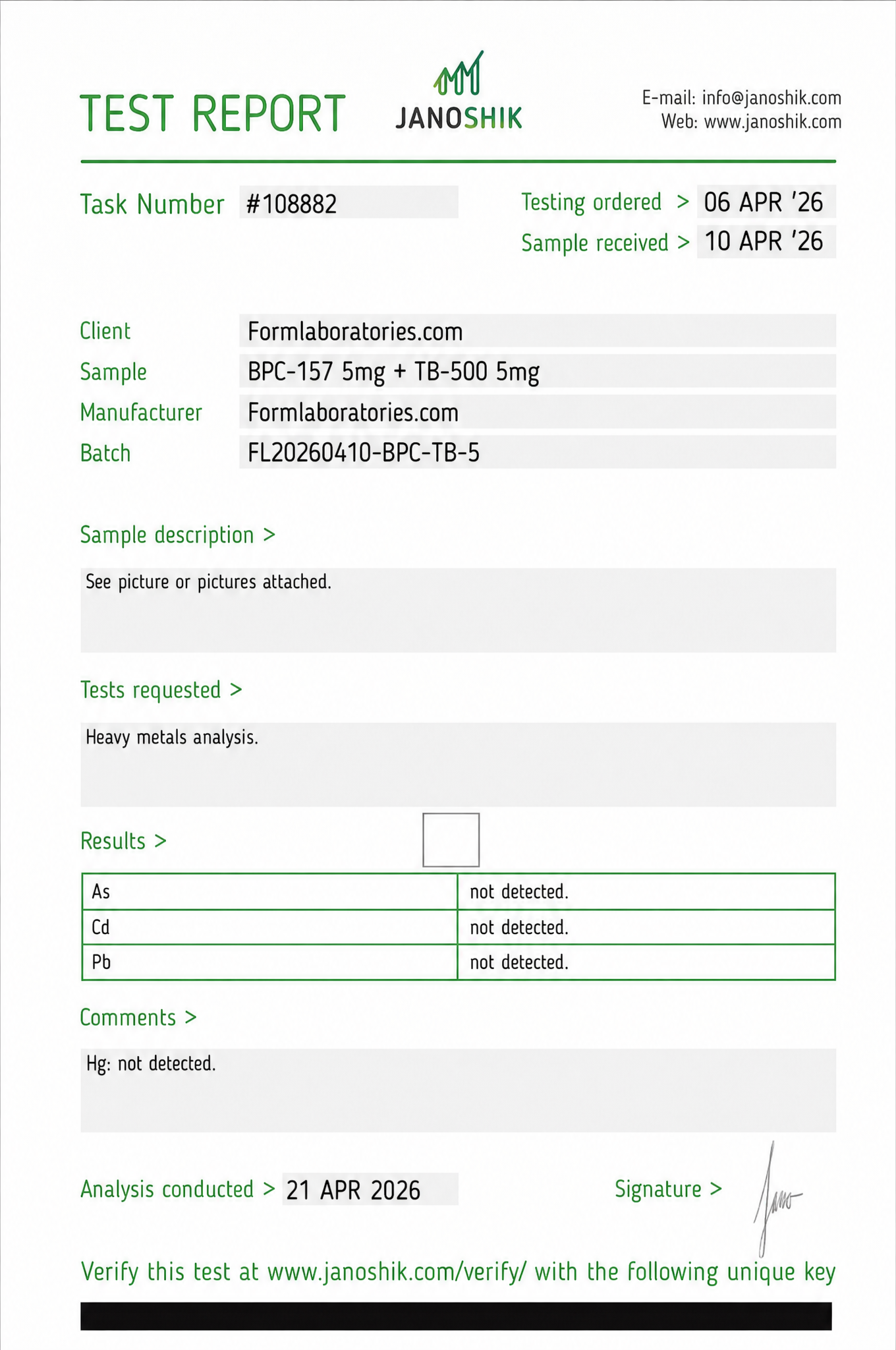
Build your stack
Study alongside other catalogue references.
These products are shown as catalogue pairings only. Add any line to the same cart for order review.
15-amino-acid research peptide
BPC-157
$99 AUD
Researchers can study this catalogue reference alongside BPC-157 & TB-500 in the same order record.
Thymosin beta-4 fragment peptide
TB-500
$109 AUD
Researchers can study this catalogue reference alongside BPC-157 & TB-500 in the same order record.
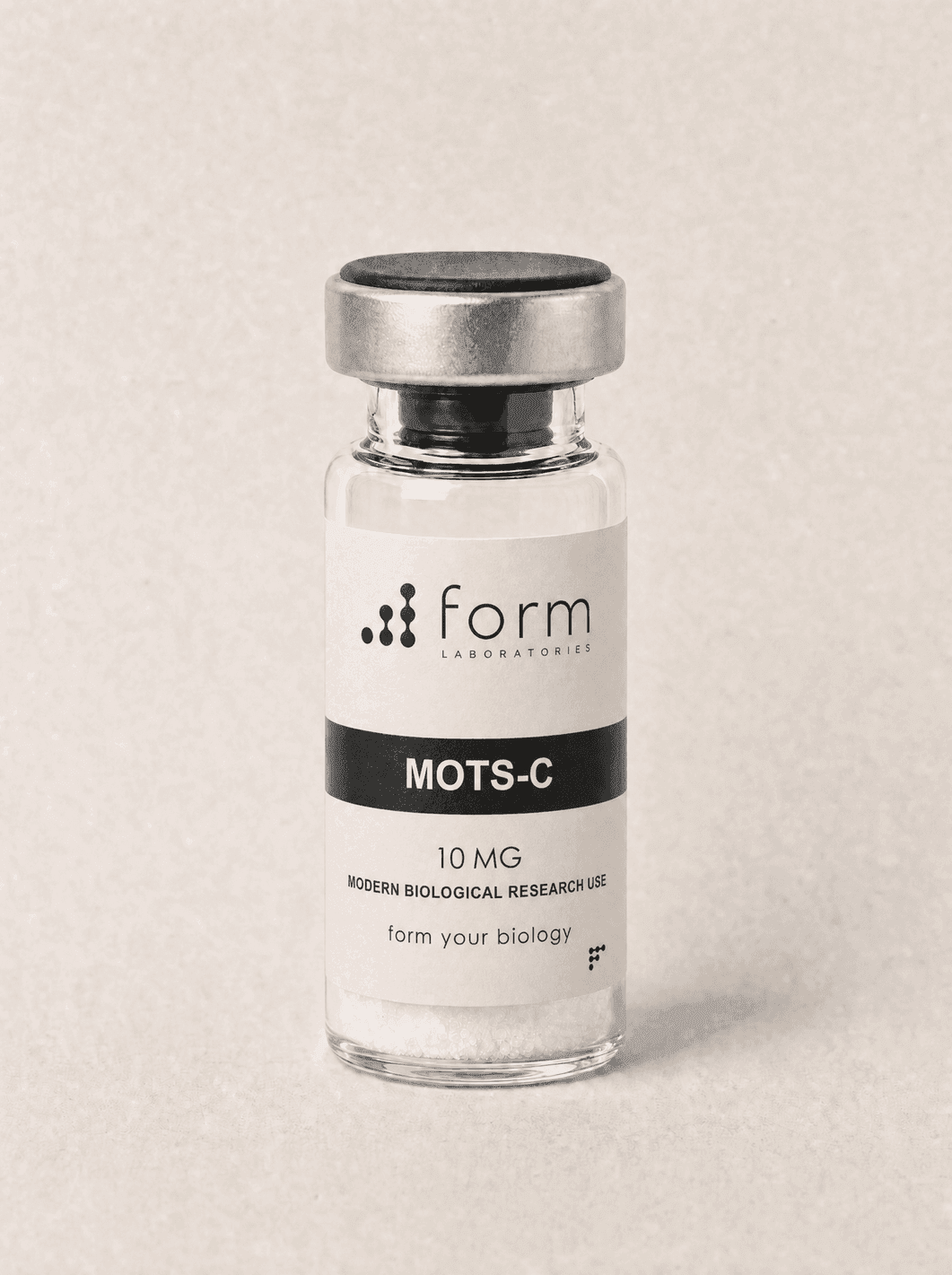
Mitochondrial-derived peptide
MOTS-C
$99 AUD
Researchers can study this catalogue reference alongside BPC-157 & TB-500 in the same order record.
FAQ
Questions, answered plainly.
BPC-157 & TB-500 is supplied as laboratory research material only. It is 21+ only, not for human consumption, and not for veterinary use.
The product page lists the lot, appearance, and storage notes for BPC-157 & TB-500, and shows the lab report on file where there is one. Those reports are heavy-metals screens: they do not measure purity and do not confirm identity.
Follow the label and matching COA paperwork. This page repeats 2-8 C storage guidance and light-protection notes before checkout.
They're two separate compounds often studied around the same topic - tissue repair - so they're offered as one research set. The page keeps them separate because each has its own identity and its own research.
We make no such claim. There's no published research showing a combined effect. They're supplied as two individual research compounds, each with its own lab report.
No. Both are supplied for laboratory research only, 21+ only, and not for human or animal consumption. Neither is approved by any medicines regulator.
The set contains two separate research peptides, each with its own lab report: BPC-157, a 15-amino-acid peptide (GEPPPGKPADDAGLV), and TB-500, a 7-amino-acid fragment (Ac-LKKTETQ) of the protein thymosin beta-4. They're two different compounds with two different research stories, supplied together and kept separate. Both are for laboratory research only.
Form Labs makes no such claim. There is no published research showing a combined or synergistic effect between BPC-157 and TB-500 - the two are studied separately, in cell and animal models. The set is supplied as two individual research compounds, not as a blended product with a shared effect.
BPC-157 is a 15-amino-acid peptide based on a partial sequence of a protein in gastric juice. In published research it's studied - mostly in rodents and cell cultures - for its possible role in how the gut lining, tendons and blood vessels repair. BPC-157 isn't an approved medicine, and there are no completed human trials.
TB-500 is a 7-amino-acid fragment (Ac-LKKTETQ) of the protein thymosin beta-4. In published research it - more often the full protein - is studied for cell movement, wound repair and blood-vessel growth, almost entirely in cell and animal models. TB-500 isn't the full protein, isn't an approved medicine, and has no published human trials of the fragment.
They're unrelated compounds. BPC-157 is a 15-amino-acid peptide (GEPPPGKPADDAGLV) based on a protein in gastric juice, studied mostly in gut, tendon and blood-vessel models. TB-500 is a 7-amino-acid fragment (Ac-LKKTETQ) of thymosin beta-4, studied mostly for cell movement and repair. Different origins, different sequences, different research.
Neither BPC-157 nor TB-500 is an approved medicine in Australia - neither is on the Australian Register of Therapeutic Goods, and the TGA has not evaluated either for safety, quality or effectiveness. Form Labs supplies both strictly as laboratory research materials, not for human or veterinary use. In sport, both are on the World Anti-Doping Agency prohibited list.
No. Neither compound has been approved as a medicine by any regulator - not the TGA in Australia, the FDA in the United States, or the EMA in Europe - for any use. Both remain investigational research compounds, and Form Labs sells the set only as reference material for laboratory research.
Not in completed, published trials. BPC-157's first controlled human trial (NCT07437547) only began in 2026, with results expected around 2027; a TB-500 safety study (NCT07487363) is recruiting but has no results. For both compounds, today's evidence is almost entirely from cell and animal research.
This set is sent to an independent laboratory, Janoshik. The lab report on file covers a vial pairing BPC-157 5 mg with TB-500 5 mg and is a heavy-metals screen: it reports arsenic, cadmium and mercury as not detected. It does not measure purity, does not confirm identity, and does not test for bacterial residue. The report is tied to the batch number.
The research-peptide market is largely unregulated, and independent analyses have repeatedly found products that are under-strength, mislabelled or contaminated. That's why every Form Labs batch - including this BPC-157 and TB-500 set - is sent to an independent laboratory and ships with the lab report on file, backed by a 30-day purity guarantee. It's also why both should be handled only as research materials.
The BPC-157 and TB-500 set ships from Perth via Australia Post or CouriersPlease in plain, unbranded packaging once your payment clears, with tracking emailed. On arrival, store the freeze-dried vials in the fridge at 2-8 C and keep them out of light. Delivery is Australia-only; a flat rate applies, with free standard shipping on orders over $250.
Add the set to your cart and check out. Instead of paying by card, you'll receive an emailed invoice with our bank details - pay by bank transfer, quoting the reference. Once the payment clears we pack and send your order, and email you tracking. A faster transfer (PayID or Osko) gets things moving sooner.
Every Form Labs compound carries a 30-day purity guarantee, and both peptides in this set are covered. If an independent lab re-tests a batch within 30 days and it comes back below the purity stated on its lab report, we refund the order in full - and you don't need to send the vial back.
No. BPC-157 and TB-500 are supplied strictly as reference materials for laboratory research - not medicines, supplements or food, and not for people or animals to take, and 21+ only. The research described on this page concerns the two molecules in published studies, not a Form Labs product.
Form your biology
BPC-157 & TB-500, with the batch details visible.
Before you order, check the batch number shown on the page against the lab report for that batch.
Added to cart