
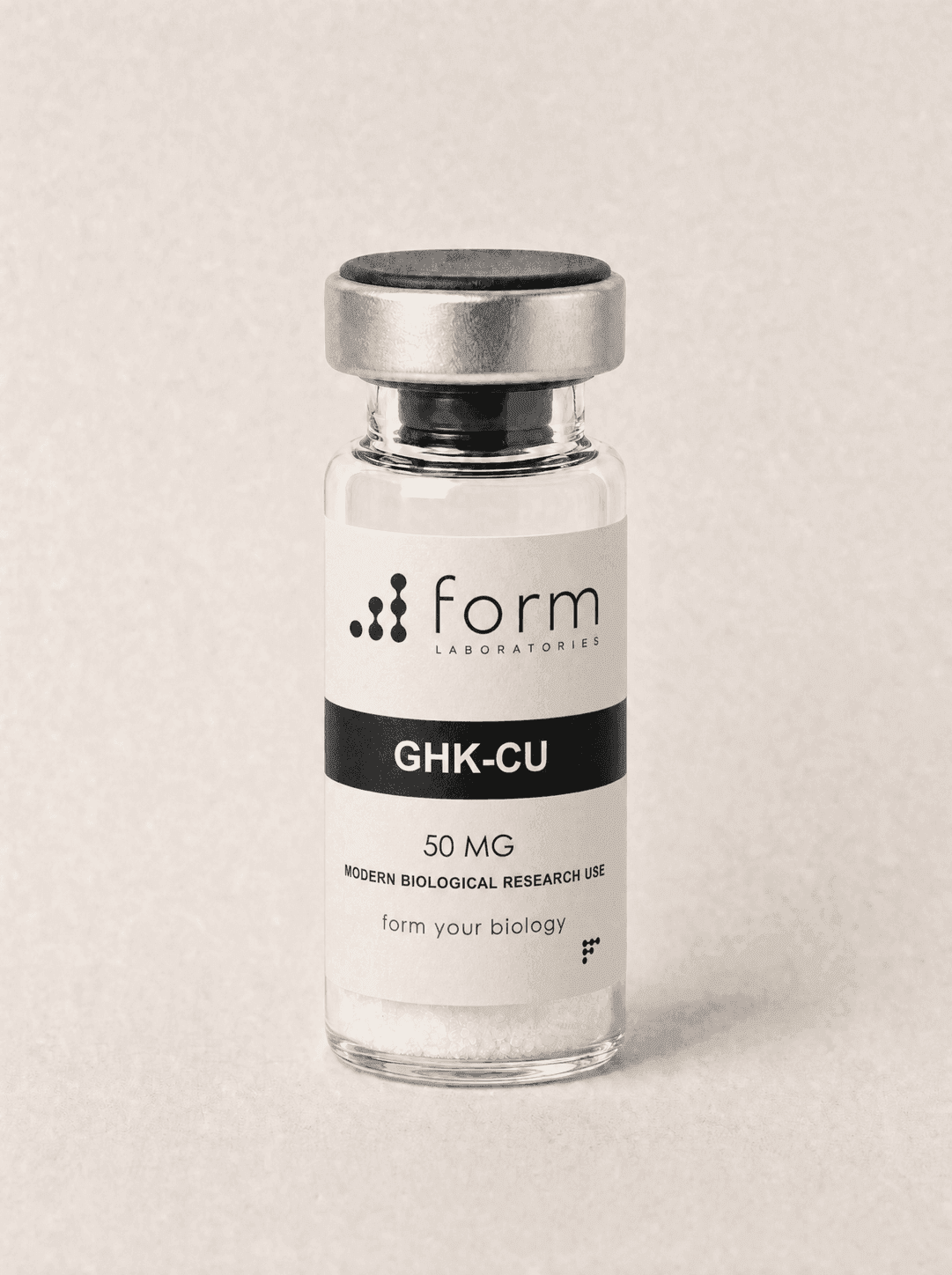
GHK-Cu is the copper-bound form of a three-amino-acid peptide - glycyl-histidyl-lysine. An identity fact, not a product claim.
Schlesinger et al., Experientia, 1977Plain-English research guideGHK-Cu (glycyl-histidyl-lysine : copper)
GHK-Cu research guide
Everything worth knowing, without the jargon.
GHK-Cu is a naturally occurring copper peptide - the copper-bound form of a three-amino-acid chain (glycyl-histidyl-lysine, GHK) that the body makes and carries in the blood. It's one of the most-studied small peptides there is, almost entirely in the lab.
REV 2026-07 · 7 Aug 20267 peer-reviewed studiesResearch-use-only context
What the papers reportThird-party literature - not product claims
The year the peptide's growth-modulating activity was first reported, in liver-cell research. Published research context, not a product claim.
Pickart, Thayer & Thaler, Biochem Biophys Res Commun, 1973About the level of GHK naturally circulating in a young adult's plasma; a 2018 review reports it falling to roughly 80 ng/mL by age 60. It's a peptide the body makes itself. Literature context, not a product claim.
Pickart & Margolina, Int J Mol Sci, 2018In gene-profiling research, the share of the genes analysed whose activity GHK shifted by at least half - some up, some down. A published research figure, not a product claim.
Pickart & Margolina, Int J Mol Sci, 2018Why it matters
A peptide the body already makes.
Unlike most compounds in a catalogue like this, GHK-Cu isn't a lab invention - it's a small peptide your own body produces and carries in the blood. Researchers noticed decades ago that its level is high when we're young and lower as we age, which is part of why it's been studied so much.
The 'Cu' is copper. GHK grabs a single copper atom, and most of the published research is on that copper-bound form - looking at copper chemistry, collagen, tissue repair, and, more recently, which genes it seems to switch on or off in cell studies.
What the research doesn't have is large human trials. So this guide sticks to what the lab and animal studies actually looked at, and treats all of it as research context - not as anything the vial will do for a person.
How it works
One tripeptide, holding one copper atom.
A plain-English look at each pathway, kept at a summary level.
GHK - the peptide
Glycine, histidine, lysine, joined in a row. On its own it's 'free GHK'. It's the same peptide the body makes.
Cu - the copper
Your body needs copper - the enzymes that cross-link collagen into strong connective tissue don't work without it - but loose copper is reactive enough to damage cells, so the body keeps almost none of it drifting around free. Small molecules carry it instead, holding it steady and handing it over where it's wanted. GHK holds one copper(II) atom that way. That's the '-Cu', it's why the powder is blue, and it's the form most of the research uses - which is why a lot of that research asks whether the carrying is the point, rather than the peptide on its own.
What researchers measure
Copper-binding chemistry, collagen in cell cultures, connective tissue in animal wounds, and gene-activity shifts in cell models.
Pharmacology at a glance
- Research code
- GHK-Cu (glycyl-histidyl-lysine : copper)
- Class
- A naturally occurring copper-binding tripeptide. 'Copper peptide' is the research category - not a drug class.
- Molecule
- A three-amino-acid peptide (glycyl-histidyl-lysine) bound to a single copper(II) atom; a blue freeze-dried powder as supplied.
- Route studied
- None given. This guide provides no route, preparation, or use guidance of any kind.
- Reported half-life
- Not applicable here - GHK-Cu isn't characterised as a dosed medicine, so there's no clinical half-life to quote.
- Originator
- A natural human peptide, not an invented drug. Its research was pioneered by Loren Pickart and colleagues from the 1970s on.
- Approval status
- Laboratory research material only. Not an approved medicine, cosmetic, or supplement, and not for human or veterinary use.
What it has been studied for
Study areas from the published literature.
Copper chemistry
How a copper(II) ion binds the GHK peptide - the chemistry that defines the complex.
Lau & Sarkar, Biochem J, 1981Collagen, in cells and animals
Collagen production in cultured skin cells, and connective tissue in animal wound models. No human study.
Maquart et al., FEBS Letters 1988 / J Clin Invest 1993Skin pathways, in the lab
Reviewed for its role in laboratory skin-regeneration pathway research. Pathway work, not a cosmetic result.
Pickart et al., BioMed Research International, 2015Hair-follicle cells, in the dish
Studied in vitro on cultured human hair-follicle (dermal-papilla) cells. Cells in a dish, not anyone's scalp.
Pyo et al., Arch Pharm Res, 2007Gene expression
Gene-profiling research describing shifts in the activity of many genes in cell models.
Pickart & Margolina, Int J Mol Sci, 2018The studies
The evidence, study by study.
Open any study for a plain summary, what it measured, the finding, and a link to the paper.
The first report that a small peptide from human plasma could change how liver cells behaved in culture.
- Studied in
- Human liver cells and hepatoma (liver-tumour) cells in culture.
- Design
- An early laboratory study - the first look at the peptide's activity.
- Measured
- Cell survival and growth in the dish.
A three-amino-acid peptide from plasma helped keep normal liver cells alive and affected growth in the tumour cells - the observation that started decades of GHK research.
DOI 10.1016/0006-291X(73)91459-9This paper pinned down the exact structure of the plasma peptide as glycyl-histidyl-lysine (GHK).
- Studied in
- Purified peptide from human plasma.
- Design
- Structural identification.
- Measured
- The amino-acid sequence of the active peptide.
The growth-modulating plasma factor was identified as the tripeptide glycyl-histidyl-lysine - the 'GHK' every later paper refers to.
DOI 10.1007/BF02002806Work suggesting GHK's activity is tied to how it carries copper into cells.
- Studied in
- Cell and biochemical systems.
- Design
- Mechanistic laboratory study.
- Measured
- How the peptide interacts with and moves copper.
The paper proposed that GHK works partly by helping copper get into cells - the idea behind studying the copper-bound form, GHK-Cu, rather than the peptide alone.
DOI 10.1038/288715a0A detailed look at the chemistry of how a copper(II) ion attaches to GHK.
- Studied in
- Purified GHK and copper(II) in solution.
- Design
- Coordination-chemistry study.
- Measured
- How, and how tightly, copper binds the peptide.
Mapped the way copper(II) coordinates to glycyl-histidyl-lysine - the chemistry that defines the GHK-Cu complex supplied as reference material.
DOI 10.1042/bj1990649One of the landmark cell studies: collagen production in cultured skin cells exposed to the GHK-Cu complex.
- Studied in
- Cultured fibroblasts (a common collagen-making skin cell).
- Design
- An in-vitro cell-culture study.
- Measured
- Collagen synthesis by the cells.
In this cell model, the GHK-Cu complex was associated with more collagen synthesis. It's an in-vitro finding - cells in a dish, not people.
DOI 10.1016/0014-5793(88)80509-XA follow-up moving from the dish to an animal model, looking at connective tissue in experimental wounds.
- Studied in
- Rat experimental wounds.
- Design
- An in-vivo animal-model study.
- Measured
- Connective-tissue accumulation at the wound site.
In this animal model, the GHK-Cu complex was associated with more connective-tissue accumulation. It's an animal finding, not a human result.
DOI 10.1172/JCI116842A review gathering gene-profiling work on GHK - which genes shift, and by how much, in cell models.
- Studied in
- A review of published cell-model gene-expression data.
- Design
- A narrative review by GHK's original researchers.
- Measured
- Reported shifts in gene activity across profiling studies.
The review reports that GHK shifted about 31.2% of the genes analysed by at least half - some up, some down - in cell-model profiling. It's a laboratory research figure, and it's a review by the peptide's own researchers, so we cite it as published context, not proof.
DOI 10.3390/ijms19071987Where evidence stops
Groups and questions not established.
- Large human clinical trials - there aren't the big randomised human studies that newer metabolic peptides have.
- Any use in or on people or animals - none of the research on this page is a use direction.
- What a specific batch does - the studies are about the molecule in general, not this vial.
Development and status
Where the research record sits.
A tiny plasma peptide is found to change liver-cell behaviour in culture (Pickart, Thayer & Thaler).
The peptide's structure is identified as glycyl-histidyl-lysine - GHK (Schlesinger et al.).
Research links GHK's activity to carrying copper into cells (Pickart et al., Nature).
The copper(II)-GHK binding chemistry is mapped in detail (Lau & Sarkar).
GHK-Cu is studied for collagen synthesis in cultured skin cells (Maquart et al.).
Connective-tissue effects are studied in animal wound models (Maquart et al.).
Human hair-follicle cells are studied in vitro (Pyo et al.).
A review pulls together gene-expression profiling of GHK (Pickart & Margolina).
Approval status: Laboratory research material only. Not an approved medicine, cosmetic, or supplement, and not for human or veterinary use.Whatever the molecule’s status elsewhere, what Form Labs supplies is research-use-only reference material - for laboratory work, not for people or animals.
Evidence and limitations
What this means, and what it does not.
Most of it is lab and animal work
The GHK-Cu evidence base is mainly cell cultures, animal models, and reviews. That's useful for understanding the molecule, but it doesn't translate into claims about people.
Some key figures come from the same authors
A lot of the recent gene and plasma-level numbers trace back to reviews by GHK's original researchers. We cite them as published context, not independent proof.
No use instructions
This guide doesn't provide preparation, dosing, cosmetic, or medical guidance. It's a plain summary of published research.
The lab report is the authority for a batch
Identity, purity, appearance, and storage for the material we ship come from the lab report and label - not from these papers.
Lab handling
Reference-material handling context.
Research-use boundary
GHK-Cu is supplied strictly for laboratory research. It's not for human consumption, veterinary, medical, or cosmetic use, and no directions for use are given.
COA and label
The certificate of analysis (COA) and vial label are the authority for identity, purity, appearance, and release for the batch you receive.
Storage
Store cold at 2-8 C and keep it out of light - copper peptides are light-sensitive.
Educational boundary
This guide is a plain summary of third-party research that Form Labs did not run. It isn't medical advice or a product claim.
Glossary
Plain-English definitions.
- GHK
- Glycyl-histidyl-lysine - a peptide of three amino acids (glycine, histidine, lysine).
- GHK-Cu
- The copper-bound form of GHK: the same peptide holding one copper(II) atom.
- Copper peptide
- A short peptide that binds a copper ion; GHK-Cu is the best-known example.
- Tripeptide
- A peptide made of three amino acids.
- In vitro
- In the dish - laboratory work in cells or solution, outside a living body.
- In vivo
- In a living organism - here, animal-model studies.
- Fibroblast
- A common skin cell that makes collagen; used in many GHK-Cu cell studies.
- Gene expression
- Which genes are switched on or off, and how strongly, in a cell.
- COA
- Certificate of analysis - the batch paperwork controlling identity, purity, appearance, and release.
- Research use only
- A lab-only boundary: not for human consumption, veterinary, medical, or cosmetic use.
FAQ
Questions answered plainly.
GHK is a peptide the body makes naturally and carries in the blood; the GHK-Cu supplied as research material is made to match it, as a copper-bound freeze-dried powder for the lab - so it is both.
Gene-profiling research describes GHK shifting the activity of a large share of the genes analysed - one 2018 review reports about 31% changing by at least half. That's a laboratory research figure in cell models, not a claim about what happens in a person. (You may see a 'resets 4,000 genes' headline online; that specific number isn't stated in the research, so we don't use it.)
A lot of the lab work looks at collagen in cultured skin cells and at hair-follicle cells in the dish. That's why those areas come up - but they're cell and animal studies, not proof of any cosmetic result, and this is research-only material.
The product label and the lab report (COA) for that batch - they're the authority for identity, purity, appearance, and storage. The papers here are background only.
No. GHK-Cu is not an approved medicine in Australia. It is not on the Australian Register of Therapeutic Goods, and the TGA has not evaluated it for safety, quality or effectiveness. You may have seen GHK-Cu listed as an ingredient in cosmetic products sold elsewhere - that is a separate regulatory category and says nothing about the material on this page. Form Labs supplies GHK-Cu strictly as laboratory research material.
GHK-Cu is supplied in Australia as research-use-only reference material, not for human or veterinary use. It is not an approved medicine and is not on the Australian Register of Therapeutic Goods. Orders are limited to laboratory and research customers aged 21 or over.
'For research use only' means GHK-Cu is supplied strictly as laboratory reference material - for in-vitro research, not for use in or on humans or animals. It is not a medicine, a supplement, a cosmetic, or food. Everything on this page describes published research and the identity of this batch, not instructions for use.
References
Every figure, sourced.
Educational references to third-party literature. Form Labs is unaffiliated with the study authors.
Pickart L, Thayer L, Thaler MM. A synthetic tripeptide which increases survival of normal liver cells and stimulates growth in hepatoma cells. Biochem Biophys Res Commun. 1973.
DOISchlesinger DH, Pickart L, Thaler MM. Growth-modulating serum tripeptide is glycyl-histidyl-lysine. Experientia. 1977.
DOIPickart L, Freedman JH, Loker WJ, et al. Growth-modulating plasma tripeptide may function by facilitating copper uptake into cells. Nature. 1980.
DOILau SJ, Sarkar B. The interaction of copper(II) and glycyl-L-histidyl-L-lysine, a growth-modulating tripeptide from plasma. Biochem J. 1981.
DOIMaquart FX, Pickart L, Laurent M, et al. Stimulation of collagen synthesis in fibroblast cultures by the tripeptide-copper complex glycyl-L-histidyl-L-lysine-Cu2+. FEBS Lett. 1988.
DOIMaquart FX, Bellon G, Chaqour B, et al. In vivo stimulation of connective tissue accumulation by the tripeptide-copper complex glycyl-L-histidyl-L-lysine-Cu2+ in rat experimental wounds. J Clin Invest. 1993.
DOIPyo HK, Yoo HG, Won CH, et al. The effect of tripeptide-copper complex on human hair growth in vitro. Arch Pharm Res. 2007.
DOIPickart L, Vasquez-Soltero JM, Margolina A. GHK peptide as a natural modulator of multiple cellular pathways in skin regeneration. Biomed Res Int. 2015.
DOIPickart L, Margolina A. Regenerative and protective actions of the GHK-Cu peptide in the light of the new gene data. Int J Mol Sci. 2018.
DOICitations are provided for education only. No therapeutic, weight-loss, or efficacy claims are made.
How we produce these guides
- Who writes them
- These guides are written and maintained in-house by the Form Laboratories research team. They are not authored by a named clinician, and nothing in them is medical advice. Where a guide is short, that is because the published research is thin - we would rather say so than fill the space.
- What they are built from
- Each guide summarises published, peer-reviewed literature. Every study we describe is listed in full at the bottom of the page with a link to the original paper, so you can open it and check what it actually says. Form Laboratories did not run any of the cited studies.
- What they deliberately leave out
- These guides describe how the biology works and what the published research measured. They do not contain dosing, preparation, reconstitution or administration instructions, and they make no claim about what any compound would do for a person. Everything we supply is research-use-only reference material.
- How we handle uncertainty
- Where the evidence is limited to cell cultures or animals, we say so in the study entry rather than implying a human result. Where a compound has no completed human trial, the guide states that plainly.
The product
Form Laboratories - GHK-Cu
Ready to see GHK-Cu?
- Independently tested - purity printed on the lab report.
- A batch number on every vial, matched to its report.
- Ships from Perth via Australia Post or CouriersPlease in plain packaging.
Build your stack
Compare nearby catalogue records.
These nearby records stay inside the research-only catalogue.
Research-use-only catalogue
Continue to the product record.
Review lot-facing product details, pricing, and checkout boundaries on the matching product page.
View GHK-Cu - from $79.00 AUD