
Amino acids in the sequence GEPPPGKPADDAGLV - an identity fact, not a product claim.
Form Labs catalog recordPlain-English research guideBPC-157 / PL 14736
BPC-157 research guide
Everything worth knowing, without the jargon.
BPC-157 is a synthetic 15-amino-acid peptide, based on a partial sequence of a protective protein found in gastric juice. It's studied - almost entirely in cells and rodents - for how tissues like the gut, tendon and blood vessels repair.
REV 2026-07 · 7 Aug 20266 peer-reviewed studiesResearch-use-only context
What the papers reportThird-party literature - not product claims
When the protective gastric-juice substance behind BPC-157 was first described.
Sikiric et al., J Physiol Paris, 1993Completed, published human trials so far - the evidence is lab and animal only.
Published researchWhen the first randomised controlled human trial began recruiting (results expected ~2027).
ClinicalTrials.gov - NCT07437547Why it matters
A lot of animal research, very little in people.
BPC-157 is unusual: it has a big, decades-long body of animal research behind it, and almost no human evidence. Most of the work is in rats and cell cultures, looking at how the gut, tendons and blood vessels repair.
That gap matters. Animal results often don't carry over to people, and here that step has barely been tested - the first properly controlled human trial only began in 2026. So this guide describes what the research looked at and found in its models, not what BPC-157 does in a person.
How it works
One fragment of a protective protein.
A plain-English look at each pathway, kept at a summary level.
Tissue repair
The recurring theme across the research is tissue repair - gut lining, tendon, ligament, muscle - studied in cell and rodent models.
Blood-vessel growth
Several studies looked at angiogenesis (new blood vessels) and the VEGFR2 signalling linked to it, in cells and rats.
How the body handles it
A pharmacokinetics study in rats and dogs measured how quickly the body cleared it (a short half-life). That's about handling, not effect.
Pharmacology at a glance
- Research code
- BPC-157 (PL 14736)
- Class
- A synthetic 15-amino-acid peptide (a 'pentadecapeptide'), studied in tissue-repair research.
- Molecule
- A short, stable lab-made chain of 15 amino acids (GEPPPGKPADDAGLV), based on a partial sequence of a protective protein found in gastric juice.
- Route studied
- In the animal studies it was given by injection or in drinking water. That's the research record, not use guidance.
- Reported half-life
- Short - under about 30 minutes in a rat and dog study that measured how quickly the body cleared it (a pharmacokinetics study).
- Originator
- First described by a University of Zagreb research group (Sikiric and colleagues).
- Approval status
- Not an approved medicine anywhere - a preclinical research compound. A first controlled human trial began in 2026.
What it has been studied for
Study areas from the published literature.
Gut & stomach lining
The original 'body protection' gastric research (Sikiric), plus rat gut-join healing (Vuksic).
Sikiric et al., 1993; Vuksic et al., 2007Tendon & connective tissue
Tendon healing and fibroblast (tissue-cell) migration in rats and cell cultures.
Chang et al., J Appl Physiol, 2011Blood-vessel growth (angiogenesis)
New-vessel growth and VEGFR2 signalling, in cultured cells and a rat model.
Hsieh et al., J Mol Med, 2017How the body handles it (PK/ADME)
How quickly rats and dogs absorbed and cleared it - a pharmacokinetics study, not an efficacy one.
He et al., Front Pharmacol, 2022Human evidence (pending)
A first randomised controlled human trial (hamstring injury) began recruiting in 2026; results aren't out yet.
ClinicalTrials.gov NCT07437547The studies
The evidence, study by study.
Open any study for a plain summary, what it measured, the finding, and a link to the paper.
This is where the idea began: the group described a protective substance they found in gastric juice, and the 'the stomach protects the body' hypothesis behind it. BPC-157 is the stable synthetic peptide later modelled on part of that sequence.
- Studied in
- Rodent models and the original gastric-juice work.
- Design
- A foundational research paper setting out the hypothesis and early findings.
- Measured
- Protective effects on the stomach and other tissues in the group's models.
It laid out the 'body protection compound' idea and the early animal observations that led to the synthetic BPC-157 peptide. It's the origin story, not a trial of the product.
DOI 10.1016/0928-4257(93)90038-UOne of many rat studies looking at whether BPC-157 changed how a surgical join in the intestine healed.
- Studied in
- Rats (in-vivo).
- Design
- An animal surgical-healing model.
- Measured
- How well an ileoileal (small-intestine) join held and healed.
In this rat model, BPC-157 was associated with better healing of the intestinal join. It's an animal result - not a human finding or a product claim.
DOI 10.1007/s00595-006-3498-9This study looked at tendon repair two ways: cultured tendon cells in a dish, and a cut Achilles tendon in rats.
- Studied in
- Cultured rat tendon fibroblasts (tissue cells) plus rats.
- Design
- A lab cell study alongside an animal tendon-healing model.
- Measured
- Cell growth and movement in the dish, and tendon healing in the rats.
The tendon cells grew and migrated more in the dish, and the rat tendons were reported to heal faster. Animal and cell results - not a claim about people.
DOI 10.1152/japplphysiol.00945.2010This study looked at angiogenesis - the growth of new blood vessels - in cultured cells and in a rat model of poor blood flow.
- Studied in
- Cultured human vascular (blood-vessel) cells plus rats.
- Design
- Lab cell experiments plus a rat hind-limb blood-flow model.
- Measured
- New-vessel growth and a signalling pathway called VEGFR2.
It linked BPC-157 to more new-vessel growth and to VEGFR2 signalling in these models. Cell and animal findings only.
DOI 10.1007/s00109-016-1488-yA review paper pulling together decades of mostly-rodent research on wound healing and blood-vessel growth.
- Studied in
- A summary of many earlier animal studies.
- Design
- A narrative review, not a new experiment.
- Measured
- What the collected animal studies reported.
It summarises the animal wound-healing and angiogenesis literature in one place. It's a review of research, not evidence about people.
DOI 10.3389/fphar.2021.627533This study measured how quickly rats and dogs absorbed and cleared BPC-157 - a 'pharmacokinetics' study. It's about handling, not healing.
- Studied in
- Rats and dogs.
- Design
- A pharmacokinetics / ADME study (absorption, distribution, metabolism, excretion).
- Measured
- Blood levels over time, half-life, and how the body cleared it.
It reported a short half-life (under about 30 minutes) and how the body processed the peptide. This is a handling study - it doesn't say anything about benefit or effect.
DOI 10.3389/fphar.2022.1026182Risks recorded in studies
The side effects the trials reported.
Human safety is largely unknown
Not establishedBecause there are no completed human trials, the human safety profile isn't established. What's known comes from animal studies and a handful of tiny, uncontrolled pilot reports.
Most evidence is from one research group
A caveatA large share of the BPC-157 literature comes from the original Zagreb group, with fewer independent replications. That's worth knowing when weighing how settled the science is.
Banned in sport
RegulatoryBPC-157 is on the World Anti-Doping Agency prohibited list, so it isn't permitted for athletes. That's context, not use guidance.
Not an approved medicine
RegulatoryNo medicines regulator (the TGA in Australia, the FDA, the EMA) has approved BPC-157 for any use. It's supplied here only as a research material.
This section summarizes third-party trial records. It is not a complete safety profile or advice.
Where evidence stops
Groups and questions not established.
- People: there are no completed, published human trials - the first controlled trial only began in 2026.
- Long-term safety: not established, in animals or people.
- Doses, timing and how to prepare it: not covered here - Form Labs gives no such guidance.
- Whether animal results carry over to humans: unknown, and not something this page claims.
Development and status
Where the research record sits.
A protective substance in gastric juice is described - the origin of the 'body protection compound' idea.
Rat and cell studies look at gut, tendon and connective-tissue healing.
Cell and rat studies look at new-blood-vessel growth (angiogenesis).
A pharmacokinetics study in rats and dogs measures how the body clears it.
The first randomised, controlled human trial begins recruiting. Results are expected around 2027.
Approval status: Not an approved medicine anywhere - a preclinical research compound. A first controlled human trial began in 2026.Whatever the molecule’s status elsewhere, what Form Labs supplies is research-use-only reference material - for laboratory work, not for people or animals.
Evidence and limitations
What this means, and what it does not.
It's preclinical
Almost all the evidence is in cell cultures and rodents. Animal results often don't carry over to people, and here that step largely hasn't been tested yet.
The human data is tiny
Beyond the animal work, there are only a few small, uncontrolled pilot reports in people - not enough to show whether it's safe or effective. A first proper trial began in 2026.
Much of it is one group's work
A large part of the literature comes from the original research group, with fewer independent replications than a well-settled field would have.
Where Form Labs fits
This guide is a plain-English summary of published research that Form Labs did not run. It's not medical advice, not a product claim, and not use guidance. We supply BPC-157 strictly as reference material, with a batch number you can match to its lab report.
Lab handling
Reference-material handling context.
Research-use boundary
BPC-157 is supplied strictly for laboratory research. It is not for human consumption, veterinary, medical, or cosmetic use, and no directions for use are given.
Storage
Supplied freeze-dried. Keep it at 2-8 C (fridge-cold) and out of light, following the vial label, the matching lab report for the batch, and your lab's own written procedures.
Reconstitution
Reconstitution means mixing the dry powder back into liquid for handling. This guide doesn't set a method - that's down to the receiving lab's written protocol and the batch paperwork.
Stability
How long a freeze-dried peptide stays within spec depends on how it's stored, and is tracked through the batch paperwork. Any working window after it's mixed belongs in the lab's own protocol, not this guide.
Perth dispatch
Available to Perth researchers as RUO reference material with lot-matched paperwork, dispatched from Perth via Australia Post or CouriersPlease. For laboratory research use only.
Glossary
Plain-English definitions.
- Peptide
- A short chain of amino acids - the building blocks of proteins.
- Pentadecapeptide
- A peptide made of 15 amino acids, which is what BPC-157 is.
- Preclinical
- Research done in cells and animals, before (or instead of) trials in people.
- In-vitro
- In a dish or test tube, outside a living body.
- In-vivo
- In a living animal.
- Angiogenesis
- The growth of new blood vessels.
- Fibroblast
- A common tissue cell studied in repair research.
- Pharmacokinetics
- How the body absorbs, moves around, and clears a compound - including half-life.
- Half-life
- The time for the amount in the blood to fall by half.
- VEGFR2
- A cell-signalling receptor linked to new-blood-vessel growth.
- Research use only
- Supplied for laboratory research - not for human or animal use, and not a medicine.
FAQ
Questions answered plainly.
BPC-157 is a synthetic 15-amino-acid peptide (GEPPPGKPADDAGLV), based on a partial sequence of a protective protein found in gastric juice, studied - mostly in cells and rodents - for how tissues repair. BPC-157 isn't an approved medicine.
BPC-157's evidence is almost entirely preclinical - cell cultures and rodents - built up over three decades, but with two big caveats: a large share comes from one originating research group (the University of Zagreb), and there are no completed, published human trials. So the animal findings are extensive, but how they translate to people is genuinely unknown.
Barely. There are no completed, published randomised controlled trials of BPC-157 - only a few very small, uncontrolled pilot reports. The first properly controlled human trial (ClinicalTrials.gov NCT07437547, a hamstring-injury study) began recruiting in 2026, with results expected around 2027.
Published BPC-157 research covers gut and stomach-lining protection (rat ulcer and anastomosis models), tendon and connective-tissue healing (Chang et al., 2011, in rats and cultured cells), blood-vessel growth or angiogenesis (Hsieh et al., 2017), and how the body clears it (He et al., 2022, a rat and dog pharmacokinetics study). All of it is preclinical.
In the one published pharmacokinetics study (He and colleagues, Frontiers in Pharmacology, 2022), BPC-157 had a short half-life - under about 30 minutes - in rats and dogs, and was cleared by the kidneys and bile. That study measured how the body handles the peptide, not what it does, and there is no equivalent human data.
No. 'Body Protection Compound' is a research name from the 1990s, when the original group described a protective substance in gastric juice. In this guide it's a historical label, not a claim. What BPC-157 does in people isn't established.
BPC-157 and TB-500 are unrelated peptides that both appear in tissue-repair research. BPC-157 is a 15-amino-acid peptide based on a gastric-juice protein; TB-500 is a 7-amino-acid fragment of the protein thymosin beta-4. Different origins and sequences, both preclinical, and no research on combining them.
BPC-157 is not approved as a medicine by any regulator (the TGA, FDA or EMA), and it's on the World Anti-Doping Agency prohibited list for athletes. Form Labs supplies BPC-157 strictly as a laboratory research material, not for human or veterinary use.
Form Labs supplies peptides strictly as laboratory research materials. This guide is a plain-English summary of published research Form Labs did not run - not medical advice, not a product claim, and not guidance for any human or veterinary use.
References
Every figure, sourced.
Educational references to third-party literature. Form Labs is unaffiliated with the study authors.
Foundational paper describing a protective substance in gastric juice and the 'body protection' hypothesis. Sikiric P, et al. Journal de Physiologie (Paris), 1993; 87(5): 313-327.
DOIRat study of intestinal (ileoileal) anastomosis healing. Vuksic T, et al. Surgery Today, 2007; 37: 768-777.
DOIRat and cultured-cell study of tendon healing and fibroblast migration. Chang C-H, et al. Journal of Applied Physiology, 2011; 110(3): 774-780.
DOICell and rat study of angiogenesis and VEGFR2 signalling. Hsieh M-J, et al. Journal of Molecular Medicine, 2017; 95(3): 323-333.
DOIReview of rodent wound-healing and angiogenesis research. Seiwerth S, et al. Frontiers in Pharmacology, 2021; 12: 627533.
DOIPharmacokinetics / ADME study in rats and dogs (how the body clears it). He L, et al. Frontiers in Pharmacology, 2022; 13: 1026182.
DOICitations are provided for education only. No therapeutic, weight-loss, or efficacy claims are made.
How we produce these guides
- Who writes them
- These guides are written and maintained in-house by the Form Laboratories research team. They are not authored by a named clinician, and nothing in them is medical advice. Where a guide is short, that is because the published research is thin - we would rather say so than fill the space.
- What they are built from
- Each guide summarises published, peer-reviewed literature. Every study we describe is listed in full at the bottom of the page with a link to the original paper, so you can open it and check what it actually says. Form Laboratories did not run any of the cited studies.
- What they deliberately leave out
- These guides describe how the biology works and what the published research measured. They do not contain dosing, preparation, reconstitution or administration instructions, and they make no claim about what any compound would do for a person. Everything we supply is research-use-only reference material.
- How we handle uncertainty
- Where the evidence is limited to cell cultures or animals, we say so in the study entry rather than implying a human result. Where a compound has no completed human trial, the guide states that plainly.
The product
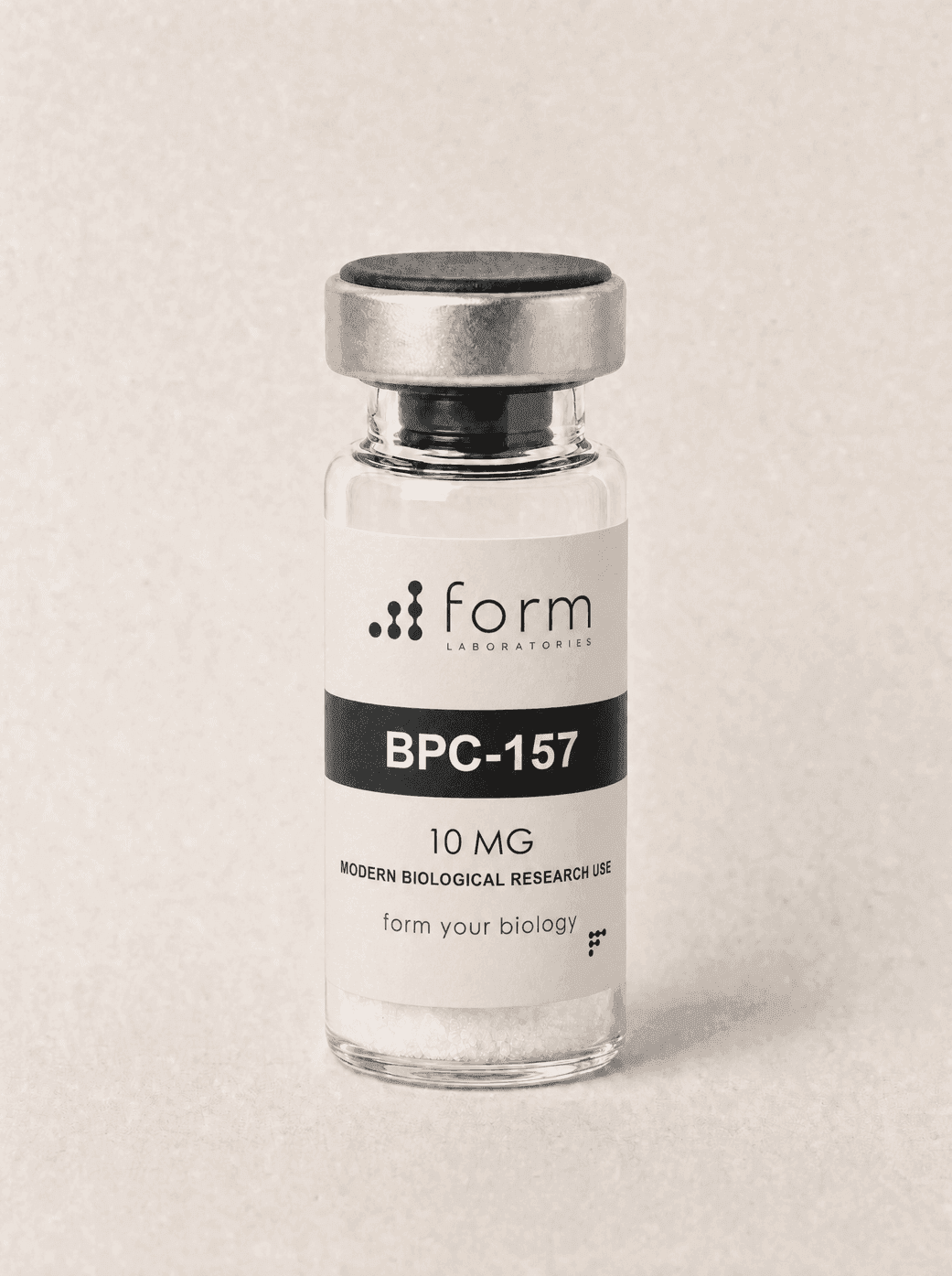
Form Laboratories - BPC-157
Ready to see BPC-157?
- Independently tested - purity printed on the lab report.
- A batch number on every vial, matched to its report.
- Ships from Perth via Australia Post or CouriersPlease in plain packaging.
Build your stack
Compare nearby catalogue records.
These nearby records stay inside the research-only catalogue.
Research-use-only catalogue
Continue to the product record.
Review lot-facing product details, pricing, and checkout boundaries on the matching product page.
View BPC-157 - from $99.00 AUD