
Semax is described as a heptapeptide - a peptide built from seven amino acids (sequence MEHFPGP). An identity fact, not a Form Labs product claim.
Semax sequence identity (MEHFPGP)Plain-English research guideMEHFPGP
Semax research guide
Everything worth knowing, without the jargon.
Semax is a synthetic heptapeptide (seven amino acids, sequence MEHFPGP) developed in Russia as an ACTH(4-10) analog - a fragment analog of the hormone ACTH - and studied in published research for its role in neuroprotection and cognition.
REV 2026-07 · 7 Aug 20266 peer-reviewed studiesResearch-use-only context
What the papers reportThird-party literature - not product claims
Adults with ischemic stroke studied alongside standard care in a published Russian clinical study. A study record, not a claim that Semax treats stroke - not a Form Labs product claim.
Gusev et al., Zhurnal Nevrologii i Psikhiatrii, 2018Approximate rise in BDNF measured in rat hippocampus after Semax, alongside increased TrkB signalling. A laboratory measurement in rats, not a Form Labs product claim.
Dolotov et al., Brain Research, 2006Genes with altered activity in injured rat brain tissue after Semax, in a genome-wide RNA-sequencing study - far short of the "4,000 genes" figure sometimes seen in marketing. A laboratory finding, not a Form Labs product claim.
Filippenkov et al., Genes (Basel), 2020Why it matters
Mostly animal research, plus one Russian clinical study.
Semax was developed in Russia in the 1980s at the Institute of Molecular Genetics, built from a fragment of the hormone ACTH (adrenocorticotropic hormone) with an added stability tail. It's registered as a medicine there, and most of what's published about it studies cognition- and neuroprotection-related questions: how the peptide behaves in cells and animal brains, and, in one notable study, alongside standard care for ischemic stroke in Russian patients.
The evidence base looks different from a Western drug-development programme. There's no Phase 1-3 trial series reviewed by the TGA, the FDA, or EU regulators - instead there's a long-running Russian research literature: rodent studies on BDNF and dopamine/serotonin systems, genome-wide screening studies, and one published clinical study in stroke patients. This guide treats all of it as research context, not as a product claim or a promise about what happens in a person.
How it works
A hormone fragment, read differently by the brain.
A plain-English look at each pathway, kept at a summary level.
MEHFPGP identity
Met-Glu-His-Phe-Pro-Gly-Pro, written MEHFPGP, is the seven-amino-acid sequence that identifies Semax in the research.
ACTH-fragment lineage
ACTH (adrenocorticotropic hormone) is a hormone the papers use for structure context. Semax is built from the ACTH(4-7) fragment with a Pro-Gly-Pro tail added for stability - an ACTH(4-10) analog, not ACTH itself.
BDNF / TrkB as research markers
BDNF (a nerve-growth marker) and TrkB (its receptor) are measurements researchers track in animal studies of neuroprotection. They're study markers here, not a benefit being promised.
Pharmacology at a glance
- Research code
- MEHFPGP
- Class
- ACTH(4-10) analog - a fragment analog of the hormone ACTH, built with a Pro-Gly-Pro tail added for stability.
- Molecule
- A synthetic heptapeptide (seven amino acids). CAS 80714-61-0, molecular formula C37H51N9O10S, molecular weight about 813.9 g/mol.
- Route studied
- The published research on Semax mostly uses intranasal delivery (drops or spray) under clinical or laboratory supervision - that's the study record, not guidance for any use. Form Labs gives no route, preparation, or dosing guidance for the material it supplies.
- Reported half-life
- Not a clean pharmacological half-life to quote - instead, published research describes Semax being rapidly broken down by peptidase enzymes (blood- and tissue-based enzymes), which is part of why the studies used repeated dosing rather than a single long-acting dose (Potaman et al., 1991).
- Originator
- Institute of Molecular Genetics, Russian Academy of Sciences (Russia)
- Approval status
- Registered as a medicine in Russia; not approved by the TGA (Australia) or the FDA (US), and no marketing authorisation in the EU.
What it has been studied for
Study areas from the published literature.
Neuroprotection & ischemic stroke
Studied in a Russian clinical study alongside standard stroke care, tracking plasma BDNF and functional recovery.
Gusev et al., Zhurnal Nevrologii i Psikhiatrii, 2018BDNF & TrkB signalling
Studied for whether it raises BDNF (a nerve-growth marker) and TrkB receptor signalling in rat brain tissue.
Dolotov et al., Brain Research, 2006Dopamine & serotonin systems
Studied for effects on dopaminergic and serotoninergic (monoamine) signalling in rodent brain research.
Eremin et al., Neurochemical Research, 2005Gene expression / transcriptome
Studied with genome-wide screening to see which genes change activity after Semax in rat brain-injury models.
Medvedeva et al., BMC Genomics, 2014; Filippenkov et al., Genes, 2020Peptidase / enzyme stability
Studied for how quickly peptidase enzymes in blood and tissue break the Semax sequence down.
Potaman et al., Biochem Biophys Res Commun, 1991The studies
The evidence, study by study.
Open any study for a plain summary, what it measured, the finding, and a link to the paper.
A laboratory dosing study measuring BDNF and TrkB receptor signalling in rat hippocampal tissue after Semax administration.
- Studied in
- Adult rats.
- Design
- A laboratory dosing study examining hippocampal tissue after Semax administration.
- Measured
- BDNF levels and TrkB receptor signalling in the hippocampus.
Semax raised BDNF in the hippocampus by roughly 1.4-fold and increased TrkB signalling - a laboratory measurement in rats, not an effect Form Labs is claiming for any person.
DOI 10.1016/j.brainres.2006.07.108A published Russian clinical study measuring plasma BDNF and a functional-recovery score in stroke patients given Semax alongside standard care.
- Studied in
- 110 adults with ischemic stroke.
- Design
- A clinical study measuring plasma BDNF and the Barthel Index (a functional-recovery score) alongside standard stroke treatment.
- Measured
- Plasma BDNF levels and Barthel Index scores.
This is a published clinical study in the Russian literature that measured plasma BDNF and functional-recovery scores in stroke patients given Semax alongside standard care. It's the human-research anchor for Semax, but it is not a Western regulatory trial, and this guide draws no efficacy conclusion from it for any individual.
DOI 10.17116/jnevro20181183261-68A genome-wide RNA-sequencing study measuring how Semax changed gene activity after an induced stroke-like injury in rats.
- Studied in
- Rat brain tissue after induced cerebral ischemia-reperfusion (a stroke-like injury model).
- Design
- Genome-wide RNA-sequencing.
- Measured
- Number and identity of genes with altered activity after Semax.
394 genes showed altered activity in the injured brain tissue after Semax, compared with untreated injury - a laboratory finding in rats, not a claim about people, and far short of the "thousands of genes" figure sometimes seen in marketing.
DOI 10.3390/genes11060681An earlier genome-wide gene-expression screening study in rat brain tissue.
- Studied in
- Rat brain tissue.
- Design
- Genome-wide gene-expression screening.
- Measured
- Genes with altered activity after Semax.
This study found a smaller set - on the order of 68 to 96 genes - with altered activity, again a laboratory measurement in rats, not a claim about people.
DOI 10.1186/1471-2164-15-228A rodent laboratory study measuring dopaminergic and serotoninergic (monoamine) system activity after Semax.
- Studied in
- Rodent brain tissue.
- Design
- Laboratory measurement of monoamine system activity after Semax administration.
- Measured
- Dopamine- and serotonin-related signalling markers.
The study reported changes in dopaminergic and serotoninergic system activity in the animals studied - a laboratory finding, not a claim about mood or cognition in people.
DOI 10.1007/s11064-005-8826-8A biochemical study measuring how blood and tissue peptidase enzymes degrade the Semax sequence.
- Studied in
- Laboratory enzyme/biochemical assays.
- Design
- An in-vitro degradation assay.
- Measured
- How quickly peptidase enzymes broke down the Semax sequence.
Semax was rapidly broken down by peptidase enzymes - part of why the published studies use repeated dosing rather than a single long-acting dose.
DOI 10.1016/S0006-291X(05)80247-5Where evidence stops
Groups and questions not established.
- Large Western clinical trials: there is no Phase 1-3 programme reviewed by the TGA, FDA, or EU regulators.
- Any use in or on people or animals: none of the research on this page is a use direction.
- What a specific batch does: the studies are about the molecule in general, not this vial.
Development and status
Where the research record sits.
Semax is developed at the Institute of Molecular Genetics, Russian Academy of Sciences, as an ACTH(4-10) analog with an added stability tail.
Early biochemical work describes how peptidase enzymes break Semax down (Potaman et al.).
Rodent research studies Semax's effect on dopaminergic and serotoninergic (monoamine) signalling (Eremin et al.).
A rat study reports Semax raising BDNF and TrkB signalling in the hippocampus (Dolotov et al.).
A genome-wide screening study finds 68-96 genes with altered activity in rat brain tissue after Semax (Medvedeva et al.).
A published Russian clinical study measures plasma BDNF and functional recovery in 110 ischemic-stroke patients given Semax alongside standard care (Gusev et al.).
An RNA-sequencing study finds 394 differentially expressed genes in rat brain tissue after stroke-like injury and Semax (Filippenkov et al.).
Approval status: Registered as a medicine in Russia; not approved by the TGA (Australia) or the FDA (US), and no marketing authorisation in the EU.Whatever the molecule’s status elsewhere, what Form Labs supplies is research-use-only reference material - for laboratory work, not for people or animals.
Evidence and limitations
What this means, and what it does not.
Mostly animal research, plus one human study
Most of the Semax evidence base is rat and rodent laboratory work - BDNF/TrkB signalling, dopamine and serotonin systems, and genome-wide gene screening. There is one published human clinical study, in Russian ischemic-stroke patients. That's a much smaller and different evidence base than a Western drug-development programme.
No TGA or FDA approval, no EU marketing authorisation
Semax is registered as a medicine in Russia, but it is not approved by the TGA (Australia) or the FDA (US), and it has no marketing authorisation in the EU. Nothing here should be read as Western regulatory approval.
The "4,000 genes" figure is wrong
A commonly repeated marketing claim says Semax changes thousands of genes. The actual genome-wide studies found dozens to a few hundred - about 68-96 genes in one 2014 study and 394 in a 2020 study. See the FAQ below for the full picture.
No dosing or use guidance
This guide doesn't provide preparation, dosing, or use instructions of any kind. It's a plain summary of published research, not a protocol.
Where Form Labs fits
This guide is a plain-English summary of published research that Form Labs did not run. It's not medical advice, not a product claim, and not use guidance. Form Labs supplies Semax strictly as reference material, with a batch number you can match to its lab report, for laboratory research.
Lab handling
Reference-material handling context.
Research-use boundary
Semax is supplied strictly for laboratory research. It's not for human, veterinary, medical, or any other use, and no directions for use are given.
COA and label
The certificate of analysis (COA) and vial label are the authority for identity, purity, appearance, and release for the batch you receive.
Storage
Supplied freeze-dried. Keep it at 2-8°C (fridge-cold) and out of light, following the vial label, the matching lab report for the batch, and the receiving lab's own written procedures.
Stability
Semax is rapidly broken down by peptidase enzymes in the published research, which is part of why studies use repeated dosing. Any reconstitution method or working window belongs in the receiving lab's own written protocol, not this guide.
Glossary
Plain-English definitions.
- Heptapeptide
- A peptide made from seven amino acids; Semax's sequence is MEHFPGP.
- ACTH
- Adrenocorticotropic hormone - the full name behind the ACTH(4-10) fragment Semax is built from. Used here only as a structural reference, not a hormone-effect claim.
- ACTH(4-10) analog
- A lab-made peptide built from amino acids 4 through 10 of ACTH, with an added Pro-Gly-Pro tail for stability.
- BDNF
- Brain-derived neurotrophic factor - a protein researchers measure as a marker of nerve-cell growth and survival.
- TrkB
- The receptor (cell signal receiver) that BDNF activates; researchers measure TrkB signalling alongside BDNF levels.
- Peptidase
- An enzyme in blood and tissue that breaks peptides down; Semax is rapidly broken down by peptidases, which shapes how the research doses it.
- Monoamine
- A group of signalling chemicals in the brain that includes dopamine and serotonin.
- Transcriptome / RNA-sequencing
- A genome-wide method for measuring which genes are active in a tissue sample, and by how much.
- Barthel Index
- A functional-recovery scoring scale used in the Russian stroke study to track patients' daily-activity ability.
- Research use only (RUO)
- A lab-only boundary: not for human consumption, veterinary, medical, or cosmetic use.
FAQ
Questions answered plainly.
Semax is a synthetic heptapeptide (a seven-amino-acid peptide) with the sequence MEHFPGP, developed in Russia at the Institute of Molecular Genetics as an ACTH(4-10) analog - a fragment analog of the hormone ACTH with a stability-enhancing Pro-Gly-Pro tail. It's studied in published research for its role in neuroprotection and cognition, mostly in animal and cell studies, plus some human clinical research in Russia. Form Labs supplies Semax strictly as research-use-only reference material, not for human or veterinary use.
Semax's sequence is MEHFPGP (Met-Glu-His-Phe-Pro-Gly-Pro), a synthetic heptapeptide built as an ACTH(4-10) analog. The first four amino acids match the ACTH(4-7) fragment of the hormone ACTH, and the Pro-Gly-Pro tail was added to make the peptide more stable against enzyme breakdown. Its chemical registry number is CAS 80714-61-0, with molecular formula C37H51N9O10S and a molecular weight of about 813.9 g/mol.
Semax is studied in research for whether it changes levels of BDNF (brain-derived neurotrophic factor) and its receptor TrkB - markers researchers use when studying nerve-cell survival and plasticity. In one published rat study (Dolotov et al., Brain Research, 2006), Semax was reported to raise BDNF in the hippocampus by roughly 1.4-fold and to increase TrkB signalling. These are measurements from laboratory animal studies, not effects Form Labs is claiming for any person.
Semax is often described in popular writing as a nootropic, but that label refers to how it is discussed, not to anything Form Labs is claiming. In the published research it is studied for its role in neuroprotection and cognition-related experiments, mostly in animal and cell models plus some Russian clinical work. Form Labs supplies Semax strictly as research-use-only reference material, and nothing on this page is a claim that it improves memory, focus, or mood in people.
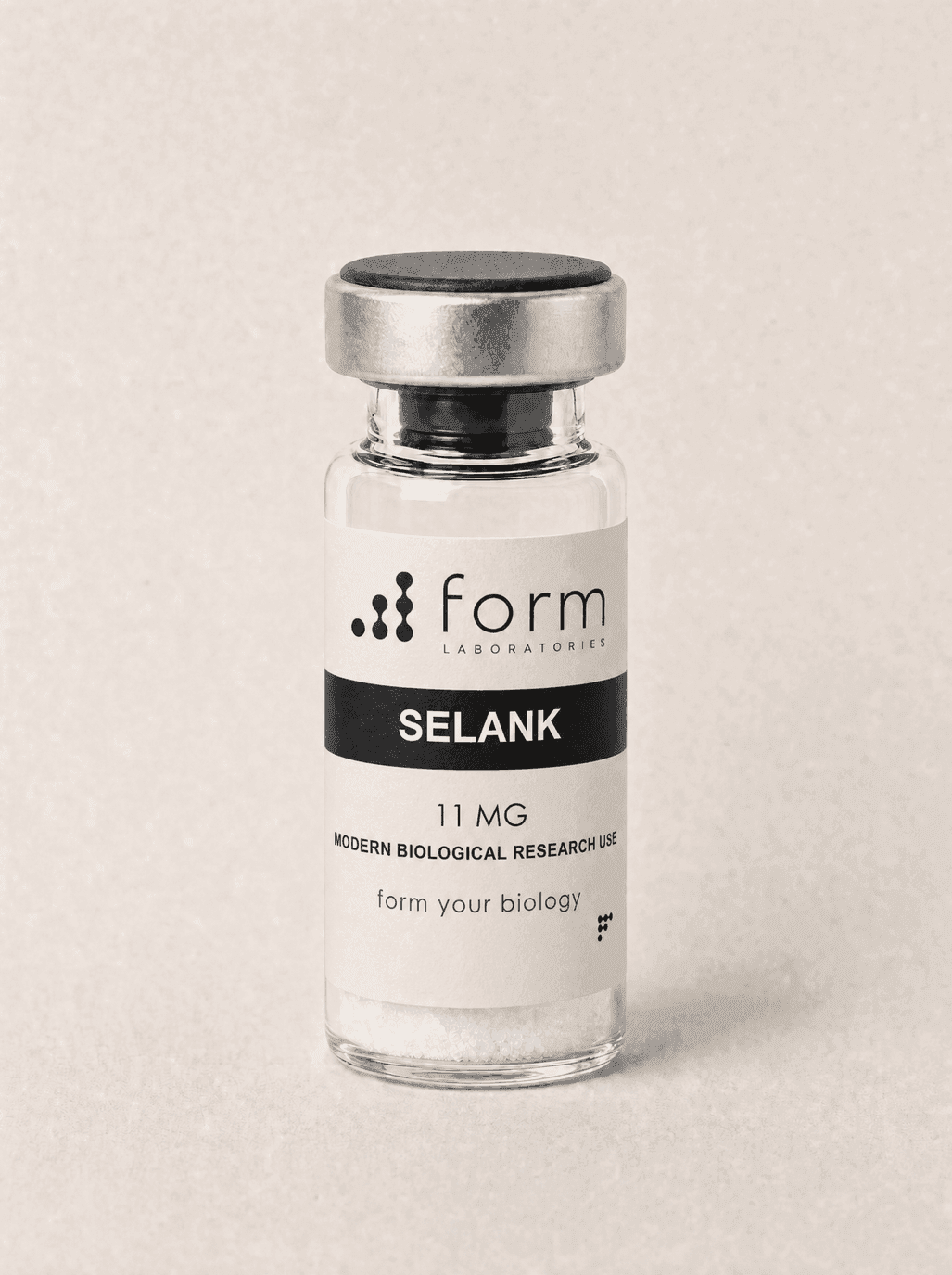
Semax and Selank are two different synthetic peptides. Semax is the sequence MEHFPGP, an analog of a fragment of the hormone ACTH, and is studied mostly in neuroprotection and cognition research; Selank is the sequence TKPRPGP, an analog of the peptide tuftsin, and is studied more in anxiety- and immune-marker research. Form Labs supplies both only as research-use-only reference material.
A widely repeated marketing claim says Semax changes the activity of several thousand genes, but the actual studies don't show that. Genome-wide studies in rat brain tissue found on the order of dozens to a few hundred genes changing after Semax - about 68-96 genes in one 2014 study and 394 in a 2020 study - not thousands. The "thousands" figure appears to confuse the total number of genes screened with the far smaller number actually affected, and either way these are laboratory measurements in animals, not a claim about people.
Semax is registered as a medicine in Russia, where it was developed, but it is not approved by the Therapeutic Goods Administration (TGA) in Australia or the FDA in the United States, and it has no marketing authorisation in the European Union. Form Labs supplies it only as research-use-only reference material, not as a medicine and not for human or veterinary use.
Form Labs supplies Semax strictly as laboratory research material. This guide is a plain-English summary of published research that Form Labs did not run - not medical advice, not a product claim, and not guidance for any human or veterinary use.
Semax is supplied freeze-dried, and the published handling notes call for storing it at 2-8°C (fridge-cold), protected from light, following the vial label and the matching lab report (COA) for the batch. Reconstitution and any working-window decisions are down to the receiving lab's own written protocol, not this guide.
References
Every figure, sourced.
Educational references to third-party literature. Form Labs is unaffiliated with the study authors.
Dolotov OV et al. Brain Research, 2006, 1117:54-60 - reported Semax regulating BDNF and TrkB signalling in rat hippocampus (~1.4-fold BDNF rise).
DOIGusev EI et al. Zhurnal Nevrologii i Psikhiatrii, 2018 - a published Russian clinical study of Semax in 110 patients with ischemic stroke, measuring plasma BDNF and the Barthel Index alongside standard care.
DOIFilippenkov IB et al. Genes (Basel), 2020, 11(6):681 - an RNA-sequencing study reporting 394 differentially expressed genes in rat brain tissue after cerebral ischaemia-reperfusion and Semax.
DOIEremin KO et al. Neurochemical Research, 2005, 30:1493-1500 - a laboratory study of Semax and dopaminergic/serotoninergic (monoamine) signalling systems in rodents.
DOIMedvedeva EV et al. BMC Genomics, 2014, 15:228 - a genome-wide screening study reporting 96/68 genes with altered activity in rat brain tissue after Semax.
DOIPotaman VN et al. Biochemical and Biophysical Research Communications, 1991, 176 - a laboratory study of enzymatic (peptidase) degradation of Semax.
DOIDeigin Y et al. Pharmaceutics, 2022, 14(4):716 - a peer-reviewed review of Russian peptide biopharmaceuticals that discusses Semax; general background context, not a Semax-dedicated study.
DOICitations are provided for education only. No therapeutic, weight-loss, or efficacy claims are made.
How we produce these guides
- Who writes them
- These guides are written and maintained in-house by the Form Laboratories research team. They are not authored by a named clinician, and nothing in them is medical advice. Where a guide is short, that is because the published research is thin - we would rather say so than fill the space.
- What they are built from
- Each guide summarises published, peer-reviewed literature. Every study we describe is listed in full at the bottom of the page with a link to the original paper, so you can open it and check what it actually says. Form Laboratories did not run any of the cited studies.
- What they deliberately leave out
- These guides describe how the biology works and what the published research measured. They do not contain dosing, preparation, reconstitution or administration instructions, and they make no claim about what any compound would do for a person. Everything we supply is research-use-only reference material.
- How we handle uncertainty
- Where the evidence is limited to cell cultures or animals, we say so in the study entry rather than implying a human result. Where a compound has no completed human trial, the guide states that plainly.
The product
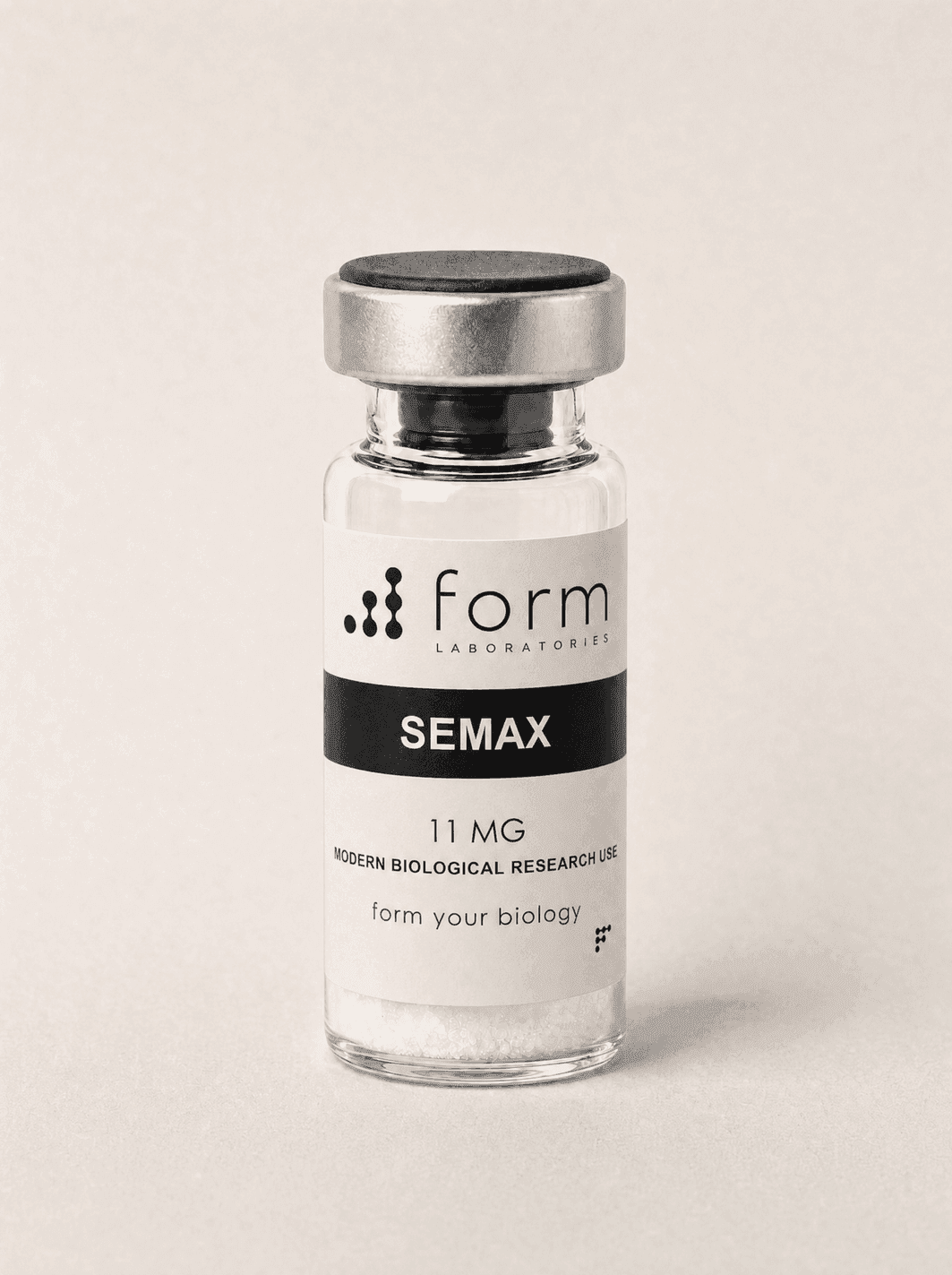
Form Laboratories - Semax
Ready to see Semax?
- Independently tested - purity printed on the lab report.
- A batch number on every vial, matched to its report.
- Ships from Perth via Australia Post or CouriersPlease in plain packaging.
Build your stack
Compare nearby catalogue records.
These nearby records stay inside the research-only catalogue.
Research-use-only catalogue
Continue to the product record.
Review lot-facing product details, pricing, and checkout boundaries on the matching product page.
View Semax - from $89.00 AUD