
Hub · Peptides in Perth: Research, Delivery and WA Law
Ordering Peptides From Perth Instead of Importing
Form Laboratories ships from Perth to Australian addresses, so a parcel stays inside the country and never meets the border inspection step an overseas parcel faces, according to its shipping page. Ordering domestically changes only the parcel's route, not the goods inside, and the Therapeutic Goods Administration's advisory of 13 April 2026 states that 'research use only' wording does not change a product's regulatory status.
An overseas parcel bound for an Australian address travels an import pathway, and at the end of it sits a room most buyers never picture: a place where the box may be opened, the label read, and a decision made about whether what is inside may enter the country. Most searches for something like 'peptides Perth delivery' are really questions about that room — whether a parcel must pass through it, and what happens if it does.
This page, part of the Perth research peptides hub, answers with the regulator's own words: what the Therapeutic Goods Administration (TGA) says about a peptide parcel at the border, what the Personal Importation Scheme permits, and why a Perth-dispatched parcel never enters that room. It is just as plain about what the shorter journey does not change.
Key facts
| Scheme named | Personal Importation Scheme (TGA) |
|---|---|
| Scheme page last updated | 8 September 2026 |
| Import warning | TGA safety alert, 7 May 2026 |
| Border agency | Australian Border Force, referring goods to the TGA |
| Labelling condition | Clear, accurate labelling that identifies the therapeutic good (TGA, 7 May 2026) |
| Outcome for unclear labels | TGA notifies the ABF to seize and destroy |
| Form Laboratories dispatch | Perth, Western Australia — domestic only |
| Customs step on a domestic parcel | None (/shipping) |
| Legal effect of a domestic journey | None. Regulatory status is unchanged (TGA, 13 April 2026) |
What happens to a peptide parcel at the Australian border?
The Australian Border Force refers peptide products to the Therapeutic Goods Administration, and the TGA assesses them against Australia's importation requirements — that referral-and-assessment step is the border in practice. The TGA's warning of 7 May 2026 states: 'Products referred to the TGA by the Australian Border Force (ABF) are often poorly labelled. This makes it impossible to verify their contents, and mean they may be products that put your health at serious risk.' Goods that fail the requirements are not released to the addressee.
Referral starts a plain sequence. Goods are referred, assessed, then either released back into the mail stream, held, or destroyed where the requirements fail. The TGA advisory of 13 April 2026 lists BPC-157, GHK-Cu, TB-500 and CJC-1295 among its examples. The BPC-157 research guide and the GHK-Cu research guide cover two of them. No authority publishes an interception rate for peptide parcels. What is documented is the mechanism, not the odds.
Evidence limits
What does ordering domestically not change?
A domestic journey changes the parcel's route and nothing more. The goods inside carry the same regulatory status whether the box crosses a border or never leaves the country. The TGA's advisory of 13 April 2026 takes the 'research use only' disclaimer printed across this market and states that the words do not change a product's regulatory status, do not permit importation, and do not remove advertising or supply obligations. No route, short or long, reclassifies what is in the vial.
Read the three consequences against a Perth parcel and each still stands. Status: an unapproved good stays unapproved wherever the box begins. Disclaimer: a disclaimer opens no border, and a domestic trip grants nothing the law withholds. Seller rules: the advertising and supply rules still bind the seller. Everything below describes a logistics difference; do not misread it as a legal one. The hub sets out the advisory's full wording.
What is the Personal Importation Scheme?
The Personal Importation Scheme is the TGA framework under which an individual may bring unapproved therapeutic goods into Australia. The TGA's scheme page, last updated 8 September 2026, states: 'The Personal Importation Scheme allows individuals to import therapeutic goods not entered in the Australian Register of Therapeutic Goods (ARTG), provided certain conditions are met.' Such products, the same page says, 'are typically shipped via mail or courier from overseas and must only be for use by that individual or their immediate family members, they cannot be sold or supplied to any other person.'
The published conditions: a valid Australian prescription or written authority at the time of importation, for prescription-only goods; no more than a three-month supply per import and fifteen months' supply across any twelve-month period; original packaging, or packaging allowing accurate identification; and no controlled substance or anything prohibited under Australian Customs or quarantine rules. One timing rule matters most: a prescription or authority obtained after the parcel is held does not bring the import inside the scheme.
This page is not a route to importing anything — the scheme matters here only as the rulebook a referred parcel is measured against.
Why does the label decide what happens at the border?
The deciding factor at the border is the label, not the molecule. In its warning of 7 May 2026, the TGA states: 'Importing unapproved peptide products under the Personal Importation Scheme is permitted only if the goods are clearly and accurately labelled to identify the therapeutic good.' Where the label fails: 'If peptide products do not meet importation requirements due to poor or unclear labelling, we will notify the ABF to seize and destroy these products when they are intercepted at the border.' And: 'Consistent with TGA requirements, these vials will not be released under the Personal Importation Scheme.'
A label is a claim printed by the seller, and the published record shows how far such claims can drift from measurement. In a 2015 study of 98 synthetic quorum-sensing peptide samples bought for research and development, every sample arrived with a certificate of analysis stating at least 95.0% purity, yet the buyers' own testing found only 43 met that specification (Verbeke et al., Journal of Pharmaceutical Analysis, 2015).
Identity is separate and is measurable, not a matter of trust. The seven-residue fragment sold as TB-500 is the N-terminal acetylated 17-23 portion of thymosin beta 4, synthesised and identity-characterised in the analytical literature (Esposito et al., Drug Testing and Analysis, 2012).
What makes accurate labelling checkable is the reference standard, a characterised yardstick whose making and testing a 2023 Pharmaceutical Research review describes (McCarthy et al., 2023). The paperwork side belongs to the peptide quality and verification hub.
What does a domestic journey actually change?
A parcel posted from Perth to another Australian address skips the border entirely: it is never presented for import inspection because it never leaves the country. The shipping page states: 'Your parcel does not go through customs. It starts in Perth and finishes at an Australian address, so it never leaves the country, never re-enters it, and is never presented for import inspection.' The change is precise — no inspection node, no import assessment, no import-related hold. It ends there.
The store is blunt: 'We are online-only and ship from our base in Perth, Western Australia.' Orders from our Perth-based research store travel with Australia Post or CouriersPlease — standard a flat $10, typically 5-7 days; Express Post a flat $20, typically 2-3 business days; standard free on orders of $250 or more (our shipping page). No WA-only or state-by-state window is quoted anywhere.
What travels inside such a parcel is research material — the BPC-157 reference material we supply leaves the same Perth dispatch bench as the rest of the catalogue. The box never meets a border, and that is a fact about the journey rather than about the goods inside it.
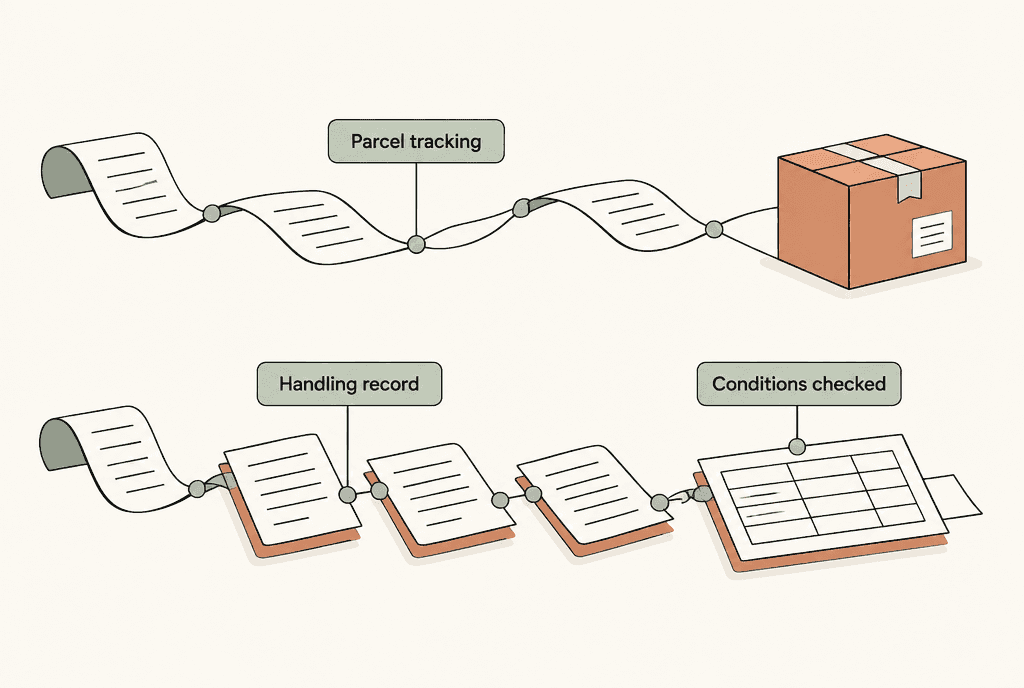
Does parcel tracking show the same checks as medical logistics?
Parcel tracking alone does not show the full handling record. Medical logistics means planning, storing, and moving medical goods with quality checks. A courier may take part in that work. The key is the records for the service used. A domestic route or delivery scan does not establish those checks.
WHO guidance covers the storage and movement of medical products. It calls for records of transport conditions where those conditions matter. Its guidance also covers how departures from required conditions are reported. That is more evidence than a scan showing that a parcel arrived.
This guidance concerns medical products, not every parcel sent within Australia. It cannot verify an unnamed research shipment or its carrier. For a Perth parcel, the route and handling are separate questions. A local starting point does not answer both.
What does the Therapeutic Goods Act say about experimental use of unapproved goods?
The Therapeutic Goods Act 1989 carries formal approval provisions for unapproved therapeutic goods in human experimental work. The TGA's page on those goods for experimental purposes, last updated 25 September 2021, describes the approval machinery, and its clearest statement is export-facing: 'The Exports Team of the TGA is responsible for granting approvals for the export from Australia of specified unapproved therapeutic goods for use solely for experimental purposes in humans under sections 19(1)(b), 32CK(1) or 41HB(1) of the Therapeutic Goods Act 1989.' Who may apply is not asserted here; the source describes the machinery, not the applicants. It names the pathway and walks no further.
What changed at the border in 2026?
What changed at the border in 2026 was enforcement posture, not import law. On 7 May 2026 the TGA published its warning on the risks of importing unapproved peptide products, and on 10 June 2026 it announced that it 'has expanded its priority focus areas to include unapproved peptide products, following increased detection of unlawful importation, supply and advertising, posing potential risks to consumer safety.' Neither notice rewrote the rules; both are enforcement of existing requirements, with importation named first.
A TGA media release of 17 August 2026 states: 'Penalties that can be imposed for breaches of the Therapeutic Goods Act 1989 include civil penalties of up to $1.82 million per breach for individuals or $18.2 million per breach for corporations, and criminal penalties of up to 7 years imprisonment.' No state penalty figures appear here; none have been verified. The wider 2024-2026 calendar sits in the hub's timeline section.
Comparison
Five criteria, two journeys: border crossing, import inspection, referral, release, regulatory status.
| Question | An overseas parcel | A domestic parcel dispatched from Perth |
|---|---|---|
| Does it cross a border? | Yes — it enters from another country | No — it starts and ends inside Australia (/shipping) |
| Is it presented for import inspection? | Yes — the import pathway includes a border inspection step | No — there is no import step in the journey (/shipping) |
| Who can refer it for assessment? | The Australian Border Force refers goods to the TGA (TGA, 7 May 2026) | None — no border step exists |
| What governs its release? | Personal Importation Scheme conditions, including labelling (TGA, 7 May 2026) | No release decision — nothing is imported |
| Regulatory status of the goods | Unchanged by the journey — an unapproved therapeutic good remains one (TGA, 13 April 2026) | Unchanged by the journey — an unapproved therapeutic good remains one (TGA, 13 April 2026) |
FAQ
Do peptides ordered within Australia go through customs?
No. A parcel sent between two Australian addresses never leaves the country, so it is never presented for import inspection. The shipping page states this for orders dispatched from Perth — and it says nothing about the legal status of the goods inside.
Will Border Force seize research peptides?
The TGA's stated position: peptide products failing importation requirements are seized and destroyed. Its 7 May 2026 warning says poorly or unclearly labelled goods meet that fate when the TGA notifies the Australian Border Force. No authority publishes an interception rate, so a page quoting one is guessing.
Does ordering from Perth make peptides legal?
No. A parcel's starting point has no effect on what the law says about its contents. The advisory of 13 April 2026 is direct: a 'research use only' disclaimer does not make supply lawful — it changes no regulatory status, opens no border, lifts no advertising or supply obligation. A domestic dispatch removes the border step and nothing else.
Can I import peptides for personal use?
The Personal Importation Scheme exists for that situation, within strict conditions: prescription-only goods need a valid Australian prescription or written authority in hand at import time; no more than three months' supply per import, fifteen months' over any twelve; packaging that identifies the product; no controlled or prohibited substances (TGA scheme page, last updated 8 September 2026). The goods must be for the individual or immediate family and cannot be sold or supplied on.
Why do parcels get held at the border?
The documented reason in peptide cases is labelling: the 7 May 2026 warning says referred products are 'often poorly labelled', leaving contents impossible to verify. Paperwork matters too — the authority for prescription-only goods must exist at import time; one obtained later does not fix it.
More in this hub
Peptides in Perth: Research, Delivery and WA Law
- Peptides in Perth: 20 Questions, Answered
- Peptide Delivery Times From Perth, State by State
- Research Peptides Across Western Australia
- Freeze-Dried Peptides and a Perth Summer: What Studies Report on Heat, Light and Water
- Are peptides legal in Western Australia and Perth?
- Retatrutide in Perth: Research Records and WA Status
- TB-500 in Perth: the Thymosin Beta-4 Fragment
- BPC-157 in Perth: Scheduling, Research and Dispatch
- CJC-1295 in Perth: No DAC, Ipamorelin and TGA Status
- MOTS-c in Perth: a Peptide Written in Mitochondrial DNA
- NAD+ in Perth: What It Is, and Why It Is Not a Peptide
- How to Read a Peptide Trial on the ANZCTR
Citations
4 sourcesVerbeke F et al. Journal of Pharmaceutical Analysis. 2015;5(3):169-181.
doi:10.1016/j.jpha.2014.12.002Esposito S et al. Drug Testing and Analysis. 2012;4(9):733-738.
doi:10.1002/dta.1402McCarthy D et al. Pharmaceutical Research. 2023;40(6):1317-1328.
doi:10.1007/s11095-023-03493-1World Health Organization WHO Technical Report Series No. 1025. 2020, Annex 7, Good storage and distribution practices for medical products; sections 2 and 18.
doi:https://cdn.who.int/media/docs/default-source/medicines/who-technical-report-series-who-expert-committee-on-specifications-for-pharmaceutical-preparations/trs1025-annex7.pdf
Form Laboratories supplies research-use-only reference material. This article is an educational summary of published third-party literature. It is not medical advice, not a use instruction, and research material is not for human or animal use.