
Compound hub · Retatrutide
Retatrutide vs Mounjaro vs Ozempic: what's the difference?
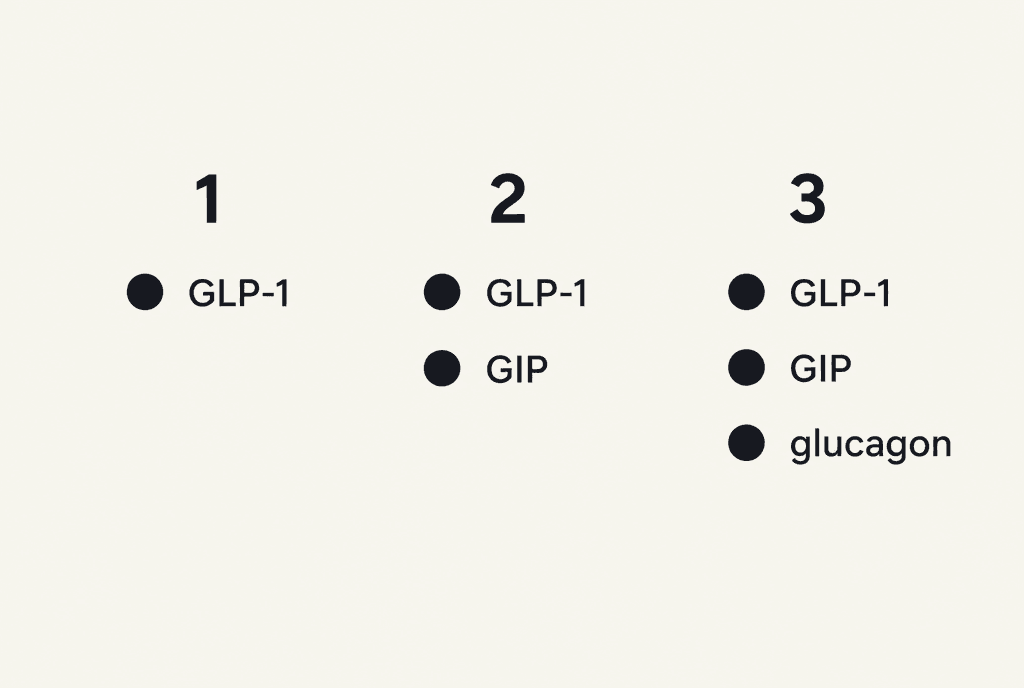
Retatrutide, Mounjaro and Ozempic differ by molecule: published papers map semaglutide (Ozempic) to one hormone signal, GLP-1 (the fullness signal), tirzepatide (Mounjaro) to two, adding GIP (the meal-and-insulin signal), and retatrutide to three, adding glucagon (the stored-energy release signal) (Coskun et al., Cell Metabolism, 2022). Mounjaro is a prescription medicine approved by the Therapeutic Goods Administration and the US Food and Drug Administration.
01DifferenceContents
You know the feeling of a meal landing. Twenty minutes in, the second helping stops calling, and you push the plate away without really deciding to. That is not willpower. That is chemistry: your gut has already sent messages up to your brain, and out to your pancreas and liver, saying what arrived and what to do with it.
Three of those messages have names. GLP-1 (glucagon-like peptide-1) is the fullness signal. GIP (glucose-dependent insulinotropic polypeptide) is the meal-and-insulin signal. Glucagon runs the other way, telling your liver to release stored energy when nothing is coming in. Your body has run all three since long before you read this sentence. This page — part of the retatrutide hub — covers the three compounds people line up against each other, and which of those signals the published papers map each one to.
Key facts
| Common name | retatrutide |
|---|---|
| Research code | LY3437943 |
| Developer | Eli Lilly |
| CAS | 2381089-83-2 |
| Molecular formula | C221H342N46O68 |
| Molecular weight | 4731.34 Da |
| Discovery year | 2022 |
| First characterisation paper | Coskun et al., Cell Metabolism, 2022 |
| Trial phase as of 2026 | Phase 3 |
| Approval as of 2026 | Approved in no country |
What is the difference between retatrutide, Mounjaro, and Ozempic?
Retatrutide, Mounjaro, and Ozempic differ in three ways: the molecule inside each one, how many hormone signals the published papers map that molecule to, and whether any regulator has approved it. Ozempic is an approved medicine built on semaglutide, described in the literature as acting on GLP-1 (glucagon-like peptide-1, the fullness signal) alone. Mounjaro is an approved medicine built on tirzepatide, which the papers map to two signals, GLP-1 and GIP (glucose-dependent insulinotropic polypeptide, the meal-and-insulin signal). Retatrutide is an experimental peptide the papers map to all three, adding glucagon. As of 2026, retatrutide is in Phase 3 trials and is approved in no country.
The short version is a key count. Semaglutide carries one key. Tirzepatide carries two. Retatrutide is built with three, and the third one is where the interest lies. Glucagon does not behave like the other two: it is the signal your liver listens for when food has stopped arriving and stored energy needs releasing. Adding it to a molecule that already speaks both mealtime signals is the question Phase 3 exists to answer.
Is retatrutide the same as Mounjaro?
Retatrutide is not the same molecule as Mounjaro. Mounjaro is a TGA- and FDA-approved prescription medicine containing tirzepatide, a 39-amino-acid peptide first characterised as a dual GIP and GLP-1 agonist (Coskun et al., Molecular Metabolism, 2018). Zepbound is a second FDA-approved medicine built on that same tirzepatide molecule, and as of 2026 Zepbound is not TGA-approved in Australia. Retatrutide is a separate experimental peptide, with a different amino-acid sequence, a different research code, and a third receptor system in its published profile.
Both compounds came out of Eli Lilly, which is exactly why the names get tangled. A shared laboratory is not a shared molecule. The pattern in the family tree is worth noticing, though: the locks never change. They are the gut-hormone signals your body has used after every meal of your life. What changes is the key. One receptor system, then two, now three.
Is Mounjaro the same molecule as Ozempic?
Mounjaro and Ozempic are different approved medicines with different active molecules. Ozempic and Wegovy contain semaglutide, which the literature maps to a single signal, GLP-1. Mounjaro and Zepbound contain tirzepatide, mapped to two, GLP-1 and GIP. The SURPASS-2 trial put the two molecules side by side in adults with type 2 diabetes over 40 weeks and recorded a 2.30-point change in HbA1c (a three-month blood-sugar marker) in the highest tirzepatide trial arm, against 1.86 points with semaglutide (Frias et al., New England Journal of Medicine, 2021).
Those numbers belong to the trial that produced them and nowhere else. SURPASS-2 measured two approved prescription medicines, in diagnosed patients, under clinical supervision, against one blood marker chosen before the trial began. That is a narrow question, answered carefully. It is not a league table of molecules.
Evidence limits
What has the research not shown yet?
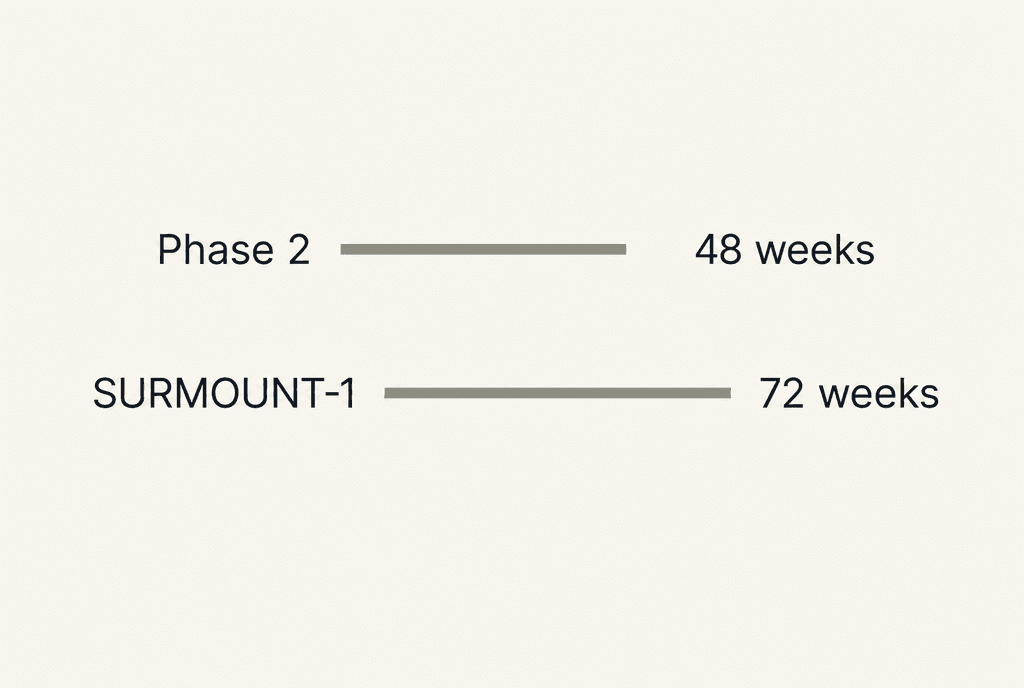
No source cited on this page is a head-to-head trial of retatrutide against Mounjaro or Ozempic. The two figures people put side by side come from separate programmes. In the 48-week Phase 2 trial of 338 adults, the highest retatrutide trial arm averaged a 24.2% body-weight change (Jastreboff et al., New England Journal of Medicine, 2023). In SURMOUNT-1, the highest tirzepatide trial arm averaged a 20.9% body-weight change over 72 weeks (Jastreboff et al., New England Journal of Medicine, 2022).
Lining those two percentages up and declaring a winner is the most natural thing in the world to do, and it is the one thing the evidence cannot support. Different trials. Different lengths — 48 weeks against 72. Different people, recruited under different rules. A percentage only means something while it is still attached to the study that produced it.
A third figure gets quoted alongside them. In a smaller imaging study of 98 adults whose liver fat started at 10% or higher, the highest retatrutide trial arm averaged an 82.4% drop in liver fat at 24 weeks (Sanyal et al., Nature Medicine, 2024). One study, one trial arm, 24 weeks — interesting, and far too narrow to build a conclusion on. TRIUMPH and TRANSCEND are the Phase 3 programmes that could answer the larger question, and this page cites none of their results.
Is research material a substitute for Mounjaro or Ozempic?
Research-use-only material is not a substitute for Mounjaro or Ozempic. Mounjaro and Ozempic are approved prescription medicines, dispensed and supervised. Laboratory reference material is not those medicines, not a cheaper route to them, and not for human or animal use. Where a research compound and a medicine happen to share a molecule, that shared identity is a fact of chemistry and nothing more. Retatrutide has no approved medicine anywhere as of 2026, so there is nothing for laboratory material to stand in for.
Price questions land in the same place. What laboratory material costs is a question about synthesis — how long the amino-acid chain is, how pure the finished powder runs, and how much testing sits behind that purity number. It is never a comparison with what a pharmacy charges. Form Laboratories lists retatrutide reference material as freeze-dried laboratory stock with lot-matched paperwork. Reading that paperwork is a skill of its own — what a certificate of analysis records, what a third-party report proves, how a batch stays traceable — and the quality and verification hub walks through it.
Comparison
Criteria stated as of 2026: (1) active molecule, (2) receptor systems named in published literature, (3) approval status, (4) same-molecule medicine names, (5) one representative published trial record. This table is not a ranking and not a use guide.
| Criterion | Semaglutide (Ozempic / Wegovy) | Tirzepatide (Mounjaro / Zepbound) | Retatrutide |
|---|---|---|---|
| Active molecule | semaglutide | tirzepatide | retatrutide |
| Receptor systems in the literature | GLP-1 | GLP-1 and GIP | GLP-1, GIP, and glucagon |
| Approval as of 2026 | Approved medicine | Approved medicine | Experimental; Phase 3; approved in no country |
| Same-molecule medicine names | Ozempic, Wegovy | Mounjaro (TGA and FDA); Zepbound (FDA only; not TGA-approved in Australia) | None |
| Representative published record | SURPASS-2 comparator: HbA1c -1.86 points over 40 weeks (Frias et al., NEJM, 2021) | SURMOUNT-1: -20.9% mean body-weight change in the highest trial arm over 72 weeks (Jastreboff et al., NEJM, 2022) | Phase 2: -24.2% mean body-weight change in the highest trial-arm group over 48 weeks in 338 adults (Jastreboff et al., NEJM, 2023) |
FAQ
How is retatrutide different from Ozempic or Mounjaro?
Semaglutide (Ozempic / Wegovy) is mapped in the published literature to one receptor system, GLP-1. Tirzepatide (Mounjaro / Zepbound) is mapped to two, GLP-1 and GIP. Retatrutide adds a third, glucagon (Coskun et al., Cell Metabolism, 2022). Ozempic and Mounjaro are approved medicines; retatrutide is experimental and approved nowhere as of 2026.
Is retatrutide the same as Mounjaro?
No. Mounjaro contains tirzepatide, a 39-amino-acid peptide. Retatrutide is a different peptide with a different sequence. Eli Lilly developed both, and a shared developer does not make two compounds the same thing.
Is Zepbound the same as Mounjaro?
Zepbound and Mounjaro are two approved-medicine names for the same molecule, tirzepatide. Mounjaro holds both TGA and FDA approval; Zepbound holds FDA approval and is not TGA-approved in Australia as of 2026. Neither name refers to retatrutide.
Is retatrutide better than Mounjaro?
No source cited on this page compares retatrutide with Mounjaro head to head. The 24.2% and 20.9% body-weight figures come from separate trials of different lengths and populations (Jastreboff et al., NEJM, 2023; Jastreboff et al., NEJM, 2022), which is not a comparison. “Better” is not a claim this page makes.
Is research retatrutide cheaper than Mounjaro?
Research-use-only material is not a cheaper version of Mounjaro or of any prescription medicine. What laboratory reference material costs reflects synthesis length, purity, and testing. It is supplied for laboratory work, and it is not a medicine.
Part of
RetatrutideRetatrutide (LY3437943) is an experimental Eli Lilly peptide described in the published literature as acting on three receptor systems at once. This hub collects the questions people ask about it and answers each one from the trial record.
Citations
6 sourcesCoskun T et al. Cell Metabolism. 2022;34(9):1234-1247.e9.
doi:10.1016/j.cmet.2022.07.013Coskun T et al. Molecular Metabolism. 2018;18:3-14.
doi:10.1016/j.molmet.2018.09.009Frias JP et al. New England Journal of Medicine. 2021;385(6):503-515.
doi:10.1056/NEJMoa2107519Jastreboff AM et al. New England Journal of Medicine. 2022;387(3):205-216.
doi:10.1056/NEJMoa2206038Jastreboff AM et al. New England Journal of Medicine. 2023.
doi:10.1056/NEJMoa2301972Sanyal AJ et al. Nature Medicine. 2024;30:2037-2048.
doi:10.1038/s41591-024-03018-2
Continue
Retatrutide reference material — batch COA includedResearch use only — not for human or animal use.
Read the retatrutide research guideForm Laboratories supplies research-use-only reference material. This article is an educational summary of published third-party literature. It is not medical advice, not a use instruction, and research material is not for human or animal use.