
Compound hub · GHK-Cu
What have studies found about GHK-Cu?
GHK-Cu studies have found changes in collagen, a structural protein, and tissue build-up in laboratory models, but those findings do not establish how human skin changes. In a small human study after laser resurfacing, measured skin outcomes showed no clear group difference, while patient ratings did; these are separate findings and cannot be combined into a general claim.
01Collagen in cellsContents
Your skin contains a scaffold of fibres, much like the mesh inside reinforced concrete. A laboratory can measure how much new fibre a cell makes. That still leaves a separate question: what changed in the whole sheet of skin? The gap between those questions runs through much of the research here.
This page in the GHK-Cu hub follows the measurements rather than listing possible uses. Start with what GHK-Cu is for the name and chemistry. The broader review of GHK-Cu outcomes covers the skin and hair questions. Here, the focus is how a finding earns its meaning.
Key facts
| Compound studied | GHK-Cu, a peptide bound to copper; a peptide is a short chain of amino acids, the building blocks of proteins |
|---|---|
| Cell studies | Collagen production; tissue-remodelling proteins |
| Animal study | Material collected in rat wound chambers |
| Isolated-skin study | Copper retained in and passing through human skin samples |
| Human trial | Skin measurements and patient questionnaires after laser resurfacing |
What did the collagen experiment actually find?
GHK-Cu increased collagen production in cultured fibroblasts, cells that make the fibres around them, without a change in cell number. Collagen is a strong structural protein in skin and other tissues. The experiment in FEBS Letters measured what cells made while growing in a laboratory. A culture is a group of cells kept outside the body. More collagen in that setting is a finding about cell activity. The experiment does not show that a person's skin became firmer or that wrinkles changed. Those questions need measurements in people, rather than an assumption that the cell result carries across.
The distinction is like a workshop making more thread without hiring more workers. Output and worker count are separate measurements. Neither measures the strength of a finished fabric.
Did studies only find more tissue being made?
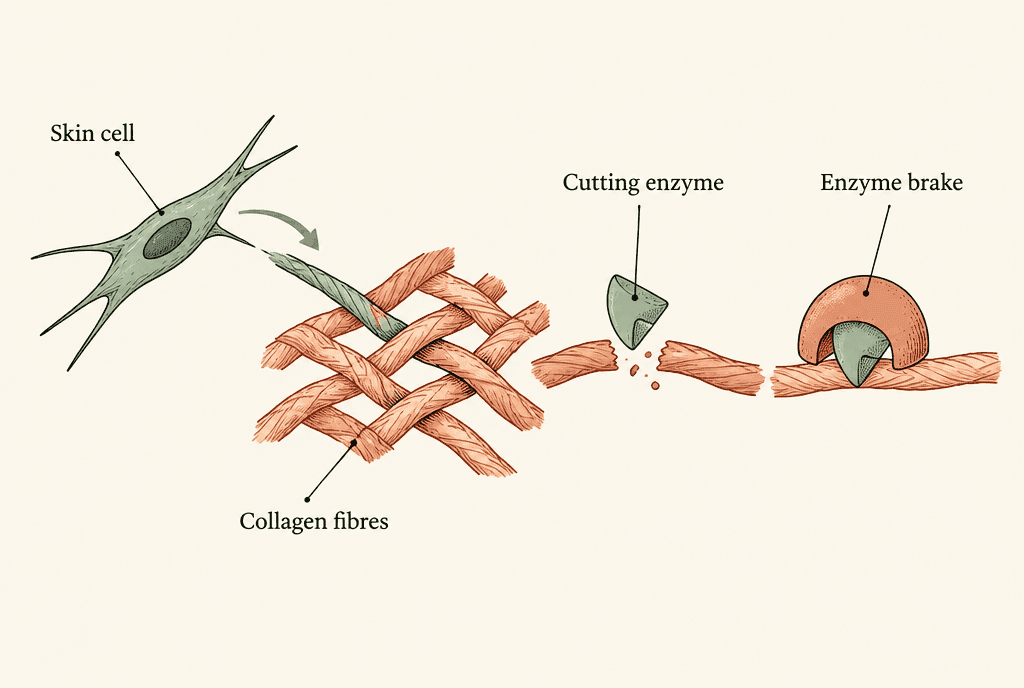
GHK-Cu cell research also found changes in proteins involved in tissue breakdown, so the findings are broader than making collagen. In Life Sciences, cultured skin fibroblasts released more MMP-2, an enzyme involved in breaking down the scaffold around cells. Enzymes are proteins that speed up chemical reactions. The cells also released more proteins that restrain these enzymes. The authors describe this as remodelling: tissue being taken apart and rebuilt. Measuring more of both kinds of protein does not reveal the final balance in living skin. The study did not measure whether human skin became stronger or looked different.
Copper on its own reproduced the MMP-2 finding, while GHK without copper did not. That comparison applies to this cell measurement. It does not mean copper and GHK-Cu have the same effects throughout the body.
The distinction between one molecule and a mixture also matters. The GHK-Cu and blend comparison explains why a shared ingredient cannot make separate research records interchangeable.
What did the rat wound study add to the cell findings?
GHK-Cu was linked to more connective-tissue material inside experimental wound chambers in rats. The Journal of Clinical Investigation paper examined collagen, other proteins and sugar-rich molecules that form part of the scaffold around cells. The researchers also measured messenger RNA, temporary copies of genetic instructions used to make proteins. Instructions for making collagen increased alongside the tissue measurements. This connects a cell-level question with an animal model, but a wound chamber is an artificial pocket for collecting tissue. The result does not measure how an ordinary human wound closes or what a healed human scar looks like.
A different short peptide served as a comparison and had no significant effect. That makes the comparison more informative than a tissue measurement alone. The cell and rat papers share authors, so separate experiments here do not mean wholly independent confirmation.
Did the skin study track intact GHK-Cu?
The GHK-Cu skin experiment measured copper, rather than tracking the complete peptide-copper pair. In Inflammation Research, researchers studied isolated human skin layers in laboratory equipment. Copper was found in the tissue and in fluid collected beyond it. The authors discuss how copper might separate from its original peptide and bind to other molecules within skin. The test therefore does not establish how much intact GHK-Cu crossed the tissue. Human skin samples are useful for studying a barrier, but this was not a trial in living people. The result cannot establish a whole-body effect or a skin outcome.
A detector that counts copper cannot tell which carrier brought every copper atom across. The paper itself calls for labelled carriers to clarify that journey. This is a limit of the measurement, rather than evidence that no intact complex crossed.
Evidence limits
Why did patient ratings and skin measurements give different answers?
The human GHK-Cu trial measured different questions, so its patient ratings and skin measurements should remain separate. The 2006 Archives of Facial Plastic Surgery abstract reports that thirteen people completed a study after laser resurfacing. Participants were assigned by chance to skin care with or without GHK-Cu. Computer analysis and assessors who did not know the group assignments found no significant difference in redness. Objective assessment detected no significant group difference in wrinkles or overall skin quality. Patient questionnaires favoured the GHK-Cu group for skin quality. A satisfaction rating does not establish a measured change in the skin itself.
The small study did not establish that the groups were equivalent, either. Failure to detect a difference is not proof that any possible difference is zero. The findings belong to this after-laser setting; they do not settle other skin questions.
The separate GHK-Cu safety page covers the adverse-event record. A study about appearance cannot fill every safety gap.
Comparison
Compare the study setting, the actual measurement and the question left unanswered. Each row refers to the primary paper named in its section; the rows are not a ranking of effects.
| Experiment | What was measured | What remains unanswered |
|---|---|---|
| Fibroblast culture — FEBS Letters | Collagen production apart from cell number | Whether living human skin changed |
| Fibroblast culture — Life Sciences | A scaffold-cutting enzyme and proteins that restrain enzymes | The net result for tissue structure |
| Rat wound chambers — Journal of Clinical Investigation | Collected tissue material and genetic instructions | Ordinary human wound closure and scar appearance |
| Isolated skin — Inflammation Research | Copper retained in and passing through tissue | The amount crossing as intact GHK-Cu |
| Human after-laser trial — Archives of Facial Plastic Surgery | Skin assessments and patient questionnaires | Effects in other skin settings |
FAQ
Does more collagen in a dish mean fewer wrinkles?
No. Collagen production in cultured cells and visible wrinkles in people are different measurements. The cell experiment cannot establish the second from the first.
Is a study of human skin a human clinical trial?
Not necessarily. The copper-penetration paper used isolated skin in laboratory equipment. A clinical trial follows living people. The word human identifies the tissue source here, rather than the study design.
Does no significant difference mean no effect?
No. A study may be too small to separate a real difference from chance variation. The after-laser trial found no significant difference on objective measures; it did not establish that every possible difference was absent.
Do GHK and GHK-Cu always give the same result?
No. In the tissue-remodelling cell study, GHK without copper did not reproduce the MMP-2 result seen with GHK-Cu. Findings about a copper-bound peptide should stay tied to the material actually tested.
More in this hub
Citations
5 sourcesMaquart FX, Pickart L, Laurent M, Gillery P, Monboisse JC, Borel JP. FEBS Letters. 1988;238(2):343-346 — collagen production in fibroblast cultures.
doi:10.1016/0014-5793(88)80509-XSiméon A, Emonard H, Hornebeck W, Maquart FX. Life Sciences. 2000;67(18):2257-2265 — MMP-2 and its inhibitors in fibroblast cultures.
doi:10.1016/S0024-3205(00)00803-1Maquart FX, Bellon G, Chaqour B, et al. Journal of Clinical Investigation. 1993;92(5):2368-2376 — connective-tissue accumulation in rat wound chambers.
doi:10.1172/JCI116842Hostynek JJ, Dreher F, Maibach HI. Inflammation Research. 2011;60(1):79-86 — copper retention and passage through isolated human skin.
doi:10.1007/s00011-010-0238-9Miller TR, Wagner JD, Baack BR, Eisbach KJ. Archives of Facial Plastic Surgery. 2006;8(4):252-259 — skin measurements and patient ratings after laser resurfacing.
doi:10.1001/archfaci.8.4.252
Form Laboratories supplies research-use-only reference material. This article is an educational summary of published third-party literature. It is not medical advice, not a use instruction, and research material is not for human or animal use.