
Compound hub · GHK-Cu
How does GHK-Cu work?
GHK-Cu works at the chemical level by binding copper to a short peptide, a small chain of amino acids, and laboratory studies suggest that copper can change hands through reactions with other molecules. Copper binding is measured chemistry, but the full chain from that chemistry to changes in human tissue is not established by the papers examined here.
01Why copper needs carriersContents
Your cells handle copper rather like a busy kitchen handles a sharp knife: the tool matters, but so does who holds it. Copper does useful chemical work. Leaving it loose is another matter. The body has carriers and gates that control where copper goes. GHK-Cu belongs in that story of molecular handling.
This page in the GHK-Cu hub follows the chemistry from binding to a possible handoff. For names and background, start with what GHK-Cu is. The question here is how a proposed mechanism fits together, and which links in that explanation have actually been tested.
Key facts
| Peptide sequence | Glycine–histidine–lysine |
|---|---|
| Copper-bound form | GHK-Cu |
| Copper state in the named complex | Copper(II), written Cu(II) |
| Main evidence discussed | Solution chemistry, structural chemistry and cultured cells |
Why does the body need to control copper?
Copper needs controlled handling because cells need the metal for chemical work, while misplaced copper can be harmful. Enzymes, proteins that speed up chemical reactions, depend on copper for several tasks. A review in Biophysical Journal describes a network of proteins that brings copper across the cell's outer boundary and passes it to targets inside. The boundary is called the cell membrane. A carrier holds copper; a transporter moves copper across that membrane. Those are different jobs. Understanding that distinction helps explain why copper binding by GHK does not, on its own, show where the metal goes next.
The kitchen comparison has a limit: molecules have no intentions. Copper changes partners through chemical reactions. A diagram showing a handoff is a way to picture those reactions, rather than a little courier choosing a destination.
How does GHK hold a copper ion?
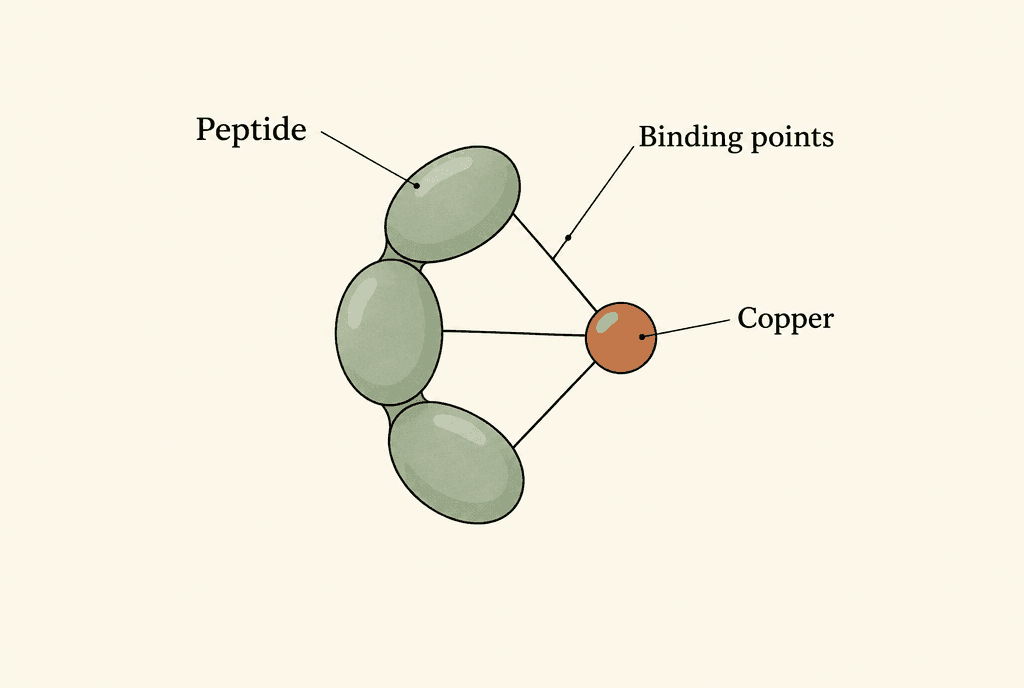
GHK holds copper through bonds between the metal and atoms in the peptide. An ion is an atom with an electrical charge. Copper(II) means copper with two positive charges. In Chemistry – A European Journal, researchers found three nitrogen atoms holding copper in the dissolved GHK complex. This arrangement is called coordination: several contact points around a metal. A claw is a useful picture, although the molecule has no moving fingers. The shape explains how the metal is held. The structural experiment does not show a complete route from that binding arrangement to a change in a person's tissue.
The bound form has its own chemical properties. A list of ingredients is therefore not a map of the bonds between them. GHK-Cu and related names covers the identity questions; the table below compares the kinds of mechanism evidence.
Does copper stay attached to GHK?
Copper binding to GHK is not a permanent seal. Laboratory work in Biochemical Journal examined mixtures containing GHK, copper and histidine, an amino acid that can also bind metals. Different combinations formed in solution. The researchers also found that GHK could compete for copper with albumin, a protein in blood. The mixture's acidity and the molecules present mattered to the chemistry. These experiments describe an exchange between possible binding partners. They do not establish a fixed share of copper carried by GHK in a person, or a fixed journey from blood into a particular tissue.
A name describes a compound, but the surrounding mixture still matters. A result from one laboratory solution cannot be assumed to describe every other setting. That is why the chemical form and the conditions belong beside a mechanism claim.
How might GHK-Cu pass copper towards a cell?
A proposed route involves glutathione, a small molecule that can give electrons to other molecules. An electron is a tiny particle with a negative charge. A study in Inorganic Chemistry examined glutathione reacting with copper-bound GHK. The researchers detected a short-lived complex containing both partners. The reaction changed the copper's electrical state from Cu(II) to Cu(I). They proposed that this chemistry could prepare copper for CTR1, a protein that transports copper into cells. The proposed connection to cell entry is an interpretation of laboratory chemistry; the experiment did not trace that whole route through a person.
Reduction is the chemical name for gaining an electron. In this case, copper gains an electron and its positive charge falls. The reaction changes the metal's state; it does not turn copper into a different element.
Evidence limits
Does a cell study prove how GHK-Cu works in people?
A cell study does not establish the full human mechanism of GHK-Cu. A paper in FEBS Letters examined collagen synthesis in cultured fibroblasts. Collagen is a structural protein; fibroblasts are cells that make connective tissue. Synthesis means making new molecules. Measuring collagen production asks what cells made in that setting. Counting cells asks whether there were more cells. Neither measurement alone identifies every step between copper binding and the cell's response. The paper also proposed that protein-cutting enzymes might release GHK from collagen at a wound. That suggestion must stay separate from the measurement made in the dish.
The published study findings cover measured outcomes in their own settings. The GHK-Cu safety page addresses a separate question. Neither the body's need for copper nor a plausible handoff answers whether added material is safe.
Comparison
What different experiments can establish about a mechanism. Sources: Hureau and colleagues, Chemistry – A European Journal 2011; Lau and Sarkar, Biochemical Journal 1981; Ufnalska and colleagues, Inorganic Chemistry 2021; Maquart and colleagues, FEBS Letters 1988. These are evidence types, not a ranking of effects.
| Evidence | Question it can answer | What it leaves open |
|---|---|---|
| Structure measurements | Which atoms hold copper in the studied complex? | Where the complex travels in a person |
| Solution chemistry | Which partners bind copper, and how can the reaction proceed? | Whether the same reaction controls copper movement in living tissue |
| Cultured cells | What do cells make or change under the tested conditions? | The complete molecular explanation and the response of a whole person |
FAQ
Is GHK-Cu just copper?
GHK-Cu is copper bound to a peptide. Binding changes the metal's chemical setting. Describing the complex as copper alone leaves out the molecule holding it.
What does chelation mean?
Chelation means that a molecule holds a metal through several contact points. GHK's copper-binding arrangement is an example. The word describes binding, without specifying a final destination for the metal.
Does GHK-Cu enter cells as a whole molecule?
That is not established by the chemistry experiments discussed here. The glutathione study proposes a route that changes the copper's state before uptake. A proposal about copper transfer does not show intact GHK-Cu crossing the cell membrane.
Is the full GHK-Cu mechanism known?
The papers examined here establish parts of the chemistry and describe cell observations. They do not join those findings into a fully demonstrated human pathway. Binding, exchange, cell entry and tissue response are separate questions.
More in this hub
Citations
5 sourcesKaplan JH, Maryon EB. Biophysical Journal. 2016;110(1):7–13.
doi:10.1016/j.bpj.2015.11.025Hureau C, Eury H, Guillot R, et al. Chemistry – A European Journal. 2011;17(36):10151–10160.
doi:10.1002/chem.201100751Lau SJ, Sarkar B. Biochemical Journal. 1981;199(3):649–656.
doi:10.1042/bj1990649Ufnalska I, Drew SC, Zhukov I, et al. Inorganic Chemistry. 2021;60(23):18048–18057.
doi:10.1021/acs.inorgchem.1c02669Maquart FX, Pickart L, Laurent M, et al. FEBS Letters. 1988;238(2):343–346.
doi:10.1016/0014-5793(88)80509-X
Form Laboratories supplies research-use-only reference material. This article is an educational summary of published third-party literature. It is not medical advice, not a use instruction, and research material is not for human or animal use.