
Compound hub · Ipamorelin
How do CJC-1295, sermorelin and ipamorelin differ?
CJC-1295 and sermorelin are lab-made relatives of growth-hormone-releasing hormone (GHRH), a natural signal. Ipamorelin works through a different receiver on cells. This is the growth hormone secretagogue receptor. The CJC-1295 that Jetté's team described also grips albumin, a blood protein. These facts sort the compounds into research groups. Separate studies do not show the effects or safety of a mix of all three.
01Evidence limitsContents
Even while you sit still, your glands pass messages through your blood. A cell needs the right receiver before it can respond to a message. Growth hormone research follows many of these message routes. That helps explain why similar names can mean different compounds. The ipamorelin hub connects the questions behind this comparison.
A search for sermorelin, ipamorelin and CJC-1295 can mean a comparison. It can also mean a mix that contains all three. This page compares the separate compounds. Seeing their names side by side does not turn separate tests into proof about a mixture.
Key facts
| CJC-1295 family | Modified growth-hormone-releasing factor; albumin-binding design (Jetté et al., 2005). |
|---|---|
| Sermorelin identity | GHRH analogue of 29 amino acids (Prakash and Goa, 1999) |
| Ipamorelin structure | Peptide of five amino acids (Raun et al., 1998) |
| Comparison basis | Receptor pathway, molecular design and measured results |
| Shared-preparation evidence | Not established by the separate studies cited here |
Evidence limits
Can separate studies show how the three compounds compare?
Separate studies of CJC-1295, sermorelin and ipamorelin cannot show which compound is better. They also cannot show how a mix of them behaves. Each human paper opened for this page asked its own question in its own group of people. Teichman's team studied CJC-1295 hormone responses in healthy adults. Gobburu's team modelled ipamorelin levels and growth hormone responses in healthy men. Losa's team compared fragments of growth-hormone-releasing factor with placebo. Placebo is a dummy treatment. None of these studies tested all the named compounds against each other. A change in a blood marker cannot show a change in health on its own.
A fair comparison needs matching groups and a shared endpoint. An endpoint is the result a study measures. A hormone peak, time in the blood and a health outcome answer different questions. The ipamorelin evidence overview separates lab findings from human studies.
Do CJC-1295, sermorelin and ipamorelin act on the same receptor?
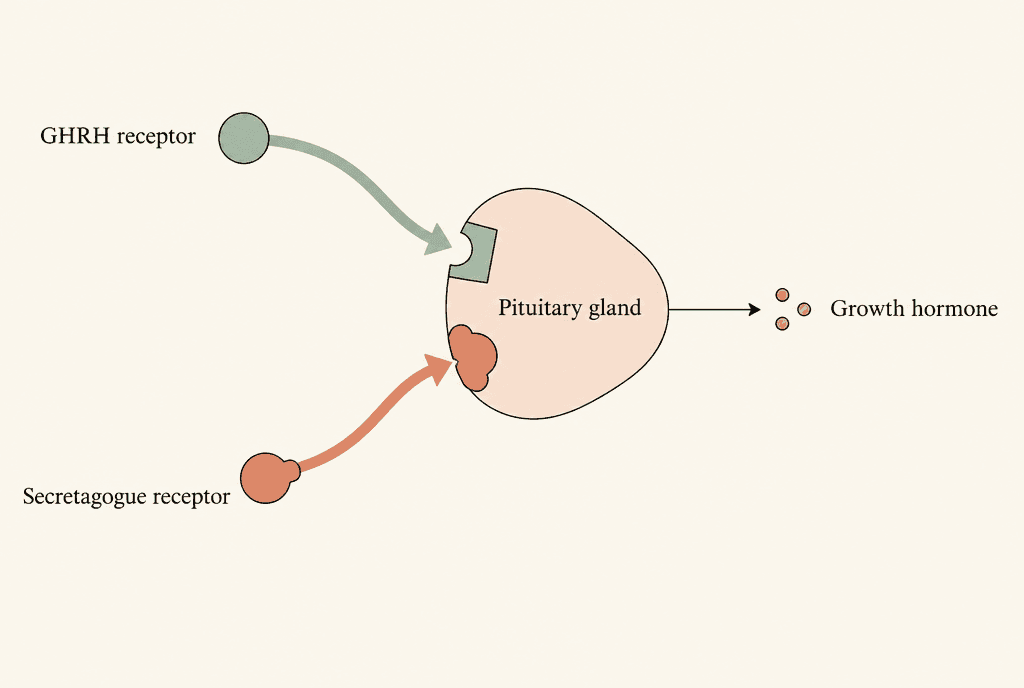
CJC-1295 and sermorelin use the growth-hormone-releasing hormone (GHRH) pathway. Ipamorelin uses a separate route, the secretagogue receptor pathway. A receptor is a protein on a cell that receives a chemical message. It is like a lock that only one shape of key fits. GHRH is one natural signal involved in growth hormone release. Howard's team found the separate secretagogue receptor. Kojima's team later found ghrelin, a natural signal for that receptor. Raun's team linked ipamorelin to the secretagogue route in rat and pig tests. These tests tell the pathways apart. They do not show what a mix would do in people.
The pituitary is a small gland below the brain. It releases growth hormone. Different chemical messages can reach one gland through different receivers, like two doors into one room. Ending at the same hormone does not make the starting compounds the same.
How is CJC-1295 different from sermorelin?
CJC-1295 differs from sermorelin in two ways. It has changes to its structure. It also has a part that grips albumin. Prakash and Goa describe sermorelin as a short lab-made relative of GHRH. Jetté's team described CJC-1295 as a changed GHRH fragment. It carries an added chemical group that binds albumin, a protein in the blood. Their paper tested cells and rats. Albumin binding helps explain why the CJC-1295 they studied stays in the blood longer. It is like a small passenger riding on a large bus. These lab findings show a design difference. They do not rank the compounds by health outcome. They do not show equal safety.
The name on a page must match the compound in the paper. A CJC-1295 label alone does not prove that a material has the albumin-binding part that Jetté's team studied. That part is called DAC, short for drug affinity complex. The CJC-1295 DAC identity explainer covers this naming problem.
What have human studies measured for these compounds?
The human studies cited here measured hormone responses. For CJC-1295 and ipamorelin, they also measured how the compounds act in the blood. Teichman's team reported lasting changes in growth hormone and in insulin-like growth factor I in healthy adults. Insulin-like growth factor I (IGF-I) is another hormone. Gobburu's team measured ipamorelin levels in the blood and a brief growth hormone response. Losa's team recorded growth hormone responses to GHRH fragments. These results describe the settings that were tested. They do not show a shared health result.
Time in the blood and the timing of a hormone response are separate results. A compound can fade from the blood while part of the signal stays changed. The CJC-1295 time-course explainer covers that difference. A longer signal tells you about timing. It does not tell you about value.
Has one trial tested CJC-1295 together with ipamorelin?
The records checked here do not show a trial of the pair. They were checked on 17 October 2026. The CJC-1295 hormone paper studied that compound alone. The ipamorelin trial record is about bowel function after surgery. Neither record tests the pair together. Separate findings cannot show what a mix would do. This is a limit of these records. It does not prove that no trial exists anywhere.
Trial NCT00672074 lists ipamorelin and a placebo, a dummy treatment. It asks about the return of gut function after surgery. The list does not name CJC-1295. (ClinicalTrials.gov, checked 17 October 2026).
The FDA safety list records each compound on its own. Its entry for ipamorelin names the acetate salt form. These are separate records, not a test of the pair (checked 17 October 2026). A shared signal in the body cannot fill that gap.
Does receptor selectivity show which compound is safer?
Receptor selectivity does not show that CJC-1295, sermorelin or ipamorelin is safer than the others. Selectivity describes which signals a compound affects in the tested setting. Raun's team studied how ipamorelin affects hormones in pigs. In that setting, two stress-hormone results, ACTH and cortisol, did not differ much from the responses to GHRH. ACTH is a signal that tells the body to release cortisol. A pig result cannot show human safety. A real safety comparison would need direct evidence about harm in matching groups of people. It would also need to show how long they were followed.
A study that reports no serious adverse events still has limits. Who took part? What was tested? How long were people watched? Missing evidence is not evidence of no risk. The ipamorelin safety evidence page explains the gaps. The papers cited here do not show the safety or effects of a mix that contains all the compared compounds.
Comparison
Each compound on its own, compared by the receptor it uses, how the molecule is built and one example of what was measured. The table does not rank outcomes or describe a mix.
| Compound | Receptor category | Design difference | Evidence example |
|---|---|---|---|
| CJC-1295 | GHRH receptor | GHRH analogue that binds albumin (Jetté et al., 2005) | Hormone markers and time in the blood in healthy adults (Teichman et al., 2006). |
| Sermorelin | GHRH pathway | Short GHRH analogue (Prakash and Goa, 1999) | Hormone responses to GHRH fragments in volunteers (Losa et al., 1984). |
| Ipamorelin | Secretagogue receptor | Different peptide family (Raun et al., 1998) | Blood levels and growth hormone response in healthy men (Gobburu et al., 1999). |
FAQ
Are sermorelin and ipamorelin the same thing?
No. Sermorelin and ipamorelin are different peptides. Sermorelin uses the GHRH pathway, and ipamorelin uses the secretagogue pathway. Both are tracked through growth hormone. That does not make them interchangeable.
Is CJC-1295 the same as sermorelin?
No. CJC-1295 and sermorelin are both related to GHRH, but their structures differ. The CJC-1295 that Jetté's team studied includes changes and an albumin-binding group. Findings about that compound cannot prove what a material with a similar label contains.
Does research establish the effects of all three together?
No. The separate papers cited on this page do not show the effects or safety of a mix that contains CJC-1295, sermorelin and ipamorelin together. A receptor diagram cannot replace a study of the exact mix. These sources leave the combined effects unproven.
More in this hub
Citations
8 sourcesJetté L, Léger R, Thibaudeau K, et al. Endocrinology. 2005;146(7):3052-3058.
doi:10.1210/en.2004-1286Teichman SL, Neale A, Lawrence B, et al. Journal of Clinical Endocrinology & Metabolism. 2006;91(3):799-805.
doi:10.1210/jc.2005-1536Raun K, Hansen BS, Johansen NL, et al. European Journal of Endocrinology. 1998;139(5):552-561.
doi:10.1530/eje.0.1390552Gobburu JV, Agersø H, Jusko WJ, Ynddal L Pharmaceutical Research. 1999;16(9):1412-1416.
doi:10.1023/a:1018955126402Losa M, Schopohl J, Müller OA, von Werder K Klinische Wochenschrift. 1984;62(23):1140-1143.
doi:10.1007/BF01782473Prakash A, Goa KL BioDrugs. 1999;12(2):139-157.
doi:10.2165/00063030-199912020-00007Howard AD, Feighner SD, Cully DF, et al. Science. 1996;273(5277):974-977.
doi:10.1126/science.273.5277.974Kojima M, Hosoda H, Date Y, et al. Nature. 1999;402(6762):656-660.
doi:10.1038/45230
Form Laboratories supplies research-use-only reference material. This article is an educational summary of published third-party literature. It is not medical advice, not a use instruction, and research material is not for human or animal use.