
Compound hub · Melanotan II
How does Melanotan II work?
Melanotan II works by switching on melanocortin receptors. These are proteins on cell surfaces, and several of them respond to alpha-MSH, a skin hormone. Melanotan II is non-selective, which means it switches on several receptor types rather than one. One of those receptors tells skin cells to make melanin, the pigment behind a tan. Acting on many receptors may explain effects beyond the skin. It does not prove the cause of each reported symptom.
01Melanocortin receptorsContents
Your cells listen for chemical messages through receptors, proteins on their surface shaped to fit one signal. Skin cells carry one kind that fits a hormone your own skin releases when sunlight hits it. Melanotan II, built in a lab, fits several receptors of that family, which is the core of the Melanotan II hub.
This page follows the mechanism step by step. First comes the receptor family. Then comes what a skin cell does when its receptor is switched on, why other parts of the body respond, and where the evidence stops. Some answers would need a number, such as how tightly the peptide binds each receptor. Where the sources searched did not give one, the page says so.
Key facts
| Target family | Melanocortin receptor family: MC1R to MC5R; this review does not map Melanotan II binding (Bardhan et al., Diseases, 2025) |
|---|---|
| Type of action | Non-selective melanocortin receptor agonist (Wessells et al., 2000) |
| Skin pathway | MC1R signalling increases melanin synthesis (Minder et al., Clinical Pharmacokinetics, 2017) |
| Binding strengths | Not established in the sources searched; no primary binding paper opened |
| Half-life in people | Not established in the sources searched |
| Compared molecule, afamelanotide | Binds MC1R (Minder et al., 2017) |
What are melanocortin receptors?
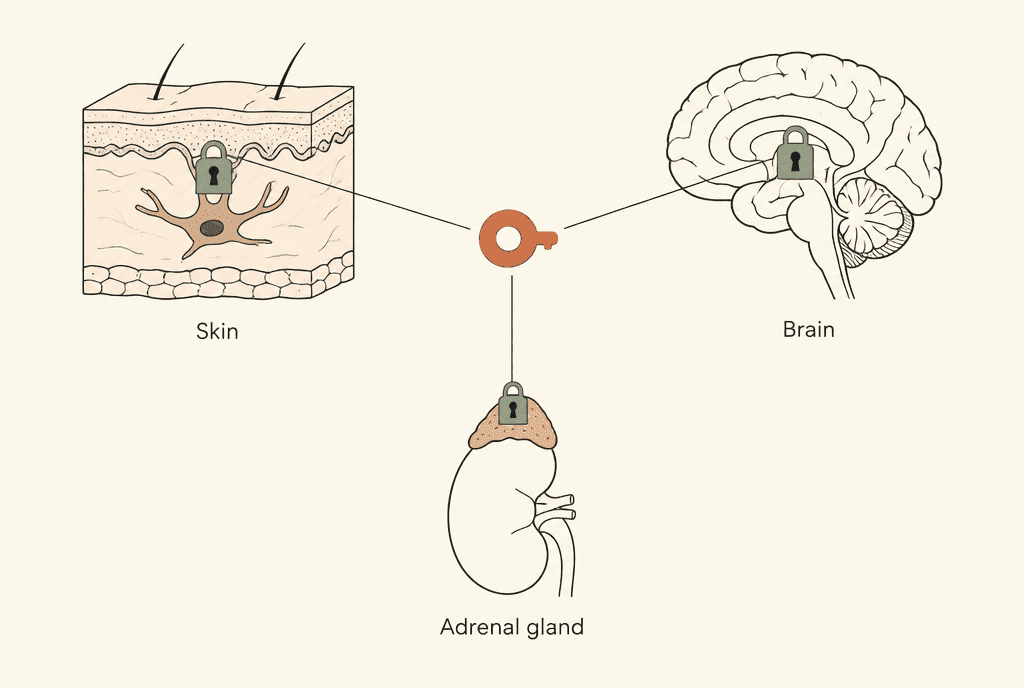
Melanocortin receptors are a family of proteins on the surface of cells. They respond to the melanocortin hormones, a group of peptide hormones with many jobs. Alpha-MSH is one of them. A 2025 review names five receptors in the family: MC1R, MC2R, MC3R, MC4R and MC5R. It says they take part in skin colour, appetite, the stress response, thinking, making steroid hormones and the body's energy balance. Different receptor types sit in different tissues. That is why one family can affect the skin, the brain and the adrenal gland, a small gland that sits on top of each kidney.
The family has five receptor types, but they do not all answer the same signal. Alpha-MSH acts at several of them. MC2R responds to ACTH, a different hormone. This overlap explains most of the confusion about what Melanotan II does.
How does Melanotan II change skin colour?
Melanotan II darkens skin through the same pathway that controls natural pigment. During a normal tan from ultraviolet light, the hormone alpha-MSH fits the melanocortin-1 receptor (MC1R). That receptor sits on melanocytes, the skin cells that make pigment. When MC1R is switched on, the cell makes more melanin. The TGA describes melanotans as lab-made peptides that increase melanin in the skin. In the 1996 pilot study, two of three healthy men had more pigment one week after the last administration. The change was measured by eye and with a meter that reads how much light the skin reflects.
That pilot study is the weakest kind of evidence. It involved three men. On alternate days they received saline, a salt-water dummy treatment called a placebo. The paper reports pigment measurements one week after the study treatment ended. The authors said it showed tanning activity in humans. They did not claim it proved a safe or reliable tan. Darker skin is also not protection. The TGA says that using melanotan to darken skin artificially will not protect against ultraviolet light the way a suitable sunscreen does.
Why does Melanotan II affect more than the skin?
Melanotan II is described as non-selective, so it can switch on receptor types that sit outside the skin. Think of a master key that opens several locks, not just one. A 2000 report covered 20 men with erectile dysfunction. In it, nausea and yawning were frequently reported effects of Melanotan II. In the 1996 pilot study, stretching and yawning appeared together with spontaneous erections. These are measured responses in small trials. Separately, the TGA names headache, vomiting, loss of appetite and facial redness as common effects of melanotans. None of these are skin effects.
In most cases, the link from receptor to symptom is a reasoned guess. The papers recorded what happened. They did not trace each effect to one receptor type. A 2025 review notes that MC4R is among the receptors tied to appetite and energy balance. That fits the TGA's mention of appetite loss. But the sources searched do not prove that link for Melanotan II. The side effects page lists what regulators and papers report.
How is Melanotan II different from afamelanotide in how it acts?
Afamelanotide, also called Melanotan I, is described as fitting MC1R, the pigment receptor. A 2017 review of how the drug behaves in the body links its skin effect to MC1R signals. Melanotan II is described as non-selective, meaning it acts on several receptor types. In Australia, afamelanotide has a registered medicine on the ARTG, the national list of approved medicines (record 327947, checked 16 October 2026). The TGA says Melanotan II has none. The sources searched give no receptor binding numbers for either peptide that this page can verify. The table below compares how each molecule is described.
Take care with this contrast. Fitting MC1R does not prove that afamelanotide acts only at MC1R. This page has not verified a study that tests the two side by side. So it does not rank the molecules by how selective they are. What Melanotan II is covers how the two molecules differ.
Evidence limits
What has research not shown about how Melanotan II works?
The sources opened here do not fully map how Melanotan II works in people. No primary paper on receptor binding was verified for this page. No half-life in people was verified either. Half-life is the time the body takes to clear half of a substance. The human studies discussed here are small. They include a pilot study in 3 men, a report covering 20 men with erectile dysfunction, and case reports, which each describe one patient. A 2017 review says conclusive evidence linking Melanotan use to new or changed moles is lacking.
Honest limits are part of the mechanism story. A receptor model explains why effects are plausible. It does not show how likely they are, how long they last, or who is at risk. The next page, Melanotan II study findings, shows what each human study measured.
Comparison
Three melanocortin molecules compared on the mechanism statements in the sources named. A blank cell means the sources searched did not state it. This is a record of descriptions, not a ranking.
| Molecule | Described receptor action | Source | What the source does not give |
|---|---|---|---|
| Melanotan II | Non-selective melanocortin receptor agonist | Wessells et al., 2000 | Binding numbers for each receptor |
| Afamelanotide (Melanotan I) | Binds MC1R; MC1R signalling increases melanin synthesis | Minder et al., 2017 | A head-to-head comparison with Melanotan II |
| Bremelanotide (PT-141) | Non-selective action; the FDA label names MC1R and MC4R as the most relevant binding sites | FDA Vyleesi label, 2019, section 12.1 | A fully mapped human mechanism |
FAQ
Does Melanotan II act on the brain?
Melanocortin receptors are found in the brain as well as the skin, a 2025 review reports, and Melanotan II is described as non-selective. The sources searched do not map which brain effects come from which receptor.
Why does Melanotan II cause nausea?
Nausea was frequently reported in the 2000 report on 20 men. In the 1996 pilot study it was mild and appeared at most levels tested. Neither paper proves which receptor causes it.
Is the mechanism of PT-141 the same as Melanotan II?
PT-141 is bremelanotide, which a 2006 review calls a newer, modified version of Melanotan II. It is a different molecule. The FDA's 2019 Vyleesi label says its mechanism in hypoactive sexual desire disorder is unknown.
How long does Melanotan II last in the body?
No half-life from a regulator label or a primary paper was found in the sources searched on 16 October 2026, so this page gives none.
More in this hub
Citations
8 sourcesWessells H, Levine N, Hadley ME, Dorr R, et al. International Journal of Impotence Research. 2000;12(Suppl 4):S74-S79.
doi:10.1038/sj.ijir.3900582Dorr RT, Lines R, Levine N, et al. Life Sciences. 1996;58(20):1777-1784.
doi:10.1016/0024-3205(96)00160-9Minder EI, Barman-Aksoezen J, Schneider-Yin X Clinical Pharmacokinetics. 2017;56:815-823.
doi:10.1007/s40262-016-0501-5Böhm M, Luger TA Der Hautarzt. 2010;61:497-504.
doi:10.1007/s00105-009-1891-1Hadley ME, Dorr RT Peptides. 2006;27(4):921-930.
doi:10.1016/j.peptides.2005.01.029Bardhan M, et al. Diseases. 2025;13(9):305.
doi:10.3390/diseases13090305Habbema L, Halk AB, Neumann M, Bergman W International Journal of Dermatology. 2017;56(10):975-980.
doi:10.1111/ijd.13585Kingsberg SA, Clayton AH, Portman D, et al. Obstetrics and Gynecology. 2019;134(5):899-908.
doi:10.1097/AOG.0000000000003500
Form Laboratories supplies research-use-only reference material. This article is an educational summary of published third-party literature. It is not medical advice, not a use instruction, and research material is not for human or animal use.