
Compound hub · Melanotan II
Melanotan II study findings
The human studies of Melanotan II are small. The sources searched on 16 October 2026 found a 1996 pilot study in 3 healthy men, a 2000 report covering 20 men with erectile dysfunction, and case reports. A vitiligo trial entry, NCT07437560, lists Phase 2 research as recruiting without results, but calls itself an example record. No randomised tanning trial and no approved Australian product label were found in the sources opened.
01What human research existsContents
A headline claim about any compound is only as good as the people it was tested in. Before reading what a study found, it helps to ask who took part, how many there were, and what was actually measured. That habit is the core of the Melanotan II hub.
This page applies that habit to Melanotan II. It lists each human study found, with its size and what it measured. Then it covers the case reports that regulators cite. It reports results as they were measured. Where a result cannot be stretched to a wider group, it says so.
Key facts
| Pilot phase I study | 3 healthy men, 2 weeks of alternating-day administration, single-blind (Dorr et al., Life Sciences, 1996) |
|---|---|
| Erectile dysfunction trial | 20 men, double-blind, placebo-controlled crossover (Wessells et al., 2000) |
| Randomised tanning trial | None located in the sources searched |
| Approved-product trial program | None located in the opened sources; no Australian product is approved (TGA, 17 August 2026) |
| Case-report categories named by the FDA | Melanoma, posterior reversible encephalopathy syndrome, sympathomimetic toxidrome, priapism (FDA, page checked on 16 October 2026) |
| Registered trial, checked 16 October 2026 | NCT07437560, Phase 2 vitiligo entry lists recruiting and no results; summary calls it an example record, active study unverified |
What human studies of Melanotan II exist?
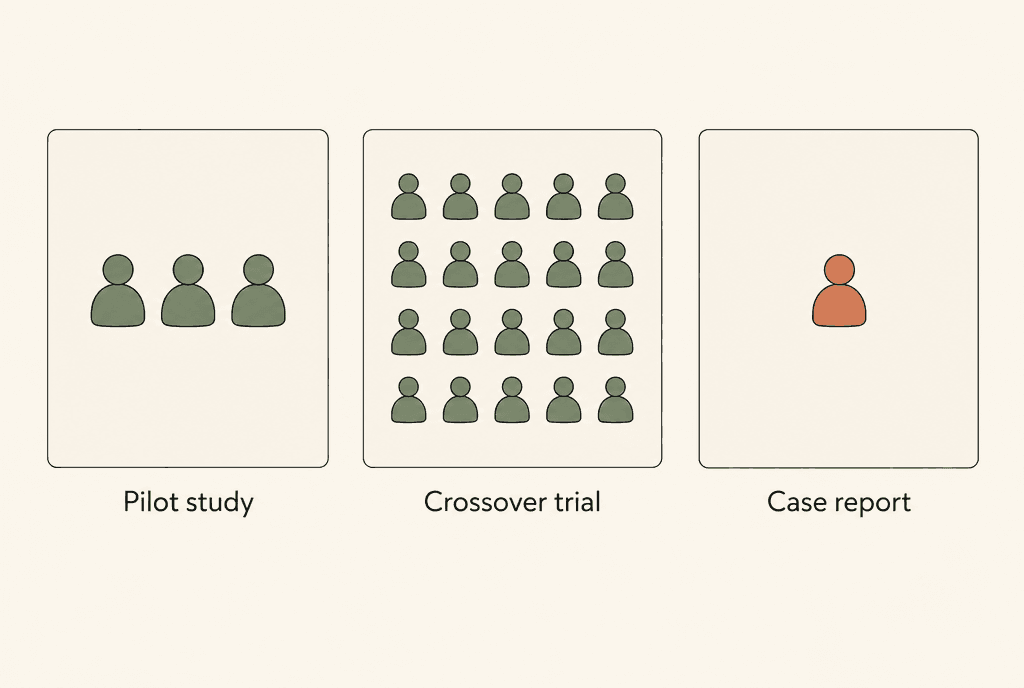
The older Melanotan II papers opened here are a small pilot study and a later crossover trial. The 1996 pilot study was phase I, the first stage of testing in people. It gave Melanotan II or saline, a salt-water placebo, to 3 healthy male volunteers on alternating days for two weeks. The later trial was double-blind and placebo-controlled. That means neither the men nor the researchers knew which treatment was given at each session. It enrolled 20 men with erectile dysfunction from psychological or physical causes. A 2006 review adds that a newer molecule, PT-141, moved on to later trials.
Both studies tested the peptide under clinical supervision, in a handful of adults. Neither was built to answer a safety question for the public. A pilot study is a first look. It can show that something happens in a few people. It cannot say how often, in whom, or for how long.
What did the 1996 pilot study of Melanotan II measure?
The 1996 pilot study recorded skin pigment, side effects and how well 3 healthy male volunteers tolerated Melanotan II. Pigment was checked by eye and with a meter that reads reflected light, one week after study treatment ended. One of the two men at the highest level tested had grade II somnolence and fatigue. That means moderate sleepiness and tiredness by World Health Organization standards. Mild nausea that needed no anti-sickness medicine appeared at most levels tested. Stretching and yawning appeared alongside spontaneous erections that came and went over one to five hours.
Three men cannot show how a larger group would respond. The authors reported a pilot result and proposed more phase I research. The study did not test long-term safety, skin cancer risk or mole changes. Its only comparison was the same men receiving saline on alternate days.
What did the trial in men with erectile dysfunction find?
The 2000 paper reports crossover research in 20 men with erectile dysfunction. In a crossover study, each man receives both the real treatment and the placebo at different times. The design was double-blind and placebo-controlled. The researchers used a RigiScan, a device that measures penile rigidity, for six hours. They used questionnaires to record sexual desire and side effects. Nausea and yawning were frequent. At one tested level, 12.9 percent of the men had severe nausea. These results describe a small, selected group of men. They do not show long-term safety, population rates of side effects, or results outside that setting.
This trial measured an erectile response in men with a diagnosed condition, over short sessions. It did not measure tanning, skin changes or long-term safety. Nor did it measure any outcome in healthy people using the peptide without supervision. Melanotan II side effects lists what regulators report beyond these trials. How Melanotan II works explains why a skin-pigment peptide could produce effects of this kind.
Is a new clinical trial of Melanotan II registered?
ClinicalTrials.gov record NCT07437560 describes a Melanotan II study. But its summary calls it an example record, so an active trial is not confirmed here. The entry, checked on 16 October 2026, lists Phase 2 research in stable nonsegmental vitiligo, a form of vitiligo, a condition that causes pale patches of skin. It names Hudson Biotech as sponsor, an estimated 60 adults, and a start date of 2 February 2026. The title says double-blind, but the design field says quadruple masking. The main outcome is the change in Vitiligo Area Scoring Index at 24 weeks. The entry says recruiting and has no posted results.
A registry entry does not prove that a study is running or that its treatment works. The record was last verified in February 2026. It gives an estimated primary completion date of February 2027. Its brief summary opens with the words 'This example interventional study record'. This check could not confirm the sponsor's identity from a second source. So the record should be read as a registry entry only. Its exclusion list bars adults with a history of melanoma or dysplastic nevus syndrome, a skin condition with unusual moles. That rule does not prove the cause or likelihood of harm.
What do case reports say about Melanotan II?
The FDA says published case reports discuss serious problems with Melanotan II. They include melanoma, a dangerous skin cancer, and posterior reversible encephalopathy syndrome, a condition with brain swelling. They also include sympathomimetic toxidrome, where the fight-or-flight system goes into overdrive, and priapism, a long, painful erection. The FDA says this on its page of bulk drug substances that may carry significant safety risks. A 2017 review found four case reports of melanomas growing from existing moles during or shortly after melanotan use. It says conclusive evidence linking the two is lacking. A case report is one person's story, so it cannot show how often something happens.
This page does not analyse the reports one by one. It cites the FDA sentence and the 2017 review instead of any single patient's story. The side effects page sets out what regulators name.
What does the TGA say about effects reported with Melanotan II?
The TGA names headache, nausea, vomiting, loss of appetite and facial redness as the most common side effects of melanotans. It says the most concerning one is the risk of serious skin cancers. For Melanotan II in particular, the TGA says there have been reports of more moles and freckles, kidney dysfunction and swelling of the brain. These statements come from a regulator summing up reports it has seen. They are not trial results. The TGA blog gives no counts or rates, so it cannot show how often any of these effects happens.
Regulator warnings and trial papers answer different questions. A warning sums up safety concerns and reported events. A trial says what happened to a defined group under controlled conditions. The sources opened here include warnings, small studies and a review of case reports. That is not a complete survey of all research.
Evidence limits
What has the research not shown about Melanotan II?
The sources opened here do not show that Melanotan II is safe outside supervised research. They contain no randomised tanning trial, no long-term follow-up, no regulator label and no half-life. The older studies discussed here enrolled men only, so they do not show results for women or other groups. The FDA says compounded Melanotan II may pose a risk of immunogenicity, an immune reaction against the peptide, for certain routes into the body. It links this to aggregation, where peptide molecules clump together, or to impurities related to the peptide.
The TGA tested seized products. It found that the estimated amount of Melanotan II varied by more than twofold across five bottles of one brand. When the content of a product is unknown, even a well-run trial of a clean laboratory sample says little about it. A forensic study of samples confiscated by police makes the same point about identity. Online accounts are personal stories, not controlled evidence. What Melanotan II is and its Australian status cover identity and regulation.
Comparison
Kinds of Melanotan II evidence found in the sources searched, with what each can and cannot show. This is a record of evidence types, not a ranking of outcomes.
| Evidence type | Example | What it can show | What it cannot show |
|---|---|---|---|
| Pilot phase I study | Dorr et al., 1996 (3 healthy men) | Pigment change and short-term tolerability in 3 men | How a larger group responds, or long-term safety |
| Controlled crossover trial | Wessells et al., 2000 (20 men with erectile dysfunction) | Recorded endpoints and reported nausea and yawning in a selected male group | Tanning effects, effects in women, or safety outside a clinic |
| Narrative review | Habbema et al., 2017 | A gathering of published case reports on moles and melanoma | That melanotan caused those changes; the review says conclusive evidence is lacking |
| Regulator statement | TGA, 24 January 2025; FDA, checked 16 October 2026 | Which effects and risks regulators have seen reported | How often any effect occurs |
FAQ
Is there a clinical trial of Melanotan II for tanning?
No randomised tanning trial was found in the sources searched on 16 October 2026. The 1996 pilot study measured pigment in 3 men as one of several outcomes.
Did the 20-man report find any side effects?
Yes. Nausea and yawning were frequently reported, and 12.9 percent of the men had severe nausea at one tested level.
Does Melanotan II cause skin cancer?
Cause has not been shown. A 2017 review found four case reports of melanoma growing from existing moles during or shortly after melanotan use. It says conclusive evidence linking them is lacking. The TGA names the risk of serious skin cancers as its most concerning risk.
Why are the human studies so old?
A 2006 review describes Melanotan II as tested for erectile dysfunction, and PT-141 as the newer molecule that moved on to later trials. The sources opened do not explain why later published Melanotan II trial reports are limited. A vitiligo registry entry describes Phase 2 research but calls itself an example record (ClinicalTrials.gov NCT07437560).
More in this hub
Citations
5 sourcesDorr RT, Lines R, Levine N, et al. Life Sciences. 1996;58(20):1777-1784.
doi:10.1016/0024-3205(96)00160-9Wessells H, Levine N, Hadley ME, Dorr R, et al. International Journal of Impotence Research. 2000;12(Suppl 4):S74-S79.
doi:10.1038/sj.ijir.3900582Hadley ME, Dorr RT Peptides. 2006;27(4):921-930.
doi:10.1016/j.peptides.2005.01.029Habbema L, Halk AB, Neumann M, Bergman W International Journal of Dermatology. 2017;56(10):975-980.
doi:10.1111/ijd.13585Mestria S, Odoardi S, Frison G, Strano Rossi S Drug Testing and Analysis. 2021;13(4):876-882.
doi:10.1002/dta.2986
Form Laboratories supplies research-use-only reference material. This article is an educational summary of published third-party literature. It is not medical advice, not a use instruction, and research material is not for human or animal use.