
Compound hub · NAD+
NAD and resveratrol: what studies found about sirtuins, precursors and the combination
NAD+ is a helper molecule, called a coenzyme, that sirtuin enzymes need in order to work. Resveratrol is a separate plant compound. It was once reported to switch sirtuins on, but later work disputed that. One randomised trial in 90 people with peripheral artery disease tested three options. These were nicotinamide riboside (NR) alone, NR with resveratrol, and a placebo. Its authors reported that resveratrol did not add to the walking change seen with NR alone.
Right now, enzymes in your cells are reading the energy state of the cell and passing the message on. A family of them, the sirtuins, cannot work without NAD+. That single fact is why the names NAD+ and resveratrol keep turning up in the same search box.
This page is part of the NAD+ hub. The basics of the molecule are on what NAD+ is. Here you will find what published studies measured, with the model, the size and the limits of each. The page gives no advice. Your body makes NAD+. The precursors and resveratrol are different molecules.
Key facts
| Molecules compared | NAD+ (coenzyme); nicotinamide riboside (NR) and nicotinamide mononucleotide (NMN), two NAD+ precursors; resveratrol, a polyphenol (plant-made compound). |
|---|---|
| Sirtuin link | Sir2, the yeast sirtuin, was shown to be an NAD-dependent histone deacetylase (Imai et al., 2000). |
| Human trial of NR with resveratrol | One randomised trial found: 90 people with peripheral artery disease, 6 months, primary outcome six-minute walk distance (NCT03743636; McDermott et al., 2024). |
| Registered studies listing both ingredients | 8 records on ClinicalTrials.gov for resveratrol with nicotinamide, searched 16 October 2026. |
| Animal studies pairing the two | 5 records in Europe PMC with both names in the title, all in rodents, searched 16 October 2026. |
| Sources read | 16 October 2026 |
Evidence limits
What has research not shown about NAD+ precursors and resveratrol together?
Human evidence on NAD+ precursors paired with resveratrol is thin. A precursor is a raw material the body turns into something else. One randomised trial, called NICE (NCT03743636), tested three options. These were nicotinamide riboside (NR) alone, NR with resveratrol, and a placebo (a dummy pill). It enrolled 90 people with peripheral artery disease. This is a condition where narrowed leg arteries limit walking. The authors reported that resveratrol did not add to the walking change seen with NR alone. One trial in one condition cannot speak for healthy adults or for other precursors. A ClinicalTrials.gov search on 16 October 2026 found no trial of nicotinamide mononucleotide (NMN) with resveratrol.
Two more limits matter. The sirtuin story began in test tubes and yeast. A 2010 study disputed part of it. Animal results with both compounds belong to mice and rats. The five rodent records found in Europe PMC are an example. They do not show the same change in people.
Raising a blood marker and changing a health outcome are different results. The do NAD+ supplements work page sets out that gap for NR and NMN, trial by trial.
How are NAD+ and sirtuins related?
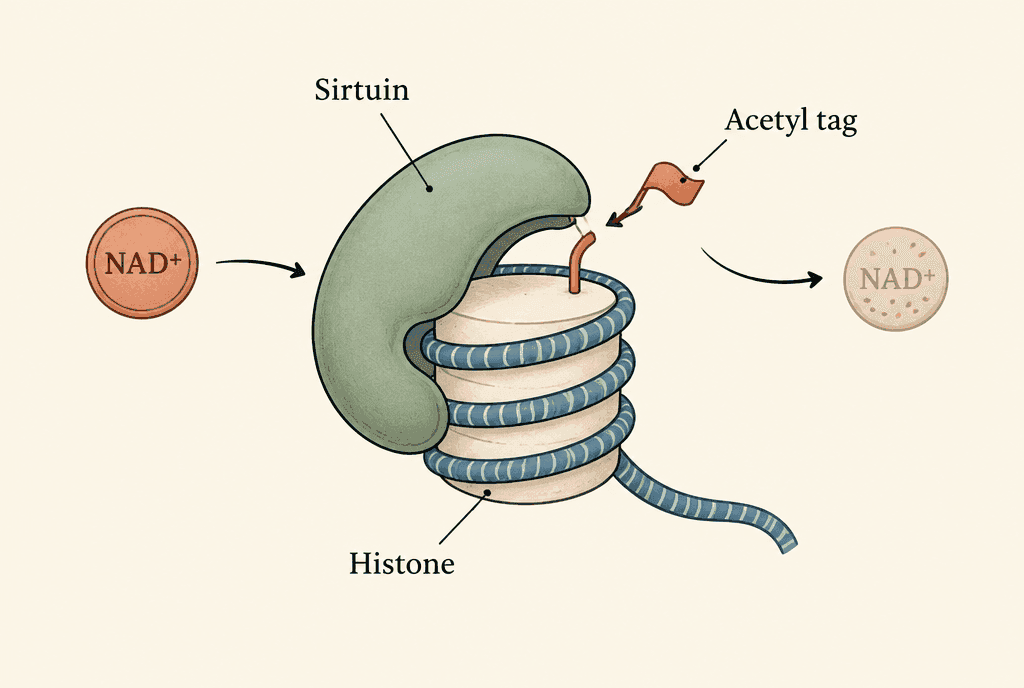
Sirtuins are enzymes that strip small chemical tags, called acetyl groups, off proteins. They use up NAD+ to do it. Think of NAD+ as a token a sirtuin must spend for each job. In 2000, a research team showed that Sir2 is an NAD-dependent histone deacetylase. Sir2 is the founding member of the family and is found in yeast. This means it removes acetyl tags from histones, the proteins that DNA wraps around. It does this only when NAD+ is present. A 2021 review lists sirtuins among the enzymes that need NAD+ as a helper. Two other enzyme families, CD38 and PARPs, do too.
Each sirtuin reaction uses up one NAD+ molecule. So the cell's supply of NAD+ can limit how fast sirtuins run. Researchers study that link. It is the reason NAD+ and sirtuins appear together in the science papers.
The link is a piece of cell chemistry. It shows how the machinery fits together. It does not show what happens to a person who adds a compound from outside.
What is resveratrol, and did it switch sirtuins on?
Resveratrol is a polyphenol, a plant-made compound built around ring-shaped chemical structures. It is not related to NAD+ in structure. A 2003 paper in the journal Nature reported that resveratrol and similar molecules stimulated sirtuins. They also lengthened the lifespan of yeast cells. A 2010 study then tested resveratrol on SIRT1, the best-known human sirtuin, using its natural targets. It found that resveratrol did not switch SIRT1 on. The switch-on seen in earlier tests depended on a fluorescent tag, a glowing marker, attached to the test peptide.
Both papers were lab studies. Neither tested a person. The 2010 result did not close the question. But it shows why a headline about sirtuin activation needs the test method behind it.
That background shapes how the human trials below read. The trial designers thought resveratrol might change how sirtuins use NAD+. The trial then asked a plain question about walking.
Are NAD+, NR and NMN the same thing?
No. NAD+ is the coenzyme itself. Nicotinamide riboside (NR) and nicotinamide mononucleotide (NMN) are precursors. These are smaller molecules the body converts toward NAD+, much as flour is on its way to becoming bread. Researchers are still studying what happens to them in the body. It seems to depend on the tissue. Resveratrol is none of these. It is not a precursor and not a coenzyme. So trials of NR or NMN say nothing direct about NAD+ given as NAD+. Trials of resveratrol say nothing direct about NAD+ levels.
Few human trials test NAD+ itself. A 2026 systematic review gathers every study that meets set rules. It found no eligible outcomes trial of NAD+ given into a vein or into a muscle for anti-aging or wellness. The NAD+ comparison page explains how NAD+, NMN, NADH and NADP differ.
The table after these sections lists each molecule next to its role. Keeping the four names apart makes every study below easier to read.
What have single-agent studies of NR and NMN measured in people?
A 2026 systematic review of 33 human studies found that NR and NMN consistently raised NAD-related substances in the blood. Results for body function, metabolism and blood vessels were mixed. They often showed no change. In a 12-week trial of 30 healthy adults, whole-blood NAD+ rose after NMN compared with placebo. In a 12-week trial of 40 obese men, NR did not improve insulin sensitivity. That means how well the body responds to the hormone insulin. This result applies to that group only. Each trial measured something different, so the results do not add up to one verdict.
A 10-week randomised trial enrolled 25 postmenopausal women with prediabetes. They were overweight or obese. Prediabetes means blood sugar above normal but below the diabetes range. Muscle insulin sensitivity rose with NMN. That is a small single-trial result for that group.
Each trial measured a different outcome in a different group. Together they show that blood markers move more reliably than health outcomes.
What have human studies of resveratrol on its own measured?
A 2021 meta-analysis pooled 15 randomised trials in 896 people with type 2 diabetes. A meta-analysis combines many trials into one larger estimate. It found lower HOMA-IR in the resveratrol groups. HOMA-IR is a blood-test score for insulin resistance. It found no significant change in total cholesterol or triglycerides, a type of blood fat. It also found no significant difference in adverse events, meaning unwanted medical events. In a 4-week trial of 24 obese but otherwise healthy men, insulin sensitivity did not change with resveratrol compared with placebo. Insulin sensitivity was the main outcome.
In a 6-month trial of 16 obese men with fatty liver disease (NCT01446276), resveratrol did not change liver fat, body make-up or the way the body handled sugar and fats. The group was very small.
The pooled diabetes result and the two small trials in obese men point in different directions. They enrolled different people and measured different things. This page does not average them into one answer.
What did the trial of NR with resveratrol find?
The NICE trial (NCT03743636) was run at Northwestern University. It randomly split 90 people with peripheral artery disease into three groups for 6 months. The groups got NR alone, NR with resveratrol, or placebo. The main outcome was six-minute walk distance, which is how far a person walks in six minutes. Compared with placebo, NR alone changed walking by +17.6 meters (+7.0 against −10.6 meters; 90% confidence interval +1.8 to infinity). Some people took at least 75% of their study pills. In that group, walking rose by 31.0 meters with NR and 26.9 meters with NR plus resveratrol. The authors concluded that resveratrol did not add to NR alone.
The trial register lists two main comparisons. These are NR alone against placebo, and NR with resveratrol against placebo. The authors also state that a larger trial is needed to confirm the findings.
Two cautions apply. Participants had peripheral artery disease, so the result belongs to that condition. A confidence interval is the range where the true value most likely lies. This one is one-sided, which is a weaker standard than the usual two-sided interval.
Is there other research that pairs NAD+ precursors with resveratrol?
Other research is mostly in animals or only on trial registers. Europe PMC is a free online library of life-science papers. A search there on 16 October 2026 for resveratrol and nicotinamide riboside in the same title found five records. All were rodent studies. Examples include fat-tissue programming in newborn mice and wound healing in diabetic rats. A ClinicalTrials.gov search the same day found eight records that mention resveratrol with nicotinamide. A record that lists several ingredients together cannot separate the effect of any single one.
One registered study, NCT07802548, lists "sirtuin activators" with a weight-loss diet. It enrolled 45 people and has body weight as its main outcome. Another, NCT07245979, is recruiting. The register entries do not name the ingredients. This page found no published results for either.
A registered study is a plan, not a finding. Results appear only when the investigators report them.
Is research-use NAD+ the same material these studies measured?
No. Every result on this page comes from a trial product given to enrolled participants, or from an animal or cell experiment. None describes research-use reference material. Research material is not a medicine and is not a substitute for one. It is not for human or animal use. The site catalogue lists NAD+ reference material as a laboratory item. The NAD+ research guide holds the longer trail of published papers. The study results here describe only what happened inside those studies, with those products and those participants.
Comparison
The four molecules named in searches for NAD and resveratrol, with the role each plays in the sirtuin research. Roles are as reported by the named authors. This is not advice.
| Molecule | What it is | Role in the sirtuin research | Source |
|---|---|---|---|
| NAD+ | A coenzyme found in every cell | Sirtuins need NAD+ as a helper to remove acetyl tags from proteins. | Imai et al., 2000; Covarrubias et al., 2021. |
| Nicotinamide riboside (NR) | A precursor the body converts toward NAD+. | Studied for its effect on NAD-related blood markers and on health outcomes in people. | Yoshino et al., 2018; Gallagher and Emmanuel, Ageing Research Reviews, 2026. |
| Nicotinamide mononucleotide (NMN) | A second precursor the body converts toward NAD+. | Studied in the same way as NR, in separate trials. | Yoshino et al., 2018; Okabe et al., 2022. |
| Resveratrol | A plant-made polyphenol, not related to NAD+ in structure. | Reported in 2003 to stimulate sirtuins in the laboratory; a 2010 study disputed direct SIRT1 activation. | Howitz et al., 2003; Pacholec et al., 2010. |
FAQ
Is resveratrol a form of NAD?
No. NAD+ is a coenzyme made inside cells. Resveratrol is a polyphenol, a plant-made compound with a different structure. Nicotinamide riboside and nicotinamide mononucleotide are the molecules described as NAD+ precursors.
Do NAD and resveratrol work together?
One randomised trial tested the pairing in people. It enrolled 90 participants with peripheral artery disease. Its authors reported that resveratrol did not add to the walking change seen with nicotinamide riboside alone. That single result applies to that condition. It does not show an effect in other groups.
Does resveratrol activate sirtuins?
The answer depends on how the test is run. A 2003 lab paper reported that resveratrol stimulated sirtuins. A 2010 study found no direct activation of SIRT1 when it used natural targets. Both were lab studies, and neither tested people.
What do sirtuins need NAD+ for?
Sirtuins use NAD+ as a helper when they remove acetyl tags from proteins. Sir2 is the founding member of the family and is found in yeast. In 2000, it was shown to be an NAD-dependent histone deacetylase.
More in this hub
- What is NAD+? Meaning, structure and what studies have found
- NAD+ vs NMN, NADH and NADP+: what is the difference?
- Is NAD+ a Substrate or a Product? What Enzyme Records Show
- How Is NAD+ Made? The Three Pathways Cells Use
- NAD+ side effects: what trials and regulators have recorded
- Do NAD+ supplements work? What human studies measured
- Is NAD+ legal in Australia? TGA, FDA and sport rules, checked 14 October 2026
Citations
15 sourcesMcDermott MM et al. Nature Communications. 2024;15:5046.
doi:10.1038/s41467-024-49092-5Imai S et al. Nature. 2000;403(6771):795-800.
doi:10.1038/35001622Covarrubias AJ et al. Nature Reviews Molecular Cell Biology. 2021;22(2):119-141.
doi:10.1038/s41580-020-00313-xHowitz KT et al. Nature. 2003;425(6954):191-196.
doi:10.1038/nature01960Pacholec M et al. Journal of Biological Chemistry. 2010;285(11):8340-8351.
doi:10.1074/jbc.M109.088682Yoshino J, Baur JA, Imai SI. Cell Metabolism. 2018;27(3):513-528.
doi:10.1016/j.cmet.2017.11.002Gallagher C, Emmanuel OO. Ageing Research Reviews. 2026;116:103057.
doi:10.1016/j.arr.2026.103057Okabe K et al. Frontiers in Nutrition. 2022;9:868640.
doi:10.3389/fnut.2022.868640Dollerup OL et al. American Journal of Clinical Nutrition. 2018;108(2):343-353.
doi:10.1093/ajcn/nqy132Yoshino M et al. Science. 2021;372(6547):1224-1229.
doi:10.1126/science.abe9985Zhang T et al. Evidence-Based Complementary and Alternative Medicine. 2021;2021:5644171.
doi:10.1155/2021/5644171Poulsen MM et al. Diabetes. 2013;62(4):1186-1195.
doi:10.2337/db12-0975Poulsen MK et al. Diabetes, Obesity and Metabolism. 2018;20(10):2504-2509.
doi:10.1111/dom.13409Serrano A et al. Nutrients. 2020;12(2):461.
doi:10.3390/nu12020461Hasan Maleki M et al. International Immunopharmacology. 2024;132:112013.
doi:10.1016/j.intimp.2024.112013
Continue
NAD+ reference materialResearch use only: not for human or animal use.
Read the NAD+ research guideForm Laboratories supplies research-use-only reference material. This article is an educational summary of published third-party literature. It is not medical advice, not a use instruction, and research material is not for human or animal use.