
Hub · Peptide Quality & Verification
How to read a certificate of analysis (COA)
A certificate of analysis (COA) is a dated, signed list of test results for one production run, or batch. ICH Q7 (the version dated 10 November 2000), the International Council for Harmonisation's good-manufacturing-practice guide for active pharmaceutical ingredients, says in clauses 11.40 to 11.43 that an authentic certificate should be issued for each batch on request, with each test, its acceptance limits and its numerical results. Reading a COA starts with one match: the lot number on the label and on the certificate.
A small vial arrives with a sheet of paper. Before any number on that sheet means anything, one string of characters has to match: the lot number — the code for one production run, also called a batch — printed on the label must be the same string printed at the top of the certificate. Until those two strings agree, the document does not establish that it covers this container.
This page, part of the peptide quality & verification hub, walks through that sheet line by line: what each field records, what a purity percentage shows, and where the paperwork stops. Purity usually arrives as an HPLC area percentage — HPLC (high-performance liquid chromatography) is a method that separates a mixture so each component shows as its own peak. Two questions run through the whole page: identity (whether the molecule is the one named on the label) and purity (how much of the measured signal is that molecule).
Key facts
| Document type | The test record for one batch: an authentic certificate should be issued for each batch on request (ICH Q7, 10 November 2000 version, clause 11.40, read 14 October 2026) |
|---|---|
| Issued by | Dated and signed by authorised personnel of the quality unit, showing the original manufacturer's name, address and telephone number (ICH Q7, clause 11.43) |
| Lot number | The batch number is among the information the certificate should carry (ICH Q7, clause 11.41), and it is the string that ties a physical label to this document |
| Lists | Each test performed, its acceptance limits and the numerical results obtained, if results are numerical (ICH Q7, clause 11.42) |
| Identity line | Whether the molecule is the one the label names |
| Purity line | How much of the measured signal is that molecule (usually an HPLC area percentage) |
| Does not show | Safety, regulatory approval, or fitness for any human use; ICH Q7 does not describe the certificate as an approval of the material |
| Contents guideline | ICH Q7, 10 November 2000 version, clauses 11.40 to 11.44: a certificate for each batch on request; each test, limit and numerical result; a signature; and rules for re-issued certificates |
| Raw-material reliance | At least one identity test per batch of incoming material, and a supplier's certificate in place of other tests where the manufacturer has a system to evaluate suppliers (ICH Q7, clause 7.30) |
| Safety data sheet (SDS) | A separate document about hazardous chemicals, with 16 numbered sections (Safe Work Australia, Code of Practice, last updated 16 June 2023) |
| Turnaround | No fixed time appears in ICH Q7 section 11.4 or in 21 CFR 211.84(d), eCFR text read 14 October 2026 |
| Sources checked | 14 October 2026 |
What is a certificate of analysis?
A certificate of analysis is the dated, signed test record for a single batch, listing each test performed with its acceptance limits and the numerical results obtained. The International Council for Harmonisation describes this record in ICH Q7, its good-manufacturing-practice guide for active pharmaceutical ingredients (10 November 2000 version, read 14 October 2026), where clause 11.40 says authentic certificates of analysis should be issued for each batch of intermediate or active pharmaceutical ingredient on request and clauses 11.41 to 11.43 set out what they carry. The certificate relates to a particular batch rather than to the product line as a whole. That is why the sheet travels with the material it describes.
The guide's wording is per batch, because a test result only describes the material actually tested. A product line can run for years, while a batch is one bounded run, and only the sheet carrying its number speaks for it. Published papers, such as those collected in the retatrutide research guide, describe a compound across trials, while a certificate speaks for a single production run.
What should a certificate of analysis include?
ICH Q7 (10 November 2000 version) says the certificate should give the name of the intermediate or active pharmaceutical ingredient, its grade where appropriate, the batch number and the date of release, plus an expiry date or retest date where one applies (clause 11.41). It should list each test performed with its acceptance limits and the numerical results obtained, if test results are numerical (clause 11.42). It should be dated and signed by authorised personnel of the quality unit and show the name, address and telephone number of the original manufacturer, and where a repacker or reprocessor did the analysis, theirs as well (clause 11.43).
The manufacturer line is where origin enters the picture: the sheet names who made the material and, where a repacker or reprocessor did the analysis, who handled it afterwards (ICH Q7, clause 11.43). The story of where tirzepatide comes from covers sourcing of a related peptide.
Clause 11.42 asks for the acceptance limit and, for numerical tests, the numerical result, so a result printed next to its limit gives a reader more to check than a bare word.
Does a COA prove identity or purity?
Identity and purity are two different tests, and a certificate lists each separately. Identity asks whether the molecule is the one named on the label; purity asks how much of the measured signal is that molecule. ICH Q6A (6 October 1999 version, read 14 October 2026), the ICH guide to specifications for new drug substances and products, says that identification solely by a single chromatographic retention time is not regarded as being specific, and that two chromatographic procedures based on different principles, or a combined test such as HPLC/MS, is generally acceptable (section 3.2.1). MS (mass spectrometry) is a method that weighs a molecule and its fragments.
A 2023 report from the United States Pharmacopeial Convention on peptide reference standards, which uses case studies of six peptides and not a survey of commercial lots, lists identity tests by NMR (structural features), LC–MS/MS (peptide mass and amino acid sequence), HPLC (comparison with a standard) and amino acid analysis (to distinguish leucine from isoleucine) (McCarthy et al., Pharmaceutical Research, 2023). Q6A is written for pharmaceutical specifications, not for research-material catalogues. The registry-level counterpart is the retatrutide molecular-formula record, which ties a sequence to a checkable mass.
Can a certificate of analysis be wrong?
In a laboratory audit of 98 synthetic quorum-sensing research peptides, linear ones from one international supplier and cyclic ones from another, with a minimum purity of 95.0% requested, all 98 were accompanied by a certificate of analysis stating at least 95.0% purity, yet in-house testing found that only 43 of the 98 met that purity, a finding for that peptide class and those two suppliers only (Verbeke et al., Journal of Pharmaceutical Analysis, 2015). The gap between paperwork and measurement is therefore documented for that sample, not shown for every catalogue. A percentage on a sheet is a claim about a run, and claims can miss.
The method changes the number. In Verbeke et al.'s laboratory audit of 98 quorum-sensing peptides from two suppliers, one peptide for which the supplier claimed at least 95.0% purity using its own chromatographic system measured 80.6% in the researchers' laboratory, a result for that single specimen only (Verbeke et al., Journal of Pharmaceutical Analysis, 2015). For the nine cyclic quorum-sensing peptides from one supplier in that laboratory audit only, none measured above 90.0% in-house although each came with a certificate stating at least 95.0%, a result that does not extend to current catalogue lots (Verbeke et al., Journal of Pharmaceutical Analysis, 2015). A percentage without its method — column, solvents, gradient, wavelength — is hard to compare across systems. The sheet states a result; the method states what the result means.
Is purity the same as peptide content?
A headline purity percentage is not the peptide content by weight. A 2023 report from the United States Pharmacopeial Convention on peptide reference standards describes a mass-balance approach to assign a quantitative value to a bulk peptide, with tests that include chromatographic purity, acetic acid and trifluoroacetic acid content, residual solvents and residue on ignition (McCarthy et al., Pharmaceutical Research, 2023). The report uses case studies of six peptides and not a survey of commercial lots. The share of signal and the share of mass answer different questions, and identity, purity and content are three separate questions.
The purity line on a sheet answers one of the three: purity, the share of signal. In the McCarthy report, content (strength) and identity each have their own tests alongside the purity test, listed in the report's Table II. A reader who keeps the three questions separate will read every certificate more accurately than one who lets a single percentage stand for all of them.
What is the purpose of a certificate of analysis?
A certificate of analysis lets a receiving party see which tests a batch passed without repeating every one of them. ICH Q7 (10 November 2000 version) says at least one test to verify the identity of each batch of incoming material should be conducted, with the exceptions in clause 7.32, and that a supplier's certificate of analysis can be used in place of performing other tests, provided that the manufacturer has a system in place to evaluate suppliers (clause 7.30). The US rule for drug components, 21 CFR 211.84(d)(2) (eCFR text read 14 October 2026), allows a report of analysis from the supplier when at least one specific identity test is conducted by the manufacturer and the manufacturer establishes the reliability of the supplier's analyses through appropriate validation at appropriate intervals. A certificate is therefore a basis for trust, with checks attached.
The checks come on a schedule. ICH Q7 says a full analysis should be performed at appropriate intervals and compared with the certificates, and that the 'Reliability of Certificates of Analysis should be checked at regular intervals' (clause 7.31). In plain terms, the paper is accepted and then audited. The 98-peptide re-testing audit above is the same idea carried out by a research laboratory, for one peptide class from two suppliers: an audit of certificates against measurement (Verbeke et al., Journal of Pharmaceutical Analysis, 2015).
What does a certificate of analysis look like?
ICH Q7 (10 November 2000 version) lists what the document carries: the product name and grade, the batch number, the release date, any expiry or retest date, each test with its acceptance limit and numerical result, and the date, signature and manufacturer details (clauses 11.41 to 11.43). A reader can sort these into three working zones, a header that names the product and batch, a results table, and a signed footer, but that grouping is this page's own, not a layout the guideline sets. No guideline opened for this page fixes a page design, so layouts differ between laboratories and suppliers.
The header holds identity: product, grade, lot, release date. The table holds evidence: one row per test, with a limit beside each result. The footer holds accountability: a date, a signature from quality-unit staff, and the maker's name, address and telephone number. The comparison table below sketches the same layout field by field.
One variation matters for supply chains. When a repacker, agent or broker issues a new certificate, ICH Q7 says it should show the name, address and telephone number of the laboratory that performed the analysis, refer to the original manufacturer and carry the original batch certificate, 'a copy of which should be attached' (clause 11.44). A re-typed sheet with no such reference has no visible link back to the lab that measured anything.
How is a certificate of analysis read, step by step?
A certificate of analysis can be read in this order: lot number first, then dates, then each result against its limit, then the signature and issuer. The order is this page's suggestion, not one set by a guideline. The lot number comes first because every figure describes only the batch the sheet names (ICH Q7, 10 November 2000 version, clauses 11.40 and 11.41). Dates come next: ICH Q7 asks for a release date and, where one applies, an expiry or retest date. The results table then pairs each test with its acceptance limit and its numerical result (clause 11.42). The issuer line closes the check, because clause 11.43 asks for a signature from authorised quality-unit personnel.
The method belongs in the reading too. A percentage with no stated method is hard to compare. In Verbeke et al.'s laboratory audit of 98 quorum-sensing peptides from two suppliers, one peptide was claimed at 95.0% purity or more by its supplier's system and measured 80.6% by the researchers' own, a result for that single specimen only (Verbeke et al., Journal of Pharmaceutical Analysis, 2015). The method line is the part of the sheet that says what the number means.
The order is a habit, not a ritual. How to check that a peptide certificate is genuine takes the same sheet through the checks that sit outside the page itself.
What is a certificate of analysis for raw materials?
A certificate of analysis for a raw material is the supplier's test record for one lot of an incoming starting material, reagent or solvent. ICH Q7 defines a raw material as 'a general term used to denote starting materials, reagents, and solvents intended for use in the production of intermediates or APIs' (ICH Q7, glossary, 10 November 2000 version). The receiving manufacturer conducts at least one identity test per batch, and a supplier's certificate can be used in place of other tests where the manufacturer has a system to evaluate suppliers (clause 7.30). Processing aids and hazardous or highly toxic raw materials do not need to be tested if the manufacturer's certificate is obtained, and the lack of on-site testing should be justified and documented (clause 7.32).
In plain terms, the buyer of a raw material tests a little, relies on the certificate for the rest and writes down why. The certificate on a finished peptide is a separate document about a different lot.
The guideline's reach is limited. ICH Q7 applies to the manufacture of active pharmaceutical ingredients for use in human drug products (section 1.3), so its raw-material rules describe pharmaceutical practice, not research-material catalogues.
What is a certificate of analysis in the pharmaceutical industry?
In the pharmaceutical industry, a certificate of analysis is a batch-level document issued under the manufacturer's quality unit, listing the tests, limits and results for one batch. ICH Q7 (10 November 2000 version) says authentic certificates should be issued for each batch of an intermediate or active pharmaceutical ingredient (API, the active substance in a medicine) on request, and that they should be dated and signed by authorised personnel of the quality unit (clauses 11.40 and 11.43). In the United States, 21 CFR 211.84(d)(2) lets a drug maker accept a supplier's report of analysis for a component under set conditions (eCFR text read 14 October 2026).
Clause 11.40 asks for 'authentic' certificates, and clause 11.44 shows one way that is protected: when a repacker or broker re-issues the sheet, the original batch certificate should be attached.
ICH Q7's scope (section 1.3) covers active ingredients for human drug products. A research-use-only certificate is not within that scope, and what a lot number lets a researcher verify explains how far the lot-number chain can be checked on its own.
Is CMC in an eCTD the same as a batch certificate?
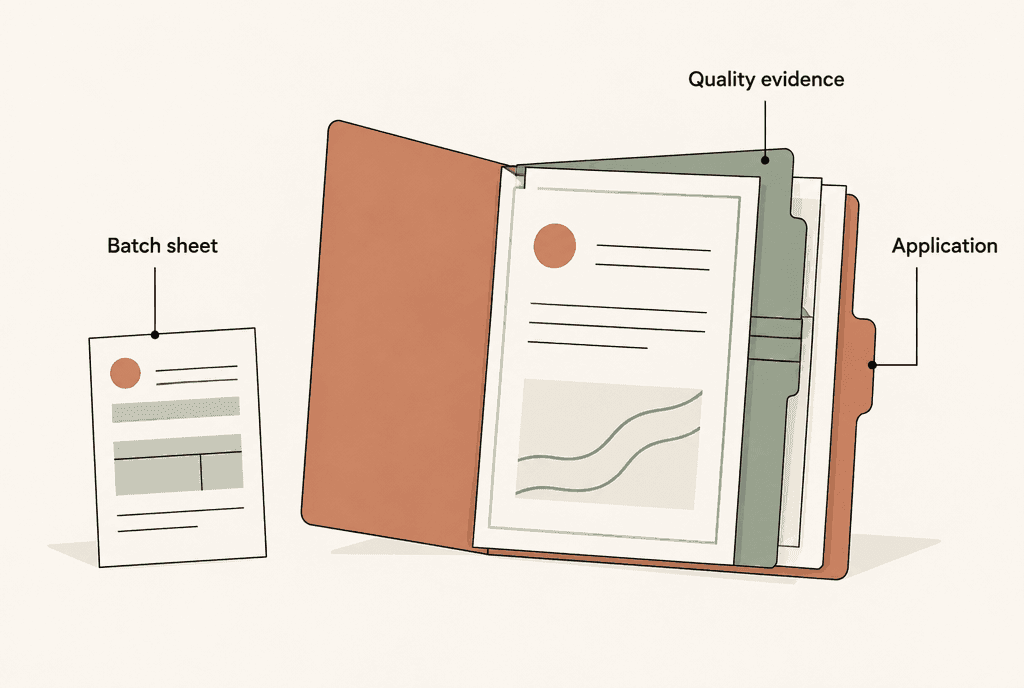
No. A batch certificate reports results for a named batch. CMC is part of a drug file that explains its quality. It stands for chemistry, manufacturing and controls: what is made and how quality is checked. An eCTD is the electronic Common Technical Document, the format for that application. A batch sheet alone is not that full file.
The FDA places this quality information in Module 3 of the application. Its PQ/CMC page was checked 17 October 2026. ICH, the body behind the format, describes five modules in total. They organise quality, safety, and evidence about whether the drug works.
A useful picture is a sheet beside a folder of evidence. The sheet answers a question about one batch and its tests. The folder has a much wider purpose. A batch sheet cannot show that a full file was sent or accepted.
What is the difference between a COA and an MSDS?
A certificate of analysis reports test results for one batch, while a safety data sheet (SDS, the current name for an MSDS) reports hazard and handling information for a chemical. The Safe Work Australia Code of Practice (last updated 16 June 2023, read 14 October 2026) says an SDS, 'previously called a Material Safety Data Sheet (MSDS)', provides information about hazardous chemicals, including the chemical's identity and ingredients, health and physical hazards, handling and storage, emergency procedures and disposal considerations (section 1.1). ICH Q7 describes a certificate as a per-batch record of tests, limits and numerical results (10 November 2000 version, clauses 11.40 to 11.42). One document reports what was measured in a batch; the other reports what is known about a chemical's hazards.
The Code lists 16 numbered sections for an SDS, from section 1, identification, to section 16, 'Any other relevant information', including section 7, 'Handling and storage', and section 11, 'Toxicological information'. A certificate of analysis has no such sections. Under work health and safety regulation 330, as the Code sets out, a manufacturer or importer of a hazardous chemical must prepare an SDS for it.
Neither document shows that a chemical is safe for human use. Whether a given research material is classed as a hazardous chemical is a classification question that this page does not decide. A supplier may hold both documents for one product, and each one answers a different question.
How is a certificate of analysis obtained?
A certificate of analysis comes from the party that tested the batch, and ICH Q7 says authentic certificates should be issued for each batch 'on request' (clause 11.40, 10 November 2000 version). This site's shipping page says Certificates of Analysis are available on request, and its home page labels the certificate it displays as a historical GHK-Cu sample report, not a current catalog lot certificate (both read 14 October 2026). Because a certificate describes one lot, a request is tied to a lot number. A sample report or a sheet for another lot does not describe the batch in hand.
Where a reseller or broker supplies the sheet instead, the clause 11.44 test applies: the sheet should show the laboratory that performed the analysis, refer to the original manufacturer and attach the original batch certificate. A sheet that cannot be traced to a laboratory is a claim, not a record.
Evidence limits
What has research not shown about certificates of analysis?
The sources read for this page did not show that a certificate of analysis demonstrates safety, regulatory approval, or suitability for human use. A certificate documents one batch's tests and nothing beyond them. The one re-testing study in the sources read covers 98 quorum-sensing peptides from two suppliers, published in 2015, and not any 2026 catalogue (Verbeke et al., Journal of Pharmaceutical Analysis, 2015). ICH Q7 and ICH Q6A are guideline expectations for pharmaceutical manufacture, not studies, and their stated scope is pharmaceutical products, not research-use-only catalogues.
The United States Pharmacopeial Convention report is a description of how peptide reference standards are characterised, using case studies of six peptides, not commercial lots, and its mass-balance material is an illustration and not a measurement of any product (McCarthy et al., Pharmaceutical Research, 2023). Research-use-only material is not a medicine, is not a substitute for any medicine, and is not for human or animal use. The sheet records tests on a batch, and everything beyond the tests is not shown by it.
Comparison
Field by field: what each line of a batch certificate can establish, and what it cannot. A generic sketch — not a real or supplier certificate.
| COA field | What it can show | What it cannot show |
|---|---|---|
| Product name + batch/lot number | Which production run this sheet describes (ICH Q7, clause 11.41) | That the container in hand came from that run (label must match) |
| Release date + expiry/retest date | The date of release and, where one applies, the expiry or retest date (ICH Q7, clause 11.41) | What happened to the material after release |
| Identity test line (e.g. HPLC + MS) | Whether the molecule matches the named one; ICH Q6A treats two chromatographic procedures on different principles, or HPLC/MS, as generally acceptable | Identity from a single retention time alone (ICH Q6A, section 3.2.1) |
| Purity line (HPLC area %) | How much of the signal was the target molecule, by that method | Peptide content by weight, or results by a different method |
| Results table (test, limit, result) | Each test performed, its acceptance limit and its numerical result (ICH Q7, clause 11.42) | What the number means without its method, or whether the method suits the molecule |
| Signature, date, manufacturer details | Who signed for the quality unit and who made the batch (ICH Q7, clause 11.43) | Anything about safety or approval |
| Reference to the original certificate (repacked or re-issued sheets) | Which laboratory performed the analysis and which maker produced the batch (ICH Q7, clause 11.44) | The chain to the original test record, when no original certificate is attached |
FAQ
What does COA stand for?
COA stands for certificate of analysis: the batch's test record, issued per lot with tests, limits, and results (ICH Q7, 10 November 2000 version, clauses 11.40 to 11.42). The letters name a document tied to one production run, not a product line. Without a matching lot number, the document does not establish that it covers this container.
What does 95% purity mean on a certificate of analysis?
A 95% purity line is usually an HPLC area percentage: about 95% of the measured signal was the target molecule, by that method, in that run. A supplier claim can still miss: in a laboratory audit of 98 quorum-sensing research peptides from two suppliers, all 98 came with certificates stating at least 95.0% purity, yet in-house re-testing found only 43 met that purity, a finding for that peptide class only (Verbeke et al., Journal of Pharmaceutical Analysis, 2015).
How do I verify a certificate of analysis?
ICH Q7 (10 November 2000 version) lists what a batch certificate carries: the batch number, the release date and any expiry or retest date, each test with its limit and numerical result, and a signature with the manufacturer's details (clauses 11.41 to 11.43). Matching those fields to the label of a container is a document check, and it does not test the material itself. Each step is small, and together the steps tie one container to one record.
Is a certificate of analysis enough to prove a product is genuine?
A certificate of analysis is the maker's own batch record, not independent proof. In a laboratory audit of 98 quorum-sensing research peptides from two suppliers, 55 of the 98 did not meet the 95.0% purity stated on their certificates, a finding for that peptide class only (Verbeke et al., Journal of Pharmaceutical Analysis, 2015). The sheet is evidence from the maker, and evidence from the maker has limits.
What is a CoA certificate?
A CoA certificate is a certificate of analysis: the dated, signed record of the tests, limits and results for one batch (ICH Q7, 10 November 2000 version, clauses 11.40 to 11.43). ICH Q7 does not describe the document as an approval of the material.
How long does it take to get a certificate of analysis?
No source opened for this page sets a turnaround. ICH Q7 says only that authentic certificates should be issued for each batch on request (clause 11.40, 10 November 2000 version). The time depends on the tests listed, and some tests run for fixed periods: the abstract of a 2018 laboratory comparison of sterility-testing methods states that the pharmacopoeial sterility test requires a 14-day incubation, a statement about that test and not about any certificate request (Bugno et al., Journal of Pharmaceutical Innovation, 2018). This site's shipping page says only that Certificates of Analysis are available on request (read 14 October 2026).
More in this hub
Peptide Quality & Verification
- Which peptide company is the most trusted?
- How to check a peptide certificate of analysis is genuine
- How to check an Australian peptide supplier is legitimate
- What research grade actually means
- What a batch or lot number lets a researcher verify
- CJC-1295 with DAC vs without DAC: what is the difference?
- Selank vs Semax: are they the same peptide?
- Is NAD+ a peptide?
- How mass spectrometry confirms peptide identity
- How HPLC purity is measured for peptides
- Endotoxin, sterility and purity: three different tests
- TB-500 vs thymosin beta-4: is TB-500 the same molecule?
- What does a peptide cleavage predictor measure?
- What is peptide mass fingerprinting, and what can it identify?
Citations
8 sourcesVerbeke F et al. Journal of Pharmaceutical Analysis. 2015;5(3):169-181.
doi:10.1016/j.jpha.2014.12.002McCarthy D et al. Pharmaceutical Research. 2023;40(6):1317-1328.
doi:10.1007/s11095-023-03493-1Bugno A et al. Journal of Pharmaceutical Innovation. 2018;13(1):27-35.
doi:10.1007/s12247-017-9303-zU.S. Food and Drug Administration Pharmaceutical Quality - Chemistry, Manufacturing & Controls. PQ/CMC overview and Module 3; checked 17 October 2026.
doi:https://www.fda.gov/industry/fda-data-standards-advisory-board/pharmaceutical-quality-chemistry-manufacturing-controls-pqcmcInternational Council for Harmonisation M4: The Common Technical Document. Application modules and electronic format; checked 17 October 2026.
doi:https://admin.ich.org/page/ctdInternational Council for Harmonisation ICH Q6A. Specifications for new drug substances and products, 6 October 1999.
doi:https://database.ich.org/sites/default/files/Q6A_Guideline.pdfU.S. Code of Federal Regulations 21 CFR 211.84. Testing and approval or rejection of components, containers, and closures.
doi:https://www.ecfr.gov/current/title-21/chapter-I/subchapter-C/part-211/subpart-E/section-211.84Safe Work Australia Model Code of Practice. Preparation of safety data sheets for hazardous chemicals.
doi:https://www.safeworkaustralia.gov.au/doc/model-code-practice-preparation-safety-data-sheets-hazardous-chemicals
Form Laboratories supplies research-use-only reference material. This article is an educational summary of published third-party literature. It is not medical advice, not a use instruction, and research material is not for human or animal use.