
Hub · Peptide Quality & Verification
What a batch or lot number lets a researcher verify
A batch or lot number is the code that names one production run, and a researcher can use it to identify which run a container came from and read that run's own records, including its certificate of analysis (COA), the test-result sheet for that run. Batch number, lot number and control number are three names for the same code (World Health Organization, Technical Report Series No. 1060, 2025).
A car model stays on sale for years, but every car that leaves the factory carries its own vehicle identification number. The model name tells you what the thing is. The number tells you which one it is — the single vehicle, built on a single day, from a single set of parts. A batch — one production run, not the product name — works the same way. The product name covers the whole catalogue line, while the lot number — the unique code for that one run — names one run rather than the line.
When a grocery chain recalls one lot of bagged salad, it does not pull every salad from every shelf. The recall names a code, and that code reaches back to one day, one line, one set of ingredients. This page sits inside the peptide quality and verification hub, and explains what that code lets a researcher check: which run a container came from, which records belong to it, and where the code's verifying power stops. A certificate of analysis (COA) — the test-result sheet issued for one run — and traceability — the ability to reconstruct that run's history from its code — run through the whole page.
Key facts
| What it identifies | One batch — a single production run, not the product line |
|---|---|
| Definition | "A unique combination of numbers, letters or symbols that identifies a batch (or lot) and from which the production and distribution history can be determined" (WHO TRS No. 1060, 2025, Annex 3) |
| Lot vs batch | The same thing: the WHO TRS No. 1060 Annex 3 glossary lists "lot number. See 'batch number'." |
| What it must permit | Determination of the history of the manufacture and control of that batch (21 CFR 211.130(c)) |
| Where the same number appears | The batch record, the container label, and the certificate of analysis (ICH Q7, 2000, clauses 6.51, 9.42, 11.41) |
| Numbering rule | Unique, not sequential (FDA, ICH Q7 Questions and Answers, 2018, question 6.2) |
| Independent re-test on record | 43 of 98 research peptides met the 95.0% purity their certificates claimed (Verbeke et al., Journal of Pharmaceutical Analysis, 2015) |
| Does not show | Safety, regulatory approval, or fitness for any human use |
What is a batch or lot number?
A lot number is the unique code that identifies one production run, and the run's production and distribution history can be determined from it (World Health Organization, Technical Report Series No. 1060, 2025, Annex 3). A batch is one bounded manufacturing run, and the lot number is its name tag: the string printed on the record, the label, and the test sheet that belong to that run. The same code is also called a batch number or control number, and the three names point at one object. The code names the run. The product name on the listing names the line.
The wording takes a moment to settle, because catalogues use batch and lot as though a distinction hides between them. None does. One run leaves the line, one code goes on its paperwork, and the listing keeps the product name it always had. A reader who keeps those two jobs apart — the name that covers the line, the code that singles out the run — will read every later section of this page without friction.
What does a lot number let a researcher verify?
A lot number lets a researcher verify which production run a container came from and what that run's own records say. The U.S. packaging and labelling rule requires each batch to carry identification with a lot or control number that permits determination of the history of the manufacture and control of the batch (21 CFR 211.130(c)). The records rule beside it requires batch production and control records for every batch, including specific identification of each batch of component or in-process material used (21 CFR 211.188). The code therefore reaches in two directions: forward to the finished run, and backward to what went into it.
Backward matters as much as forward. A finished run is the end of a chain of ingredients and steps, and the lot number is the thread a reader can pull to see the chain. Trial literature works at the compound level — the retatrutide research guide follows one molecule across studies — while the lot number works one level down, at the single run. Both questions deserve asking. What a compound showed in studies, and which run a container came from, are different questions with different documents behind them.
Where should the same lot number appear?
The same lot number should appear in three places: on the batch record, on the container, and on the certificate of analysis. ICH Q7 (2000) sets good manufacturing practice for active pharmaceutical ingredients. The guideline asks that batch records carry a unique batch or identification number (clause 6.51). Each container, or grouping of containers, carries a distinctive code used when recording that batch's disposition (clause 7.24). Labels indicate the lot number (clause 9.42). The certificate of analysis states it as well (clause 11.41). Three surfaces, one string: the record describes the run, the label names the run on the shelf, and the sheet reports the run's tests.
When one of the three is missing or disagrees, the pairing is unproven rather than disproven. A label without a matching sheet leaves the tests homeless. A sheet without a matching label leaves the container anonymous. Either gap calls for a steadier look at the paperwork. How to read a certificate of analysis walks through that sheet line by line: which fields matter, how far a purity figure reaches, and where the document runs out.
What does a LIMS record, and what does it test?
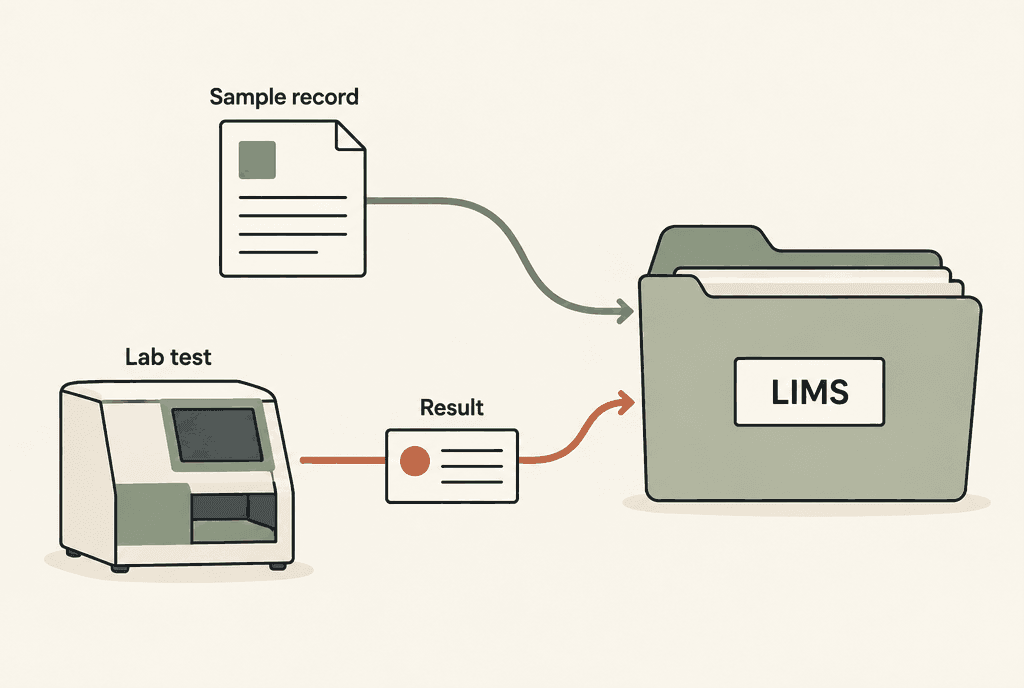
A LIMS tracks a sample and its results through the lab. The name means laboratory information management system: software for lab records. The CDC describes this role from sample arrival to the final report. The software can work with test machines and process their data. A record in the system is not itself a chemical test.
The CDC says a LIMS can track results and carry out calculations. It can also keep a history of work on a sample. Think of that history as a trail through the lab. The trail connects the sample, the test work, and the report.
That trail still needs test evidence behind each reported finding. A neat file does not show which tests were actually run. Your lot code links a batch to its records. The lab record must then show which sample and test produced each result.
What else should a reader look for on a reagent label?
A lot number is only part of a useful label. A reagent is a substance used in a lab test. The FDA lists its name, maker, warnings, and storage details among label fields. That guidance covers products for tests used to assess health. It is not a blanket label rule for every research peptide.
The FDA page was checked 17 October 2026. Its scope is in vitro diagnostic products: tests on samples taken from the body. Those tests aim to find disease or assess health. A research peptide does not become such a test through label wording.
Read the fields as separate answers, not a single seal of quality. The name says what the contents are claimed to be. The lot code ties that claim to a batch record. Storage details describe conditions; warnings flag hazards or limits. None of those fields supplies a missing test result.
Does the format of a lot number mean anything?
The format of a lot number means nothing. FDA's questions-and-answers document for ICH Q7 (2018) puts the question directly — 'Does a batch numbering system need to be sequential?' — and answers it with a single word: 'No' (question 6.2). The underlying rule, ICH Q7 (2000) paragraph 6.51, asks only that the number be unique. A code that looks like a date may not encode one. A short code may not mean a small run, and a long code may not mean anything at all. Reading volumes, dates, or quality tiers out of the shape of the string invents meaning the rule never put there.
A number is a pointer, not a description. Pointers need only be distinct, and distinct is the whole of the requirement here. The supply-chain question sits elsewhere: the certificate's manufacturer line, not the code's shape, is what FDA ties to traceability (question 17.4). Catalogue phrases that sound like standards raise a similar temptation to read meaning into wording, and what research grade actually means takes one such phrase apart word by word.
Does a matching lot number prove the material is what the paperwork says?
A matching lot number does not prove the material is what the paperwork says. The match identifies which sheet belongs to which run; it says nothing about whether the numbers on that sheet hold. Verbeke and colleagues tested 98 synthetic research peptides against the purity each supplier's certificate claimed. Of those 98, only 43 reached the certified 95.0% figure under the researchers' own methods (Verbeke et al., Journal of Pharmaceutical Analysis, 2015). A pairing check is the first step, not the verdict.
The distinction is gentle but firm. Trust in the pairing and trust in the figures are two separate acts, and the second needs its own evidence. Catalogues keep the two beside each other: the listing for retatrutide reference material sets stock alongside historical sample documentation; each report describes only its named lot. Checking that the strings agree is quick. Knowing what agreement establishes — and what it leaves open — is the slower skill this page is about.
Evidence limits
What has research not shown about batch and lot numbers?
Published evidence does not show that a lot number demonstrates safety, regulatory approval, or fitness for any human use. The sources behind this page are manufacturing rules and guidelines, not studies. 21 CFR 211, ICH Q7 (2000), and WHO Technical Report Series No. 1060 were all written for pharmaceutical manufacture, and none of them speaks to a research-use-only catalogue. Only one re-testing study sits behind the purity figure in the section above, and its 98 peptides were quorum-sensing compounds rather than stock from a 2026 listing (Verbeke et al., Journal of Pharmaceutical Analysis, 2015). What the code does establish — one run, tied to its records — remains useful within those walls.
Paperwork has walls, and those walls are the whole point of it. Research-use-only material is laboratory stock: it is not a medicine, it stands in for no approved medicine, and nothing about it is intended for human or animal use. A lot number cannot turn laboratory stock into an approved product, and a purity percentage says nothing about whether a substance is safe. Within its remit the code does honest work: it singles out one run from the line and holds its records together. A small string, faithfully matched, that keeps one run's story straight.
Comparison
What each identifier names, who assigns it, what a reader can check with it, and what it does not establish.
| Distinction | Product name on the listing | Batch (lot) number | Certificate of analysis |
|---|---|---|---|
| What it names | The product line | One production run | The tests run on that one run |
| Who assigns it | The seller | The manufacturer (WHO TRS No. 1060, 2025, Annex 3, 10.9) | Issued for each batch on request (ICH Q7, 2000, 11.40) |
| What it lets a reader check | Nothing about a run | Which run the container came from (21 CFR 211.130(c)) | What that run measured |
| Where it is defined | Nowhere published | 21 CFR 211.130; ICH Q7 6.51; WHO TRS No. 1060 Annex 3 | ICH Q7 11.40–11.41 |
| What it does not establish | Quality, origin, or testing | Purity, safety, or approval | Independent verification (Verbeke et al., 2015) |
FAQ
Is a lot number the same as a batch number?
Yes. The WHO Technical Report Series No. 1060 (2025) Annex 3 glossary lists 'lot number' with a cross-reference — 'See batch number' — so the two terms name one object: the code for a single production run.
Do lot numbers have to follow a standard format?
No. FDA's ICH Q7 Questions and Answers (2018) asks in question 6.2 whether a batch numbering system needs to be sequential and answers 'No': ICH Q7 paragraph 6.51 requires only that each number be unique.
What does matching a label to a certificate actually confirm?
A label-to-certificate match confirms that the sheet describes the run the container came from — a pairing check rather than a quality verdict. The match says which records belong together, not whether the figures on them would survive independent testing.
Does a lot number mean the material was independently tested?
No. Every one of the 98 research peptides in a 2015 study came with a supplier certificate claiming 95.0% purity or better, and re-testing confirmed that figure for 43 of them (Verbeke et al., Journal of Pharmaceutical Analysis, 2015). A lot number ties paperwork to a run; it is not itself a test result.
More in this hub
Peptide Quality & Verification
- Which peptide company is the most trusted?
- How to read a certificate of analysis (COA)
- How to check a peptide certificate of analysis is genuine
- How to check an Australian peptide supplier is legitimate
- What research grade actually means
- CJC-1295 with DAC vs without DAC: what is the difference?
- Selank vs Semax: are they the same peptide?
- Is NAD+ a peptide?
- How mass spectrometry confirms peptide identity
- How HPLC purity is measured for peptides
- Endotoxin, sterility and purity: three different tests
- TB-500 vs thymosin beta-4: is TB-500 the same molecule?
- What does a peptide cleavage predictor measure?
- What is peptide mass fingerprinting, and what can it identify?
Citations
8 sourcesU.S. Code of Federal Regulations 21 CFR 211.130. Packaging and labeling operations, section (c).
doi:https://www.law.cornell.edu/cfr/text/21/211.130U.S. Code of Federal Regulations 21 CFR 211.188. Batch production and control records.
doi:https://www.law.cornell.edu/cfr/text/21/211.188International Council for Harmonisation ICH Q7. Good Manufacturing Practice Guide for Active Pharmaceutical Ingredients, 2000, clauses 6.51, 7.24, 9.42, 11.40–11.41.
doi:https://database.ich.org/sites/default/files/Q7%20Guideline.pdfU.S. Food and Drug Administration ICH Q7 Questions and Answers. Guidance for Industry, 2018, questions 6.2 and 17.4.
doi:https://www.fda.gov/media/112426/downloadWorld Health Organization WHO Technical Report Series, No. 1060. Annex 3, WHO good manufacturing practices for excipients used in pharmaceutical products, 2025, glossary and clauses 10.9, 10.28.
doi:https://cdn.who.int/media/docs/default-source/medicines/norms-and-standards/guidelines/production/annex-3_who-good-manufacturing-practices-for-excipients-used-in-pharmaceutical-products.pdfVerbeke F et al. Journal of Pharmaceutical Analysis. 2015;5(3):169-181.
doi:10.1016/j.jpha.2014.12.002Centers for Disease Control and Prevention OneLab REACH. What is a LIMS? Video job aid and transcript; checked 17 October 2026.
doi:https://reach.cdc.gov/jobaid/introduction-laboratory-informatics-life-specimen-what-limsU.S. Food and Drug Administration In Vitro Diagnostic Device Labeling Requirements. Immediate-container fields and scope; checked 17 October 2026.
doi:https://www.fda.gov/medical-devices/device-labeling/in-vitro-diagnostic-device-labeling-requirements
Form Laboratories supplies research-use-only reference material. This article is an educational summary of published third-party literature. It is not medical advice, not a use instruction, and research material is not for human or animal use.