
Hub · Peptides in Perth: Research, Delivery and WA Law
Are peptides legal in Western Australia and Perth?
Peptide legality in Western Australia, including Perth, depends on the compound, product and activity under Commonwealth and WA law. The Medicines and Poisons Act 2014 and Regulations 2016 add state controls, including Schedule 4 classification under regulation 6. The TGA says a research-use-only label does not remove regulatory obligations (official sources checked 14 October 2026). This page describes research material only; it gives no personal legal advice.
01The honest answerContents
Checked 14 October 2026: the official Medicines and Poisons Act 2014, Medicines and Poisons Regulations 2016, WA Health overview and TGA peptide regulation guidance were read for this page in the Perth research peptides hub. The Act is version 00-l0-00; the Regulations are version 00-u0-00, in force from 2 October 2026. The compound schedule record below retains its 1 October 2026 reading date.
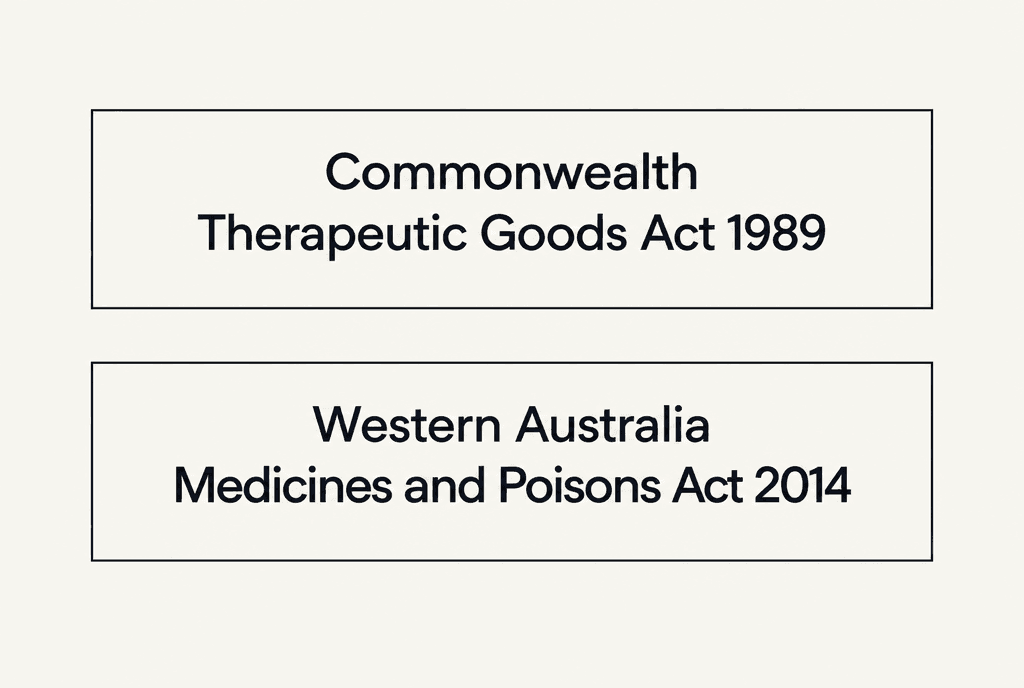
A national standard becomes binding only when a state passes the law that gives it effect, and peptide products sit inside that arrangement. Asking whether peptides are legal in Western Australia is really asking two questions at once: what the Commonwealth has decided about a substance, and what Western Australia has written around that decision.
This page, part of the Perth research peptides hub, opens each instrument in that chain, quotes it with its version and date, and stops where the reading stops. It is not legal advice, and never tells anyone what they may lawfully do.
Key facts
| Federal Act | Therapeutic Goods Act 1989 (Cth) |
|---|---|
| Federal instrument | Poisons Standard, October 2026 edition — F2026L01327, registered 30 September 2026, in force from 1 October 2026 |
| Also cited as | The SUSMP — a second name for the same document |
| How it binds in WA | Medicines and Poisons Regulations 2016 (WA), reg 6 — substance-by-substance adoption |
| WA Act | Medicines and Poisons Act 2014 (WA) — assent 2 July 2014 |
| WA consolidation read | Version 00-l0-00, current from 26 Sep 2025 (legislation.wa.gov.au) |
| Regulations consolidation read | Version 00-u0-00, current from 2 Oct 2026; checked 14 Oct 2026 |
| Replaced | Poisons Act 1964 and Poisons Regulations 1965 |
| Separate WA track | Therapeutic Goods Law Application Act 2024 (WA) — applies Commonwealth therapeutic-goods law |
| Research pathway in WA | WA Health Research/Education permit — reg 79, issued to schools, universities, government departments and research organisations |
| Commonwealth enforcement | Civil and criminal penalties apply to breaches of the Therapeutic Goods Act 1989 (TGA, 17 Aug 2026) |
Are peptides legal in Western Australia?
Western Australian law controls peptides by substance and activity; a research-use label is not legal permission. Regulation 6 of the Medicines and Poisons Regulations 2016 adopts the current Poisons Standard schedules. Commonwealth therapeutic-goods obligations also apply where a peptide product meets that definition. The TGA says labelling alone does not remove those obligations (WA legislation and TGA guidance checked 14 October 2026).
The TGA's 13 April 2026 advisory distinguishes approved peptide medicines on the Australian Register of Therapeutic Goods (ARTG) from unapproved peptide products that have not been entered in that register. State and territory laws may add controls on sale, supply and possession. The TGA's peptide products overview, updated 23 September 2026, explains that a product's contents, promotion and intended purpose determine whether it is a therapeutic good (both pages checked 14 October 2026).
Vendor pages print 'research use only' as though the words were shelter; the advisory answers in writing (TGA, 13 April 2026): 'Disclaimers that a product is for "research use only" does not make its supply lawful. These disclaimers alone do not: change a product's regulatory status; permit importation; or remove advertising or supply obligations.' This page identified no general research-use or in-vitro permission for private buyers in the specific texts reviewed: the Poisons Standard, the Medicines and Poisons Act 2014, the Medicines and Poisons Regulations 2016 and the WA Health permit material. The label alone creates no permission; the research pathway described below is an institutional permit. The TGA also describes specific exemptions, approvals and authorities in its regulatory guidance, which this page does not assess for any person.
Evidence limits
What will this page not tell you?
Four things, declared up front. This page cannot tell you what you may lawfully do — applying these instruments to a person's situation is legal advice. It gives no compound a legal or illegal verdict, because a Schedule entry is a classification rather than a permission. It prints no penalty figure from either jurisdiction: both the Commonwealth and the State set them, and this page reads the instruments rather than reprinting the numbers inside them.
And it covers Western Australia alone — other states run instruments this page has not opened.
The discipline is the laboratory one this cluster lives by: a claim is only as good as the document behind it. In a 2015 study, 98 synthetic research peptides arrived with certificates stating at least 95.0% purity, and independent re-testing confirmed the specification for 43 (Verbeke et al., Journal of Pharmaceutical Analysis, 2015). Legal text gets the same treatment: quoted, dated, or left out.
How does a federal schedule become WA law?
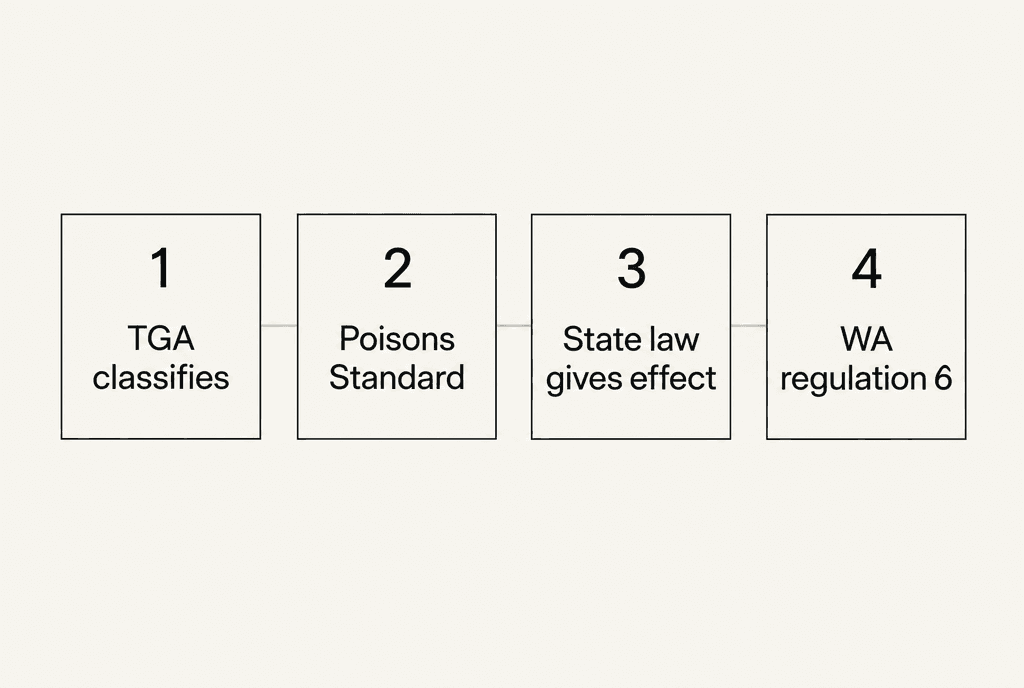
WA gives the Poisons Standard schedules legal effect through regulation 6 of the Medicines and Poisons Regulations 2016. The TGA first classifies substances by the controls needed and publishes those schedules in the Poisons Standard. Regulation 6 then classifies the listed substances as WA poisons, subject to its exceptions for exempt substances and nicotine (official Regulations and TGA sources checked 14 October 2026).
The TGA classifies medicines and chemicals 'into Schedules according to the level of regulatory control over the availability of the medicine or chemical required to protect public health and safety' (TGA scheduling page). Those schedules are published in the Therapeutic Goods (Poisons Standard—October 2026) Instrument 2026, registered 30 September 2026.
Third, a state gives the schedules legal effect — the Standard 'is given legal effect through State and Territory legislation' (TGA, Introduction to the Poisons Standard). Fourth, WA's reg 6 classifies each listed substance as a WA poison, Schedule by Schedule (Medicines and Poisons Regulations 2016).
Regulation 6 provides: 'Each substance, other than an exempt substance or nicotine, described in an item in the Table is classified as a poison included in the Schedule specified in that item'; the Table's Schedule 4 entry reads 'A substance listed in the current Poisons Standard Schedule 4'; and regulation 3 ties the phrase to section 3(1) of the Commonwealth Act. Change the federal instrument and the WA classification moves with it (version 00-u0-00, current from 2 October 2026).
WA runs two adoption tracks. The therapeutic-goods law — ARTG, advertising, import — arrives through the Therapeutic Goods Law Application Act 2024 (WA), proclaimed 30 August 2024, and WA Health states it covers 'persons conducting business in Western Australia, whether operating as a corporate entity or as a sole trader' (page last reviewed 4 September 2024). Poisons-and-scheduling controls travel the other track: the 2014 Act and Regulations.
Sources checked 14 October 2026: TGA scheduling, Introduction to the Poisons Standard, the October 2026 instrument and WA Health on therapeutic-goods law.
What does the Medicines and Poisons Act 2014 do?
The Medicines and Poisons Act 2014 (WA) — Act No. 013 of 2014, assented 2 July 2014 — is Western Australia's law for the manufacture, supply, possession and use of medicines and poisons, with the Medicines and Poisons Regulations 2016 as subsidiary legislation. WA Health describes the pair as containing 'a number of key reforms for health practitioners and businesses handling medicines', replacing the ageing Poisons Act 1964 and Poisons Regulations 1965.
Most provisions commenced 30 January 2017; the consolidation read here is version 00-l0-00, current from 26 September 2025 (legislation.wa.gov.au). Its definition of supply reaches online offers expressly (s 8).
Section 8 of the Medicines and Poisons Act 2014 includes offers to supply and expressly covers indirect supply through the internet. WA Health confirms which older laws the Act and Regulations replaced (checked 14 October 2026).
Is there a research permit pathway in WA?
Yes, and it is institutional. Regulation 79 of the Medicines and Poisons Regulations 2016 defines a 'Research/ Education permit' as one 'to use specified poisons for the purpose of education or research on behalf of a specified school, university, government department or research organisation'.
WA Health's licences-and-permits page, last reviewed 16 June 2026, describes purchase 'for education or research, such as at a school or university' and states the boundary: permits allow purchase from a licensed supplier and storage at listed premises, but 'do not allow resale and will be issued for a specified use'.
The application form's first listed purpose is 'In vitro research' — work in glassware, not bodies — then teaching and demonstration, and human and animal research, both requiring ethics-committee approval. The permit is no consumer pathway and creates no general research exemption: it is the state supervising a purchase, not waiving one.
The official WA Health licences and permits page and Research/Education permit application were checked 14 October 2026. Regulation 79 is in the official Regulations text.
Which peptide has a dated scheduling decision?
BPC-157 has a dated TGA scheduling decision. The final decision of November 2023 created a new Schedule 4 entry for BPC-157 with an Appendix D, clause 5 listing — the appendix for poisons whose possession without authority is illegal — implemented on 1 June 2024, the delegate citing 48 import referrals since 1 July 2022. The October 2026 instrument F2026L01327 carries BPC-157 in Schedule 4 and Appendix D, clause 5 (text checked 1 October 2026).
One compound, its status read from two documents.
BPC-157 is a synthetic fragment of a protein found in human gastric juice. Its literature opens with a 1993 paper in the Journal of Physiology-Paris (Sikiric et al., 1993) and runs mostly through animals and cells: a 2011 Journal of Applied Physiology study tracked tendon outcomes in rats and cultured tendon cells (Chang et al., 2011). The BPC-157 research guide covers the record.
CJC-1295, ipamorelin and TB-500 carry the same Schedule 4 and Appendix D, clause 5 entries in the October 2026 instrument (checked 1 October 2026); the CJC-1295 and ipamorelin research guide covers that pair. Four others — semax, selank, MOTS-c and NAD+ — are not individually listed as of 1 October 2026; absence from a document is never a permission. The BPC-157 reference material we supply is freeze-dried. Check any available report against the vial label; 'research grade' is a market category, not a legal one (what research grade actually means).
Read the TGA final BPC-157 scheduling decision and the national schedule table. The decision and October instrument were checked 14 October 2026; the table preserves its original reading date.
Is advertising a separate question?
Advertising is regulated apart from supply and apart from scheduling, under the therapeutic-goods advertising rules, and the TGA has aimed at the peptide market's main channel: 'Advertising or promoting unapproved peptide products, particularly through social media or influencer channels, is likely to breach Australian therapeutic goods advertising laws' (advisory, 13 April 2026). It is a separate rulebook, biting even where no supply ever happens.
Anyone learning about these compounds from sponsored posts is reading what the regulator describes in those terms.
The TGA prescription-medicine advertising guidance, published 18 June 2026, explains that not all information is advertising; purpose and context matter. This page describes legal records for laboratory research only, without claims about personal use (guidance checked 14 October 2026).
What happens when the rules are broken?
The TGA media release of 17 August 2026 records that breaches of the Therapeutic Goods Act 1989 carry civil and criminal penalties, so enforcement is real rather than theoretical. Those are Commonwealth consequences for Commonwealth breaches. Advertising is policed separately from supply: the therapeutic-goods advertising rules bite even where no supply ever happens.
No penalty number appears on this page, from either jurisdiction: each figure sits in its own instrument, where its context is visible, and this page stays with the instrument rather than lifting the number out of it.
One honest absence belongs on the record: a September 2026 search pass found no WA-specific peptide prosecution, no Perth enforcement story and no WA Health peptide warning — an absence in a search, not proof of absence. Importing is its own federal question — what the TGA says about importing — and the logistics pages sit inside the hub's wider Perth peptides guide.
The Perth-side notes on this page come from Form Laboratories, a Perth-based research-use-only supplier. What the Act means for anyone's circumstances is a question for a lawyer, not a catalogue.
The TGA media release of 17 August 2026 was checked 14 October 2026. Its enforcement examples concern Commonwealth law; they do not establish a WA prosecution.
Comparison
Three separate questions people collapse into one; the rows state what each asks, who answers, and what a 'yes' does not imply.
| Criterion | Is it on the ARTG? | Is it scheduled? | May it be advertised? |
|---|---|---|---|
| What the question asks | Whether the TGA has evaluated a product and entered it in the ARTG (TGA, 13 April 2026) | Whether a substance sits in a Poisons Standard Schedule (TGA scheduling page) | Whether promoting the product complies with advertising law (TGA, 13 April 2026) |
| Who answers it | The TGA, which approves peptide medicines and includes them in the ARTG (TGA, 13 April 2026) | The TGA scheduling delegate; WA gives it effect through reg 6 (Medicines and Poisons Regulations 2016 (WA), reg 6, version 00-u0-00, current from 2 October 2026) | The Therapeutic Goods Act 1989 advertising provisions, applied to the promotion (TGA, 13 April 2026) |
| Which document records it | An ARTG entry — an unapproved product has none (TGA, 13 April 2026) | The current Poisons Standard: F2026L01327, registered 30 September 2026 | The promotion itself, read against the Therapeutic Goods Act 1989 advertising provisions (TGA, 13 April 2026) |
| What a 'yes' does not imply | Nothing about any other product, including research-use-only material with the same name (TGA, 13 April 2026) | That any product containing the substance is approved, or that anyone's dealings are authorised (Medicines and Poisons Regulations 2016 (WA), reg 6, version 00-u0-00, current from 2 October 2026) | Nothing comfortable: promoting unapproved peptide products is likely to breach advertising laws (TGA, 13 April 2026) |
FAQ
Are peptides legal in Western Australia?
Peptide products that meet the therapeutic-goods definition are regulated under the Commonwealth Therapeutic Goods Act 1989; WA adds its own controls in the Medicines and Poisons Act 2014 and the Medicines and Poisons Regulations 2016. Approved peptide medicines carry ARTG entries; unapproved products have not been evaluated by the TGA (advisory, 13 April 2026). Whether an activity is lawful depends on the substance, the product and the person.
Does 'research use only' make peptides legal?
The TGA advisory of 13 April 2026 states that 'research use only' wording alters no product's regulatory status, permits no importation and removes no advertising or supply obligations. No general research-use permission for private buyers was identified in the specific texts reviewed: the Poisons Standard, the Medicines and Poisons Act 2014, the Medicines and Poisons Regulations 2016 and the WA Health permit material; the research pathway described on this page is the institutional Research/Education permit. This page does not assess other specific exemptions, approvals or authorities.
Do I need a permit to buy peptides for a lab in WA?
WA Health describes a permit to purchase medicines or poisons for research and educational settings for schools, universities, government departments and research organisations. The Research/Education permit is institutional rather than for private buyers (regulation 79); in-vitro research is a listed purpose on its form, and it permits no resale.
Is BPC-157 prescription only in Australia?
BPC-157 is listed in Schedule 4 of the Poisons Standard under a TGA final decision of November 2023, implemented 1 June 2024, with an Appendix D, clause 5 entry (checked 1 October 2026). The October 2026 instrument still carries both entries (checked 1 October 2026).
Which Act covers medicines and poisons in WA?
The Medicines and Poisons Act 2014 (WA) and its subsidiary legislation, the Medicines and Poisons Regulations 2016, which replaced the Poisons Act 1964 and Poisons Regulations 1965 (WA Department of Health). The Therapeutic Goods Law Application Act 2024 separately applies Commonwealth therapeutic-goods law inside the state.
More in this hub
Peptides in Perth: Research, Delivery and WA Law
- Peptides in Perth: 20 Questions, Answered
- Ordering Peptides From Perth Instead of Importing
- Peptide Delivery Times From Perth, State by State
- Research Peptides Across Western Australia
- Freeze-Dried Peptides and a Perth Summer: What Studies Report on Heat, Light and Water
- Retatrutide in Perth: Research Records and WA Status
- TB-500 in Perth: the Thymosin Beta-4 Fragment
- BPC-157 in Perth: Scheduling, Research and Dispatch
- CJC-1295 in Perth: No DAC, Ipamorelin and TGA Status
- MOTS-c in Perth: a Peptide Written in Mitochondrial DNA
- NAD+ in Perth: What It Is, and Why It Is Not a Peptide
- How to Read a Peptide Trial on the ANZCTR
Citations
3 sourcesSikiric P et al. Journal of Physiology-Paris. 1993;87(5):313-327.
doi:10.1016/0928-4257(93)90038-UChang CH et al. Journal of Applied Physiology. 2011;110(3):774-780.
doi:10.1152/japplphysiol.00945.2010Verbeke F et al. Journal of Pharmaceutical Analysis. 2015;5(3):169-181.
doi:10.1016/j.jpha.2014.12.002
Continue
Research compound catalogue - supplied for laboratory research onlyResearch peptides in PerthForm Laboratories supplies research-use-only reference material. This article is an educational summary of published third-party literature. It is not medical advice, not a use instruction, and research material is not for human or animal use.