
Compound hub · IGF-1 LR3
What are the side effects of IGF-1 LR3?
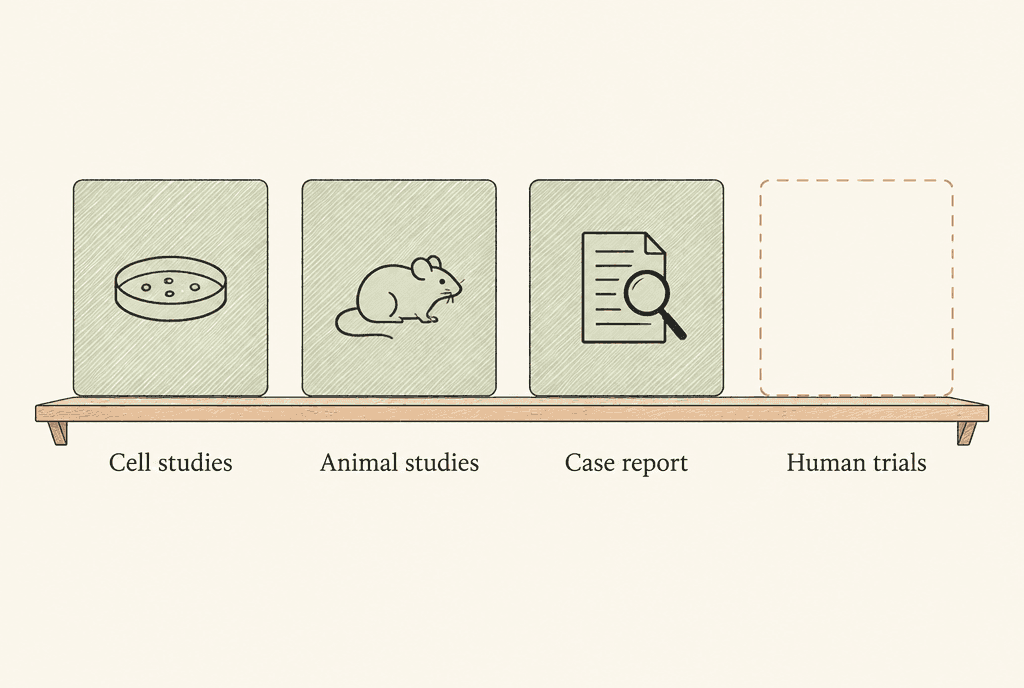
No human trial of IGF-1 LR3 was found, so no side-effect list measured in a trial exists. A 2026 review says reports from people using IGF-1 LR3 outside medical care mostly describe insulin-like effects, such as signs of low blood sugar. The review warns that many of those reports do not come from clinics or studies. Safety of IGF-1 LR3 in people is therefore not established.
01What is documentedContents
Blood sugar has to stay inside a narrow band, and insulin is the hormone that does most of the steering. IGF-I is a close relative of insulin, and its receptor looks a lot like the insulin receptor. Because of that family link, safety records for IGF-type molecules keep coming back to blood sugar. That link frames this page of the IGF-1 LR3 hub.
Below are the records that exist: a 2026 review, the label of the approved IGF-1 medicine mecasermin, animal observations and a case report on what one vial contained. Each is tied to what it covers. None is a safety study of IGF-1 LR3 in people.
Key facts
| Human trials of IGF-1 LR3 | None found on ClinicalTrials.gov, 16 October 2026 |
|---|---|
| Concern named most often in a 2026 review | Insulin-like activity, with symptoms suggestive of low blood sugar (Dominikowski et al., 2026) |
| Cancer risk | Described as theoretical, with no long-term safety data (Dominikowski et al., 2026) |
| Label of the approved IGF-1 medicine | FDA label for Increlex: a different molecule, not IGF-1 LR3 |
| Product-identity case report | His-tagged Long-R3-IGF-I found in a black-market vial (Kohler et al., 2010) |
| Evidence tier in the 2026 review | Tier D: no peer-reviewed human studies |
What side effects are documented for IGF-1 LR3?
No controlled human study of IGF-1 LR3 side effects was found in the sources checked. A 2026 review by Dominikowski and colleagues describes reports of hypoglycaemia symptoms, meaning signs of low blood sugar, from use outside medical care. It warns that many of these reports do not come from clinics or studies. The review calls cancer concerns theoretical and notes there are no long-term safety data. A personal story cannot show how often a problem happens. Neither can a theory about how the molecule works. Nor can either show that IGF-1 LR3 caused it. So a human safety profile is not established.
The review placed IGF-1 LR3 in its lowest evidence group, with no peer-reviewed human studies. It said contact with compounds like this should be treated as poorly supported by evidence. A report that someone felt unwell is an account, not a controlled finding. Only a controlled study, where a comparison group is followed in the same way, could show whether the analogue caused it.
What studies show about IGF-1 LR3 lists the cell and animal research that does exist.
What does the label of the approved IGF-1 medicine warn about?
The FDA label for mecasermin (Increlex) lists these warnings: severe low blood sugar with seizures, serious allergic reactions, and raised pressure inside the skull. It also lists enlarged lymphoid tissue, which is part of the immune system, and slipped capital femoral epiphysis, a hip problem where the top of the thigh bone slips. Scoliosis getting worse and malignant tumours are listed too. The label covers growth failure in children aged two and older with severe primary IGF-1 deficiency, or with growth hormone gene deletion and antibodies that block growth hormone. These warnings are about mecasermin, a different molecule. They are not measured side effects of IGF-1 LR3.
Mecasermin has the same sequence as human IGF-1, and IGF-1 LR3 does not. The label gives no safety data for IGF-1 LR3. It describes children treated for a defined condition, not other groups. These records do not show whether IGF-1 LR3 shares those effects in people.
The label does show why researchers watch blood sugar. It says the medicine lowers blood sugar the way insulin does. The label is dated July 2025. The general peptide side-effects guide explains how to read labels like this.
What did animal studies note about IGF-1 LR3?
Animal studies noted changes in hormones and body measures, not human side effects. In guinea pigs given a 7-day infusion of LR3-IGF-I, blood levels of IGF-I, IGF-II and IGF binding proteins went down. At the same time, several organs grew heavier compared with body weight. In normal fetal sheep, a 1-week infusion lowered insulin and lowered the release of insulin in response to sugar. In fetal sheep that were growing too slowly, the infusion was followed by lower amino acids in the blood. These results come from a 1995 guinea pig study and a 2025 sheep study.
These observations come from different species and settings. Fetal sheep model a pregnancy, not an adult person. The studies show that the analogue changes other hormone systems in animals. They are not reports of harm in people, and no human equivalent was measured.
Evidence limits
Can the contents of an IGF-1 LR3 product be trusted?
What a product really contains was a documented problem in one black-market sample. Kohler and colleagues used mass spectrometry, a lab test that weighs molecules to identify them, on a vial. They found His-tagged Long-R3-IGF-I, a form usually made for lab studies of proteins. A His-tag is a short handle added so scientists can fish the protein out. The authors said the effects of this tagged form in people had not been described. They suggested it could be a by-product of lab work. This case report shows what one sample held. It does not show how common such material is, or what any other vial holds.
The 2026 review also gives uncertainty about what is in products from unregulated supply chains as a reason for caution. The TGA, Australia's medicines regulator, states that unapproved peptide products have not been assessed by the TGA for safety, quality or effectiveness (TGA advisory, 13 April 2026). That advisory names other compounds as examples and does not name IGF-1 LR3.
The peptide quality and verification hub explains how a certificate of analysis and a mass spectrometry result describe what a vial contains. How mass spectrometry confirms peptide identity explains the test used in this case.
Comparison
Four kinds of safety record and what each covers. The table records sources, not a ranking, and it gives no advice.
| Record | Source | What it covers | What it does not cover |
|---|---|---|---|
| Narrative review | Dominikowski et al., Frontiers in Endocrinology, 2026 | Reported effects from use outside medical care, and theoretical concerns; rated tier D | Controlled human data on IGF-1 LR3 |
| Approved-medicine label | FDA label for Increlex (mecasermin) | Warnings for a different IGF-1 molecule in children under medical supervision | Any safety data for IGF-1 LR3 |
| Animal studies | Conlon et al., 1995; White et al., 2025 | Hormone and body measures in guinea pigs and fetal sheep | Harm in people |
| Case report | Kohler et al., Growth Hormone & IGF Research, 2010 | What one black-market vial contained | How common the problem is, or any effect in people |
FAQ
Does IGF-1 LR3 cause low blood sugar?
No controlled human study answers this. A 2026 review says reports from use outside medical care often describe signs of low blood sugar, and that many of them do not come from clinics or studies. The label of the approved IGF-1 medicine mecasermin warns of severe low blood sugar, but mecasermin is a different molecule.
Does IGF-1 LR3 raise cancer risk?
Not shown. The 2026 review calls the risk theoretical but clinically relevant. It points to studies that link higher blood levels of IGF-1 with several cancers. It also notes there are no long-term safety data for IGF-1 analogues.
Is IGF-1 LR3 safer than mecasermin?
No human safety comparison was found in the sources checked. Mecasermin has a regulator-reviewed label for a defined condition in children. The cited review lists no human studies for IGF-1 LR3. Neither record allows a safety ranking.
What did the product-identity case report find?
A vial from the black market held His-tagged Long-R3-IGF-I, identified by mass spectrometry. The 2010 authors reported that the effects of that form in people have not been worked out.
More in this hub
Citations
4 sourcesDominikowski A, Rękoś Z, Olejarz M, et al. Frontiers in Endocrinology. 2026;17:1822475.
doi:10.3389/fendo.2026.1822475Kohler M, Thomas A, Walpurgis K, et al. Growth Hormone & IGF Research. 2010;20(5):386-390.
doi:10.1016/j.ghir.2010.07.001Conlon MA, Tomas FM, Owens PC, et al. Journal of Endocrinology. 1995;146(2):247-253.
doi:10.1677/joe.0.1460247White A, Stremming J, Wesolowski SR, et al. American Journal of Physiology Endocrinology and Metabolism. 2025;328(1):E116-E125.
doi:10.1152/ajpendo.00259.2024
Form Laboratories supplies research-use-only reference material. This article is an educational summary of published third-party literature. It is not medical advice, not a use instruction, and research material is not for human or animal use.