
Compound hub · IGF-1 LR3
What do studies show about IGF-1 LR3?
Published research on IGF-1 LR3 is made up of cell experiments and animal studies in rats, guinea pigs, cattle, sheep and mice. No human trial of IGF-1 LR3 was found on ClinicalTrials.gov on 16 October 2026. A 2026 review placed IGF-1 LR3 in its lowest evidence group, because no human studies had been published in peer-reviewed journals.
01Human evidenceContents
Ask who or what was studied before you ask what a study found. A result in a dish of cells, a rat or an unborn lamb shows how a molecule behaves in that setting, and nothing more. Most research on IGF-1 LR3 is of that kind, and the IGF-1 LR3 hub collects it.
This page lists the main findings with their species and limits, starting with what has not been shown. For the reasons behind the cell results, see how IGF-1 LR3 works.
Key facts
| Registered human trials, checked 16 October 2026 | None found on ClinicalTrials.gov for four search phrases |
|---|---|
| Evidence tier in a 2026 review | Tier D: no peer-reviewed human studies (Dominikowski et al., 2026) |
| Foundational cell paper | Francis et al., 1992, cell experiments (PMID 1378742) |
| Animal models in the papers opened | Rat, guinea pig, cow, sheep, mouse |
| Most recent animal papers opened | 2025 (fetal sheep; mouse model of Alzheimer's disease) |
| Human half-life | Not established in the sources opened |
Evidence limits
Has IGF-1 LR3 been tested in human trials?
No human trial of IGF-1 LR3 was found in the searches checked. On 16 October 2026, ClinicalTrials.gov was searched for four phrases: IGF-1 LR3, Long R3 IGF, LR3-IGF-1 and long arginine 3 IGF. None returned a study of the analogue. The last phrase returned one unrelated study of OncoLAR, NCT00001436. A 2026 review by Dominikowski and colleagues lists no peer-reviewed human studies. It says what is known about how IGF-1 LR3 works is borrowed from IGF-I biology. These sources show a gap in the evidence. They cannot prove that no human study exists anywhere.
The main papers checked here cover cells grown in dishes (Francis and colleagues in 1992; Devi and colleagues in 2001), diabetic rats (1993), guinea pigs (1995), fetal sheep (2025) and mice (2025). A 1998 paper that built a blood test for the analogue used plasma from cattle. This is a check of named sources, not of every published report.
No trial does not mean safe, and it does not mean harmful. It means the question is still open. The side-effects page records what is documented about safety.
What did the first IGF-1 LR3 cell experiments find?
The first cell experiments, by Francis and colleagues in 1992, found that Long [Arg3]-IGF-I was more potent than IGF-I in L6 rat myoblasts, a line of young muscle cells. Potency means how strong an effect a set amount produces. The team measured three things: protein building, DNA building and protein breakdown. In cell lines that released IGF binding proteins, the analogue came out ahead. In chicken embryo fibroblasts with no binding proteins detected, it was less potent than IGF-I. The authors linked the difference to binding proteins. These results describe cells in dishes, not people.
A 2001 experiment tested several IGFs and analogues, including Long(R3)IGF-I. It looked at how strongly each one switched on the receptor. A carrier protein called IGF-binding protein 3 reduced that switching for all of them, over a similar range of concentrations. These are cell results too, and they do not show what happens in a person.
What did rat and guinea pig studies find?
In diabetic rats, LR3-IGF-I and des(1-3)IGF-I were 2.5 to 3 times more potent than IGF-I at restoring growth rate. Not all insulin-dependent processes in liver, muscle and fat were restored. That was a 1993 study in the Biochemical Journal. In a 1995 guinea pig study, animals were given LR3-IGF-I by infusion for 7 days. Their adrenal glands, gut, kidneys and spleen grew heavier compared with body weight. Overall growth did not increase. Blood levels of IGF-I, IGF-II and IGF binding proteins fell. These are animal results, and they do not show the same response in people.
The two papers show how a result can change with the species. The same analogue that raised growth rate in diabetic rats left overall growth unchanged in guinea pigs. The guinea pig study offered a possible reason: the total amount of IGF in the blood did not go up with the treatments.
What did fetal sheep and mouse studies find?
A 2025 study looked at fetal sheep that were growing too slowly. Seven received IGF-1 LR3 by infusion for 1 week, and seven received a plain carrier liquid for comparison. The analogue did not improve growth, and amino acids in the blood fell. A second 2025 study used male 5XFAD mice, which are bred to model Alzheimer's disease. They received long R3 IGF-1 through the nose for 7 months. It changed features of amyloid plaques in the cortex, the brain's outer layer. It did not clearly change memory and thinking problems. Neither study shows the same outcomes in people.
The sheep authors noted their earlier work in normal fetal sheep. There, a 1-week infusion raised body weight but lowered insulin and the release of insulin in response to sugar. The mouse authors concluded that their data do not support the analogue as a treatment on its own, and that combinations would need further study.
What IGF-1 LR3 is explains why researchers chose this analogue for animal work.
How strong is the evidence for IGF-1 LR3?
IGF-1 LR3 has preclinical evidence only, meaning work done before any testing in people. The cited review found no peer-reviewed human studies. Cell experiments show what happens in cells grown in dishes. Animal experiments show responses in one species under set conditions. Neither shows how a person responds. Dominikowski and colleagues place IGF-1 LR3 in tier D, their group for compounds with no peer-reviewed human studies. They separate a believable mechanism from clinical evidence. Tier D is the review authors' own system. It is not a regulator approval, a safety rating or a measurement in people.
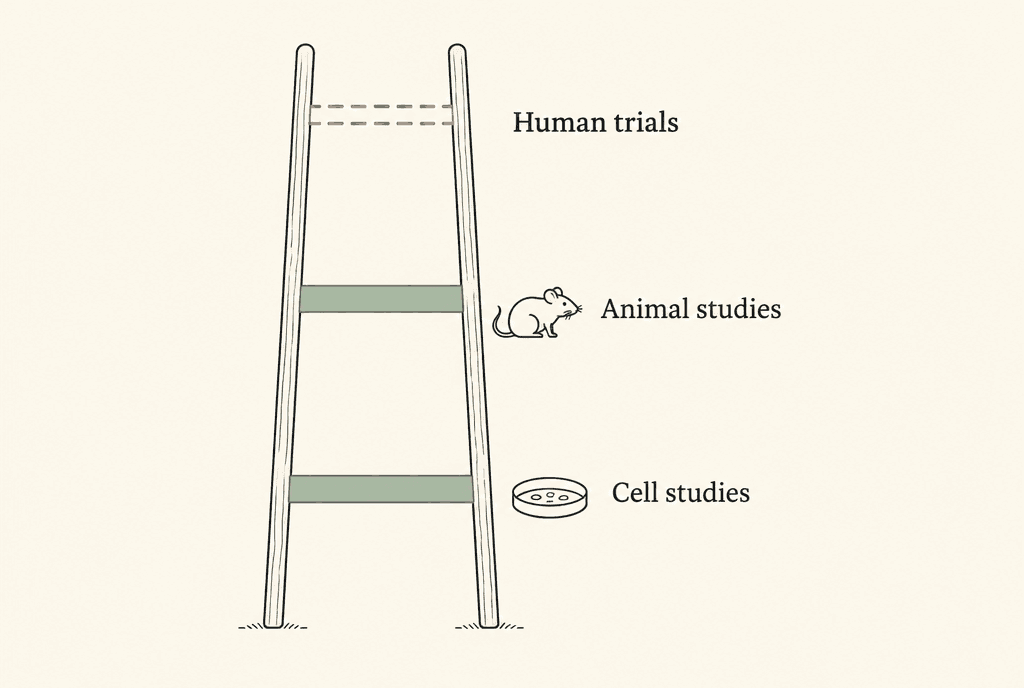
Think of evidence as a ladder. Cell studies are the bottom rung, animal studies the middle, and controlled human trials the top. For IGF-1 LR3, the top rung is empty.
Online posts are personal accounts, not controlled studies. The guide to peptide side effects explains how to grade the evidence behind safety claims, and the Australian peptide law guide covers the regulator records.
Comparison
What each kind of IGF-1 LR3 evidence can show about people. Examples are the named studies on this page. This is a record of evidence types, not a ranking of outcomes.
| Evidence type | Example | What it can show | What it cannot show |
|---|---|---|---|
| Cells grown in dishes | Francis et al., 1992; Devi et al., 2001 | How potency and receptor switching change when binding proteins are present or absent | How a whole person responds |
| Rats and guinea pigs | Tomas et al., 1993 (diabetic rats); Conlon et al., 1995 (guinea pigs) | A whole-animal response under set conditions, which differed between the two species | That the same response occurs in people |
| Fetal sheep and mice | White et al., 2025; Engel et al., 2025 | Effects on fetal growth markers in sheep, and on plaque and behaviour measures in a mouse model | Any human outcome |
| Human trials | None found (ClinicalTrials.gov, 16 October 2026) | Nothing yet for IGF-1 LR3 | Effects, safety or half-life in people |
| Narrative review | Dominikowski et al., 2026 | Where the evidence sits, by tier, and what is borrowed from IGF-I biology | New data; a review gathers published reports and tests nothing itself |
FAQ
Are there clinical trials of IGF-1 LR3?
None were found. ClinicalTrials.gov showed no study of the analogue for four search phrases on 16 October 2026. A 2026 review in Frontiers in Endocrinology lists no peer-reviewed human studies.
What did the 1992 paper on IGF-1 LR3 find?
Francis and colleagues made Long [Arg3]-IGF-I in bacteria and compared it with IGF-I in cells grown in dishes. It was more potent in cells that release IGF binding proteins. It was less potent in cells where none were detected.
Do animal studies show what IGF-1 LR3 does in people?
No. The animal studies reached different results in different species. Growth rate rose in diabetic rats in 1993, while overall growth did not change in guinea pigs in 1995. Neither measured a human response.
Why does this hub give no half-life for IGF-1 LR3?
No human study of how the body handles IGF-1 LR3 was found. A 2026 review lists the half-life as not documented. A seller's estimate cannot replace a measured human result.
More in this hub
Citations
8 sourcesGajanandana O, Irvine K, Grant PA, et al. Journal of Endocrinology. 1998;156(3):407-414.
doi:10.1677/joe.0.1560407Francis GL, Ross M, Ballard FJ, et al. Journal of Molecular Endocrinology. 1992;8(3):213-223.
doi:10.1677/jme.0.0080213Devi GR, Graham DL, Oh Y, Rosenfeld RG Growth Hormone & IGF Research. 2001;11(4):231-239.
doi:10.1054/ghir.2001.0231Tomas FM, Knowles SE, Owens PC, et al. Biochemical Journal. 1993;291(3):781-786.
doi:10.1042/bj2910781Conlon MA, Tomas FM, Owens PC, et al. Journal of Endocrinology. 1995;146(2):247-253.
doi:10.1677/joe.0.1460247White A, Stremming J, Wesolowski SR, et al. American Journal of Physiology Endocrinology and Metabolism. 2025;328(1):E116-E125.
doi:10.1152/ajpendo.00259.2024Engel et al. Journal of Alzheimer's Disease. 2025;103(1):113-126.
doi:10.1177/13872877241299056Dominikowski A, Rękoś Z, Olejarz M, et al. Frontiers in Endocrinology. 2026;17:1822475.
doi:10.3389/fendo.2026.1822475
Form Laboratories supplies research-use-only reference material. This article is an educational summary of published third-party literature. It is not medical advice, not a use instruction, and research material is not for human or animal use.