
Compound hub · IGF-1 LR3
What is IGF-1 LR3?
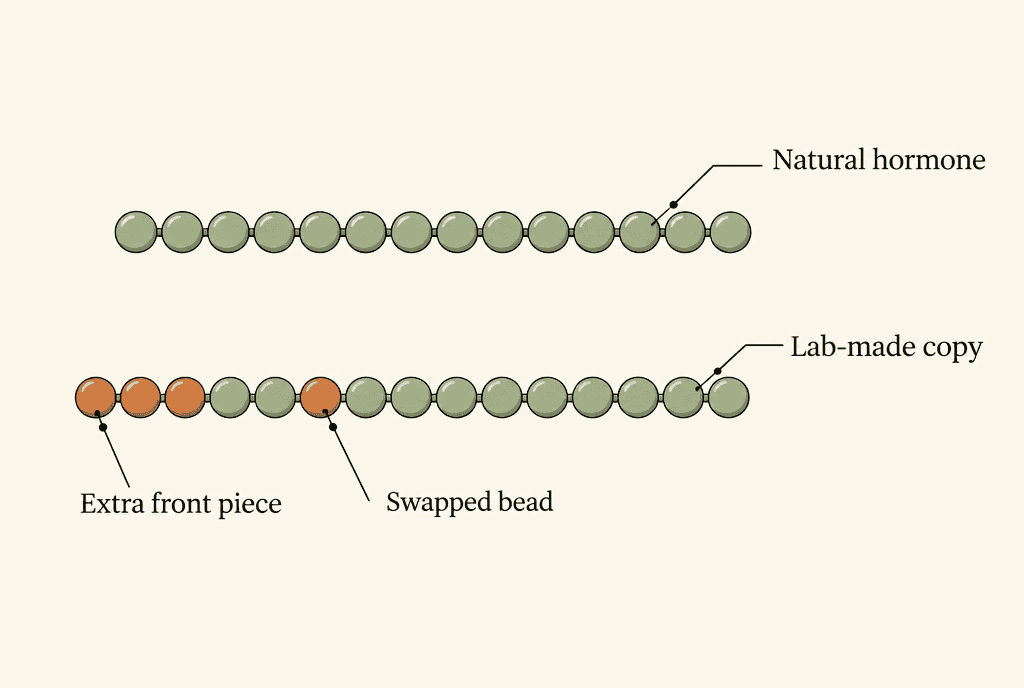
IGF-1 LR3 is a lab-made copy of IGF-I, a natural hormone that carries growth signals around the body. The copy has two changes: one building block near the start of the chain is swapped for another, and a short extra piece is added to the front. Scientists in Adelaide first described IGF-1 LR3 in 1992. No human trial of IGF-1 LR3 was found.
01What it isContents
Picture a hormone that passes growth messages from one part of your body to another. Your liver and many other tissues make one like that, called IGF-I, short for insulin-like growth factor I. Most of it rides through your blood held by carrier proteins. Researchers wanted to see what happens when those carriers cannot hold on, so they built a changed copy. That copy is IGF-1 LR3, the subject of the IGF-1 LR3 hub.
This page answers the plain questions first: what IGF-1 LR3 is, what its name means, how it differs from IGF-I and from the approved medicine mecasermin, and what is known about people. It sticks to what was measured, and it says plainly where nothing was found.
Key facts
| Common name | IGF-1 LR3 |
|---|---|
| Other names in papers | Long [Arg3]-IGF-I; LR3IGF-I; Long R3 IGF-I |
| Parent hormone | Insulin-like growth factor I (IGF-I), 70 amino acids (FDA label for mecasermin) |
| Change at position 3 | Glutamic acid replaced by arginine (Francis et al., 1992) |
| Other change | Extra amino acids at the front of the chain (Francis et al., 1992) |
| Foundational cell paper | Francis et al., Journal of Molecular Endocrinology, 1992 (PMID 1378742) |
| Made in | Escherichia coli bacteria, as a fusion protein (Francis et al., 1992) |
| Registered human trials, checked 16 October 2026 | None found on ClinicalTrials.gov for four search phrases |
| Human half-life | Not established in the sources opened |
What is IGF-1 LR3?
IGF-1 LR3 is an analogue of IGF-I. An analogue is a related molecule with a changed structure, a bit like a key cut with one extra notch. Francis and colleagues described how to make it in 1992. They grew it in Escherichia coli bacteria as a fusion protein, which means two protein pieces built as one chain. The front piece is the first 11 amino acids of methionyl porcine growth hormone, a pig hormone, plus two more amino acids, valine and asparagine. In the IGF-I part, arginine replaces glutamic acid at position 3. They named the result Long [Arg3]-IGF-I.
Amino acids are the small building blocks of proteins. They link up like beads on a string. Natural IGF-I is a string of 70 of them.
The extra front piece is not part of human IGF-I. In the 1992 paper, it helped the chain fold into its working shape. The authors wrote that a hydrophobic front extension, meaning one that avoids water, appears to help the chain fold correctly.
The same paper made two sister molecules. One had glycine at position 3. The other kept the normal IGF-I sequence behind the same front piece.
The PubMed record lists the work as coming from a research group in Adelaide, South Australia. A 2026 review describes IGF-1 LR3 the same way: arginine in place of glutamic acid at position 3, plus an extra piece at the front.
What does LR3 stand for in IGF-1 LR3?
LR3 is short for Long [Arg3], the name used in the first paper in 1992. "Long" refers to the extra piece at the front of the chain. "Arg3" means arginine sits at position 3 of the IGF-I part, where glutamic acid normally sits. A 1998 paper by Gajanandana and colleagues called the same molecule Long-Arg3-IGF-I and LR3IGF-I. These names describe the shape of the molecule. "Long" does not mean the molecule lasts a long time in a person. The names say nothing about how long it stays in the body.
Names in this field drift. The 1992 paper called the two sister molecules Long IGF-I and Long [Gly3]-IGF-I. This hub uses IGF-1 LR3 for the lab-made analogue and IGF-I for the natural hormone, so the two never get mixed up.
How is IGF-1 LR3 different from IGF-I and from mecasermin?
IGF-1 LR3 differs from IGF-I in two ways: its sequence, and how tightly carrier proteins grab it. These carriers are called IGF binding proteins. A 1998 study found that IGF-1 LR3 binds them much less than natural IGF-I and IGF-II do. Mecasermin is a third molecule. It is a medicine made in the lab with exactly the same sequence as natural IGF-I. Its label covers defined growth disorders in children. IGF-1 LR3 has a changed sequence, so the mecasermin label cannot show its safety, how fast the body clears it, or whether it is approved.
The table below puts the three molecules side by side. Similar names do not make them the same molecule. The approval of mecasermin says nothing about IGF-1 LR3, because the label describes only mecasermin.
How IGF-1 LR3 works explains why the weaker grip on carrier proteins changed the results in cell experiments.
Is IGF-1 LR3 an approved medicine?
No approval for IGF-1 LR3 was found in the records checked. The label from the US Food and Drug Administration (FDA) covers mecasermin, not IGF-1 LR3. In Australia, the Australian Register of Therapeutic Goods (ARTG) is the national list of medicines and other health products. It lists the mecasermin product Increlex as entry 308494, registered on 22 November 2019. Neither record names IGF-1 LR3. The check covered only those named records. It was not a full search of every registration. So this page cannot prove that IGF-1 LR3 is missing from the register. It can only say the check did not find it.
Being on sale and being lawful are separate questions. Is IGF-1 LR3 legal in Australia? sets out the Poisons Standard, TGA and WADA records, each with the date it was checked.
Evidence limits
What human evidence exists for IGF-1 LR3?
No human trial of IGF-1 LR3 was found. On 16 October 2026, four different searches on ClinicalTrials.gov, the main public list of clinical trials, found no study of the analogue. One search returned a single unrelated study of OncoLAR, NCT00001436. A 2026 review of peptides linked to growth hormone put IGF-1 LR3 in its lowest evidence group. The reason was that no human studies had appeared in peer-reviewed journals, where other scientists check the work before it is published. Studies in cells and animals do exist. They cannot show what the analogue does in a whole person under controlled conditions.
Half-life means the time the body takes to clear half of a substance. No human half-life for IGF-1 LR3 was found in the sources checked, so this hub prints no number. The same review lists the half-life as not documented. A cell study cannot supply a half-life, and the half-life of mecasermin must not be copied onto a different molecule.
Stories posted online are personal accounts, not controlled studies. What studies show about IGF-1 LR3 covers the cell and animal work, and the peptide side-effects guide explains how safety evidence is graded.
Comparison
Three related molecules and what the records say about each. This is a record of facts from named sources, not a ranking and not advice.
| Molecule | What it is | How carrier proteins bind it | Human trial and approval record |
|---|---|---|---|
| IGF-I (natural hormone) | A hormone of 70 amino acids made by the body | Held by IGF binding proteins; in blood, more than 80% is carried in a group with IGFBP-3 and a partner protein called the acid-labile subunit (FDA label for Increlex) | Not a medicine; it is the body's own hormone |
| Mecasermin | A lab-made medicine with exactly the same sequence as natural IGF-I | Same sequence as natural IGF-I, so the same carrier proteins are expected to bind it | Approved by the FDA and listed on the ARTG as Increlex (entry 308494) for a defined condition in children |
| IGF-1 LR3 | A lab-made analogue: arginine at position 3 and an extra piece at the front (Francis et al., 1992) | Bound much less by carrier proteins than natural IGF-I (Gajanandana et al., 1998) | No human trial found on ClinicalTrials.gov on 16 October 2026; no approval found in the sources opened |
FAQ
Is IGF-1 LR3 the same as IGF-1?
No. IGF-1 LR3 is a changed copy of IGF-I. It has arginine at position 3 and an extra piece at the front of the chain, as the 1992 paper by Francis and colleagues describes. Natural IGF-I has 70 amino acids and a different start to the chain.
Is IGF-1 LR3 the same as mecasermin?
No. Mecasermin is a lab-made medicine with exactly the same sequence as natural IGF-I. It is the active ingredient of the approved medicine Increlex, according to its FDA label. IGF-1 LR3 is a separate molecule.
Is IGF-1 LR3 a peptide?
Yes, in the broad sense: it is a chain of amino acids. Natural IGF-I has 70 of them, and where a peptide ends and a protein begins is a matter of convention. The guide to peptides versus proteins explains where the line is drawn.
Has IGF-1 LR3 been tested in people?
No human trial was found. On 16 October 2026, ClinicalTrials.gov showed no study of IGF-1 LR3 for four search phrases. A 2026 review in Frontiers in Endocrinology also placed it in its lowest evidence group.
More in this hub
Citations
3 sourcesFrancis GL, Ross M, Ballard FJ, et al. Journal of Molecular Endocrinology. 1992;8(3):213-223.
doi:10.1677/jme.0.0080213Gajanandana O, Irvine K, Grant PA, et al. Journal of Endocrinology. 1998;156(3):407-414.
doi:10.1677/joe.0.1560407Dominikowski A, Rękoś Z, Olejarz M, et al. Frontiers in Endocrinology. 2026;17:1822475.
doi:10.3389/fendo.2026.1822475
Form Laboratories supplies research-use-only reference material. This article is an educational summary of published third-party literature. It is not medical advice, not a use instruction, and research material is not for human or animal use.