
Hub · ANP and the Natriuretic Peptides: How the Heart's Hormones Work
ANP vs BNP vs CNP: what is the difference?
ANP, BNP and CNP are three related hormones called the natriuretic peptides. ANP and BNP come mainly from the heart and bind a receptor called natriuretic peptide receptor A (NPR-A). CNP comes mainly from the cells that line blood vessels and binds a different receptor, natriuretic peptide receptor B (NPR-B). A third receptor, NPR-C, binds all three hormones and clears them from the blood.
01The familyContents
Three letters, three hormones, one family. Your heart and your blood vessels each send out natriuretic peptides, and doctors read the letters on a lab report the way a mechanic reads a gauge. This guide lines the three up so you can see how they differ. It is one of several guides in our ANP hub.
The comparison table sits in the middle of the page. After it, the sections explain the receptor names and the one signalling step that two of those receptors share.
Key facts
| Family | Natriuretic peptides: ANP, BNP, CNP |
|---|---|
| ANP length | 28 amino acids (Kerkelä et al., 2015) |
| BNP length | 32 amino acids; released as a 108-amino-acid precursor, proBNP (Kerkelä et al., 2015) |
| CNP length | 22 and 53 amino acids (Kerkelä et al., 2015) |
| Receptors | NPR-A, NPR-B (both make cGMP) and NPR-C (clearance) (Kerkelä et al., 2015) |
| Medicine forms | Carperitide (ANP), nesiritide (BNP), vosoritide (a CNP analogue) |
What are the natriuretic peptides?
The natriuretic peptides are a family of three hormones: ANP, BNP and CNP. Each one starts as a longer chain, called a precursor, that is cut into a shorter active peptide. Active ANP is 28 amino acids long and active BNP is 32. CNP comes in two lengths, 22 and 53. ANP and BNP have been known as heart hormones since the 1980s. CNP is the third member, and studies of evolution suggest that it is the most ancient of the three. Unlike ANP and BNP, CNP does not stimulate natriuresis, the loss of sodium in urine.
Each hormone has its own story. The ANP guide covers ANP. BNP got its name because it was first isolated from pig brain. A later review, though, calls it a hormone that comes mainly from the ventricles, the heart's two lower chambers.
Where is each natriuretic peptide made, and what releases it?
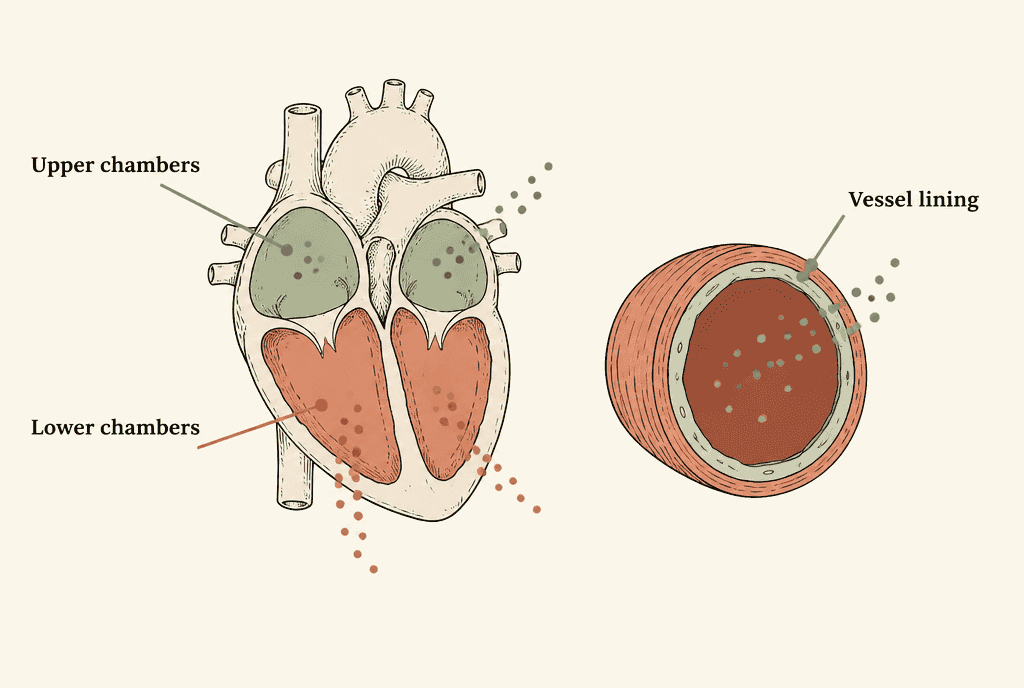
ANP comes from the atria, the heart's two upper chambers. BNP comes mainly from the ventricles, the two lower chambers. For both, the key release signal is stretch of the heart muscle. CNP is different. It comes mainly from endothelial cells, the thin layer of cells that lines blood vessels. These cells release CNP in response to cytokines, which are small signalling molecules involved in inflammation. A 2019 review adds that heart muscle cells and fibroblasts also make CNP. CNP levels in the blood are low, which suggests that CNP acts mostly as a local messenger, close to where it is made.
ANP is cut from a larger precursor and then released as an active hormone. BNP can leave the heart as a longer precursor of 108 amino acids. Enzymes called corin or furin then cut it into two parts: an inactive piece and active BNP. In 2019, Forte and colleagues reported that no valid commercial test kit detected only the active form of BNP. That is a dated account of the tests. It is not a check of every test available in 2026.
Which receptor does each natriuretic peptide use?
A receptor is a docking site on a cell that a hormone fits into. ANP and BNP mainly bind and signal through NPR-A. CNP binds NPR-B. The clearance receptor, NPR-C, binds all of them. NPR-A is also called GC-A, and NPR-B is also called GC-B. That is because both are guanylyl cyclases, enzymes that make the messenger molecule cGMP. NPR-C lacks that enzyme part. It signals instead through an inhibitory G protein, a type of switch protein inside the cell. A 2019 review adds that CNP also acts through NPR-C in blood vessels.
These are main routes, not rules without exceptions. The sources say primarily, and that word matters. In one set of experiments, CNP raised cGMP in heart fibroblasts but not in heart muscle cells.
What is the cGMP step?
The cGMP step is the shared signal that NPR-A and NPR-B send. When either receptor is switched on, the cell raises its level of cyclic guanosine monophosphate, or cGMP. Think of cGMP as a relay runner carrying a baton. It activates protein kinase G (PKG), an enzyme that changes other proteins in the cell. Reviewers call PKG a key effector, meaning a molecule that carries the signal onward. In the 2011 review, ANP and BNP binding NPR-A raised cGMP and changed blood vessel tone, meaning how tight or relaxed the vessel walls are.
Nitric oxide reaches the same messenger through a different enzyme, called soluble guanylyl cyclase. Two routes lead to cGMP. That is part of why the molecule appears so often in heart and blood vessel research.
Which natriuretic peptides exist as medicines?
Each of the three has a laboratory-made form or a close copy, called an analogue. Carperitide is recombinant human ANP, used mainly in Japan. Recombinant means made in a laboratory from the human gene. Nesiritide is recombinant human BNP. A 2011 review listed it as available in the United States, Switzerland, Argentina, Colombia and Israel. Vosoritide is a CNP analogue. Its FDA label describes it for children with achondroplasia whose growth plates are still open. Each medicine has its own patient group and regulatory record. The 2011 country list is historical and does not establish availability in 2026.
How each was tested is the subject of the medicines page. The largest nesiritide trial is covered in the ASCEND-HF guide.
Evidence limits
What does this comparison leave out?
This comparison rests on review articles, and a table of main routes hides variation. The sources do not agree on every number. The same peptide can have different half-life values in different reviews. Receptor effects also differ from one cell type to another. Nothing here shows that any one natriuretic peptide is better or worse than another. The three do different jobs in different tissues, like different tools in one toolbox. The table records what the papers assign. It is not a ranking.
For how long each hormone lasts in the blood and how the body clears it, see the half-life and clearance guide.
Comparison
What the cited papers assign to each natriuretic peptide: origin, release signal, main receptor and medicine form. The table is a record of reported assignments, not a ranking and not a statement about use.
| Feature | ANP | BNP | CNP |
|---|---|---|---|
| Length of the active peptide | 28 amino acids (Kerkelä et al., 2015) | 32 amino acids, released as a 108-amino-acid precursor (Kerkelä et al., 2015) | 22 and 53 amino acids (Kerkelä et al., 2015) |
| Main source | Heart atria (Mitaka et al., 2011) | Mainly the ventricles (Mitaka et al., 2011; Kerkelä et al., 2015) | Mainly endothelial cells; also heart muscle cells and fibroblasts (Kerkelä et al., 2015; Moyes and Hobbs, 2019) |
| Release signal | Acute atrial stretch or pressure rise (Mitaka et al., 2011) | Gene-level control; responds to atrial and ventricular pressure (Mitaka et al., 2011) | Cytokines acting on endothelial cells (Kerkelä et al., 2015) |
| Main receptor | NPR-A (Kerkelä et al., 2015) | NPR-A (Kerkelä et al., 2015) | NPR-B, and NPR-C in blood vessels (Kerkelä et al., 2015; Moyes and Hobbs, 2019) |
| Effect on natriuresis | Stimulates natriuresis (Mitaka et al., 2011) | Stimulates natriuresis (Kerkelä et al., 2015) | Does not stimulate natriuresis (Kerkelä et al., 2015) |
| Laboratory-made form or analogue | Carperitide, used mainly in Japan (Mitaka et al., 2011; Shiga et al., 2025) | Nesiritide (Mitaka et al., 2011) | Vosoritide, a CNP analogue (FDA label, 2024) |
FAQ
What does natriuretic mean?
Natriuretic means that a substance promotes the loss of sodium in urine. In 1981, the first heart extracts tested in rats increased urine output and sodium loss. That effect gave the family its name.
Is BNP made in the brain?
BNP was first isolated from pig brain, which is why it is also called brain natriuretic peptide. But it comes mainly from the heart's ventricles, the two lower chambers.
What is NPR-C?
NPR-C is the clearance receptor for natriuretic peptides. It binds all of them, but it lacks the guanylyl cyclase part that NPR-A and NPR-B carry. A 2019 review states that NPR-C is responsible for the clearance of natriuretic peptides.
Which receptor does CNP use?
CNP binds NPR-B. A 2019 review also describes CNP acting through NPR-C.
More in this hub
ANP and the Natriuretic Peptides: How the Heart's Hormones Work
Citations
6 sourcesKerkelä R, Ulvila J, Magga J. Journal of the American Heart Association. 2015;4(10):e002423.
doi:10.1161/JAHA.115.002423Mitaka C, Kudo T, Haraguchi G, Tomita M. Critical Care. 2011;15(5):R258.
doi:10.1186/cc10519Moyes AJ, Hobbs AJ. International Journal of Molecular Sciences. 2019;20(9):2281.
doi:10.3390/ijms20092281Forte M, Madonna M, Schiavon S, et al. International Journal of Molecular Sciences. 2019;20(16):3874.
doi:10.3390/ijms20163874Nakagawa H, Saito Y. Biology. 2022;11(7):1017.
doi:10.3390/biology11071017Shiga T, Suzuki A, Inoue S, Hashiguchi M. BMC Cardiovascular Disorders. 2025;25:896.
doi:10.1186/s12872-025-05394-0
Form Laboratories supplies research-use-only reference material. This article is an educational summary of published third-party literature. It is not medical advice, not a use instruction, and research material is not for human or animal use.