
Hub · ANP and the Natriuretic Peptides: How the Heart's Hormones Work
Are ANP, BNP and CNP used as medicines? Carperitide, nesiritide and vosoritide
Three lab-made forms of the natriuretic peptides are medicines. Carperitide is a lab-made copy of ANP. It is approved only in Japan, for acute heart failure. Nesiritide is a lab-made copy of BNP. The FDA approved it in 2001 for acute heart failure. It is now listed as discontinued. Vosoritide is an analogue built to act like CNP. The FDA has approved it for achondroplasia in children.
01CarperitideContents
Your body already makes ANP, BNP and CNP. So it is fair to ask whether doctors use them. A few are in use. Each is a tightly defined hospital or specialist medicine. This guide is part of the natriuretic peptides hub. It keeps each medicine apart from the hormone it resembles.
This guide records what each medicine is and what its studies measured. It also records what the regulators and the sport rules say. We read them on 16 October 2026. The guide does not describe how any of them is used.
Key facts
| Carperitide | Recombinant human ANP; used in Japan for acute heart failure (Mitaka et al., 2011; Shiga et al., 2025) |
|---|---|
| Nesiritide | Recombinant human BNP. FDA approval 10 August 2001, Natrecor, NDA 020920. Listed as discontinued (Drugs@FDA) |
| Vosoritide | CNP analogue, Voxzogo, NDA 214938. FDA use is in children with achondroplasia (Drugs@FDA) |
| Vosoritide in Australia | Included in the ARTG, entry 376616 (read 16 October 2026) |
| Poisons Standard, October 2026 | Nesiritide and vosoritide each have their own Schedule 4 entry. None found for carperitide, ANP or BNP (F2026L01327, read 16 October 2026) |
| WADA 2026 Prohibited List | No natriuretic peptide named in the text read; in force from 1 January 2026 |
What is carperitide, and what do its studies show?
Carperitide is recombinant human ANP. It is a copy of the body's own hormone, made in a lab. Doctors use it for acute heart failure, mainly in Japan. It has not been shown to work well in practice. A 2025 meta-analysis pooled nine studies. Four were randomised trials. Five were propensity-matched studies. These pair up like patients to make a fairer comparison. Taken together, the carperitide groups had a higher in-hospital death rate (odds ratio 1.38; 95% CI 1.07 to 1.78). The randomised trials alone showed no significant difference (odds ratio 0.85; 95% CI 0.07 to 10.49).
An odds ratio compares how often an event happened in two groups. A value of 1 means no difference. The 95% CI is the confidence interval. It is the range of values that fit the data.
The authors give reasons to read these numbers with care. All the studies were run in Japan. The oldest trial is about 30 years old. Every trial was small. Two large database studies drove the pooled result. Removing them erased the difference. The authors suggest that sicker patients may have received the drug in those studies. The paper also says newer Japanese Circulation Society guidelines do not advise routine use of it in acute heart failure. There it would act as a vasodilator, a drug that widens blood vessels.
A different analysis pooled 15 randomised trials of ANP or BNP in heart surgery patients. It measured urine output and serum creatinine. Serum creatinine is a blood marker that doctors use to check the kidneys. The authors found the combined data were not enough to judge long-term outcomes. They called for a large trial. This page does not turn those measurements into advice.
What is nesiritide, and where does it stand today?
Nesiritide is a lab-made copy of human BNP. The FDA approved it as Natrecor on 10 August 2001. Its application number is NDA 020920. Today the FDA's Drugs@FDA record lists the product as discontinued. The same record notes a Federal Register finding. It found that the product was not stopped or withdrawn for safety or effectiveness reasons. A 2011 review listed nesiritide as available in the United States, Switzerland, Argentina, Colombia and Israel. That list is a snapshot from the past. It does not show availability in those countries in 2026.
The ASCEND-HF guide covers the largest nesiritide trial. It had 7,141 patients. The dyspnoea (breathlessness) result did not meet its pre-specified bar. The authors concluded that doctors cannot recommend nesiritide for routine use in the broad group of patients with acute heart failure.
The sources opened for this page do not say why the product was discontinued. We do not guess a reason.
What is vosoritide, and why is a CNP analogue a medicine?
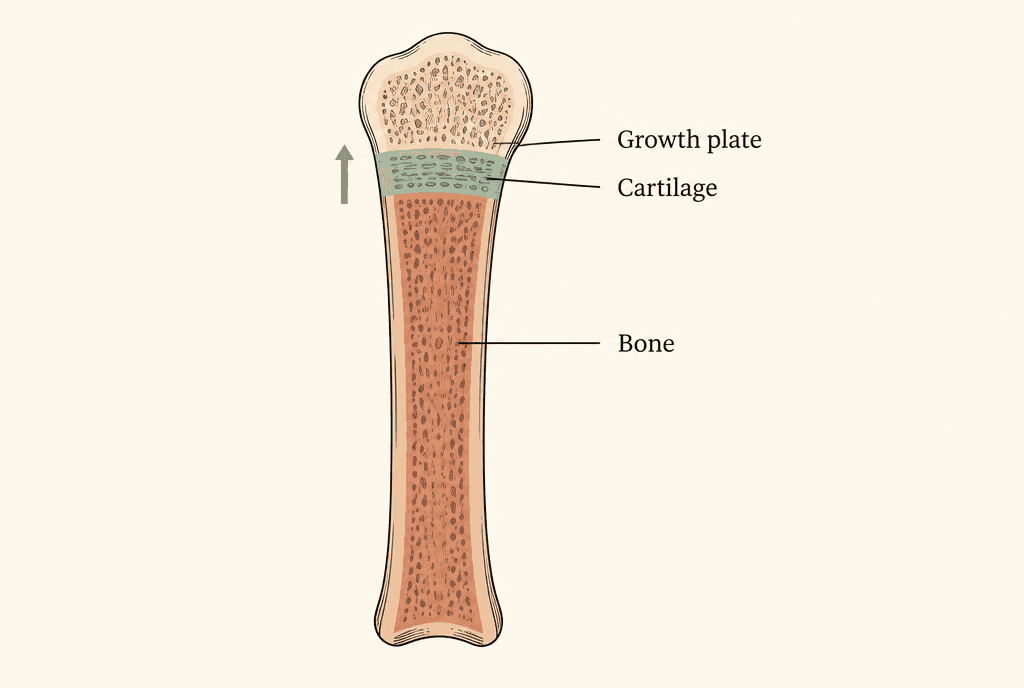
Vosoritide (Voxzogo) is a CNP analogue, a lab-made molecule built to act like CNP. The FDA gave it accelerated approval for children with achondroplasia whose growth plates are still open. Growth plates are areas of cartilage near the ends of bones, where bones grow longer. The approval rests on annualized growth velocity. This is a measure of growth over a year. Later confirmatory trials may decide if approval continues. The FDA label names natriuretic peptide receptor B (NPR-B) as its receptor. It describes a pathway involved in endochondral bone growth. That is the process by which cartilage becomes bone. That record applies only to the named medicine and patient group.
The label concerns children with a genetic condition. It ties the cause to a gain-of-function change in the FGFR3 gene. This gene sends growth-plate signals. Gain-of-function means the change makes the gene's product more active than normal. The ANP, BNP and CNP comparison shows vosoritide's place in the family.
The ARTG is the national register of medicines and other health products in Australia. Its full name is the Australian Register of Therapeutic Goods. It lists vosoritide under entry 376616 (read 16 October 2026). An ARTG entry covers one product. It does not approve every preparation. It does not approve every indication, which means every condition a product is used for.
What is the Australian Poisons Standard status of these medicines?
Australia's Poisons Standard sorts medicines into schedules, or control levels. In F2026L01327, the October 2026 Poisons Standard instrument, nesiritide and vosoritide each have their own entry in Schedule 4. That schedule is for prescription medicines. We read the instrument text on 16 October 2026. A text search found no entry of its own for carperitide, anaritide, ularitide or ANP. It found no use of the phrase natriuretic peptide. A missing name alone does not show a product's legal status. This page leaves the meaning of those missing entries open.
Schedule 4 is a control level for medicines that need a prescription. The Schedule 4 guide explains it. A schedule entry and an ARTG entry are separate records. This page does not establish the ARTG status of nesiritide and carperitide.
The TGA regulates medicines in Australia. In an advisory on 13 April 2026, it said that a 'research use only' disclaimer alone does not change a product's legal status. An ARTG registration covers one specific product. A similar name alone does not show that a sample is that registered product.
Are carperitide, nesiritide or vosoritide on the WADA Prohibited List?
None of the three is named in the WADA 2026 Prohibited List text we read for this page. WADA is the World Anti-Doping Agency. The List is in force from 1 January 2026. It does not name ANP, BNP or any natriuretic peptide. But the List also has broad classes. Class S5 covers all diuretics and masking agents. It also covers substances with similar chemical structures or biological effects. Class S0 covers drugs that no later section of the List deals with. It also needs the drug to have no current approval from any government health regulator for human therapeutic use. Neither class is limited to named examples.
This page does not establish whether a natriuretic peptide medicine falls within a broader class. A missing name does not mean permission in sport. The guide to peptides and drug tests takes a wider look at the topic.
Evidence limits
What does this page leave unresolved?
Several facts are not established here. We did not confirm the half-lives of these two drugs against a primary label. We did not open the Japanese label for carperitide. This page does not know the ARTG status of nesiritide and carperitide. Reviews mention other forms and analogues, but those are outside this comparison. We did not check their primary trials, so we report no findings for them. Nothing here shows that any of these medicines works for a person who is not in the studied group.
The fair summary is narrow. Three natriuretic peptide products have regulator records. Each is for a named condition. Two have trial evidence that is mixed or small. The third was approved on a measure of growth. The natriuretic peptides hub lists the other guides.
Comparison
Regulator and evidence records for the three medicines, read 16 October 2026. The table lists what each source says. It is not a ranking and not advice.
| Medicine | Peptide form | Regulator record | Evidence noted |
|---|---|---|---|
| Carperitide | Recombinant human ANP | Approved only in Japan (Shiga et al., 2025); no Australian entry found in the Poisons Standard | Meta-analysis of nine studies; benefit not shown (Shiga et al., 2025) |
| Nesiritide | Recombinant human BNP | FDA approval 10 August 2001. Listed as discontinued. Schedule 4 in the October 2026 Poisons Standard | ASCEND-HF, 7,141 patients: dyspnoea result missed its pre-specified bar (O'Connor et al., 2011) |
| Vosoritide | CNP analogue | FDA accelerated approval in children with achondroplasia. ARTG entry 376616. Schedule 4 in the October 2026 Poisons Standard | Approval rests on yearly growth speed; later trials may be needed (FDA, 2024) |
FAQ
Is carperitide approved outside Japan?
A 2025 meta-analysis says carperitide is approved only in Japan. Its use there is also restricted. The sources read for this page show no approval elsewhere.
Is nesiritide an approved medicine?
The FDA approved Natrecor (nesiritide) on 10 August 2001. The FDA's Drugs@FDA record now lists it as discontinued. Nesiritide has its own Schedule 4 entry in the October 2026 Poisons Standard.
What is vosoritide used for?
The FDA label for Voxzogo calls vosoritide a CNP analogue. It has accelerated approval for children with achondroplasia and open growth plates. The approval rests on a measure of yearly growth. Later confirmatory trials may decide if approval continues.
Is ANP a Schedule 4 substance in Australia?
We read the text of the October 2026 Poisons Standard, F2026L01327, on 16 October 2026. We found no entry for ANP or atrial natriuretic peptide. This page does not say what the missing entry means for any supply.
More in this hub
ANP and the Natriuretic Peptides: How the Heart's Hormones Work
Citations
3 sourcesShiga T, Suzuki A, Inoue S, Hashiguchi M. BMC Cardiovascular Disorders. 2025;25:896.
doi:10.1186/s12872-025-05394-0O'Connor CM, Starling RC, Hernandez AF, et al. New England Journal of Medicine. 2011;365(1):32-43.
doi:10.1056/NEJMoa1100171Mitaka C, Kudo T, Haraguchi G, Tomita M. Critical Care. 2011;15(5):R258.
doi:10.1186/cc10519
Form Laboratories supplies research-use-only reference material. This article is an educational summary of published third-party literature. It is not medical advice, not a use instruction, and research material is not for human or animal use.