
Hub · ANP and the Natriuretic Peptides: How the Heart's Hormones Work
What is ANP?
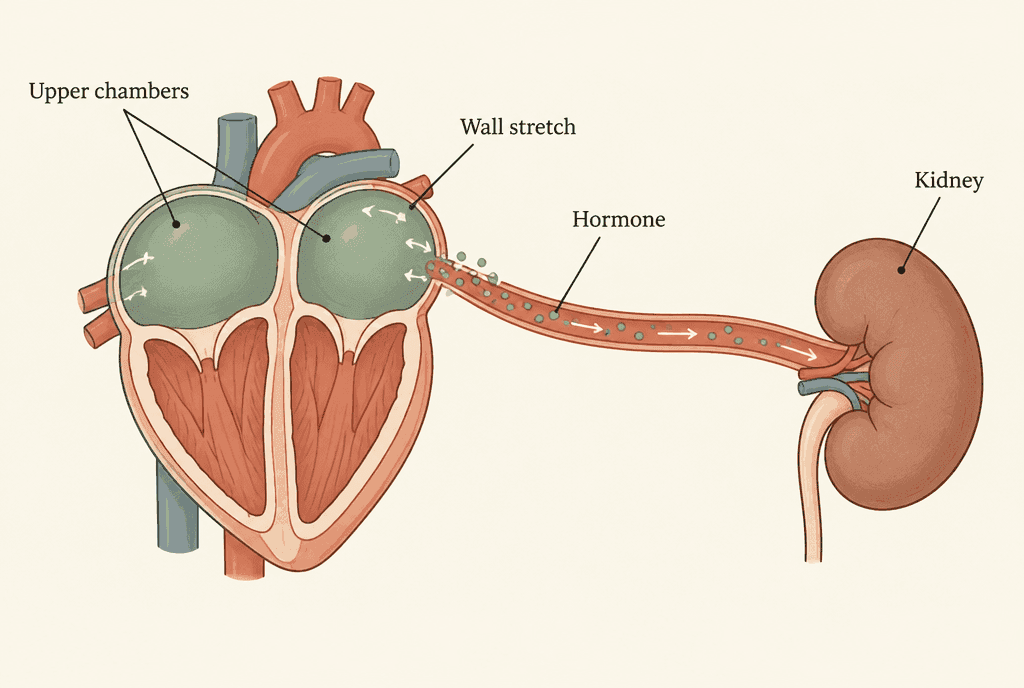
ANP (atrial natriuretic peptide) is a hormone made by the heart. ANP is a short chain of 28 amino acids, the small building blocks that also make up proteins. Cells in the heart's two upper chambers, the atria, release ANP into the blood when the chamber walls stretch. ANP is a natural hormone of the body. ANP is not a growth hormone peptide and not a tanning peptide.
01What it isContents
Your heart does more than pump. As blood flows back into its two upper chambers, the atria, their walls stretch a little, and cells in those walls answer by sending a hormone into your blood. That hormone is ANP, the first member of the family covered in the natriuretic peptides hub.
This page answers the simple questions first. What is ANP? What makes the heart release it? How was it found? What does it do when it reaches a cell? Every answer uses only what the cited papers measured.
Key facts
| Common name | ANP, atrial natriuretic peptide |
|---|---|
| Length | 28 amino acids (Mitaka et al., 2011; Kerkelä et al., 2015) |
| Made by | Heart cells in the atria (Mitaka et al., 2011) |
| Release signal | Stretch of the atrial wall and a rise in atrial pressure (Mitaka et al., 2011) |
| Main receptor | Natriuretic peptide receptor A, NPR-A (Kerkelä et al., 2015) |
| Second messenger | Cyclic GMP, cGMP (Kerkelä et al., 2015) |
| Plasma half-life reports | About 3 minutes (Mitaka et al., 2011); 2 to 4 minutes (Nakagawa and Saito, 2022) |
| First reported | 1981, atrial extract in rats; ANP isolated and sequenced in 1983 to 1984 (Kerkelä et al., 2015) |
| Recombinant form | Carperitide, used mainly in Japan (Shiga et al., 2025) |
| Sport status | Not named in the WADA 2026 Prohibited List, in force from 1 January 2026 |
What is ANP?
ANP is a peptide hormone. A peptide is a short chain of amino acids, and ANP has 28 of them. The heart's upper chambers, the atria, make ANP and release it into the blood. The word natriuretic means causing sodium loss in urine. A 2011 review calls ANP a potent natriuretic, diuretic and vasorelaxant substance. In plain words, ANP moves salt and water out of the body through the kidneys, and it relaxes the walls of blood vessels. ANP has two close relatives, B-type and C-type natriuretic peptide. Together the three make one family of hormones.
The peptides guide explains where peptides end and proteins begin. ANP starts as a larger precursor, a longer chain that is later cut down, and the body releases it as an active hormone. Its relative BNP can leave the heart as a longer precursor of 108 amino acids that is cut down afterwards.
The ANP, BNP and CNP guide compares the three family members side by side.
What makes the heart release ANP?
The heart releases ANP when the wall of an atrium stretches, or when the pressure inside it rises quickly. Think of a balloon. As more blood fills the chamber, the wall is pulled tight, and the muscle cells in it respond. A second review agrees. It names stretch of the heart muscle, called myocardial stretch, as the key trigger for both ANP and BNP. The same review lists other triggers that raised ANP and BNP production in heart muscle cells in laboratory work. These are angiotensin II, endothelin-1 and two adrenaline-like compounds.
Stretch is a physical signal, not a chemical one. The atria fill, the muscle cells feel the pull, and the hormone goes out into the blood. Researchers describe ANP as answering sudden stretch. BNP is controlled more through gene activity, meaning how strongly the cell's genes are switched on to make it.
Knowing what the signal is does not mean anyone can steer it. Both papers describe the body's own control of ANP release. Neither describes release caused from outside the body.
How was ANP discovered?
The story starts in 1981. That year, de Bold and colleagues gave rats extracts made from heart atria. The rats then made more urine and passed more sodium. In 1983 and 1984, researchers isolated and purified ANP. They also worked out the order of its amino acids, in both rats and humans. ANP's relative BNP was found later, in extracts of pig brain. That is why BNP still carries the word brain in its older name, brain natriuretic peptide. A 2015 review and a 2011 review tell this history.
The rat experiment linked the heart to changes in urine output and sodium loss. That finding helped show that the heart is a source of hormones, and not only a pump.
What does ANP do at its receptor?
ANP works by fitting into a receptor, a docking site on the surface of a cell. Its main receptor is natriuretic peptide receptor A, or NPR-A. When ANP binds, the cell makes more of a messenger molecule called cGMP (cyclic guanosine monophosphate). The 2011 review links this step to the widening of veins and arteries. ANP also acts on the kidney's tiny filters. It widens the vessel that carries blood in and narrows the vessel that carries blood out. Like pinching the end of a garden hose, this raises the pressure inside the filter, so filtration increases.
The same review also discusses animal models of acute, meaning sudden, kidney failure. Results in animals do not show what happens in people.
The effect can change from one cell type to another. In one set of experiments, ANP raised cGMP in heart muscle cells through NPR-A, but CNP did not raise it there. In heart fibroblasts, the cells that build scar-like tissue, both ANP and CNP raised it. The pathway is real, but the details depend on the tissue.
Is ANP the same kind of peptide as growth hormone or tanning peptides?
No. ANP belongs to the natriuretic peptide family. It is not part of the growth hormone peptide group or the tanning peptide group. The cited reviews discuss ANP in connection with heart function, blood pressure, salt and water balance, and heart failure. That tells us which family the hormone belongs to. It does not settle every role ANP might have in other tissues of the body. The natriuretic peptides hub explains ANP's two relatives, BNP and CNP, alongside ANP itself, so the whole family can be read in one place.
ANP also has a medicine form. Carperitide is a recombinant version of human ANP, meaning one made in a laboratory from the human gene. A 2025 meta-analysis, a study that pools the results of earlier studies, states that carperitide is approved only in Japan. The medicines page sets out what is known about it.
Evidence limits
How strong is the evidence about ANP in people?
The evidence in people is thin. The cited reviews do not establish that carperitide works in clinical care. They also do not establish long-term results from ANP in heart surgery. A 2025 meta-analysis pooled trials of carperitide. Those trials were small, all came from Japan, and the oldest ran about 30 years before the 2025 analysis. The authors write that carperitide's clinical effectiveness has not been established. A 2011 review pooled 15 trials in heart surgery patients. It states that the combined data were not enough to judge long-term outcome.
Gene studies give a hint, not proof. In an Italian study, people who carried a gene variant linked to lower ANP in the blood had a larger heart-muscle mass index, a measure of how much heart muscle there is for a person's body size. In a Swedish group, a variant linked to higher ANP and BNP went with a lower rate of enlarged heart muscle. These are patterns in groups of people. They are not tests of ANP given from outside the body.
How fast the body clears the hormone shapes everything else. The half-life guide covers it.
Comparison
Where ANP acts in the body and what the cited reviews report at each place. Each row is a reported finding, not a claim about any use.
| Place in the body | What the reviews report |
|---|---|
| Atria, the upper heart chambers | Make ANP and release it when the wall stretches or the pressure rises quickly |
| Blood vessels | ANP binding NPR-A raises cGMP, a step linked to widening of veins and arteries |
| Kidney filters | The vessel carrying blood in widens and the vessel carrying blood out narrows, which increases filtration |
| Urine | More sodium and water leave the body |
| Heart cells | In experiments, ANP raised cGMP in heart muscle cells and in heart fibroblasts |
FAQ
Is ANP the same as BNP?
No. ANP and BNP are related hormones, but they differ in length, source and the way they are released. ANP has 28 amino acids and is made in the atria. BNP has 32 amino acids and comes mainly from the ventricles, the heart's two lower chambers. Both bind the same receptor, natriuretic peptide receptor A.
Where is ANP made in the body?
Heart muscle cells make ANP, mainly in the atria, the two upper chambers of the heart. ANP leaves the cell as an active hormone. BNP is different: it is released first as a longer precursor.
Is ANP banned in sport?
ANP is not named in the WADA 2026 Prohibited List, in force from 1 January 2026. That does not establish permission in sport, because broad classes on the List can cover substances that are not named. Whether a natriuretic peptide medicine falls inside such a class is not established here.
Is ANP a medicine?
A laboratory-made form of ANP, carperitide, is used in Japan for acute heart failure, meaning heart failure that comes on or worsens suddenly. No approval for carperitide outside Japan was found in the sources read for this page.
More in this hub
ANP and the Natriuretic Peptides: How the Heart's Hormones Work
Citations
4 sourcesMitaka C, Kudo T, Haraguchi G, Tomita M. Critical Care. 2011;15(5):R258.
doi:10.1186/cc10519Kerkelä R, Ulvila J, Magga J. Journal of the American Heart Association. 2015;4(10):e002423.
doi:10.1161/JAHA.115.002423Nakagawa H, Saito Y. Biology. 2022;11(7):1017.
doi:10.3390/biology11071017Shiga T, Suzuki A, Inoue S, Hashiguchi M. BMC Cardiovascular Disorders. 2025;25:896.
doi:10.1186/s12872-025-05394-0
Form Laboratories supplies research-use-only reference material. This article is an educational summary of published third-party literature. It is not medical advice, not a use instruction, and research material is not for human or animal use.