
Compound hub · PT-141
How does PT-141 work?
PT-141 (bremelanotide) switches on several melanocortin receptors. The FDA label ranks them by potency as MC1R, MC4R, MC3R, MC5R and MC2R, and says MC1R and MC4R matter most at therapeutic exposure, the levels reached in treatment. The same label states that the way the approved product works in low sexual desire is unknown. The full path from receptor to desire has not been established.
01Melanocortin receptorsContents
Think of a receptor as a docking site on the surface of a cell. When the right molecule fits, the cell changes what it is doing. Your skin cells, your brain and your adrenal glands all carry docking sites for one family of messengers, the melanocortins. PT-141 switches on several of these docking sites. It is the subject of the PT-141 hub.
This page pulls apart three things that web pages tend to blur. First, which receptors bremelanotide binds. Second, what researchers think that binding might do. Third, what the body does with the peptide afterwards. For the basics, start with what PT-141 is.
Key facts
| Drug class | Melanocortin receptor agonist (FDA label, 2019) |
|---|---|
| Receptors activated | MC1R, MC4R, MC3R, MC5R and MC2R, in that order of potency (FDA label, 2019) |
| Receptors most relevant at therapeutic exposure | MC1R and MC4R (FDA label, 2019) |
| Mechanism for low sexual desire | Unknown (FDA label, 2019) |
| Time to peak level in plasma, median | About 1.0 hour, range 0.5 to 1.0 (FDA label, 2019) |
| Terminal half-life, mean | About 2.7 hours, range 1.9 to 4.0 (FDA label, 2019) |
| Main breakdown route | Hydrolysis (splitting by water) of the amide bonds of the ring (FDA label, 2019) |
| Label source | Drugs@FDA label for NDA 210557, 2019 |
What are melanocortin receptors?
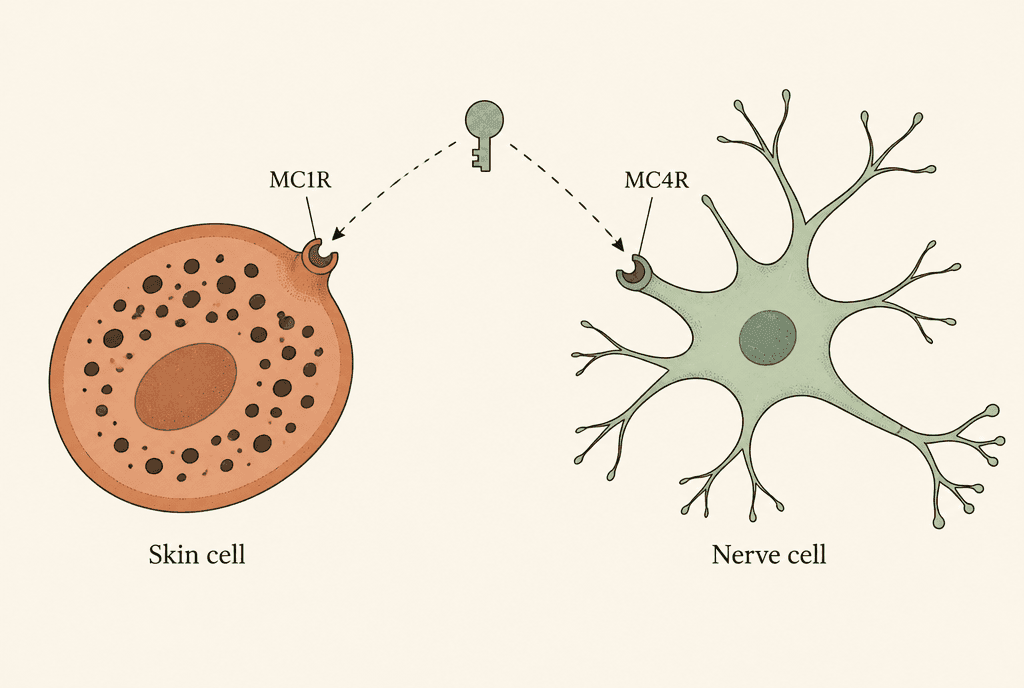
Melanocortin receptors are a family of five docking sites on cells, named MC1R to MC5R. They respond to melanocortin messengers such as alpha-melanocyte-stimulating hormone. The FDA label for bremelanotide names all five. It records that MC1R sits on melanocytes, the cells that make skin pigment. When a molecule binds MC1R there, the cell makes more melanin and pigmentation increases. The label also records that nerve cells carrying MC4R are found in many parts of the central nervous system, the brain and spinal cord. These receptors sit in different tissues. So one molecule that binds several of them can reach several body systems.
The label does not describe the jobs of MC2R, MC3R or MC5R, and this page does not guess. The point here is smaller. A skin receptor and a brain receptor can respond to the same peptide. That fact alone does not explain every side effect in the label. The side-effects page sets out those records.
Which receptors does bremelanotide activate?
Bremelanotide is a nonselective agonist. An agonist is a molecule that switches a receptor on. Nonselective means it switches on several receptor types instead of one. The FDA label ranks the five receptors by potency: MC1R, MC4R, MC3R, MC5R, then MC2R. It says that at therapeutic exposure, binding at MC1R and MC4R matters most. Kingsberg and colleagues describe bremelanotide as a ring-shaped, seven-amino-acid version of alpha-melanocyte-stimulating hormone that binds tightly to the melanocortin-4 receptor. The sources opened for this page give no binding constants for bremelanotide. So this page gives no number for how tightly it binds.
Order of potency means which receptor responds most readily to the same molecule. Picture five locks and one key that turns some locks more easily than others. The ranking says which locks turn first. It is not a map of what each receptor does in a person.
Evidence limits
How does PT-141 affect sexual desire?
The FDA label says the way PT-141 affects sexual desire is unknown. In its words, the clinical mechanism of bremelanotide in hypoactive sexual desire disorder (HSDD) is unknown. That statement describes the 2019 label and does not rule out later research. Kingsberg and colleagues write that preclinical work, meaning lab and animal studies, suggests an action on the brain's messenger pathways for desire and arousal. They do not claim a fully mapped human mechanism. The phase 3 trials measured desire and distress scores and counts of sexual events. None of their measured outcomes was brain chemistry.
The label does not establish that bremelanotide raises dopamine, one of the brain's chemical messengers. The large trials did not measure dopamine either. A receptor can be switched on without anyone having shown the whole chain from receptor to behaviour.
A receptor result and a questionnaire answer are different kinds of evidence. A receptor test shows what happens at the docking site. A questionnaire shows what a woman reported. Neither one alone maps the path between the two. What the trials measured shows how narrow the measured outcome was.
How does the body handle bremelanotide?
The FDA label records how the body handles the approved product after one under-the-skin administration. The level in plasma, the liquid part of blood, peaks after a median of about 1.0 hour. Absolute bioavailability, the share that reaches the bloodstream, is about 100%. The average terminal half-life is about 2.7 hours, with a range of 1.9 to 4.0 hours. The body breaks the peptide down by hydrolysis, which means water splits the amide bonds that hold its ring together. In a study with a radioactive tag on the peptide, 64.8% of the radioactivity was recovered in urine and 22.8% in faeces.
Half-life is the time it takes for the plasma level to fall by half once absorption is done. These figures belong to the approved product in the label's studies. The sources opened for this page give no half-life for any other material, so none is stated here.
The table below lists the label's main figures, each with a plain meaning beside it.
Comparison
Pharmacology values recorded in the FDA label for bremelanotide after one under-the-skin administration. They describe the approved product in the label's studies, not other material.
| Measure | Label value | Plain meaning |
|---|---|---|
| Median time to peak level | About 1.0 hour (range 0.5 to 1.0) | How long the plasma level takes to reach its highest point |
| Absolute bioavailability | About 100% | The share of the peptide that reaches the bloodstream after an under-the-skin administration |
| Bound to serum protein | 21% | The share carried attached to proteins in blood |
| Volume of distribution | 25.0 ± 5.8 L | A calculated figure that links the amount in the body to the plasma level |
| Mean terminal half-life | About 2.7 hours (range 1.9 to 4.0) | Time for the plasma level to halve once absorption is done |
| Mean clearance | 6.5 ± 1.0 L per hour | How fast the body removes the peptide from plasma |
FAQ
Does PT-141 act on the brain?
The FDA label records that nerve cells carrying the MC4R receptor are found in many parts of the central nervous system. It also says binding at MC4R is among the most relevant at therapeutic exposure. The same label states that the mechanism for low sexual desire is unknown.
Is PT-141 a vasodilator or an erectile drug?
The FDA label identifies bremelanotide as a melanocortin receptor agonist and does not establish an erectile-function indication. The approved product is not indicated in men, and the sources opened for this page include no erectile-function trial.
Why does PT-141 darken skin in some people?
The label explains the likely route. MC1R sits on melanocytes, the skin's pigment cells, and binding there leads to more melanin and increased pigmentation. Focal hyperpigmentation, patches of darker skin, appears among the label's warnings, and the side-effects page gives the figures.
Is the half-life the same for every PT-141 product?
Not established. The 2.7-hour figure comes from the label's studies of the approved product. The sources opened for this page give no half-life for other PT-141 material.
More in this hub
Citations
2 sourcesKingsberg SA, Clayton AH, Portman D, et al. Obstetrics & Gynecology. 2019;134(5):899-908.
doi:10.1097/AOG.0000000000003500Yang Y, Mishra V, Crasto CJ, et al. Journal of Biological Chemistry. 2015;290(12):7685-7692.
doi:10.1074/jbc.M114.596122
Form Laboratories supplies research-use-only reference material. This article is an educational summary of published third-party literature. It is not medical advice, not a use instruction, and research material is not for human or animal use.