
Compound hub · PT-141
What is PT-141?
PT-141 is the research name for bremelanotide, a lab-made peptide: a short chain of seven amino acids with a ring built into it. Bremelanotide switches on melanocortin receptors, which are docking sites on cells. In 2019 the US FDA approved one prescription product containing bremelanotide, Vyleesi, for premenopausal women with acquired, generalised hypoactive sexual desire disorder. The label states that Vyleesi is not indicated in men.
01What it isContents
Your body already makes its own messenger molecules called melanocortins. Their receptors sit on the pigment cells of your skin and on nerve cells all over your brain. PT-141 is a laboratory-made peptide that reaches some of those same receptors. It is the subject of the PT-141 hub.
This page answers the plain questions first. What does the name mean? Is PT-141 the same thing as bremelanotide, or as Melanotan II? What did the 2019 approval cover? How PT-141 works and what the trials found each have their own page.
Key facts
| Common name | PT-141 |
|---|---|
| Generic name | Bremelanotide |
| US brand name | Vyleesi |
| Structure | Cyclic heptapeptide, Ac-Nle-cyclo-(Asp-His-D-Phe-Arg-Trp-Lys-OH) (FDA label, 2019) |
| Formula and weight | C50H68N14O10; molecular weight 1025.2, free base (FDA label, 2019) |
| CAS (database identifier) | 189691-06-3 (PubChem) |
| Parent molecule | Analogue of alpha-melanocyte-stimulating hormone (Kingsberg et al., Obstetrics & Gynecology, 2019) |
| FDA-approved use | Premenopausal women with acquired, generalised hypoactive sexual desire disorder (FDA label, 2019) |
| Stated limits of the approval | Not indicated in postmenopausal women or in men; not indicated to enhance sexual performance (FDA label, 2019) |
| Pivotal trials | NCT02333071 and NCT02338960 |
What is PT-141?
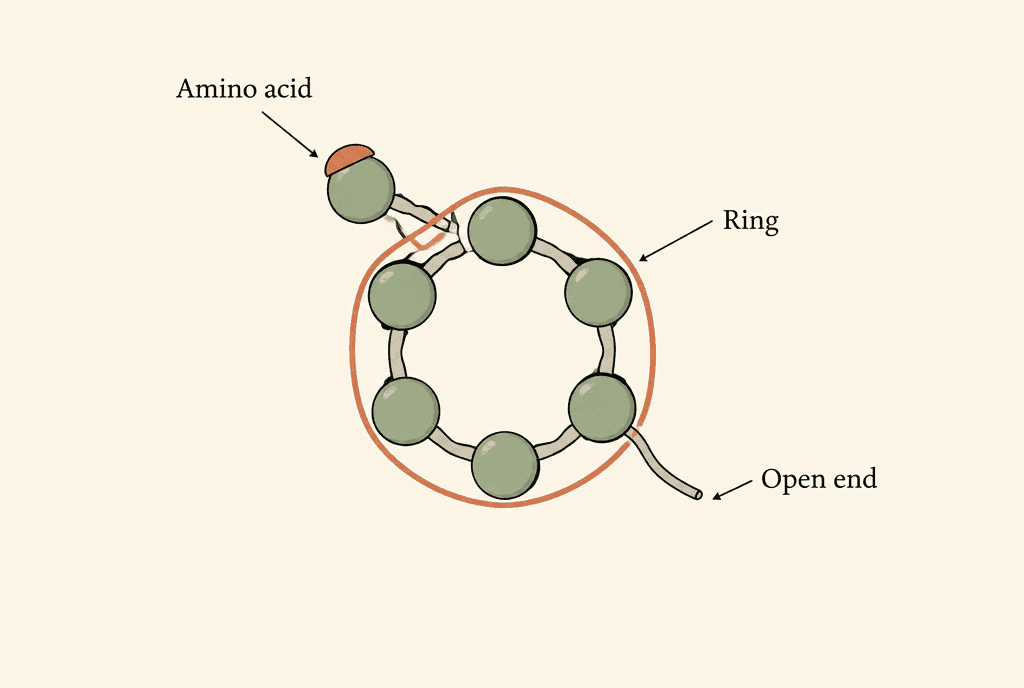
PT-141 is the name used in research and online for bremelanotide, a lab-made peptide. A peptide is a short chain of amino acids, the small building blocks that proteins are also made from. Bremelanotide has seven of them, and part of the chain is closed into a ring. The FDA label calls bremelanotide acetate a synthetic, cyclic heptapeptide: a man-made, ring-shaped chain of seven amino acids. The label gives a molecular weight of 1025.2 for the free base, the molecule without its salt. Kingsberg and colleagues describe bremelanotide as a modified version of alpha-melanocyte-stimulating hormone that binds tightly to the melanocortin-4 receptor. Those are facts about shape and targets, not about what a person feels.
The label also describes the two ends of the chain. One end, the amino end, carries an acetyl group, a small chemical cap. The other end is a free acid. One amino acid, Nle (norleucine), sits outside the part marked as a ring. So a ring-shaped peptide does not always join the two ends of the whole chain. Here the ring sits inside the chain, and the two ends stay separate.
Seven amino acids make a short chain. The guide on what peptides are explains where the line between a peptide and a protein falls.
What is the difference between PT-141, bremelanotide and Vyleesi?
PT-141 and bremelanotide are two names for the same molecule. Vyleesi is the US brand name of an FDA-approved prescription product that contains bremelanotide. The FDA label uses the names bremelanotide and Vyleesi. PubChem, a free public chemistry database, lists PT-141 and PT141 among the other names for bremelanotide, under CAS number 189691-06-3. A CAS number is an ID number given to one chemical. A name on a vial or a listing does not show what is inside it. The TGA, Australia's medicines regulator, warns that unapproved peptide products have not been assessed for safety, quality or effectiveness. The table below sets the names side by side.
The FDA label describes one reviewed brand-name product. It records what that product contains and how it behaved in studies. It does not describe other material that carries the same molecule name.
Is PT-141 the same as Melanotan II?
No. PT-141 (bremelanotide) and Melanotan II are different molecules, and each has its own regulatory record. The TGA describes melanotans as lab-made peptides that make the skin produce more melanin, the pigment that darkens skin. The TGA says melanotans are not approved for sale or use as a tanning agent in Australia. The bremelanotide label makes a related point: when bremelanotide binds the MC1R receptor on pigment cells, pigmentation increases. The October 2026 Poisons Standard, Australia's legal list of controlled medicines and poisons, names Melanotan II. A search of its text on 16 October 2026 found no entry for bremelanotide.
People often mix the two up because both appear in the same online lists of melanocortin peptides. The records do not support treating one as the other. The Australian status page keeps the two legal records apart.
What is the FDA-approved use of bremelanotide?
The FDA label for Vyleesi names one use: premenopausal women with acquired, generalised hypoactive sexual desire disorder (HSDD). Premenopausal means before menopause. HSDD means low sexual desire that causes marked distress and is not due to another medical or psychiatric condition, relationship problems or the effects of a medicine. The label sets two limits. Vyleesi is not indicated, meaning not approved, for HSDD in postmenopausal women or in men. It is also not indicated to enhance sexual performance. The FDA approved the product in 2019, and the approval rests on two large phase 3 trials.
Two words in that use matter. Acquired means the low desire began after a time without problems. Generalised means it happens whatever the situation or partner. The two phase 3 trials enrolled only women who matched that description, and they did not enrol men.
The label does describe a separate study of alcohol interaction that included men. So the limit in men comes from the approval and the trials. It is not a sign that no man was ever studied.
Evidence limits
What has research not shown about PT-141?
The 2019 FDA label states that the clinical mechanism of bremelanotide in HSDD, meaning how it works in patients, is unknown. That is the label's account of the evidence at that date. It is not a claim that no later research on the mechanism exists. No phase 3 trial in these records enrolled men or postmenopausal women. The label also notes that safety and effectiveness have not been established in geriatric patients, meaning older adults. The large trials measured questionnaire scores and counts of sexual events. Those outcomes do not directly measure brain chemistry, and they do not establish findings outside the group studied.
The label does not establish a dopamine mechanism. Dopamine is one of the brain's chemical messengers, and the large trials did not measure it. The mechanism page separates what receptor studies show from what is still a guess.
Comparison
Four names that appear in PT-141 searches, what each one refers to, and the record that uses it. The rows describe names, not products or effects.
| Name | What it refers to | Record that uses it |
|---|---|---|
| PT-141 | A research and online name for bremelanotide | PubChem synonym list |
| Bremelanotide | The generic name of the molecule, a ring-shaped chain of seven amino acids | FDA label, 2019 |
| Vyleesi | US brand name of the FDA-approved prescription product that contains bremelanotide | FDA label, 2019 |
| Melanotan II | A different melanocortin peptide, not the same molecule | TGA blog, 24 January 2025; Poisons Standard F2026L01327 |
FAQ
Is PT-141 a hormone?
No. PT-141 is a lab-made peptide, not a hormone the body makes. It is an analogue of alpha-melanocyte-stimulating hormone, one of the body's natural messengers. Analogue means a related molecule with a changed structure.
Does PT-141 have a half-life?
Yes, and the FDA label records it. Half-life is the time the level in the blood takes to fall by half. After one subcutaneous (under-the-skin) administration of the approved product, the average terminal half-life of bremelanotide is about 2.7 hours, with a range of 1.9 to 4.0 hours. The label gives no half-life for other material.
Is bremelanotide approved anywhere besides the United States?
The sources opened for this page confirm no approval outside the United States. A European Medicines Agency record was not opened, so this page makes no statement about Europe. Australian records appear on the Australian status page.
Where did the name PT-141 come from?
The sources opened for this page do not state where the code PT-141 came from, so this page does not give an origin. PubChem lists PT-141 as another name for bremelanotide.
More in this hub
Citations
1 sourcesKingsberg SA, Clayton AH, Portman D, et al. Obstetrics & Gynecology. 2019;134(5):899-908.
doi:10.1097/AOG.0000000000003500
Form Laboratories supplies research-use-only reference material. This article is an educational summary of published third-party literature. It is not medical advice, not a use instruction, and research material is not for human or animal use.