
Compound hub · AOD-9604
AOD-9604 side effects: what has actually been recorded
AOD-9604 has one published human safety report, by Stier and colleagues in 2013, based on trials the developer paid for. The report lists adverse events, but its authors had ties to the company, and its summary and details do not fully match. The FDA also reports serious adverse events that may be linked to AOD-9604, while saying the cause is unclear. These records do not show that AOD-9604 is safe in general.
01Side effectsContents
When a new substance is tested, researchers write down every health problem that happens along the way: a headache, an upset stomach, an odd blood test. People search for AOD-9604 side effects because they want that list in plain words. The AOD-9604 hub gathers the answers, and this page goes through the record one source at a time.
The record has five parts: a published human safety summary, a company statement about one trial, an FDA safety text, animal studies and general warnings from regulators. Each part answers a different question. The study findings page describes the trial, and what AOD-9604 is gives the background.
Key facts
| Compound | AOD-9604, a 16-amino-acid peptide based on the tail end of human growth hormone |
|---|---|
| Human trial safety statement | Sponsor's preliminary analysis: no difference from placebo on safety or tolerability (ASX announcement, 21 February 2007) |
| Trial size | 536 enrolled in the OPTIONS study, per the sponsor |
| Published adverse-event data | Stier et al., Journal of Endocrinology and Metabolism, 2013; sponsor-funded trials |
| Limits of the human safety report | Sponsor ties; summary and detailed adverse-event text differ (Stier et al., 2013) |
| FDA wording | FDA compounding page, content current as of 22 April 2026: no, or only limited, safety-related information; immunogenicity risk for compounded drugs |
| Registered on ClinicalTrials.gov | No records for AOD-9604 or AOD9604 (16 October 2026); OPTIONS is on ANZCTR as ACTRN12605000067673 |
| Published human half-life | Not established in the sources read |
What are the side effects of AOD-9604?
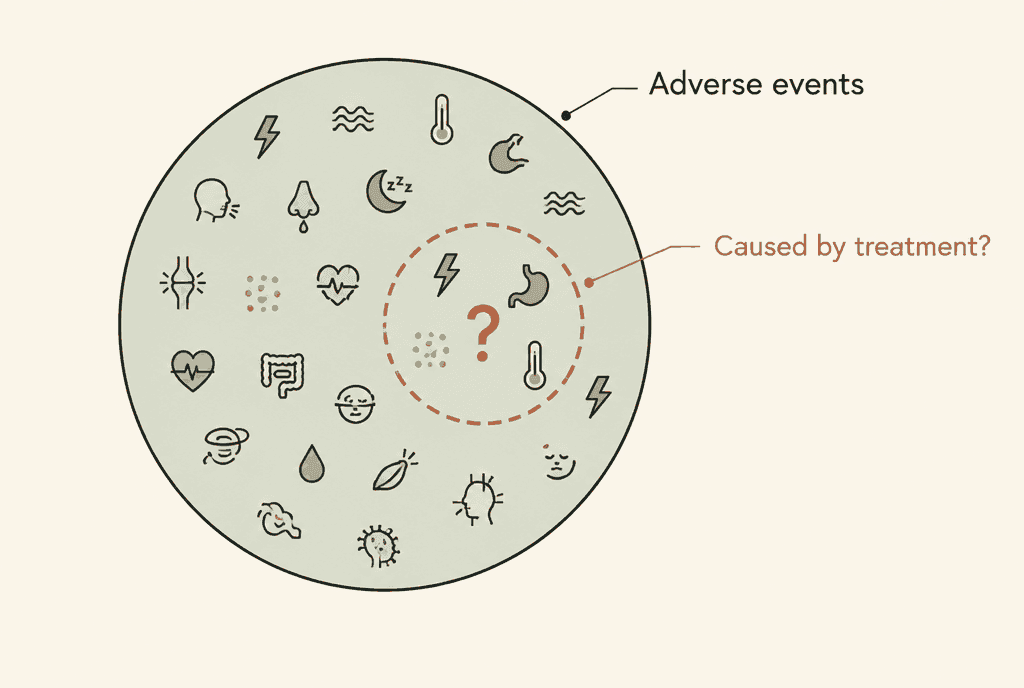
A 2013 human safety paper lists adverse events, including headache and digestive symptoms. An adverse event is any health problem that happens during a trial, and not every one is caused by the peptide. The paper's summary says no related serious adverse event happened. Yet its detailed section describes serious diarrhoea that was judged possibly related to treatment. That mismatch matters when you read the summary. Metabolic Pharmaceuticals paid for the trials, and the paper declares that its authors had ties to the company. The report shows what was seen under trial conditions. It does not show safety for other products or settings.
The company's 2007 announcement called its safety comparison preliminary, meaning early and not final, and it listed no individual adverse events. The later journal paper gives more detail, but its broad conclusion needs to be read beside those details. Neither source is an independent check of material sold outside the trials.
What has the FDA said about the safety of AOD-9604?
The FDA, the US medicines regulator, lists AOD-9604 in a table of bulk drug substances that were nominated for compounding and then withdrawn by the people who nominated them. Compounding is when a pharmacy makes up a drug for a patient. The FDA says compounded drugs containing AOD-9604 may carry a significant risk of immunogenicity, meaning an immune system reaction, for certain ways of giving the drug. It also flags possible problems with peptide-related impurities. The FDA says it has found little or no safety information, so it cannot tell whether the drug would harm people. It also knows of serious adverse events that may be linked to AOD-9604, without a proven cause.
A withdrawn nomination is not an approval. It also does not put AOD-9604 on the FDA's list of bulk substances that may be compounded.
The FDA text does not name the adverse events, so this page cannot say what they were. The Australian records from the Poisons Standard and the TGA are on the Australian legal status page.
Did animal studies show safety problems with AOD-9604?
The early animal studies looked at a few metabolic measures. They were not full safety studies. In obese Zucker rats treated daily for 19 days, AOD-9604 did not harm insulin sensitivity, which is how well the body responds to insulin. In obese mice, AOD-9604 did not cause high blood sugar or lower insulin release. In a cell test, AOD-9604 did not make cells carrying the growth hormone receptor multiply. These papers measured metabolism and how cells respond. So they do not show safety in animals over time, or safety in people.
In each test, the researchers compared AOD-9604 with growth hormone, and growth hormone did cause these effects. That comparison shows how the fragment differs from the whole hormone. It does not show how safe the fragment is. How AOD-9604 works reports the experiments in full.
What do regulators and reviews say about unapproved peptide products?
The TGA, Australia's medicines regulator, says unapproved peptide products have not been assessed by the TGA for safety, quality or effectiveness. It says important facts about them are unknown, such as how they are made, whether they are sterile, meaning free of germs, and what they contain. The TGA advisory lists adverse events reported for unapproved peptides as a group. It does not link any of them to AOD-9604. A 2026 review of peptides that act on the growth hormone system, AOD-9604 among them, lists reported adverse effects for the whole group. The review also notes doubt about what these products contain.
Whether a product really contains AOD-9604 is a real question. A 2014 case report described finding AOD9604 in unknown products seized by Belgian authorities. A 2015 lab paper noted that the peptide had recently been found in confiscated vials in the USA. The quality and verification hub explains how purity and identity are documented in general.
Evidence limits
Is AOD-9604 safe?
The sources read do not show that AOD-9604 is safe in general. A published human safety summary exists. But it reports trials the developer paid for, and its authors declare ties to the developer. Results from those trials cannot show safety for other people, products or settings. The FDA says it does not have enough information to know whether AOD-9604 would cause harm in people. It also notes serious adverse events with an unclear cause. A good-looking summary of a few trial measures does not remove those doubts. It also does not show that no harm can occur.
One more gap: no half-life was established in the sources read. A half-life is the time it takes for the measured level of a substance to fall by half. Without it, there is no answer here to how long exposure lasts.
Comparison
What each source on this page reports about AOD-9604 safety, and its main limit. The table does not rank the sources.
| Source | What it reports | Main limit |
|---|---|---|
| Human safety paper, Stier et al., 2013 | Adverse events in company-funded trials, including headache and digestive symptoms | Authors had company ties; the summary and the detailed adverse-event text differ |
| Company announcement, 21 February 2007 | Early analysis: no difference from placebo on safety or tolerability | Not peer reviewed; lists no individual adverse events |
| FDA compounding page, 22 April 2026 | Possible immunogenicity risk; little or no safety information; serious adverse events with an unclear cause | Does not name the adverse events |
| Animal and cell studies, 2000 and 2001 | Insulin sensitivity, blood sugar and insulin release in obese rats and mice; cell growth | A few selected measures, not a full safety assessment; not in people |
| TGA advisory, 13 April 2026 | Unapproved peptide products not assessed for safety, quality or effectiveness | Covers peptides as a group; does not name AOD-9604 |
FAQ
Does AOD-9604 affect blood sugar?
Animal studies found no blood sugar problem. Obese mice given AOD-9604 did not get the high blood sugar that growth hormone caused, and obese rats kept their insulin sensitivity. Both are animal findings. A 2013 paper reports human blood sugar readings, but they do not show safety in people with diabetes.
Is AOD-9604 the same as growth hormone for safety purposes?
The sources read do not support treating the two as the same. In a 2001 cell test, AOD-9604 did not compete with growth hormone for its receptor. A 2013 human safety summary exists, but it does not show equal safety or general safety for AOD-9604.
Has the TGA issued a warning naming AOD-9604?
The TGA texts read on 16 October 2026 do not name AOD-9604. The advisory of 13 April 2026 covers unapproved peptide products as a group. It says that research-use-only labels alone do not make their supply lawful.
What did the FDA say about serious adverse events and AOD-9604?
The FDA page, current as of 22 April 2026, reports serious adverse events that may be linked to AOD-9604, without showing the link. The page does not name the events, so what they were is not known from that source.
More in this hub
- AOD-9604 study findings: what the human obesity trial reported and what animal studies measured
- How does AOD-9604 work? What rat and mouse studies measured
- Is AOD-9604 legal in Australia? Poisons Standard, TGA, FDA and WADA records
- What is AOD-9604? The growth hormone fragment peptide explained from the research
Citations
7 sourcesStier H, Vos E, Kenley D. Journal of Endocrinology and Metabolism. 2013;3(1-2):7-15.
doi:10.4021/jem157wNg FM, Sun J, Sharma L, et al. Hormone Research. 2000;53(6):274-278.
doi:10.1159/000053183Heffernan MA, Thorburn AW, Fam B, et al. International Journal of Obesity. 2001;25(10):1442-1449.
doi:10.1038/sj.ijo.0801740Vanhee C, Moens G, Deconinck E, De Beer JO Drug Testing and Analysis. 2014;6(9):964-968.
doi:10.1002/dta.1687Cox HD, Smeal SJ, Hughes CM, Cox JE, Eichner D. Drug Testing and Analysis. 2015;7(1):31-38.
doi:10.1002/dta.1715Dominikowski A, Rękoś Z, Olejarz M, et al. Frontiers in Endocrinology. 2026;17:1822475.
doi:10.3389/fendo.2026.1822475Mendias CL, Awan TM Sports Medicine. 2026;56(8):1921-1935.
doi:10.1007/s40279-026-02437-0
Form Laboratories supplies research-use-only reference material. This article is an educational summary of published third-party literature. It is not medical advice, not a use instruction, and research material is not for human or animal use.