
Compound hub · AOD-9604
AOD-9604 study findings: what has been measured
AOD-9604 was tested in people in an obesity trial. On 21 February 2007, Metabolic Pharmaceuticals said its 536-person phase 2b trial did not reach statistical significance for weight loss against placebo at 12 or 24 weeks, and ended work on AOD-9604 for obesity. A 2013 paper by Stier and colleagues reported safety observations, not full weight-loss results. Animal and cell papers look at how the peptide might work.
01Human programContents
A bathroom scale tells you that your weight changed, but not why. A trial is built to answer the why. It compares a treated group with a comparison group, over a set time, using a measure chosen in advance. This page, part of the AOD-9604 reference hub, reads the AOD-9604 trial record that way.
Each section says what a source measured, who took part and what is missing. The animal work is on how AOD-9604 works. What AOD-9604 is explains the peptide itself.
Key facts
| Compound | AOD-9604, a 16-amino-acid peptide based on the tail end of human growth hormone |
|---|---|
| Sponsor | Metabolic Pharmaceuticals Limited, Melbourne |
| Final obesity trial (OPTIONS) | 536 enrolled; 16 sites in Australia; double-blind, placebo-controlled; tablets; 24 weeks of treatment after a 4-week run-in (ASX announcement, 21 February 2007) |
| Primary endpoint | Weight loss against placebo at week 12, plus safety and tolerability (ASX announcement, 21 February 2007) |
| Reported outcome | Primary endpoint not met; weight loss against placebo under 1 kg in all treatment groups once the diet and exercise programme was accounted for (company statement) |
| Published human safety report | Stier et al., Journal of Endocrinology and Metabolism, 2013; not a full weight-loss results report |
| Registry records | No ClinicalTrials.gov records for AOD-9604 or AOD9604 (16 October 2026); ANZCTR ACTRN12605000067673 names OPTIONS; target sample size 360 |
| Published human half-life | Not established in the sources read (16 October 2026) |
Has AOD-9604 been tested in people?
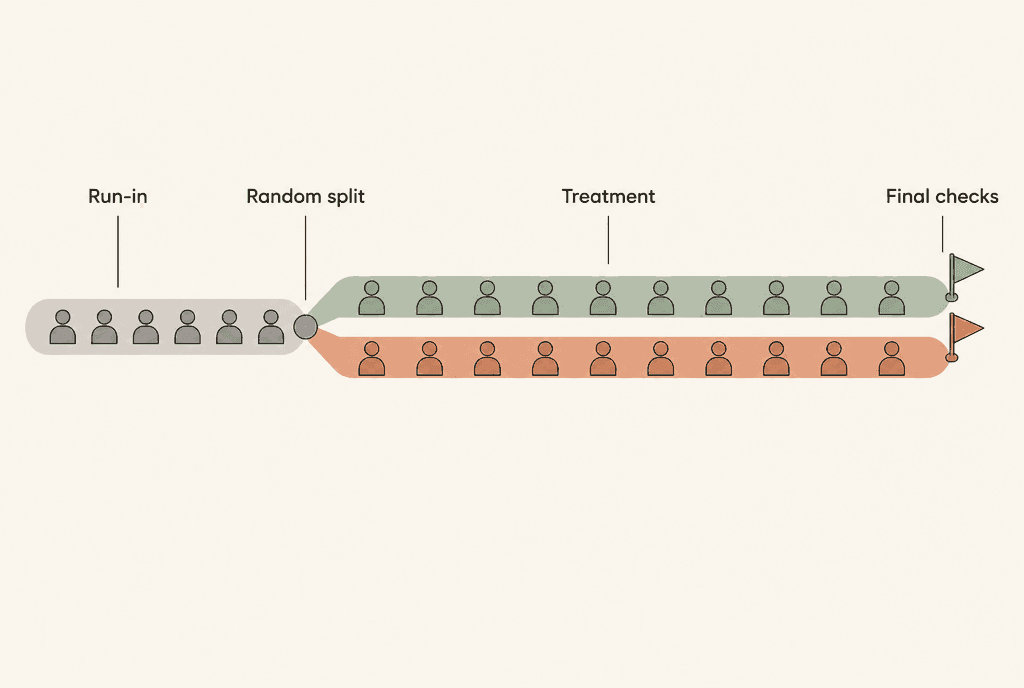
Yes. An Australian company, Metabolic Pharmaceuticals Limited, ran a human obesity program. On 21 February 2007, it described its final trial, called OPTIONS, to the Australian Securities Exchange. OPTIONS enrolled 536 people at 16 sites across Australia. Adults took tablets for 24 weeks. Before that came a four-week run-in, a warm-up stage with a diet and exercise programme supervised by dietitians. The trial was double-blind and placebo-controlled. A placebo is a dummy tablet with no active drug. The company announcement gives the weight-loss results. A later journal paper, from 2013, reports safety observations.
Double-blind means neither the people in the trial nor the staff knew who got AOD-9604 and who got placebo. That stops hopes and expectations from tilting the result.
During the four-week run-in, everyone took placebo. That stage was single-blind: only the participants did not know what they were taking. At week 0, people were randomised, meaning put into groups by chance. They left the study at week 28 after final checks.
What did the AOD-9604 obesity trial find?
The company said OPTIONS did not meet its primary endpoint, the main result a trial is designed to test. Here that was weight loss compared with placebo after 12 weeks of treatment. The company said weight loss compared with placebo, at 12 or 24 weeks, was too small to reach statistical significance. Statistical significance means a result is unlikely to be down to chance alone. After allowing for the diet and exercise programme, the extra weight loss was under 1 kg in every treatment group. The company then stopped developing AOD-9604 for obesity. These figures come from a company statement, not a peer-reviewed paper.
The trial design picked out one subgroup before any results were known: women who lost little weight during the four-week run-in. The company said this subgroup showed effect sizes similar to the earlier trial, and that the full group did not respond in a consistent way. The company also suggested that large weight loss in the placebo group may have drowned out any drug effect.
A subgroup result from a trial that missed its main goal is a lead for more research. It is not a finding that the compound works in that group. No later trial in that subgroup was found in the sources read.
What did the earlier AOD-9604 trial report?
The same 2007 announcement describes an earlier phase 2b trial with no formal diet and exercise programme. After 12 weeks, all five AOD-9604 treatment groups lost more weight on average than the placebo group. The best group still fell short of statistical significance in the main analysis. Its p-value was 0.1, and 0.05 was needed; a smaller p-value means a result is less likely to be chance. That group did reach significance among women. For both sexes, the response was bimodal, which means people fell into two separate clusters. These weight-loss claims rest on the company's own account, not a journal paper.
OPTIONS was set up to test whether the earlier result would hold up in conditions closer to a phase 3 trial. Phase 3 is the large, final stage of testing before a regulator reviews a drug. The company said the result did not hold up across the whole group.
Which trial registry records exist for AOD-9604?
A trial registry is a public list where researchers record a trial's plan. ClinicalTrials.gov, the US registry, returned no records for AOD-9604 or AOD9604 on 16 October 2026. The Australian New Zealand Clinical Trials Registry (ANZCTR) has record ACTRN12605000067673. It names OPTIONS and the sponsor code METAOD006. That record lists a target of 360 people and no final count. The company's 2007 announcement said 536 enrolled. The 2013 safety paper said 534 enrolled and 502 were randomised. All three point to the same study, but the counts do not agree. A target number is not the number who actually took part.
The ANZCTR record was last updated on 14 September 2007. Its results and publications fields hold no uploaded or automatically found documents. An empty field does not prove that no paper exists: the 2013 safety paper can be read at its journal. The sources checked do not explain why the enrolled counts differ.
Who took part in the AOD-9604 obesity trial, and who was left out?
The registry lists otherwise healthy adults aged 18 to 65. Their body mass index (BMI), a measure of weight for height, was 30 to 45. Their waist was at least 102 cm for men or 95 cm for women. People were left out if they took regular medicine, or had diabetes or high blood pressure. Also left out: anyone with hypersensitivity, a strong reaction, to growth-hormone-related products, anyone with severe or many allergies, and anyone dieting or on a weight-loss programme in the three months before screening. The company gives the same age and BMI limits, uses greater-than wording for waist size, and reports about equal numbers of men and women.
A list of who was left out shows where the data are missing. It is not a safety finding about those groups. People with diabetes or high blood pressure, and children, were outside these records, so the trial says nothing about AOD-9604 in them.
Evidence limits
Does a mouse result show a human weight result?
No. The rat and mouse studies measured weight gain, signs of fat breakdown and blood sugar in obese animals. The human trial measured weight loss in adults over 24 weeks, and the company said it did not reach its primary endpoint. Animal bodies handle food and fat differently from human bodies in many ways. That gap is why the sources read do not support any claim about weight in people. The 2013 human paper is a safety summary. It is not a full report of weight-loss results, and the two should not be confused.
The mouse work is still good science. It asked a clear question about how the peptide acts and recorded the answer, and how AOD-9604 works reports it. A 2026 review in Sports Medicine found that many unapproved peptides show good results in animal studies, while careful human safety data are scarce. The side-effects page covers the safety record.
Comparison
What each kind of AOD-9604 evidence can and cannot show about people. Examples are the sources named on this page. The table records evidence types and does not rank outcomes.
| Evidence type | Example | What it can show | What it cannot show |
|---|---|---|---|
| Cell test | Heffernan et al., International Journal of Obesity, 2001 | Whether the peptide competes with growth hormone for its receptor in specially built cells | How a whole person responds |
| Rats and mice | Ng et al., 2000; Heffernan et al., 2001 (two papers) | Weight gain, signs of fat breakdown and blood sugar in obese animals under set conditions | That the same response happens in people |
| Human trial, company announcement | OPTIONS study, 536 enrolled, announcement of 21 February 2007 | That the company reported the primary endpoint was not met, and that weight loss against placebo was under 1 kg in all treatment groups | Independently checked results; the figures have not been through peer review |
| Registry record | ACTRN12605000067673, target sample size 360 | The design, eligibility and sponsor of a registered 24-week phase 2b study | A final count of people or published results; the record gives neither |
FAQ
Did the AOD-9604 clinical trial work?
Not by the company's own account. Metabolic Pharmaceuticals announced on 21 February 2007 that its 536-person phase 2b trial missed its primary endpoint, and it ended development of AOD-9604 for obesity. That statement has not been through peer review.
How many people were in the AOD-9604 trial?
The company announcement of 21 February 2007 reports 536 enrolled. ANZCTR record ACTRN12605000067673 lists 360 as a target, not an actual count. The 2013 safety paper reports 534 enrolled and 502 randomised. The sources do not explain the difference.
Is there a published paper on the AOD-9604 human trial?
A journal safety summary exists: Stier and colleagues, Journal of Endocrinology and Metabolism, 2013, DOI 10.4021/jem157w. That is not a full weight-loss results report. The unsuccessful weight-loss comparison is described in the company's 2007 announcement.
Why did the company stop developing AOD-9604 for obesity?
The announcement of 21 February 2007 says the phase 2b results did not support the commercial viability of AOD-9604 as an obesity treatment. The company said it would focus on pain, osteoporosis and its work on taking peptides by mouth.
More in this hub
Citations
5 sourcesStier H, Vos E, Kenley D. Journal of Endocrinology and Metabolism. 2013;3(1-2):7-15.
doi:10.4021/jem157wNg FM, Sun J, Sharma L, et al. Hormone Research. 2000;53(6):274-278.
doi:10.1159/000053183Heffernan MA, Thorburn AW, Fam B, et al. International Journal of Obesity. 2001;25(10):1442-1449.
doi:10.1038/sj.ijo.0801740Heffernan M, Summers RJ, Thorburn A, et al. Endocrinology. 2001;142(12):5182-5189.
doi:10.1210/endo.142.12.8522Mendias CL, Awan TM Sports Medicine. 2026;56(8):1921-1935.
doi:10.1007/s40279-026-02437-0
Form Laboratories supplies research-use-only reference material. This article is an educational summary of published third-party literature. It is not medical advice, not a use instruction, and research material is not for human or animal use.