
Compound hub · AOD-9604
What is AOD-9604?
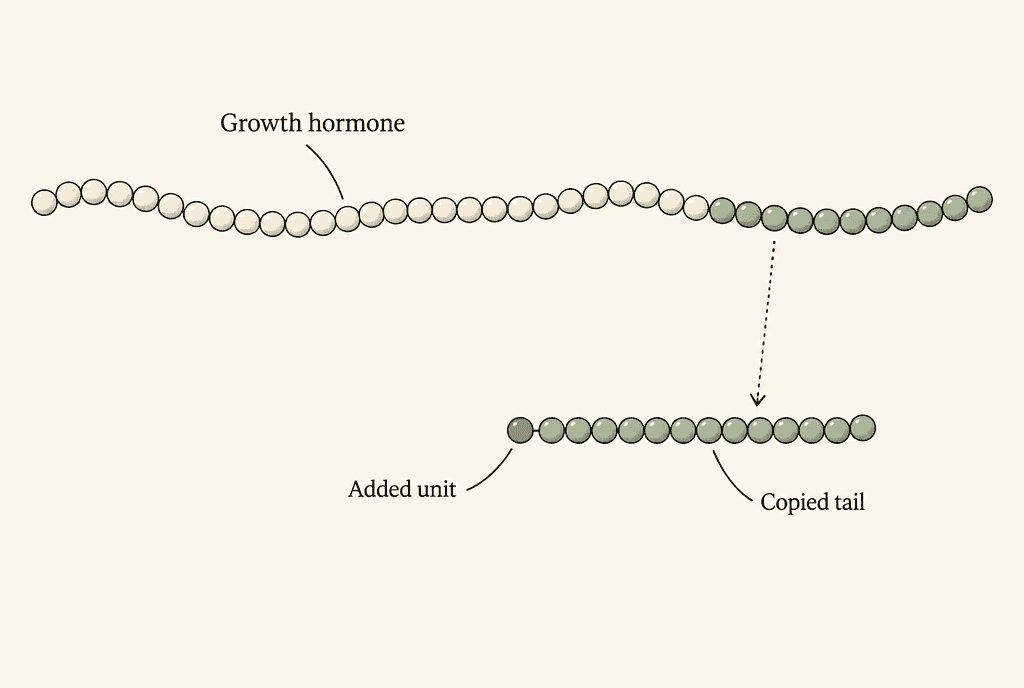
AOD-9604 is a peptide made in a laboratory. A peptide is a short chain of amino acids, the small building blocks of proteins. AOD-9604 has 16: amino acids 177 to 191 copied from the tail end of human growth hormone, plus one added tyrosine. Monash University researchers first published rat and mouse studies of the peptide in 2000 and 2001. AOD-9604 is not growth hormone, and the sources read did not confirm any approved medicine that contains it.
01What it isContents
Picture human growth hormone as a long necklace, where every bead is one amino acid. Researchers at Monash University in Melbourne took a short run of beads from one end and made that piece on its own in the lab. That small piece, with one extra bead added, is AOD-9604, the subject of the AOD-9604 hub.
This page answers the simple questions first. What is AOD-9604? How is it different from growth hormone? Who made it, and what does the name mean? For what studies measured, see the AOD-9604 study findings page. For the legal records, see the Australian legal status page.
Key facts
| Common name | AOD-9604 |
|---|---|
| Name origin | Anti-obesity drug 9604 (Sports Medicine review, 2026) |
| Structure | Amino acids 177 to 191 of human growth hormone plus one tyrosine at the N-terminal end (Cox et al., 2015) |
| Length | 16 amino acids (15 from the growth hormone tail plus the added tyrosine) |
| CAS number | 221231-10-3 (Poisons Standard, October 2026) |
| Earliest studies found in PubMed | Ng et al., Hormone Research, 2000 (Monash University) |
| Developer of the human obesity trial | Metabolic Pharmaceuticals Limited, Melbourne (ASX announcement, 21 February 2007) |
| Registered on ClinicalTrials.gov | No records for AOD-9604 or AOD9604 (16 October 2026); OPTIONS is on ANZCTR as ACTRN12605000067673 |
| Published human half-life | Not established in the sources read (16 October 2026) |
| WADA 2026 Prohibited List | Named as a growth hormone fragment at S2.2.3 of the WADA 2026 List |
What is AOD-9604?
AOD-9604 is a synthetic peptide. Synthetic means it is made in a laboratory. A peptide is a short chain of amino acids, the small building blocks that also make up proteins. AOD-9604 copies amino acids 177 to 191 from the tail end of human growth hormone. One more amino acid, called tyrosine, is added at the front, the N-terminal end. That makes 16 amino acids in total. The first paper, from 2000, called the peptide a lab-made copy of the part of growth hormone linked to fat breakdown, and tested it in obese Zucker rats. The early papers describe lab and animal work, not results in people.
Do not mix up AOD-9604 with hGH 176-191. That is a different named fragment of growth hormone. The World Anti-Doping Agency lists the two separately in its 2026 list. A result for one fragment does not carry over to the other, so this hub reports only what was measured for AOD-9604 itself.
The 2000 paper is listed in PubMed, the medical research database run by the US National Library of Medicine at the National Institutes of Health. Its summary calls the peptide a synthetic analogue, which means a lab-made copy. It does not claim any result in people.
Is AOD-9604 the same as human growth hormone?
No. Human growth hormone, also called somatropin, is a protein hormone. AOD-9604 is a 16-amino-acid peptide built from one end of it. A 2001 study tested both on cells in a dish. AOD-9604 did not compete with growth hormone for the growth hormone receptor. A receptor is a docking spot on a cell that a hormone fits into. AOD-9604 also did not make those cells multiply, but growth hormone did. That is a result in cells, so it does not describe a whole body or people. Australia's Poisons Standard also lists AOD-9604 under its own name, apart from somatropin.
Think of the receptor as a lock on the outside of a cell, and growth hormone as the key that fits it. In the cell test, AOD-9604 did not compete with the key for the lock. The authors wrote that pieces of growth hormone can act in ways that differ from the usual growth hormone pathways.
The same paper found a second difference in obese mice. Growth hormone raised blood sugar and lowered the release of insulin, the hormone that moves sugar out of the blood. AOD-9604 did neither. This is a mouse result, and it does not show the same pattern in people. How AOD-9604 works follows the animal studies in more detail.
What does AOD-9604 stand for, and who developed it?
AOD-9604 stands for anti-obesity drug 9604. The name tells you what the project first set out to do. It is not a result. The earliest studies found in PubMed came from the Department of Biochemistry and Molecular Biology at Monash University in Melbourne, starting in 2000. Later, an Australian company called Metabolic Pharmaceuticals Limited ran the human obesity trial. On 21 February 2007, the company told the Australian Securities Exchange that it was ending work on AOD-9604 for obesity. That was an announcement to its shareholders, not a peer-reviewed paper.
Peer review means other experts check a paper before a journal prints it. The company announcement did not go through that step. The study findings page sets out what it says.
The announcement also said animal work on osteoporosis, a disease that makes bones weak, would continue, and that further development would be considered. No human osteoporosis results were found in the sources read.
Is AOD-9604 an approved medicine?
The sources read for this page did not confirm any approved medicine that contains AOD-9604. Australia's Poisons Standard names AOD-9604 in Schedule 4, the group for prescription-only medicines. Being named in a schedule is not the same as being approved. The TGA, Australia's medicines regulator, says unapproved peptide products have not been assessed by the TGA for safety, quality or effectiveness. To find out whether a named product is on the Australian Register of Therapeutic Goods (ARTG), you search the register itself. This page did not use that search to confirm an exact product.
The Poisons Standard, the TGA, the US Food and Drug Administration (FDA) and the World Anti-Doping Agency each keep records about AOD-9604. Each record answers a different question, and the Australian legal status page keeps them apart. What Schedule 4 and Appendix D mean explains the schedule wording.
Evidence limits
How strong is the evidence about AOD-9604?
The evidence is thin, especially in people. It comes in three kinds. First, animal papers about how the peptide might work. Second, a human safety summary published in 2013 by Stier and colleagues. That paper is not a full report of weight-loss results, and it has ties to the company that ran the trials. Third, a 2007 company report of an obesity trial that missed its main weight-loss goal. A ClinicalTrials.gov name search on 16 October 2026 found no records for AOD-9604 or AOD9604. The OPTIONS trial is registered on ANZCTR as ACTRN12605000067673. No human half-life was established in the sources read.
ANZCTR is the Australian New Zealand Clinical Trials Registry. A half-life is the time it takes for the measured level of a substance in the body to fall by half.
Evidence shows how much weight a claim deserves, and for AOD-9604 the human weight is light. A 2026 review in Sports Medicine found that many unapproved peptides show good results in animal studies, while careful human safety data are scarce. Posts online are personal stories, not controlled studies. The side-effects page sets out the safety record.
Comparison
How AOD-9604 differs from two things it is often confused with. Each cell records what the sources on this page say; a cell marked not checked means those sources did not cover it. The table does not rank anything.
| Question | AOD-9604 | Human growth hormone (somatropin) | hGH 176-191 |
|---|---|---|---|
| What it is | A synthetic peptide of 16 amino acids | A protein hormone the body makes | A different named fragment of growth hormone |
| Where it comes from | Growth hormone amino acids 177 to 191, plus one added tyrosine | The whole hormone | Not checked for this page |
| Growth hormone receptor, 2001 cell test | Did not compete for the receptor; did not make the cells multiply | Competed for the receptor and made the cells multiply | Not tested in that paper |
| Blood sugar in obese mice, 2001 | Did not raise blood sugar or lower insulin release | Raised blood sugar and lowered insulin release | Not tested in that paper |
| Australian Poisons Standard, October 2026 | Its own Schedule 4 entry, CAS number 221231-10-3 | Listed separately, as somatropin | Not checked for this page |
| WADA 2026 Prohibited List | Named at S2.2.3 as a growth hormone fragment | Not checked for this page | Named at S2.2.3 as a separate example |
FAQ
Is AOD-9604 a peptide or a hormone?
AOD-9604 is a synthetic peptide. Its structure comes from human growth hormone, but in a 2001 cell test it did not compete for the growth hormone receptor. The sources read do not describe AOD-9604 as a hormone.
How many amino acids does AOD-9604 have?
AOD-9604 has 16 amino acids: growth hormone amino acids 177 to 191, which makes 15, plus one added tyrosine.
Is AOD-9604 the same as hGH 176-191?
No. The WADA 2026 Prohibited List names AOD-9604 and hGH 176-191 as two separate examples of growth hormone fragments at S2.2.3. The October 2026 Poisons Standard names AOD-9604 with its own CAS number, 221231-10-3. The sources read do not show that results for one fragment apply to the other.
Has a human half-life for AOD-9604 been published?
Not in the sources read for this page on 16 October 2026. A lab study mixed the peptide with serum and urine in a dish and found six possible breakdown products. That describes chemistry in a dish, not how long the peptide stays in the human body.
More in this hub
- AOD-9604 side effects: what trials, the FDA and regulators have recorded
- AOD-9604 study findings: what the human obesity trial reported and what animal studies measured
- How does AOD-9604 work? What rat and mouse studies measured
- Is AOD-9604 legal in Australia? Poisons Standard, TGA, FDA and WADA records
Citations
5 sourcesStier H, Vos E, Kenley D. Journal of Endocrinology and Metabolism. 2013;3(1-2):7-15.
doi:10.4021/jem157wNg FM, Sun J, Sharma L, et al. Hormone Research. 2000;53(6):274-278.
doi:10.1159/000053183Heffernan MA, Thorburn AW, Fam B, et al. International Journal of Obesity. 2001;25(10):1442-1449.
doi:10.1038/sj.ijo.0801740Cox HD, Smeal SJ, Hughes CM, Cox JE, Eichner D. Drug Testing and Analysis. 2015;7(1):31-38.
doi:10.1002/dta.1715Mendias CL, Awan TM Sports Medicine. 2026;56(8):1921-1935.
doi:10.1007/s40279-026-02437-0
Form Laboratories supplies research-use-only reference material. This article is an educational summary of published third-party literature. It is not medical advice, not a use instruction, and research material is not for human or animal use.