
Hub · Growth Hormone and Growth Hormone-Releasing Peptides
What is somatropin?
Somatropin is human growth hormone made in bacteria. It is a protein of 191 amino acids, built with recombinant DNA technology, and its sequence is identical to the growth hormone your pituitary gland makes. The FDA labels describe somatropin as a prescription medicine with named uses, including growth hormone deficiency. Somatropin is a separate molecule from every growth hormone-releasing peptide.
01What it isContents
Deep under your brain sits a pea-sized gland called the pituitary. All through life it lets out growth hormone in short bursts. The hormone rides in your blood to cells that carry a matching receiver. Somatropin is a factory-made copy of that same hormone, and it is the fixed point that the growth hormone peptides hub measures everything else against.
The other molecules in that hub work one step earlier. They are signals that tell the pituitary to let its own hormone out. Somatropin skips that step, because it is the hormone itself.
This page explains what somatropin is, what its label says happens inside the body, and what Australian and sport records say about it. It does not describe how the medicine is given. The hub covers how things work and what the records say, nothing more.
Key facts
| Generic name | Somatropin |
|---|---|
| Length | 191 amino acid residues (Humatrope and Genotropin labels, FDA) |
| Origin | Produced by recombinant DNA technology in Escherichia coli; sequence identical to pituitary-origin human growth hormone |
| Receptor | Dimeric growth hormone receptors in target-cell membranes |
| Downstream proteins named on the label | IGF-1, IGF binding protein-3 and the acid-labile subunit |
| Example FDA records | Humatrope, BLA 019640; Genotropin, BLA 020280 |
| Poisons Standard, October 2026 | Schedule 4 and Appendix D clause 5; registered somatropin medicine: ARTG 78811, checked 16 October 2026 |
| WADA 2026 List | S2.2.3, prohibited at all times |
What is somatropin?
Somatropin is human growth hormone made by bacteria. Scientists put the human gene for the hormone into Escherichia coli, a common lab bacterium. This is called recombinant DNA technology. The bacteria then build the hormone for us. The finished protein is a chain of 191 amino acids, the small building blocks that make up every protein. Its order of building blocks is identical to the growth hormone your own pituitary makes. The Humatrope label gives a weight of about 22,125 daltons. The Genotropin label gives 191 building blocks and 22,124 daltons. A dalton is a tiny unit used to weigh molecules.
Because the chain matches the natural hormone, somatropin is a copy of the hormone. It is not a signal that asks the body to release hormone.
That is the main difference from the other peptides in this hub. Those are different molecules, and they press different switches on different cells. The page on HGH and releasing peptides puts the groups side by side.
A chain of 191 building blocks is long for a hormone. Is it a peptide or a protein? The page on peptides and proteins explains the naming habit. Chain length alone is not a strict line between the two.
How does somatropin act in the body?
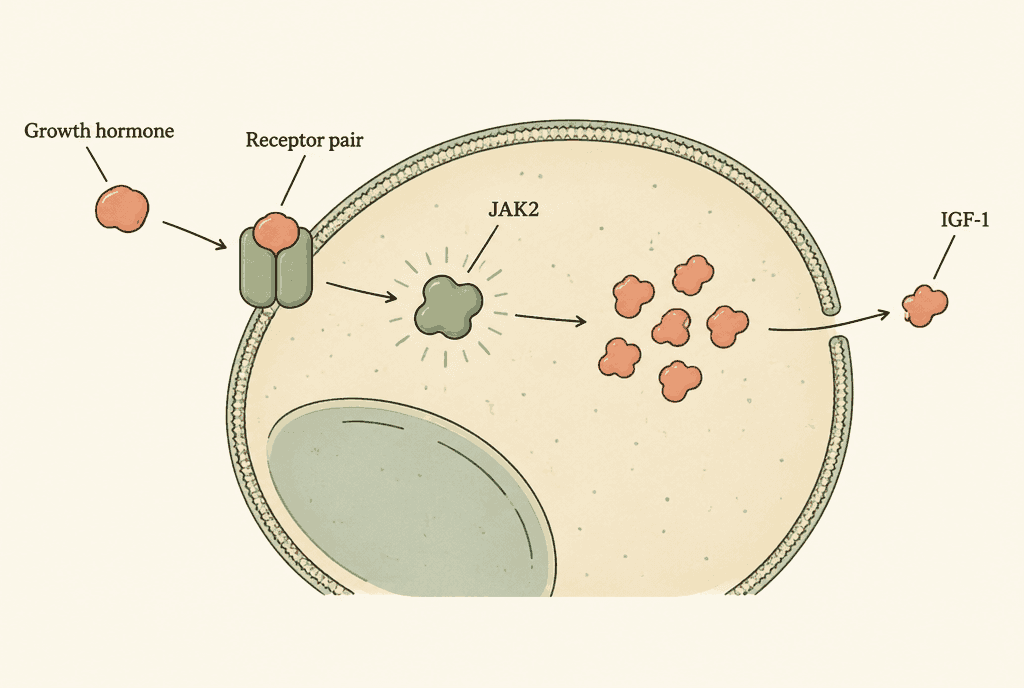
Somatropin works by docking onto a receiver on the outside of a cell. That receiver is called the growth hormone receptor. It is "dimeric", which means it works as a pair. According to the Humatrope label, docking sends a message into the cell. The cell then reads certain genes and builds new proteins from them. The label names three: IGF-1, IGF binding protein-3 and the acid-labile subunit. IGF-1 means insulin-like growth factor 1. It is a second hormone that carries part of the growth hormone message onward. So growth hormone often works through a relay, not only directly.
The label says somatropin has direct effects on tissues and on how the body handles fuel. It also has indirect effects that pass through IGF-1. The label lists effects on growth plates, on how much sugar the liver releases, on how the body builds protein and on how it breaks down fat. This page repeats the label's account of how the hormone works. It does not repeat the details of approved use.
The label does not describe the steps between the receiver and the new proteins. A 2010 review in Nature Reviews Endocrinology fills in that picture. It describes the receptor as a pair that already exists before the hormone arrives. When the hormone docks, the two halves shift position. That shift switches on JAK2, an enzyme attached to the inside of the receptor. An enzyme is a protein that speeds up a chemical step. JAK2 then tags the receptor and other proteins with phosphate groups, which works like flipping them to "on".
A 1992 study in Science took a 3D snapshot of the hormone stuck to the outer part of its receptor. It showed one hormone molecule holding two receptor molecules, like one hand gripping two handles. This was a picture of purified proteins in the lab, not of a living body.
What is somatropin approved for?
The Humatrope label, approved by the FDA, lists uses in children and in adults. In children it lists poor growth because the body makes too little growth hormone. It also lists short height linked to Turner syndrome, short height with no known cause (idiopathic short stature), SHOX deficiency, and short height in children born small for their stage of pregnancy. In adults it lists replacing growth hormone when the body lacks it. These are named uses of a prescription medicine, and each one is tied to a diagnosis. The approval covers somatropin products only. It is not an approval of any releasing peptide.
The Genotropin label splits adults who lack growth hormone into two groups. In the first group the problem started in adulthood. It came from disease of the pituitary or the hypothalamus, a nearby control area of the brain, or from surgery, radiation or injury. In the second group the problem started in childhood.
The Genotropin label also notes how doctors usually confirm the diagnosis in adults. They generally use a growth hormone provocative test. That is a clinical test that checks how the pituitary responds when it is challenged.
What do the Australian and sport records say about somatropin?
In Australia, somatropin has its own Schedule 4 entry, and Appendix D clause 5 applies. Schedule 4 is the prescription-only group. This comes from the October 2026 Poisons Standard, instrument F2026L01327, checked line by line on 16 October 2026. The national medicines database, the Australian Register of Therapeutic Goods (ARTG), lists one somatropin medicine, Genotropin, ARTG 78811, in the same check. In sport, the WADA 2026 Prohibited List names growth hormone, its analogues and fragments at S2.2.3. The list has applied since 1 January 2026, and it bans these substances at all times.
A registered product is approved only for the uses and form written on its own entry. One ARTG listing for one product does not approve every product with the same ingredient.
What Schedule 4 and Appendix D mean explains both Poisons Standard terms. The legal status page lists the matching rows for the releasing peptides.
Evidence limits
What do the label and records not tell a reader about somatropin?
The Humatrope label does not tell us whether somatropin and the releasing peptides lead to the same results in people. The label describes one somatropin product: how it works and what it is approved for. It is not a review of research on the releasing peptides. A finding about one molecule, or one group of patients, cannot answer a question about a different molecule. So this page does not claim that no head-to-head trials exist anywhere. It also makes no claim about products sold outside the regulated medicine supply. Those questions sit outside what these records cover.
That is why the hub keeps the three groups apart. The label supports statements about somatropin, and only somatropin.
The pages on CJC-1295 and ipamorelin report what studies of those compounds measured. Their results are not somatropin results.
FAQ
Is somatropin the same as HGH?
Yes. Somatropin is human growth hormone made with recombinant DNA technology, and its chain matches the hormone the pituitary makes. The phrase "HGH peptides" is different. It usually means signals that ask the body to release hormone, not the hormone itself.
What does IGF-1 have to do with somatropin?
When somatropin docks on its receptor, cells start making IGF-1, IGF binding protein-3 and the acid-labile subunit. The Humatrope label says some of somatropin's effects pass indirectly through IGF-1, a second hormone that relays part of the message.
Is somatropin a peptide?
Somatropin is a protein of 191 amino acids. Where a peptide ends and a protein begins is a naming habit, not a hard rule. The label calls a chain of this length a protein.
More in this hub
Growth Hormone and Growth Hormone-Releasing Peptides
- Are growth hormone peptides legal in Australia? Poisons Standard, TGA and WADA records
- GHRH analogues vs ghrelin-receptor peptides: two inputs to growth hormone release
- HGH peptides vs HGH: are growth hormone-releasing peptides growth hormone?
- What is the half-life of growth hormone? Minutes in a vein, hours under the skin
Citations
2 sourcesBrooks AJ, Waters MJ Nature Reviews Endocrinology. 2010;6(9):515-525.
doi:10.1038/nrendo.2010.123de Vos AM, Ultsch M, Kossiakoff AA Science. 1992;255(5042):306-312.
doi:10.1126/science.1549776
Form Laboratories supplies research-use-only reference material. This article is an educational summary of published third-party literature. It is not medical advice, not a use instruction, and research material is not for human or animal use.