
Hub · Growth Hormone and Growth Hormone-Releasing Peptides
HGH vs growth hormone-releasing peptides: what is the difference?
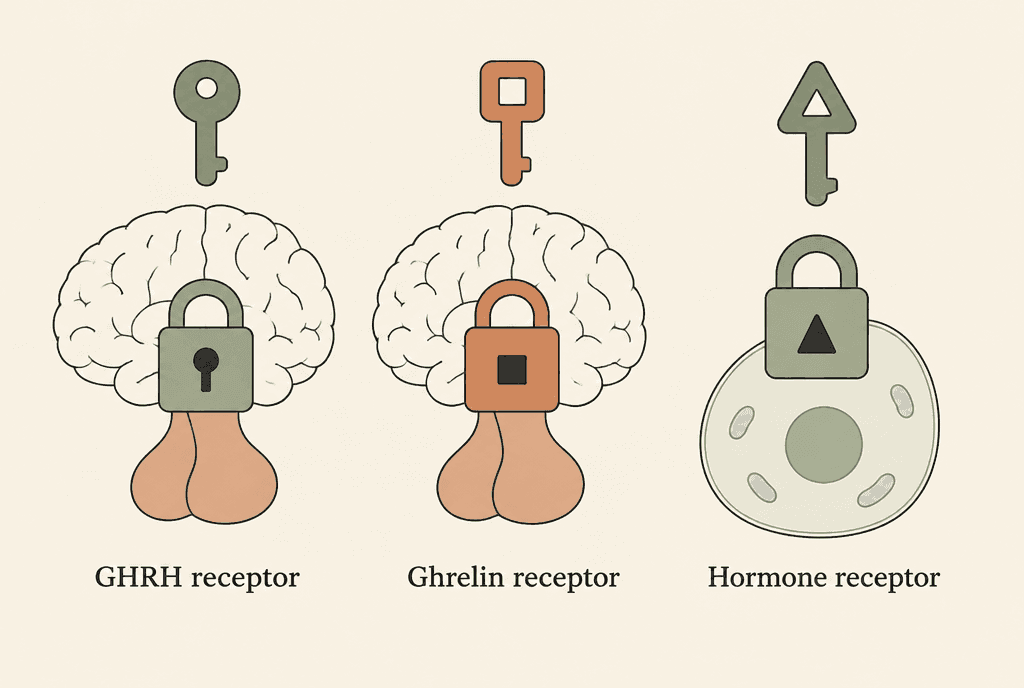
Growth hormone, also called HGH or somatropin, is a hormone of 191 amino acids that docks on growth hormone receptors. Growth hormone-releasing peptides are different molecules. GHRH analogues act on the receptor for growth hormone-releasing hormone. Peptides such as GHRP-6 act on the ghrelin receptor. Both families work one step before growth hormone is released. Neither family is growth hormone.
Form Labs materials are research reference materials, not the approved medicines; no Form Labs product is approved for human or veterinary use.
01Same thing?Contents
"HGH peptides" sounds like one thing. It is really a mix-up of a hormone and the messages that control it. Your pituitary, a pea-sized gland at the base of your brain, lets out growth hormone in bursts. Other tissues send it signals that say when to do that.
Scientists copied two of those signals and built whole families of lab-made peptides from them. The growth hormone peptides hub pulls the hormone and its signals back apart.
This page sets the three groups side by side: growth hormone itself, GHRH analogues and ghrelin-receptor peptides. For each one it names the receptor, says what the records show and what they do not, and links to that compound's own guide. Sister pages go deeper on what somatropin is and on the two releasing families.
Key facts
| Growth hormone, generic name | Somatropin (recombinant human growth hormone) |
|---|---|
| Length of somatropin | 191 amino acids, identical in sequence to human growth hormone of pituitary origin (Humatrope label, FDA record BLA 019640) |
| Receptor for growth hormone | Growth hormone receptor on target-cell membranes |
| Receptor for GHRH analogues | GHRH receptor on the pituitary |
| Receptor for GHRPs and ghrelin mimetics | Ghrelin receptor (growth hormone secretagogue receptor type 1a) |
| WADA 2026 List | Growth hormone at S2.2.3; releasing factors at S2.2.4; all prohibited at all times (WADA 2026 Prohibited List) |
| Records checked | 16 October 2026 |
Evidence limits
Are growth hormone-releasing peptides the same as growth hormone?
No. Growth hormone is a hormone made of 191 amino acids, the building blocks of proteins. The somatropin sold as a medicine has exactly the same chain as the growth hormone your pituitary makes. Releasing peptides are different molecules that press different switches, called receptors. The 1992 Bowers study measured how much hormone was released. The 2005 Jetté paper reports work in animals and in the lab. Neither one compares somatropin with releasing peptides in patients. So these papers do not show that the molecules lead to the same results in people.
That gap matters for the phrase "HGH peptides". If growth hormone rises after a releasing signal, that shows the pituitary answered the signal. It does not show that the result matches what growth hormone itself does over months. The cited hormone-release study did not test that question.
Approved growth hormone treatment is a prescription medicine with named uses. These include children and adults whose bodies make too little growth hormone (Humatrope label, FDA record BLA 019640). That approval does not cover the releasing peptides.
What are the three things people call HGH peptides?
People use "HGH peptides" for three different groups. The first is growth hormone itself, sold as somatropin products. The second is GHRH analogues. These are lab-made copies of the brain's own "release growth hormone" signal. WADA names sermorelin, tesamorelin and CJC-1295 as examples. The third is ghrelin-pathway agents. These include the peptides GHRP-2, GHRP-6 and ipamorelin, and also ibutamoren, which is not a peptide. Each group works through a different receptor, so the three names cannot be swapped for each other. What a molecule is made of and which receptor it acts on are two separate facts.
The table below puts the groups next to each other.
Ibutamoren is not a peptide. A 2021 paper in Nature Communications calls it a non-peptide that switches on the ghrelin receptor. It shares the peptides' receptor, but it is a different kind of chemical.
Two more names turn up in the same searches. WADA describes AOD-9604 as a piece (fragment) of growth hormone. IGF-1 LR3 is a lab-made version of IGF-1, a protein the body makes after growth hormone acts. Neither one is a releasing peptide. That is one more reason the catch-all phrase misleads.
Which receptor does each one act on?
Each group fits a different lock. Growth hormone docks on growth hormone receptors, which sit as pairs in the outer skin of target cells. Docking sends a message into the cell, and the cell starts making proteins such as IGF-1. GHRH analogues act on the GHRH receptor in the pituitary. CJC-1295 did this in rat experiments, which do not prove the same happens in people. Ghrelin-receptor peptides act on a different receptor. Scientists first copied (cloned) that receptor's gene from pituitary and hypothalamus tissue in 1996. The hypothalamus is a control area of the brain.
The ghrelin receptor has a natural partner, ghrelin. Ghrelin is a peptide of 28 amino acids. Scientists first purified it from rat stomach in 1999. Your stomach makes it, and one of its jobs is to nudge the pituitary. The lab-made peptides copy part of that nudge.
In a 1992 study, GHRP-6 released growth hormone in men when it was given into a vein. Taken by mouth, its activity was far lower in the same study.
The ipamorelin guide records that ipamorelin raised growth hormone in rat cells, in rats and in pigs. Tests with blocking chemicals linked the rat-cell response to a GHRP-like receptor. That is an animal result. It does not show the same effect in people.
Where do CJC-1295, ipamorelin, tesamorelin, GHRP-2, GHRP-6, IGF-1 LR3 and AOD-9604 fit?
CJC-1295 and tesamorelin belong to the GHRH-analogue group. Ipamorelin, GHRP-2 and GHRP-6 belong to the ghrelin-receptor group. IGF-1 LR3 and AOD-9604 sit outside both groups. WADA lists the first five as growth hormone releasing factors at S2.2.4. It lists AOD-9604 as a growth hormone fragment at S2.2.3. Tesamorelin has an FDA product label, Egrifta WR, but that label covers tesamorelin only. Each compound has its own guide: CJC-1295, tesamorelin, ipamorelin, GHRP-2 and GHRP-6, IGF-1 LR3 and AOD-9604. Each guide says what its compound is and where the evidence stops.
Each guide also reports what the studies measured. The Egrifta WR label documents an approved tesamorelin medicine. It also documents controlled trials in adults living with HIV. Those findings belong to tesamorelin. They do not carry over to the other compounds.
Does either class have a different status in sport or in Australian law?
In sport, both are banned. In Australian product records, they differ. The WADA 2026 Prohibited List has applied since 1 January 2026. It names both classes and bans them at all times. Growth hormone and its fragments sit at S2.2.3. GHRH analogues, ghrelin mimetics and GHRPs sit at S2.2.4. In Australia, somatropin and several named releasing peptides each have their own Schedule 4 entry in the October 2026 Poisons Standard, instrument F2026L01327. Schedule 4 is the prescription-only group. The legal status page lists each row, with the limits of each check.
One class does not stand in for the other. Using a releasing peptide does not get around a rule written for growth hormone, because the WADA list names both.
Comparison
Receptor, origin and one fact from a named record for each group. The groups are those used in the WADA 2026 List. This is a record of what each group is, not a ranking.
| Group | Examples with a regulatory name | Receptor | What it is not |
|---|---|---|---|
| Growth hormone itself | Somatropin products (Humatrope, Genotropin) | Growth hormone receptor, then IGF-1 production (Humatrope prescribing information) | A releasing signal |
| GHRH analogues | Sermorelin, tesamorelin, CJC-1295 (WADA S2.2.4) | GHRH receptor on the pituitary | Growth hormone, or a ghrelin-receptor peptide |
| Ghrelin-pathway agents | GHRP-2 (pralmorelin), GHRP-6, ipamorelin; ibutamoren is a non-peptide mimetic (WADA S2.2.4; Liu et al., 2021) | Ghrelin receptor (growth hormone secretagogue receptor type 1a) | Growth hormone, or a GHRH analogue |
FAQ
Is sermorelin or CJC-1295 the same as HGH?
No. Both are GHRH analogues: lab-made copies of a signal that acts on the pituitary. Growth hormone is the hormone the pituitary then lets out. The WADA 2026 List puts CJC-1295 and sermorelin with the GHRH analogues at S2.2.4. Growth hormone sits apart, at S2.2.3.
Is GHRP-6 a growth hormone?
No. GHRP-6 is a lab-made chain of six amino acids, with the sequence His-D-Trp-Ala-Trp-D-Phe-Lys-NH2. In a 1992 study it made the body release growth hormone in men. So it acts on the release step. It is not the hormone itself.
Has a trial shown that releasing peptides match growth hormone?
The Bowers study cited here measured how much hormone was released. It did not compare releasing peptides with somatropin in patients. A rise in growth hormone does not, on its own, show the same results in people. These sources do not settle whether such head-to-head trials exist elsewhere.
More in this hub
Growth Hormone and Growth Hormone-Releasing Peptides
- Are growth hormone peptides legal in Australia? Poisons Standard, TGA and WADA records
- GHRH analogues vs ghrelin-receptor peptides: two inputs to growth hormone release
- What is the half-life of growth hormone? Minutes in a vein, hours under the skin
- What is somatropin? Recombinant human growth hormone explained from the label
Citations
7 sourcesLiu H, Sun D, Myasnikov A, et al. Nature Communications. 2021;12(1):6410.
doi:10.1038/s41467-021-26735-5Lu Z, Liu N, Huang H, et al. Applied Microbiology and Biotechnology. 2023;107(14):4543-4551.
doi:10.1007/s00253-023-12606-0Bowers CY, Alster DK, Frentz JM. Journal of Clinical Endocrinology and Metabolism. 1992;74(2):292-298.
doi:10.1210/jcem.74.2.1730807Howard AD, Feighner SD, Cully DF, et al. Science. 1996;273(5277):974-977.
doi:10.1126/science.273.5277.974Kojima M, Hosoda H, Date Y, et al. Nature. 1999;402(6762):656-660.
doi:10.1038/45230Jetté L, Léger R, Thibaudeau K, et al. Endocrinology. 2005;146(7):3052-3058.
doi:10.1210/en.2004-1286Raun K, Hansen BS, Johansen NL, et al. European Journal of Endocrinology. 1998;139(5):552-561.
doi:10.1530/eje.0.1390552
Form Laboratories supplies research-use-only reference material. This article is an educational summary of published third-party literature. It is not medical advice, not a use instruction, and research material is not for human or animal use.