
Hub · Growth Hormone and Growth Hormone-Releasing Peptides
GHRH analogues vs ghrelin-receptor peptides: what is the difference?
GHRH analogues are lab-made copies of growth hormone-releasing hormone, and they act on the GHRH receptor. Ghrelin-receptor peptides, such as GHRP-6 and ipamorelin, act on a different switch: the ghrelin receptor, first cloned from pituitary and brain tissue in 1996. Both families change how much growth hormone is released. Neither family is growth hormone.
Form Labs materials are research reference materials, not the approved medicines; no Form Labs product is approved for human or veterinary use.
01The differenceContents
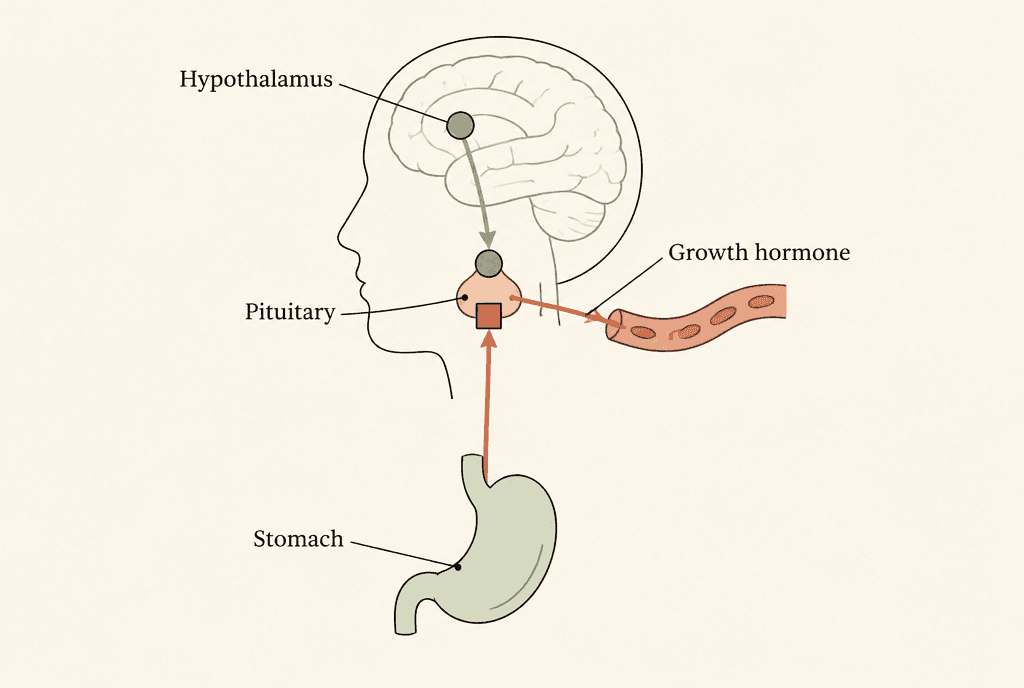
Think of the pituitary as a tap for growth hormone, with two different hands that can turn it. One hand is a message from the hypothalamus, a control centre deep in the brain. That message is called growth hormone-releasing hormone, or GHRH. The other hand is ghrelin, a message made mostly in the stomach.
Scientists have built lab-made peptides that copy each hand. The growth hormone peptides hub sorts them into two families, one for each message.
This page compares the two families side by side. It covers the switch each one presses, the compounds in each family and what the papers we opened actually measured. Those papers asked different questions. So they cannot show that one family leads to the same results in people as the other.
Key facts
| GHRH analogues | CJC-1295, sermorelin, tesamorelin (named in WADA S2.2.4) |
|---|---|
| Ghrelin-receptor peptides | GHRP-2 (pralmorelin), GHRP-6, ipamorelin (named in WADA S2.2.4) |
| Receptor, GHRH analogues | GHRH receptor on the pituitary |
| Receptor, ghrelin-receptor peptides | Ghrelin receptor, also called growth hormone secretagogue receptor type 1a |
| Natural partner of the ghrelin receptor | Ghrelin, a 28-amino-acid peptide first purified from rat stomach in 1999 (Kojima et al., 1999) |
| GHRP-6 sequence | His-D-Trp-Ala-Trp-D-Phe-Lys-NH2 (Bowers et al., 1992) |
| Records checked | 16 October 2026 |
What is the difference between a GHRH analogue and a ghrelin-receptor peptide?
The difference is the receptor, the switch on the cell that each one presses. A GHRH analogue is a lab-made copy of growth hormone-releasing hormone. It presses the GHRH receptor. CJC-1295 was shown to do this in rat experiments, which do not prove the same happens in people. A ghrelin-receptor peptide copies part of the ghrelin message instead. It presses the ghrelin receptor. In tests on rat pituitary cells, scientists used chemicals that block one switch at a time. Ipamorelin released growth hormone through a GHRP-like receptor, not through the GHRH receptor.
That is why the WADA 2026 List writes the two families as separate bullets inside S2.2.4. GHRH and its analogues sit in one bullet. Growth hormone secretagogues and their mimetics sit in another. GH-releasing peptides sit in a third.
A secretagogue is a compound that makes a gland release something. Here, that something is growth hormone.
The table below sets the two families out by receptor, named compounds and human record.
Which compounds are GHRH analogues?
WADA names four examples of GHRH and its analogues: CJC-1293, CJC-1295, sermorelin and tesamorelin. CJC-1295 with DAC is a lab-made chain of 30 amino acids that copies GHRH. DAC stands for drug affinity complex. It is a chemical hook, and in rats it bonded the peptide to albumin, a common blood protein. Two placebo-controlled trials then tested CJC-1295 in healthy adults aged 21 to 61. Placebo-controlled means some people got a dummy treatment for fair contrast. In those trials, the estimated half-life of CJC-1295 was 5.8 to 8.1 days. A half-life is how long the body takes to clear half of it.
Tesamorelin has an approved medicine form in the United States. The tesamorelin hub reports what its trials in adults living with HIV measured.
The CJC-1295 hub reports the much thinner human record for CJC-1295. There, the 2006 Teichman paper reports two short trials in healthy adults.
Which compounds act on the ghrelin receptor?
GHRP-6, GHRP-2 (also called pralmorelin) and ipamorelin act on the ghrelin receptor. WADA also lists ibutamoren among the ghrelin mimetics, meaning compounds that copy ghrelin's action. GHRP-6 is a hexapeptide, a chain of six amino acids. Its sequence is His-D-Trp-Ala-Trp-D-Phe-Lys-NH2. In a 1992 study, GHRP-6 given into a vein made the body release growth hormone in men. Ipamorelin is a pentapeptide, a chain of five amino acids. A 1998 paper described it using experiments in the lab and in animals. Each of these compounds presses the same switch as the body's own ghrelin.
Scientists cloned the receptor itself in 1996, from pituitary and hypothalamus tissue. They purified its natural partner, ghrelin, from rat stomach three years later, in 1999. In other words, researchers built the lab-made keys before they found the natural one.
A 2004 review in Drugs in R&D described pralmorelin (GHRP-2) as a ghrelin-pathway peptide. At that time it was awaiting approval in Japan as a test for diagnosing a lack of growth hormone. That passage describes a proposed diagnostic use. It does not prove approval, or that the product is available today.
The hub page on GHRP-2 and GHRP-6 covers both of those peptides. The ipamorelin hub covers ipamorelin.
Evidence limits
What has research not shown about the two families?
The papers cited here do not show which family leads to better results in patients. The 1992 Bowers study measured hormone release linked to GHRP-6 in people. The 2006 Teichman study measured hormone levels and how long CJC-1295 stayed in the blood of healthy adults. The 2004 Drugs in R&D review described pralmorelin's proposed diagnostic role and how far its development had got at that time. These are different questions, asked in different groups of people. They cannot rank the two families. This page also does not claim that no other human research exists.
"Which family is better?" has no answer in these records. The papers describe what a receptor does, what a hormone level did and what a regulator wrote.
To compare results across the two families, you would need a trial designed to compare them directly.
Comparison
The switch each family presses, its named compounds and what the papers and labels we opened show in people. Examples come from the WADA 2026 List and the papers cited on this page. This is a record of what each family is, not a ranking.
| Family | Named compounds | Receptor (switch) | Human record we opened |
|---|---|---|---|
| GHRH analogues | CJC-1295, sermorelin, tesamorelin | GHRH receptor on the pituitary (CJC-1295 in rat experiments, Jetté et al., 2005) | CJC-1295: two short trials in healthy adults (Teichman et al., 2006). Tesamorelin: approved US medicine with controlled trials in adults with HIV (Egrifta WR label, FDA, 2025) |
| Ghrelin-receptor peptides | GHRP-2 (pralmorelin), GHRP-6, ipamorelin; ibutamoren as a mimetic | Ghrelin receptor (Howard et al., 1996) | GHRP-6: growth hormone release in men (Bowers et al., 1992). Pralmorelin: awaiting Japanese diagnostic approval in the 2004 review (Drugs R D, 2004) |
FAQ
Is ipamorelin a GHRH analogue?
No. Ipamorelin is a chain of five amino acids that acts on the ghrelin receptor. Tests on rat pituitary cells linked its release of growth hormone to a GHRP-like receptor. The WADA 2026 List puts it with growth hormone secretagogues and their mimetics, not with GHRH analogues.
Is GHRP-2 the same as pralmorelin?
Yes. WADA writes "GHRP-2 (pralmorelin)". The Poisons Standard entry, instrument F2026L01327, is indexed under both pralmorelin and GHRP-2, in a record check on 16 October 2026.
Does ghrelin only act on growth hormone?
No. The FDA's review of ipamorelin notes that ghrelin receptors are found in many organs. These include the heart, lung, liver, kidney, pancreas, intestine, adrenal gland, testis, fat tissue and stomach (FDA review, 19 August 2024; see the ipamorelin hub). Finding a receptor in an organ shows where the receptor is. It does not show what a compound does there.
More in this hub
Growth Hormone and Growth Hormone-Releasing Peptides
- Are growth hormone peptides legal in Australia? Poisons Standard, TGA and WADA records
- HGH peptides vs HGH: are growth hormone-releasing peptides growth hormone?
- What is the half-life of growth hormone? Minutes in a vein, hours under the skin
- What is somatropin? Recombinant human growth hormone explained from the label
Citations
7 sourcesHoward AD, Feighner SD, Cully DF, et al. Science. 1996;273(5277):974-977.
doi:10.1126/science.273.5277.974Kojima M, Hosoda H, Date Y, et al. Nature. 1999;402(6762):656-660.
doi:10.1038/45230Bowers CY, Alster DK, Frentz JM. Journal of Clinical Endocrinology and Metabolism. 1992;74(2):292-298.
doi:10.1210/jcem.74.2.1730807Raun K, Hansen BS, Johansen NL, et al. European Journal of Endocrinology. 1998;139(5):552-561.
doi:10.1530/eje.0.1390552Jetté L, Léger R, Thibaudeau K, et al. Endocrinology. 2005;146(7):3052-3058.
doi:10.1210/en.2004-1286Teichman SL, Neale A, Lawrence B, Gagnon C, Castaigne JP, Frohman LA. Journal of Clinical Endocrinology & Metabolism. 2006;91(3):799-805.
doi:10.1210/jc.2005-1536No author listed. Drugs in R&D. 2004;5(4):236-239.
doi:10.2165/00126839-200405040-00011
Form Laboratories supplies research-use-only reference material. This article is an educational summary of published third-party literature. It is not medical advice, not a use instruction, and research material is not for human or animal use.