
Hub · Peptide Quality & Verification
What is peptide mass fingerprinting, and what can it identify?
Peptide mass fingerprinting identifies a likely protein by measuring the masses of its smaller pieces, called peptides, and matching them against a database of known sequences. A fingerprint supports a protein match. It does not read every amino acid in order. Neither a fingerprint nor the mass of a whole peptide can, on its own, show how pure a batch is.
01Peptide massContents
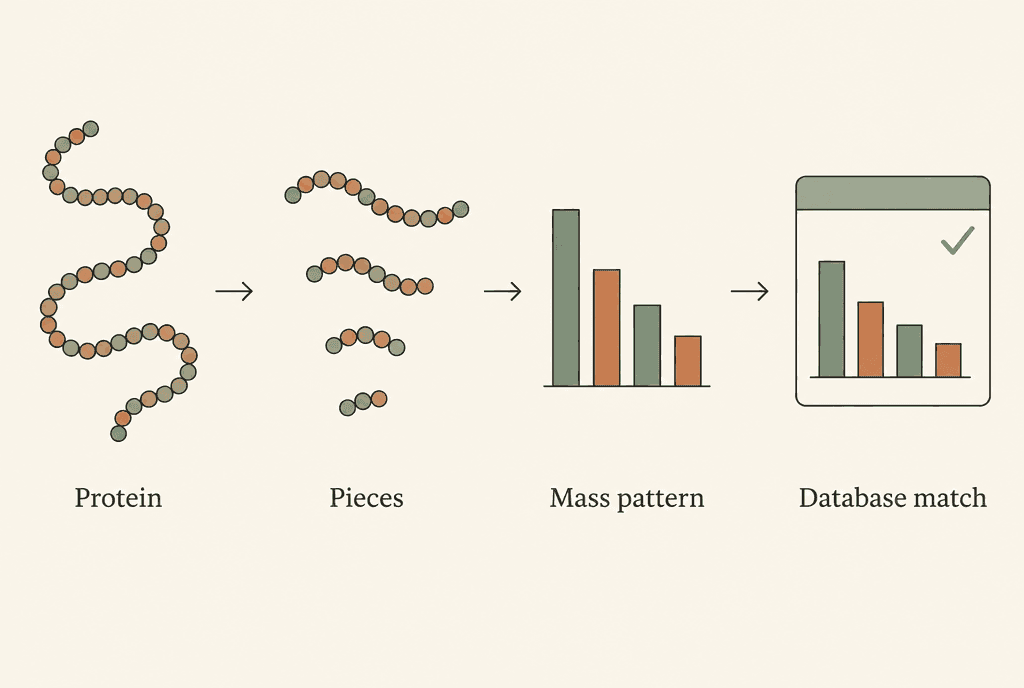
Your hair, skin and muscles are packed with proteins. Each one is a long chain of small building blocks called amino acids, and the order of those blocks makes every protein different. A lab can learn a lot by snapping a chain into shorter pieces and weighing each piece, a bit like naming a broken necklace from the weights of its parts.
This page in the peptide quality and verification hub explains what those weights can reveal, and what they leave unknown.
Key facts
| Method name | Peptide mass fingerprinting |
|---|---|
| Short name | PMF |
| Measured signal | Mass-to-charge ratio (m/z) |
| Mass unit | Dalton (Da) |
| Reference | Protein sequence database |
| Early research | Henzel et al., PNAS, 1993 |
What does peptide mass mean?
Peptide mass is the mass of a chain of amino acids. It is usually given in daltons, written Da. Mass and sequence are different facts. Mass describes the whole molecule. Sequence describes the order of its building blocks. A measured mass can match the mass expected for a named peptide without proving every detail of its structure. McCarthy and colleagues point out, in a 2023 paper, that some amino acids have equal masses. They also describe separate tests for mirror-image forms, molecules built like a left and a right hand. So a mass value is a useful clue to identity, not a full description.
A mass match answers one narrow question: does the measured mass fit the proposed molecule? The explanation of mass spectrometry and peptide identity covers the wider evidence needed to link a signal to a named structure.
Is mass-to-charge ratio the same as peptide mass?
No. Mass-to-charge ratio, written m/z, relates an ion's mass to its number of charges. An ion is an atom or molecule that carries an electric charge. Mass spectrometers detect ions, so their charts show m/z, not simply the mass of an uncharged molecule. Electrospray ionization, a way of turning a liquid sample into ions, can give one molecule several charges. Fenn and colleagues described these families of charged signals in 1989. So several peaks on one chart can come from the same molecule carrying different charges, rather than from different peptides.
An everyday comparison is a restaurant bill split between friends. The total stays the same, but each share looks smaller when more people split it. In the same way, one molecule with more charges shows up at a lower m/z value.
What is peptide mass fingerprinting?
Peptide mass fingerprinting identifies a protein from the pattern of its peptide masses. A protein is a long chain of amino acids, and shorter pieces of that chain are peptides. In the classic method, enzymes, which are proteins that speed up chemical reactions, cut a protein at the spots they recognise. The masses of the pieces form a pattern. That pattern is compared with patterns predicted from known protein sequences. Henzel and colleagues showed this approach in 1993. The fingerprint is the whole set of mass clues. The protein's name comes from matching that set against a database, not from one peak.
The fingerprint idea rests on a shared pattern: several measured pieces fit the same parent protein. Henzel and colleagues checked their mass-based matches against separate sequence evidence. A predicted fit and a direct reading of the sequence remain two different kinds of evidence.
What can peptide mass fingerprinting identify?
Peptide mass fingerprinting can identify a known protein when the pattern gives a convincing match to a sequence in the database searched. The result depends on the database records and on the quality of the mass data. If a sequence is missing or incomplete, a real protein can go unmatched. If related proteins share peptide masses, they can be hard to tell apart. Henzel and colleagues reported both problems: shared matches across species, and a protein missed because its database sequence was incomplete. So a fingerprint supports one database match. The protein name alone does not show how certain that match is.
A search score measures evidence under a search model. Perkins and colleagues introduced probability-based scoring in 1999 to judge protein matches and to deal with false positives, meaning matches to the wrong protein. A high place in a results list does not, on its own, show how much of the sample is that protein.
Does a peptide mass fingerprint confirm the full sequence?
No. A peptide mass fingerprint does not directly establish the full amino acid sequence. Fingerprinting compares masses with a predicted pattern. Sequence analysis asks which building block sits at each position. Tandem mass spectrometry, written MS/MS, examines smaller pieces formed from selected peptide ions and can give evidence about their order. Hunt and colleagues described protein sequencing through this kind of piece analysis in 1986. Perkins and colleagues treated peptide mass searches and tandem mass searches as separate inputs in 1999. Both share the word mass, but their results are not interchangeable. A report needs to say which evidence was collected.
Sequence coverage means how much of a proposed chain the evidence actually covers. Any part not covered stays outside that evidence. Amino acids with equal masses can need other tests even when mass data exist, as McCarthy and colleagues explain for synthetic peptide reference standards.
Evidence limits
Can a fingerprint prove peptide batch purity?
No. A peptide mass fingerprint cannot on its own establish batch purity, which means how much of a sample is the intended material. Identity and purity are separate questions. McCarthy and colleagues used a range of tests on peptide reference standards, with separate evidence for identity, impurities and content. Fingerprint matches also carry uncertainty. Dodds and colleagues showed in 2008 that mass measurement error affects false peptide and protein matches. None of these method findings shows what is in a batch that was not tested. No batch-specific identity or purity finding has been established for this page.
A purity figure needs its method and limits printed beside it. The HPLC purity explanation describes how high-performance liquid chromatography separates the parts of a sample. The certificate of analysis guide explains where those results belong in a report. The lot-number explanation covers the link between a tested sample and a production batch.
Comparison
The question each kind of analytical evidence answers, and the limit of that evidence on its own.
| Evidence | Question it answers | Limit on its own |
|---|---|---|
| Intact molecular mass | Does the mass fit the proposed molecule? | A matching mass does not establish amino acid order. |
| Peptide mass fingerprint | Which database protein fits the pattern of peptide masses? | The match depends on the database records and match quality. |
| Tandem mass spectrum | Which sequence fits the measured pieces? | The conclusion is limited by coverage and unresolved structures. |
| Purity analysis | Which impurities does the method detect and measure? | A result covers only the tested sample and the method's scope. |
FAQ
Is peptide mass fingerprinting the same as measuring peptide mass?
No. Measuring one peptide's mass gives a single clue. Peptide mass fingerprinting uses a set of peptide masses to identify a parent protein through a database match. One intact-mass value is not a classic peptide mass fingerprint, as the 1993 work by Henzel and colleagues shows.
Can different peptides have the same mass?
Yes. Different peptide structures can share a mass. McCarthy and colleagues discuss amino acids with equal masses and the need for extra tests when describing a peptide. A matching mass alone leaves those structure questions open.
Can peptide mass fingerprinting give a wrong protein match?
Yes. Peptide mass fingerprinting can produce a false match. Dodds and colleagues linked false matches to mass measurement error. They also showed why the search score alone can miss important differences in match quality.
Does a fingerprint show what a peptide does in the body?
No. A fingerprint addresses chemical identity by matching a mass pattern. A finding about biological activity needs separate experiments. A database protein name does not establish a biological response, so an identity result should not be read as an activity result.
More in this hub
Peptide Quality & Verification
- How to read a certificate of analysis (COA)
- How to check a peptide certificate of analysis is genuine
- How to check an Australian peptide supplier is legitimate
- What research grade actually means
- What a batch or lot number lets a researcher verify
- CJC-1295 with DAC vs without DAC: what is the difference?
- Selank vs Semax: are they the same peptide?
- Is NAD+ a peptide?
- How mass spectrometry confirms peptide identity
- How HPLC purity is measured for peptides
- Endotoxin, sterility and purity: three different tests
- TB-500 vs thymosin beta-4: is TB-500 the same molecule?
- What does a peptide cleavage predictor measure?
Citations
6 sourcesHenzel WJ, Billeci TM, Stults JT, et al. Proceedings of the National Academy of Sciences. 1993;90(11):5011-5015.
doi:10.1073/pnas.90.11.5011Fenn JB, Mann M, Meng CK, et al. Science. 1989;246(4926):64-71.
doi:10.1126/science.2675315Perkins DN, Pappin DJ, Creasy DM, Cottrell JS Electrophoresis. 1999;20(18):3551-3567.
doi:10.1002/(SICI)1522-2683(19991201)20:18%3C3551::AID-ELPS3551%3E3.0.CO;2-2Hunt DF, Yates JR, Shabanowitz J, et al. Proceedings of the National Academy of Sciences. 1986;83(17):6233-6237.
doi:10.1073/pnas.83.17.6233Dodds ED, Clowers BH, Hagerman PJ, Lebrilla CB Analytical Biochemistry. 2008;372(2):156-166.
doi:10.1016/j.ab.2007.10.009McCarthy D, Han Y, Carrick K, et al. Pharmaceutical Research. 2023;40:1317-1328.
doi:10.1007/s11095-023-03493-1
Form Laboratories supplies research-use-only reference material. This article is an educational summary of published third-party literature. It is not medical advice, not a use instruction, and research material is not for human or animal use.