
Hub · Peptide Quality & Verification
What does a peptide cleavage predictor measure?
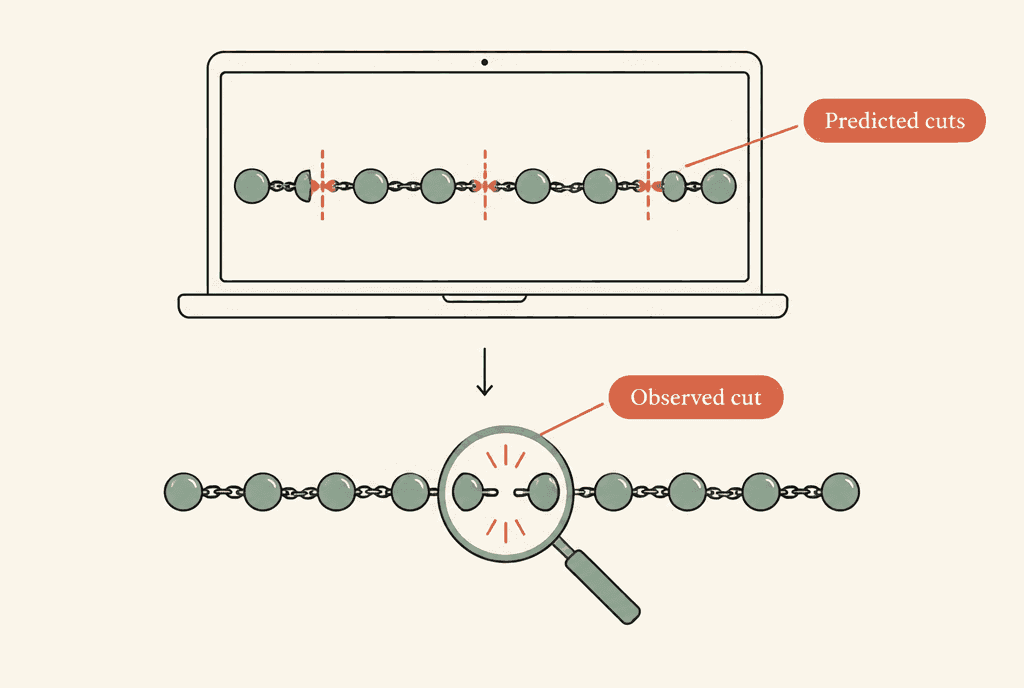
A peptide cleavage predictor is software that estimates where a peptide or protein chain might be cut. It does not measure a real sample, and it does not establish how a chain breaks down in the body. It uses sequence rules or trained models to mark possible cut sites for particular enzymes. The output is a prediction to test, not an observed event.
01What the output meansContents
Your stomach breaks the protein in food into smaller pieces, and those cuts are not random. Enzymes look for particular spots along each chain, a bit like scissors that only snip at certain marks. A peptide cutter is a computer tool built on that idea. It reads the written sequence and flags spots where a cut might happen, without watching any digestion take place.
The useful question is what those flags can really tell you. This page in the peptide quality and verification hub explains the difference between a predicted cut and evidence of a real one.
Key facts
| Input | Amino acid sequence |
|---|---|
| Target | Possible cleavage sites |
| PeptideCutter approach | Mostly sequence rules (SIB documentation) |
| PROSPER approach | Trained prediction models (Song et al., 2012) |
| Evidence type | Computer prediction |
What does a peptide cutter predict?
A peptide cutter predicts possible breaks along an amino acid chain. It does not measure cleavage in a sample. Cleavage means breaking a link in the chain. The peptide bond is the link between neighbouring amino acids. PeptideCutter, a tool from the SIB Swiss Institute of Bioinformatics, shows possible cut positions as lists or as a map of the sequence. Its documentation also describes the calculated pieces of the chain and their masses. Those pieces are what the program expects under its own assumptions. They are not material that an instrument has detected.
Why do different enzymes predict different cut sites?
Different enzymes recognise different short patterns in an amino acid chain. A protease is an enzyme that breaks peptide bonds. Its specificity is the set of patterns it prefers. The PeptideCutter reference describes trypsin as preferring to cut after lysine or arginine, with exceptions that depend on nearby amino acids. So a matching letter alone cannot decide whether a cut will happen. The neighbouring letters matter too. These preferences come from earlier experiments, simplified into rules for the program. They are not a promise that every matching bond will break.
A sequence is the order of amino acids, not a picture of the chain's shape. The guide to what peptides are explains those building blocks. PeptideCutter's own reference warns that lab results can differ from its predictions.
Does a cleavage prediction score mean the chain will break?
No. A cleavage prediction score shows how confident a model is, not proof that a bond has broken. Song and colleagues describe such scores in their 2012 paper on the PROSPER tool. A threshold is the cut-off score used to label a site as possible. Moving that cut-off changes the balance between finding real sites and flagging sites that never get cut, much like turning a smoke alarm's sensitivity up or down. The score belongs to one model and one enzyme. A high score does not establish how fast a reaction runs, how much material is cut, or how long a peptide lasts in blood.
Can a cleavage predictor account for protein shape?
Some cleavage predictors include estimates of protein shape, but those estimates still need separate evidence. Song and colleagues' 2019 iProt-Sub paper combines sequence features with shape features. These include solvent accessibility, meaning how exposed a region is to the surrounding water, and disorder, meaning a region has no fixed fold. The difference between a peptide and a protein helps explain why a short chain and a folded protein pose different problems. Adding shape information widens what the model can see. The output is still a prediction of possible sites.
Evidence limits
Can a peptide cutter establish stability in the body?
No. A peptide cutter cannot establish stability in the body from a sequence map alone. A flagged bond may be buried inside a folded protein. Or the enzyme and the chain may never meet. The 2012 PROSPER paper discusses both access to the bond and location as limits on cleavage. PeptideCutter's documentation also states that its model does not account for sequence modifications, meaning chemical changes made to the amino acids. So a count of predicted sites does not establish a blood half-life, the time it takes for a blood level to fall by half.
What evidence confirms a predicted cleavage site?
Lab experiments confirm a cut by finding the pieces, or the new chain ends, present after a real reaction. Tušar and colleagues paired predictions with lab measurements of protein cleavage in a 2023 paper. Some predicted sites matched the cuts they observed. Other results exposed gaps in the training data, the examples used to teach the model. That is why a prediction and an observation need separate labels. Methods such as mass spectrometry can give evidence about the resulting pieces. That evidence describes the tested material and setting. A computer map alone cannot supply it.
A cleavage result also answers a different question from HPLC purity testing. A list of possible cut sites is neither a purity result nor a batch identity check. Reading each result for what was actually measured keeps those claims apart.
Comparison
Three prediction approaches and lab evidence, compared by what each uses, what it gives and what it cannot establish on its own.
| Approach | What it uses | What it gives | What it cannot establish alone |
|---|---|---|---|
| PeptideCutter (SIB) | Mostly sequence rules for each enzyme | Possible cut positions, plus calculated pieces and their masses | A real cut in a sample; it does not consider sequence modifications |
| PROSPER (Song et al., 2012) | Trained prediction models | Scores for possible cut sites | Reaction speed, amount of material cut, or lifetime in blood |
| iProt-Sub (Song et al., 2019) | Sequence features plus shape features such as solvent accessibility and disorder | Predicted possible cut sites | That a predicted site is actually cut |
| Lab experiment (for example Tušar et al., 2023) | Measurements after a real reaction | The pieces or new chain ends present | Results beyond the tested material and setting |
FAQ
Is a peptide cutter an enzyme?
No. In a software search, peptide cutter usually means a cleavage prediction tool. A protease is the physical enzyme that breaks peptide bonds. The program models possible cuts without carrying out any chemical reaction.
Does no predicted cleavage mean a peptide is stable?
No. No predicted cleavage means only that the model did not flag a site under its rules. Other enzymes, chemical changes and features the model ignores remain open. The map does not establish stability in any particular setting.
Does PeptideCutter account for modified amino acids?
No. PeptideCutter's documentation states that sequence modifications, and changes caused by cleavage, are not considered. A result for the written sequence cannot establish how a modified molecule would be cut.
Can a predicted cut be wrong?
Yes. A predicted site can differ from an observed cut. Tušar and colleagues reported both matches and mismatches between predictions and lab findings, including a missed site linked to a gap in the training examples.
More in this hub
Peptide Quality & Verification
- How to read a certificate of analysis (COA)
- How to check a peptide certificate of analysis is genuine
- How to check an Australian peptide supplier is legitimate
- What research grade actually means
- What a batch or lot number lets a researcher verify
- CJC-1295 with DAC vs without DAC: what is the difference?
- Selank vs Semax: are they the same peptide?
- Is NAD+ a peptide?
- How mass spectrometry confirms peptide identity
- How HPLC purity is measured for peptides
- Endotoxin, sterility and purity: three different tests
- TB-500 vs thymosin beta-4: is TB-500 the same molecule?
- What is peptide mass fingerprinting, and what can it identify?
Citations
3 sourcesSong J, Tan H, Perry AJ, et al. PLOS ONE. 2012;7(11):e50300.
doi:10.1371/journal.pone.0050300Song J, Wang Y, Li F, et al. Briefings in Bioinformatics. 2019;20(2):638–658.
doi:10.1093/bib/bby028Tušar L, Loboda J, Impens F, et al. Communications Biology. 2023;6:450.
doi:10.1038/s42003-023-04772-8
Form Laboratories supplies research-use-only reference material. This article is an educational summary of published third-party literature. It is not medical advice, not a use instruction, and research material is not for human or animal use.