
Compound hub · Tesamorelin
What have studies found about tesamorelin?
Tesamorelin studies have found less fat around abdominal organs in selected adults with HIV, and smaller trials have also recorded changes in liver fat and blood sugar. These findings describe specific measurements in specific groups; they do not establish lasting health outcomes or predict what will happen in another person.
01What remains openContents
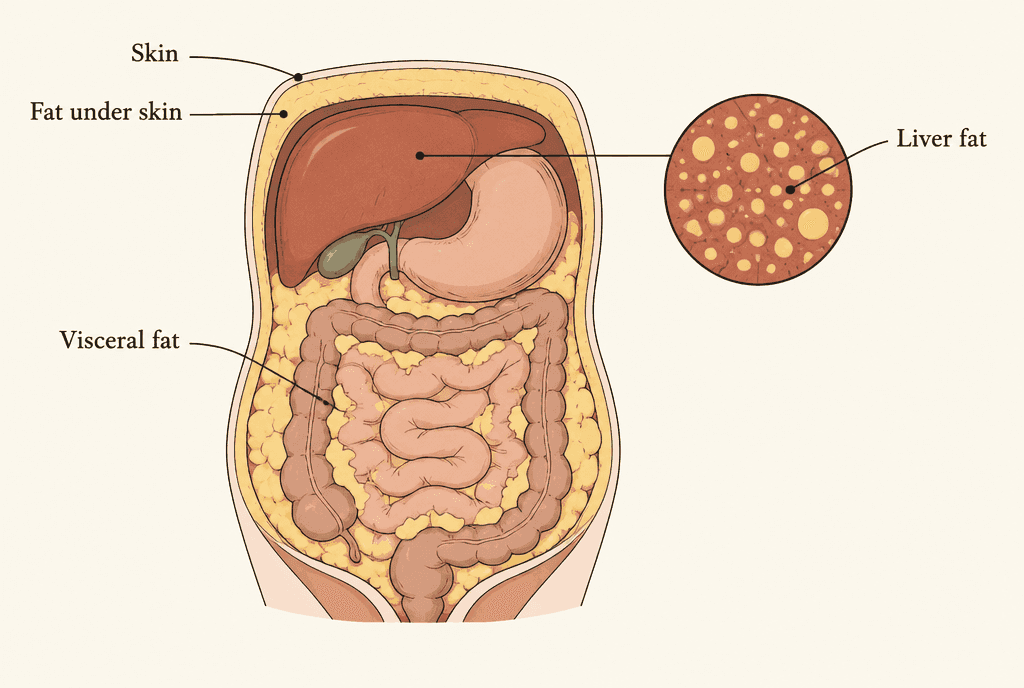
Your bathroom scales count everything together: bone, water, muscle and fat. A scan can ask a much narrower question. Where is the fat? Around an organ and inside an organ are different places. Keep that distinction in mind when you read the evidence on tesamorelin.
A headline can squeeze a whole trial into a falling percentage. Here, the interesting part is what sits behind that number: which tissue was measured, what the comparison group showed, and which questions the study could not answer.
Key facts
| Compound | Tesamorelin |
|---|---|
| Study designs covered | Randomised, placebo-controlled human trials |
| Study populations | Adults with HIV and abdominal fat accumulation or fatty liver disease |
| Papers covered | New England Journal of Medicine 2007; JAIDS 2010; JAMA 2014; The Lancet HIV 2019 |
Evidence limits
What do these tesamorelin studies leave unanswered?
The tesamorelin trials discussed here do not establish lasting health outcomes for people outside the groups studied. These papers concern adults with HIV, a virus that affects the immune system, and particular patterns of fat accumulation. A change on a scan is a finding about tissue. A change in blood sugar is a finding about a blood test. Neither alone shows how someone will feel or what illness they will develop later. The JAMA liver-study authors called their findings preliminary. The Lancet HIV researchers also called for further work on long-term liver changes.
Evidence has a boundary set by the question asked. A trial built around a fat measurement cannot silently become a trial of lifespan, physical strength or every possible harm. Findings from the study material also do not establish the properties of laboratory reference material.
Why did tesamorelin trials measure fat with scans?
Tesamorelin trials used scans to measure visceral fat, the fat around organs inside the abdomen, rather than relying on body weight. In the New England Journal of Medicine trial, Falutz and colleagues studied 412 adults with HIV over 26 weeks. The main measure was change in visceral fat on computed tomography, or CT, an X-ray scan that builds pictures of internal tissue. The tesamorelin group showed a fall in this measure compared with a rise in the placebo group. That result concerns a particular fat store. A bathroom-scale reading cannot show where a change happened.
Fat under the skin, called subcutaneous fat, and fat inside the liver are separate measurements. Treating them as one thing loses the point of the scan. The existing tesamorelin overview lists the individual trials and their numerical results.
What does a placebo comparison add to a tesamorelin finding?
A placebo comparison helps separate a tesamorelin finding from changes that also happen without the active study compound. A placebo resembles the study treatment but lacks its active ingredient. Random assignment puts participants into groups by chance. In the JAIDS trial, Falutz and colleagues studied 404 adults with HIV and excess abdominal fat. Participants and researchers did not know the treatment assignments. Visceral fat fell more in the tesamorelin group during the first phase. This design gives stronger evidence than a photograph or a story from someone who has no comparison group.
A comparison within one trial is different from setting unrelated studies beside each other. Their participants and measurements may differ. That distinction also matters when reading the tesamorelin and sermorelin comparison.
What did the tesamorelin liver-fat study find?
Tesamorelin was associated with a larger fall in liver fat than placebo in a trial of adults with HIV and fatty liver disease. Stanley and colleagues' 2019 Lancet HIV paper enrolled 61 adults and compared the groups over 12 months. The researchers measured hepatic fat fraction, meaning the share of liver tissue measured as fat. Their reported difference was 4.1 percentage points lower with tesamorelin than placebo. This is a measurement inside the liver, rather than fat wrapped around it. The authors said further studies were needed to establish long-term effects on liver tissue.
A percentage-point change is a gap between percentages. A relative percentage change compares that gap with the starting amount. Those figures can look very different while describing the same finding. A headline that drops the type of percentage can change the meaning.
Why does the timing of a blood-sugar test matter?
Tesamorelin blood-sugar findings can differ across measurement times, so an end-of-study result can leave out an earlier change. In Stanley and colleagues' JAMA trial of 50 adults with HIV, fasting glucose, meaning blood sugar measured after a fast, rose more with tesamorelin than placebo at two weeks. By six months, the change did not differ significantly between groups. A statistically significant result means the evidence passed the study's statistical test; a result below that threshold does not prove that nothing happened. The earlier rise still belongs in the account of that trial.
Safety also includes symptoms and reasons people leave a study. The tesamorelin side-effects page covers that wider record. A final blood test cannot replace the rest of the observations made along the way.
Comparison
The measurements ask different questions. This table compares their meaning, rather than ranking study results. Sources: Falutz and colleagues, New England Journal of Medicine 2007 and JAIDS 2010; Stanley and colleagues, JAMA 2014 and The Lancet HIV 2019.
| Measurement | What it records | What it cannot establish alone |
|---|---|---|
| Visceral fat on a scan | Fat around abdominal organs | Total body-weight change or a later health outcome |
| Liver fat fraction | Fat content within liver tissue | Whether liver disease will progress over later years |
| Fasting glucose | Blood sugar after a fast at a particular visit | Blood-sugar changes at every other time |
| Belly-appearance questionnaire | How participants rated their own appearance | The amount of fat visible on a scan |
FAQ
Does less visceral fat mean less liver fat?
The two measurements describe different places. Visceral fat surrounds organs. Liver fat lies within the liver. The JAMA investigators measured both, so a result for one was not assumed from a result for the other.
Do tesamorelin study averages predict an individual's result?
No. A group result summarises observations in the enrolled participants. That result does not supply a prediction for another person with a different medical history or starting measurement.
Did a lower fat measurement prove lasting liver recovery?
No. The Lancet HIV authors explicitly called for further research on long-term liver tissue changes. A lower fat fraction and lasting recovery are different questions.
Were the changes permanent after the study treatment stopped?
Permanence was not established. In the JAIDS extension, participants switched from tesamorelin to placebo lost the initial visceral-fat reduction. That observation concerns the extension group, whose size the abstract does not state.
More in this hub
- Tesamorelin side effects: what the FDA label and trials report
- What does tesamorelin do? What published studies found
- Tesamorelin vs sermorelin: what the records compare
- Is tesamorelin legal in Australia? ARTG, TGA, FDA and WADA records
- How does tesamorelin work? From a cell signal to growth hormone
- What is tesamorelin? The hormone signal behind the name
Citations
4 sourcesFalutz J, Allas S, Blot K, et al. New England Journal of Medicine. 2007;357(23):2359-2370.
doi:10.1056/NEJMoa072375Falutz J, Potvin D, Mamputu JC, et al. Journal of Acquired Immune Deficiency Syndromes. 2010;53(3):311-322.
doi:10.1097/QAI.0b013e3181cbdaffStanley TL, Feldpausch MN, Oh J, et al. JAMA. 2014;312(4):380-389.
doi:10.1001/jama.2014.8334Stanley TL, Fourman LT, Feldpausch MN, et al. The Lancet HIV. 2019;6(12):e821-e830.
doi:10.1016/S2352-3018(19)30338-8
Form Laboratories supplies research-use-only reference material. This article is an educational summary of published third-party literature. It is not medical advice, not a use instruction, and research material is not for human or animal use.