
Compound hub · Tesamorelin
How does tesamorelin work?
Tesamorelin copies growth-hormone-releasing hormone (GHRH), a brain messenger that acts at a receptor, a cell's signal receiver, on the pituitary gland to prompt growth hormone release. That hormone can then stimulate production of insulin-like growth factor 1 (IGF-1), another body signal; this chain explains the mechanism, but a hormone change alone does not establish a health outcome or show that every person will respond alike.
01What a mechanism can showContents
A doorbell starts a conversation without carrying the reply. Your body's hormone messages can work in a similar way: one signal reaches a gland, and the gland releases a different signal. Tesamorelin copies the first message in one such exchange. The tesamorelin hub brings the related questions together.
The useful question is what happens between the messages. Below, follow the cell's receiver, the relay inside the cell and the return message that can slow the system down. For the building blocks behind these signals, what peptides are explains how short chains of amino acids form a peptide.
Key facts
| Signal copied | Growth-hormone-releasing hormone, also called GHRH |
|---|---|
| Molecular family | Peptide: a chain of amino acids |
| Structure | 44 amino acids with a hexenoyl group at one end; Clemmons and colleagues, PLoS ONE, 2017 |
| Receptor | GHRH receptor on growth-hormone-producing pituitary cells |
| Cell messenger | Cyclic AMP, a chemical relay inside a cell |
| Signals distinguished below | GHRH-like signal, growth hormone and IGF-1 |
Evidence limits
What does knowing tesamorelin's mechanism actually tell us?
Tesamorelin's mechanism explains a route to hormone release; it cannot establish a health outcome by itself. A receptor experiment tests how a molecule sends a cell signal. A blood study tests whether hormone levels change. A study of health outcomes asks a further question about what happens to people. Those are separate tests. The receptor structure reported in Nature Communications shows natural GHRH bound to its receptor, rather than tesamorelin. That distinction matters: a picture of a related signal is useful background, but it is not a direct picture of tesamorelin binding.
The rest of this page follows the mechanism. The published study findings cover measured outcomes and the groups studied. A change in a messenger level should not be read as proof of an outcome that the experiment never measured.
Where does tesamorelin's signal enter the hormone system?
Tesamorelin acts at the GHRH receptor on cells in the pituitary, a small gland beneath the brain. These cells are called somatotrophs, meaning cells that make growth hormone. Natural GHRH comes from the hypothalamus, the brain region that helps control the pituitary. Tesamorelin is an analogue: a lab-made version of that natural message. The receptor is the receiver for the message, not the growth hormone itself. The gland still supplies the growth hormone. A doorbell is a useful comparison here: pressing the button sends a request, while the response comes from inside.
An agonist is a molecule that switches a receptor on. Tesamorelin belongs to this group at the GHRH receptor. The word describes an action at a receiver, rather than a guaranteed result throughout the body.
Tesamorelin is not an exact copy of natural GHRH. Clemmons and colleagues describe an added hexenoyl group, a small chemical piece attached at the start of the chain. Their paper explains that this change makes the molecule more stable in serum, the liquid left after blood clots. That is a chemistry distinction, not a prediction of what any person will experience.
What happens after the GHRH receptor switches on?
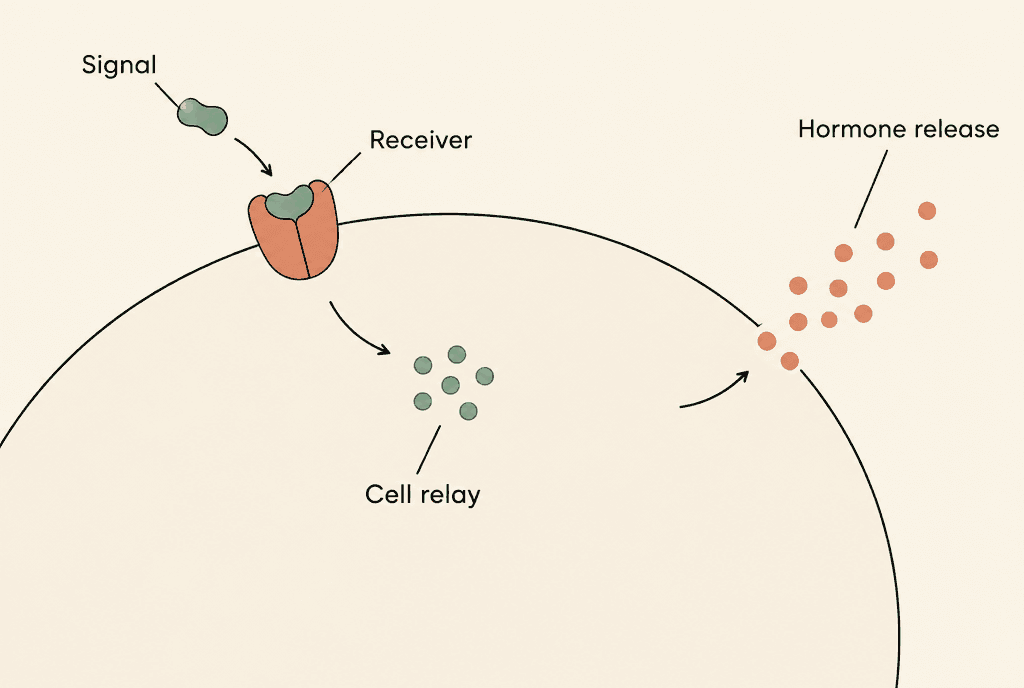
The GHRH receptor passes a signal into the cell through a chemical relay called cyclic AMP, usually shortened to cAMP. The receptor spans the cell's outer boundary. When natural GHRH binds, the receptor changes shape and connects with a G protein, a relay partner inside the cell. This starts signalling that raises cAMP and helps the cell make and release growth hormone. The structural study in Nature Communications combined a picture of this receptor complex with cell tests. Those tests examined signalling at the receiver, rather than health outcomes in people.
Binding means that the messenger attaches to the receiver. Activation means that the attachment switches the receiver on. These are different ideas. In the receptor study, researchers changed parts of the receiver and measured how its cAMP response changed. That helped connect the shape of the binding site with the signal sent inside.
The detailed structure in that experiment belongs to natural GHRH. The sources read for this page do not establish every contact made by tesamorelin at the same site. The broad pathway is clearer than that finer molecular detail.
Why do researchers measure growth-hormone pulses?
Growth hormone leaves the pituitary in bursts, so a single blood sample cannot describe the whole pattern. Pulsatile means released in pulses; basal secretion means the background release between them. In a study of 13 healthy men reported by Stanley and colleagues in Journal of Clinical Endocrinology and Metabolism, frequent overnight samples showed increased background release and pulse area after two weeks of tesamorelin. Pulse area combines how high a burst rises with how long it lasts. This was a small, short study with comparisons to the men's starting measurements, rather than a placebo group.
A single reading is like hearing one note and trying to judge a whole tune. Repeated samples show the rises and falls. Researchers then use a mathematical model to estimate the release pattern behind the measured blood levels.
A larger pulse area does not, by itself, mean more frequent pulses. The abstract read for this page does not report a result for pulse frequency, so no frequency claim is made here. Nor can this small study settle how the pattern would change in other groups.
How do IGF-1 and feedback fit into the pathway?
IGF-1 is a further signal that can rise after growth hormone release, and it also helps restrain further growth hormone release. Feedback means that a later part of a system sends information back to an earlier part. The liver supplies much of the IGF-1 in blood in response to growth hormone. Somatostatin, another brain messenger, acts as a brake on pituitary release. Together these signals help regulate the flow. This is a network with return messages, rather than a straight pipe in which each extra signal must produce the same fixed response.
A feedback experiment in Journal of Clinical Investigation studied six healthy men and found that raising IGF-1 suppressed growth hormone release. The authors considered the pattern consistent with increased somatostatin signalling. That experiment tested IGF-1 feedback, not tesamorelin, and did not directly measure somatostatin release in the brain.
Feedback is a control mechanism, not proof that an outside signal is harmless. The side-effects evidence answers the separate safety question. The table below keeps the messages apart. For a comparison with another GHRH analogue, tesamorelin and sermorelin have their own page.
Comparison
Different jobs in the hormone pathway, rather than a ranking: receptor and cell work from Zhou and colleagues; human hormone measurements from Stanley and colleagues; feedback from Bermann and colleagues; liver physiology from Yuen and colleagues.
| Question | Tesamorelin | Growth hormone | IGF-1 |
|---|---|---|---|
| What kind of message? | A lab-made GHRH-like signal | A hormone released by the pituitary | A further signal made in the liver and other tissues |
| Where does it fit here? | At the receptor that prompts pituitary release | Between pituitary release and signals to other tissues | After growth hormone signalling, with feedback to restrain release |
| What does its measurement leave open? | Binding alone does not measure a whole-body outcome | One blood value does not reveal the full pulse pattern | A blood level alone does not show every tissue's response |
FAQ
Is tesamorelin growth hormone?
No. Tesamorelin copies a message that prompts the pituitary to release growth hormone. Growth hormone is a different molecule, made by the gland. Sharing a place in the same pathway does not make the messages interchangeable.
Does tesamorelin act directly on IGF-1?
The pathway described here starts at the GHRH receptor. Growth hormone release can then stimulate IGF-1 production. That is an indirect route through another hormone, rather than tesamorelin being IGF-1 or attaching to IGF-1 itself.
Does more growth hormone always mean more IGF-1?
No fixed relationship applies to every situation. Liver response, nutrition and insulin, a hormone involved in blood-sugar control, can change the relationship. The same growth-hormone reading need not correspond to the same IGF-1 reading in different people.
Does feedback prove tesamorelin is safe?
No. Feedback describes how the body controls a signal. Safety requires separate evidence about unwanted effects in defined groups. A receptor pathway cannot replace that evidence or establish long-term safety.
More in this hub
- Tesamorelin side effects: what the FDA label and trials report
- What does tesamorelin do? What published studies found
- Tesamorelin vs sermorelin: what the records compare
- Is tesamorelin legal in Australia? ARTG, TGA, FDA and WADA records
- What have studies found about tesamorelin?
- What is tesamorelin? The hormone signal behind the name
Citations
5 sourcesZhou F, Zhang H, Cong Z, et al. Nature Communications. 2020;11:5205.
doi:10.1038/s41467-020-18945-0Stanley TL, Chen CY, Branch KL, Makimura H, Grinspoon SK. Journal of Clinical Endocrinology and Metabolism. 2011;96(1):150-158.
doi:10.1210/jc.2010-1587Clemmons DR, Miller S, Mamputu JC. PLoS ONE. 2017;12(6):e0179538.
doi:10.1371/journal.pone.0179538Bermann M, Jaffe CA, Tsai W, DeMott-Friberg R, Barkan AL. Journal of Clinical Investigation. 1994;94(1):138-145.
doi:10.1172/JCI117299Yuen KCJ, Hjortebjerg R, Ganeshalingam AA, Clemmons DR, Frystyk J. Frontiers in Endocrinology. 2024;15:1456195.
doi:10.3389/fendo.2024.1456195
Form Laboratories supplies research-use-only reference material. This article is an educational summary of published third-party literature. It is not medical advice, not a use instruction, and research material is not for human or animal use.