
Compound hub · Tesamorelin
What is tesamorelin?
Tesamorelin is a lab-made peptide, a chain of amino acids, that copies growth-hormone-releasing hormone (GHRH), the body's message for releasing growth hormone from the pituitary gland. Tesamorelin acts on the signalling system that controls growth hormone release; understanding that mechanism alone does not establish a health outcome or safety for any individual.
01The moleculeContents
Your body sends chemical messages while you sleep, eat and move. Some messages tell a gland to send another message onwards. Think of a doorbell: the ring calls someone to the door, but the ring and the person are different things. Tesamorelin belongs on the signal side of that comparison. The tesamorelin hub brings together the questions about this molecule.
This introduction follows the message from its chemical shape to the gland that receives it. The useful distinction is between what a molecule is, what a blood test measures and what a study can conclude. Those are separate questions.
Key facts
| Molecule | Tesamorelin |
|---|---|
| Family | GHRH analogue: a modified copy of a hormone signal |
| Chain length | 44 amino acids; Clemmons and colleagues, PLOS ONE, 2017 |
| Structural change | Hexenoyl group attached at the start of the chain; Clemmons and colleagues, PLOS ONE, 2017 |
| Signal studied | Growth hormone release |
What kind of peptide is tesamorelin?
Tesamorelin is an analogue of growth-hormone-releasing hormone, or GHRH. Analogue means a molecule with a structure similar to another molecule. In their 2017 PLOS ONE paper, Clemmons and colleagues describe tesamorelin as the human GHRH sequence of 44 amino acids with a hexenoyl group attached at the start. Amino acids are the small building blocks joined together in a peptide. A hexenoyl group is a small chemical addition containing a carbon chain. Tesamorelin therefore resembles a hormone the body makes, but its chemical structure has been changed. Lab-made and identical to the natural hormone are different descriptions.
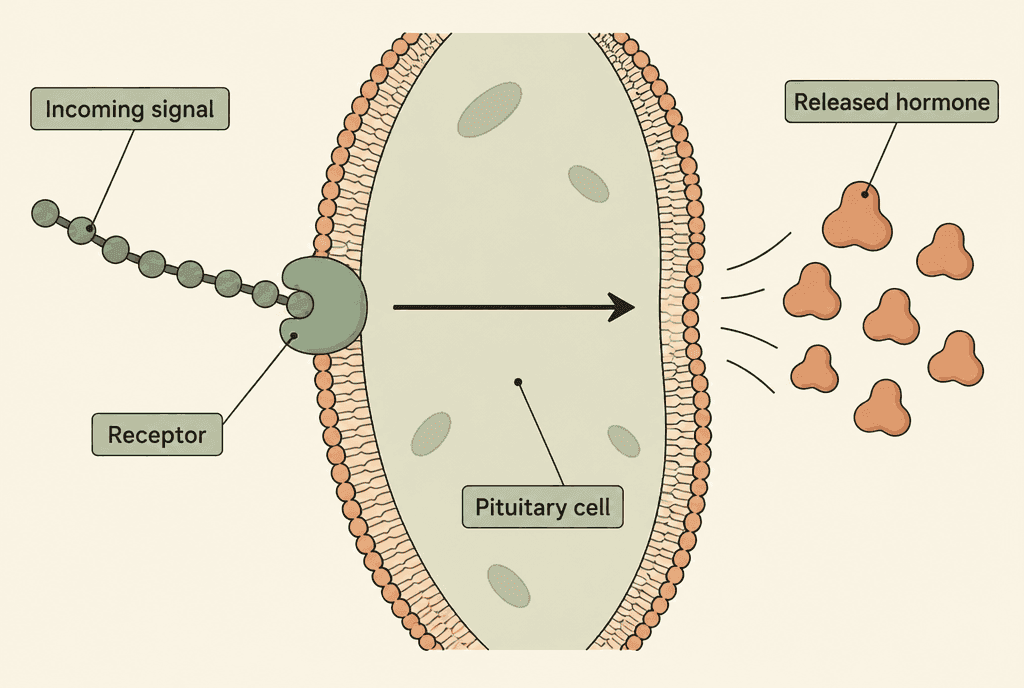
A peptide is often drawn as beads on a string. The order of the beads matters, as does any change at an end. What peptides are explains that basic chemistry. The bead picture is a way to follow the chain, rather than a literal view of its folded shape.
The word analogue does not describe every related peptide as interchangeable. Different structures need their own evidence. The comparison with sermorelin covers the differences between those molecules.
Where does the GHRH signal act?
GHRH acts at receptors on cells of the pituitary, a small gland beneath the brain. A receptor is a protein that receives a chemical message. The GHRH receptor passes that message into the cell, linking a signal outside the cell to activity inside. Tesamorelin is studied as a copy of the releasing signal, rather than as growth hormone itself. Growth hormone is a separate messenger released by the gland. This distinction places tesamorelin earlier in the message chain. The signal, its receptor and the hormone released afterwards each have a different part in the process.
Zhou and colleagues examined the natural GHRH molecule bound to its receptor in Nature Communications. Their work used cryo-electron microscopy, a method that builds detailed images of frozen molecules. The study mapped how the natural message fits its receiver. It was not a study of tesamorelin's effects in people.
A doorbell is useful here because pressing a button and opening a door are separate events. Likewise, showing that a receptor receives a message does not measure a later health outcome.
Why do tesamorelin papers discuss growth hormone pulses?
Growth hormone pulses are rises and falls in the amount of growth hormone released into blood. The pattern matters when researchers ask how tesamorelin affects the body's own hormone release. Stanley and colleagues studied 13 healthy men over two weeks in a paper in the Journal of Clinical Endocrinology and Metabolism. They took repeated overnight blood samples to examine growth hormone release. Their study measured both the average level and features of the pulses. A single blood sample cannot show that overnight pattern. The findings describe a small, short study, rather than a general result for all adults.
A pulse is like a wave on a graph. Its height, width and spacing describe different features. A higher average does not by itself mean that waves arrive more often.
The study also measured IGF-1, short for insulin-like growth factor 1, another hormone involved in growth signalling. Growth hormone and IGF-1 are separate measurements. Neither blood result alone is a measure of how someone feels or functions.
Evidence limits
What does knowing the mechanism leave unanswered?
Tesamorelin's hormone pathway alone does not establish health outcomes or long-term safety in every population. A receptor experiment, a blood measurement and a clinical trial answer different questions. In the New England Journal of Medicine, Falutz and colleagues studied 412 adults with HIV and excess abdominal fat over 26 weeks. HIV is the human immunodeficiency virus. That study measured body fat with scans and collected other results, including adverse events, meaning unwanted health events. Its participants and follow-up define the reach of its findings. A mechanism cannot fill gaps in who was studied or how long they were observed.
The study findings page covers measured outcomes. The side-effects page covers unwanted events and safety gaps. Reading those records separately helps keep an explanation of the molecule from becoming a prediction about an individual.
The table compares kinds of evidence. A detailed picture of a receptor can answer a very precise question while leaving a much larger question open. More detail at one level does not remove uncertainty at another.
Comparison
Different research questions, illustrated by the receptor study of Zhou and colleagues, the hormone study of Stanley and colleagues and the clinical trial of Falutz and colleagues. The rows compare evidence types, not compounds or expected results.
| Evidence type | What it can examine | What it cannot establish alone |
|---|---|---|
| Molecular structure study | How a messenger fits its receptor | A health outcome in a person |
| Repeated hormone measurements | Blood levels and patterns of hormone release | A change in symptoms or long-term safety |
| Controlled clinical trial | Specified outcomes in the people enrolled | Results for every other population or beyond the follow-up period |
FAQ
What does GHRH stand for?
GHRH stands for growth-hormone-releasing hormone. The name describes a chemical message that prompts the pituitary gland to release growth hormone. Tesamorelin is a modified version of that message.
Does the body make tesamorelin?
The body makes GHRH. Tesamorelin is a lab-made analogue with a chemical change at the start of the peptide chain. Resembling a natural signal does not make a modified molecule identical to that signal.
What does endogenous growth hormone mean?
Endogenous means made within the body. In tesamorelin research, endogenous growth hormone means the hormone released by the participant's own pituitary gland. The term identifies where the hormone came from; it does not establish safety.
Does a higher hormone reading prove a health outcome?
A blood reading measures the hormone in the sample. Establishing an effect on symptoms, physical function or future illness requires studies that measure those outcomes. A hormone result does not settle those other questions.
More in this hub
- Tesamorelin side effects: what the FDA label and trials report
- What does tesamorelin do? What published studies found
- Tesamorelin vs sermorelin: what the records compare
- Is tesamorelin legal in Australia? ARTG, TGA, FDA and WADA records
- How does tesamorelin work? From a cell signal to growth hormone
- What have studies found about tesamorelin?
Citations
4 sourcesClemmons DR, Miller S, Mamputu JC. PLOS ONE. 2017;12(6):e0179538.
doi:10.1371/journal.pone.0179538Zhou F, Zhang H, Cong Z, et al. Nature Communications. 2020;11:5205.
doi:10.1038/s41467-020-18945-0Stanley TL, Chen CY, Branch KL, Makimura H, Grinspoon SK. Journal of Clinical Endocrinology and Metabolism. 2011;96(1):150-158.
doi:10.1210/jc.2010-1587Falutz J, Allas S, Blot K, et al. New England Journal of Medicine. 2007;357(23):2359-2370.
doi:10.1056/NEJMoa072375
Form Laboratories supplies research-use-only reference material. This article is an educational summary of published third-party literature. It is not medical advice, not a use instruction, and research material is not for human or animal use.