
Compound hub · GHRP-2 and GHRP-6
GHRP-2 and GHRP-6 study findings
The human studies read for GHRP-2 (pralmorelin) and GHRP-6 measured how much growth hormone was released, and they support one approval for a diagnostic test. None measured body composition, the balance of muscle and fat. A 1992 study found that GHRP-6 released growth hormone in men. In Japan, pralmorelin is approved as a test for growth hormone secretion failure. This page is not a full review of all human research.
01Growth hormone releaseContents
Headlines about peptides often skip one plain question: what did the researchers actually measure? For GHRP-2 and GHRP-6, the honest answer is narrow. Researchers measured how much growth hormone the pituitary gland released. For GHRP-2, they also checked whether that response could tell apart people with a growth hormone problem and people without one.
This page goes through each type of study, who was in it, and its limits. It keeps the two peptides apart, and it names the gaps. For background, see what GHRP-2 and GHRP-6 are and how they work.
Key facts
| GHRP-6 human study | Bowers et al., 1992: oral GHRP-6 in five healthy men and nine short-stature children; intravenous comparison in men (PubMed 1730807) |
|---|---|
| GHRP-2 diagnostic cut-off | Growth hormone peak of 15.0 micrograms per litre separated growth hormone deficiency from healthy controls (Drugs in R&D, 2004) |
| Pralmorelin approval | Japan: diagnostic for growth hormone secretion failure; approval number 21600AMZ00573000; sales began February 2005 (Japanese prescribing information, July 2022) |
| Japanese Phase I/II, healthy people (89) | Peak growth hormone 15.88 to 345.06 ng/mL, mean 84.60 (Japanese prescribing information) |
| Japanese Phase II/III, diagnosed deficiency (60) | Peak growth hormone 0.05 or less to 14.79 ng/mL, mean 1.37 (Japanese prescribing information) |
| Urine study | One volunteer per peptide, nasal route: GHRP-2 detected up to 47 hours, GHRP-6 at 23 hours (Semenistaya et al., 2015) |
| Body-composition outcome trial | None opened for this page |
| Records checked | 16 October 2026 |
What did the GHRP-6 studies in people measure?
The only GHRP-6 study in people found for this page is a 1992 paper. It measured growth hormone release in five healthy men, and in nine short children whose growth hormone was low to different degrees. GHRP-6 was given by mouth, and also into a vein for comparison. In the men, growth hormone rose well above its starting level and fell back within about three hours. In four of the nine children, the response matched the men. In the other five, it was low or could not be detected. The paper reports hormone levels only. It does not show any effect on body composition or appetite.
The 1992 team wanted to know whether a peptide taken by mouth could release growth hormone at all. By their sums, GHRP-6 by mouth had about 0.3% of the activity of the form given into a vein. How the peptides work covers the half-life and distribution-volume figures from the same paper.
The group was small: five men and nine children, as the abstract on PubMed describes. Read the paper as a measurement of one hormone response in a few people. That is the most the study can show.
What is pralmorelin (GHRP-2) approved for in Japan?
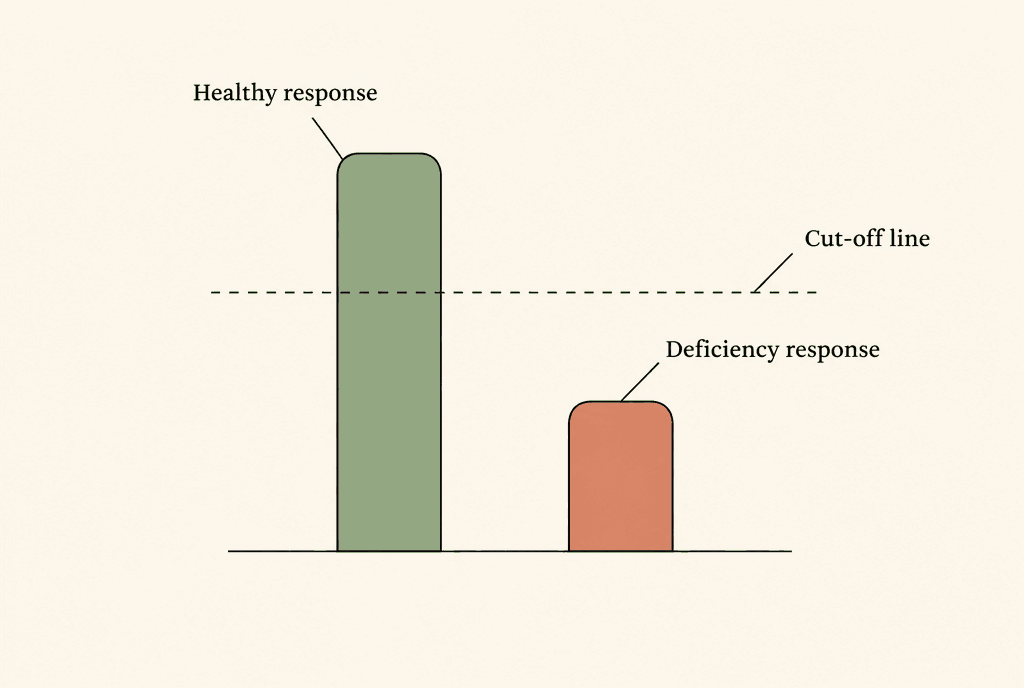
In Japan, pralmorelin hydrochloride is approved as a diagnostic for growth hormone secretion failure. Its approval number is 21600AMZ00573000, and sales started in February 2005. A diagnostic is a test, not a treatment. The drug is given to see how strongly the pituitary gland responds. For severe deficiency, the label sets a cut-off at a growth hormone peak of 15 ng/mL, or 9 ng/mL when measured against a recombinant (lab-made) reference standard. A nanogram (ng) is a billionth of a gram, so ng/mL means nanograms in each millilitre. The label says that other findings and the lab method also matter.
A 2004 drug profile explains the idea behind the test. In healthy people, the peptide raises growth hormone strongly: in men and women, in people with and without obesity, and across age groups. In people with growth hormone deficiency, the rise is much smaller. The authors used a ROC (receiver-operating characteristic) analysis, a standard way to pick the best cut-off between two groups. It put the line between deficiency and healthy controls at a growth hormone peak of 15.0 micrograms per litre. That profile was written before the Japanese launch.
The label reports two Japanese trials. The first tested 89 healthy people, including children who were short but healthy (normal short stature). Their peak growth hormone ranged from 15.88 to 345.06 ng/mL, with an average of 84.60. The response was somewhat lower in people aged 40 and over, and in women after menopause. It did not differ by sex or by degree of obesity. The second tested 60 patients already diagnosed with severe deficiency. Their peak ranged from 0.05 or below to 14.79 ng/mL, with an average of 1.37.
What did the anti-doping urine study measure?
Semenistaya and colleagues studied five growth hormone-releasing peptides, with one volunteer for each. Each volunteer received a peptide through the nose, and the team checked what showed up in the urine. GHRP-2 and two of its breakdown products, GHRP-2 free acid and GHRP-2 (1-3) free acid, were found for up to 47 hours. GHRP-6 mostly left the body unchanged. It was found at 23 hours, and its breakdown products were found for 12 hours. The study was written to give sport labs a test method. It was not a trial of effects. With one person per peptide, it cannot show how people differ.
The authors say detection time depends on each person's metabolism, the form of the product and the route. So read the figures as examples from one volunteer each, not as fixed numbers. Do peptides show up on drug tests explains how testing labs use this kind of method paper.
Evidence limits
What has research not shown about GHRP-2 and GHRP-6?
The sources read for this page include no trial of body composition for GHRP-2 or GHRP-6. They cover growth hormone release, one approval for a diagnostic test, and a urine study with one volunteer per peptide. Claims that one peptide causes less hunger or less cortisol than the other need a head-to-head paper. None was found, so this page states no difference. These studies do not show long-term safety in people. They cannot show clinical outcomes, meaning real changes in health, and they are not a full review of all human research.
A rise in a hormone is a biomarker: a lab number that stands in for something else. It is not an outcome. Knowing that growth hormone goes up does not tell you whether muscle, fat, sleep or recovery change, and these papers did not measure those things. The same caution applies to forum posts and seller pages. They are personal stories, not controlled studies.
Some regulators have gone further than the research. The FDA puts GHRP-6, and GHRP-2 for two named routes, in a category of bulk substances that raise significant safety risks (FDA 503B list, updated 21 March 2025). The side-effects page sets that out next to the label's own warnings.
Comparison
What each kind of GHRP-2 and GHRP-6 evidence found for this page can show about people. The examples are the studies named on this page. This table sorts types of evidence; it does not rank products or outcomes.
| Type of evidence | Example | What it can show | What it cannot show |
|---|---|---|---|
| Hormone-release study, GHRP-6 | Bowers et al., 1992 (five healthy men, nine short children) | Growth hormone rose after GHRP-6 in men, and the response varied in children | Any outcome beyond a hormone level |
| Diagnostic trials, GHRP-2 (pralmorelin) | Japanese Phase I/II (89 people) and Phase II/III (60 patients), reported on the label | A range of peak growth hormone in healthy people, against a much lower range in people with severe deficiency | Effects of treatment; the approval is for a test |
| Urine detection, both | Semenistaya et al., 2015 (one volunteer per peptide) | How long a method could find GHRP-2 (up to 47 hours) and GHRP-6 (23 hours) after the nasal route | Effects, or typical detection times in other people |
| Body-composition outcome trial | None found | No conclusion from the sources read | Any claim about changes in the body |
FAQ
Have studies shown that GHRP-6 builds muscle?
No study read for this page measured muscle, or any change in body composition, after GHRP-6. The 1992 paper measured growth hormone release in five men and nine children. That is a hormone level, not a muscle outcome.
Is GHRP-2 stronger than GHRP-6?
This page found no head-to-head paper that compares them on growth hormone release, appetite or cortisol, so it states no comparison. The figures for each come from different studies with different methods, and they cannot be ranked against each other.
Why is pralmorelin approved in Japan only as a diagnostic?
The approved use is a test of growth hormone secretion. It works as a test because the response to pralmorelin is much lower in people with deficiency than in healthy people. The sources read do not say why a treatment use was not pursued, so this page gives no reason.
How many people were studied for GHRP-2?
Japan's label reports 89 healthy people in a Phase I/II trial and 60 patients with severe growth hormone deficiency, diagnosed earlier, in a Phase II/III trial. It also reports 18 healthy men in the half-life data. The urine study tested one volunteer.
More in this hub
- GHRP-2 and GHRP-6 side effects: what the Japanese label, the FDA and the TGA record
- How do GHRP-2 and GHRP-6 work? The ghrelin receptor and what the studies measured
- Is GHRP-6 legal in Australia? Poisons Standard, TGA, FDA and WADA records for GHRP-2 and GHRP-6
- What are GHRP-2 and GHRP-6? Two growth hormone secretagogues explained
Citations
3 sourcesBowers CY, Alster DK, Frentz JM Journal of Clinical Endocrinology and Metabolism. 1992;74(2):292-298.
doi:10.1210/jcem.74.2.1730807Adis Editorial Drugs in R&D. 2004;5(4):236-239.
doi:10.2165/00126839-200405040-00011Semenistaya E, Zvereva I, Thomas A, Thevis M, Krotov G, Rodchenkov G Drug Testing and Analysis. 2015;7(10):919-925.
doi:10.1002/dta.1787
Form Laboratories supplies research-use-only reference material. This article is an educational summary of published third-party literature. It is not medical advice, not a use instruction, and research material is not for human or animal use.