
Compound hub · GHRP-2 and GHRP-6
What are GHRP-2 and GHRP-6?
GHRP-2 (also called pralmorelin) and GHRP-6 are two lab-made peptides. A peptide is a short chain of amino acids, the building blocks of protein, and each of these has six. Both are growth hormone secretagogues: they act on the body's ghrelin receptor and prompt the release of growth hormone. Neither one is growth hormone itself. The sources read for this page do not show any change in body composition.
01What they areContents
Growth hormone does not flow out of your body in a steady stream. It comes in bursts from your pituitary gland, a pea-sized gland just under your brain. Ghrelin, a hormone made mostly in your stomach, is one of the signals that can set off a burst. GHRP-2 and GHRP-6 are lab-made peptides that copy part of that ghrelin signal. Both are covered by the hub page for these two peptides.
This page starts at the beginning: what each name means, how the two peptides differ from the hormones people mix them up with, and what is still unknown. Later pages explain how they work and what studies measured.
Key facts
| Common names | GHRP-2 (international nonproprietary name pralmorelin) and GHRP-6 |
|---|---|
| Length | Six amino acids each (hexapeptides) |
| Class | Growth hormone secretagogues |
| Target | The ghrelin receptor (growth hormone secretagogue receptor type 1a) |
| GHRP-6 sequence | His-D-Trp-Ala-Trp-D-Phe-Lys-NH2 (Bowers et al., 1992) |
| GHRP-2 sequence | Not established from an opened paper for this page, so it is not printed |
| Developed from | Work by Cyril Bowers and colleagues at Tulane University, with Polygen in Germany (Drugs in R&D, 2004) |
| Approved human use found | Pralmorelin as a diagnostic for growth hormone secretion failure in Japan; sales began February 2005 |
| Records checked | 16 October 2026 |
What are GHRP-2 and GHRP-6?
GHRP-2 and GHRP-6 are hexapeptides. Hexa means six, so each one is a chain of six amino acids. GHRP stands for growth hormone-releasing peptide. Both act as growth hormone secretagogues, which means they prompt the body to release growth hormone. They do this at the ghrelin receptor, whose formal name is the growth hormone secretagogue receptor type 1a. A receptor is like a lock on the outside of a cell, and a molecule that fits it is like a key. A 1992 paper by Cyril Bowers and colleagues gives the GHRP-6 sequence as His-D-Trp-Ala-Trp-D-Phe-Lys-NH2. No paper read for this page gave the GHRP-2 sequence, so it is not printed.
GHRP-2 has an official international name: pralmorelin. Australia's October 2026 Poisons Standard, the national list of controlled medicines and chemicals, files it under that name. A 2004 drug profile describes pralmorelin as a synthetic growth hormone-releasing peptide that is active when taken by mouth. It came from a series of peptides made at Tulane University and by Polygen, a company in Germany. The profile says these peptides copy the action of ghrelin, a natural peptide of 28 amino acids that controls growth hormone release.
People often write the two names together because they belong to the same family and act on the same receptor. They are still two different molecules, each with its own records. The study findings page keeps them apart.
What is the difference between a growth hormone secretagogue, GHRH and growth hormone?
Three names here sound alike but mean different things. Growth hormone is the hormone itself. The pituitary gland releases it into the blood. Growth hormone-releasing hormone, or GHRH, is a separate natural signal that tells the pituitary to release growth hormone. A growth hormone secretagogue in this family sends a similar release message, but through a different lock: the ghrelin receptor, not the receptor for GHRH. GHRP-2 and GHRP-6 are secretagogues. They are not growth hormone, and they are not GHRH. Think of growth hormone as a parcel, and of GHRH and the secretagogues as two different messengers that can each ask for the parcel to be sent.
Japan's prescribing label for pralmorelin says the same thing in official words. The drug is thought to attach to the growth hormone secretagogue receptor. It is thought to work mainly through the hypothalamus, the brain area that sits just above the pituitary, and so to push the pituitary to release growth hormone.
The table below sets the four names side by side. Australia's Poisons Standard also keeps these groups apart. It has separate entries for growth hormone-releasing hormones, growth hormone-releasing peptides and growth hormone secretagogues (F2026L01327). What Schedule 4 and Appendix D mean explains how those entries work.
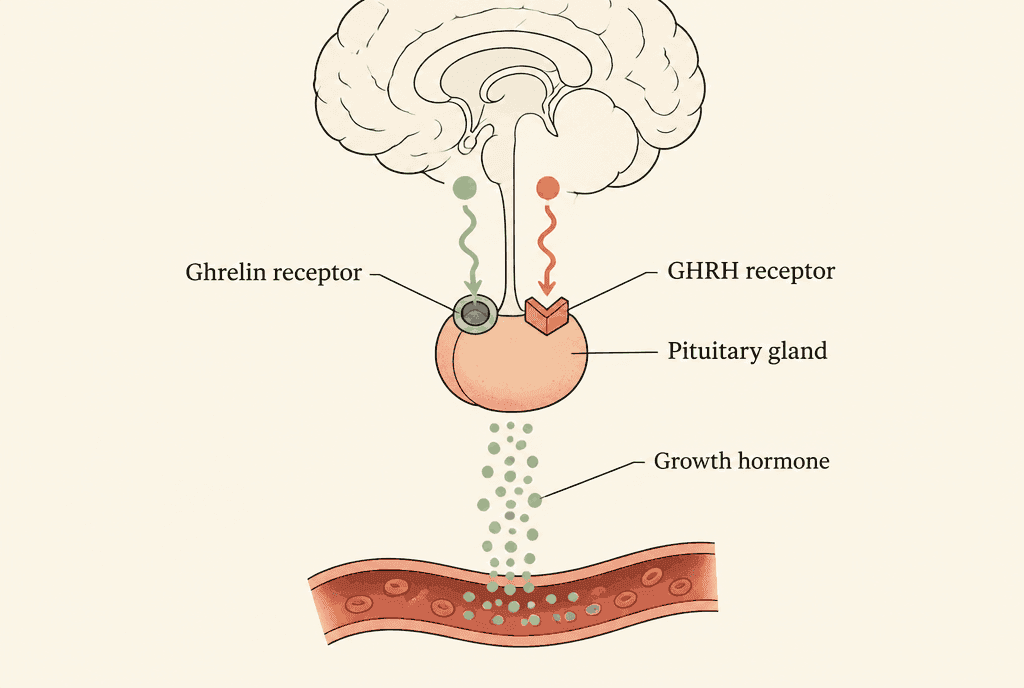
Are GHRP-2 and GHRP-6 peptides or hormones?
GHRP-2 and GHRP-6 are peptides. A peptide is a short chain of amino acids, and each of these has six. They are made by chemical synthesis in a lab. The body does not make them. Ghrelin is different: it is a natural hormone that the body makes, with 28 amino acids. The two lab peptides copy the action of ghrelin by fitting the same receptor. The word peptide describes what a molecule is built from. The word hormone describes a job: carrying a message through the body. A lab-made peptide can copy the job of a hormone without being that hormone. So these peptides act like ghrelin, but they are not ghrelin.
Where a peptide ends and a protein begins depends only on size, and a chain of six amino acids is well on the peptide side. For another peptide in the same wider family of secretagogues, see what ipamorelin is.
Who developed GHRP-2 and GHRP-6, and are they medicines?
A team at Tulane University in the United States, led by Cyril Bowers, made a series of small peptides that strongly release growth hormone. Pralmorelin (GHRP-2) belongs to a series developed by Tulane and Polygen, a company in Germany. Of the two peptides, only pralmorelin has an approval that this page found. In Japan it is approved as a diagnostic: a test drug, given into a vein, that checks for growth hormone secretion failure. Its approval number is 21600AMZ00573000, and sales began in February 2005. The sources read for this page show no approval for GHRP-6.
The 2004 drug profile also records two mid-stage (Phase II) programmes that existed at the time: one in short stature in Japan, and one in growth hormone deficiency in the United States. The US programme seemed to have stopped. The profile was written before the Japanese launch, so it describes plans, not results.
A diagnostic approval does not mean the drug treats anyone. The approved use is a test of how well the pituitary gland responds. The study findings page explains what that test measured.
Evidence limits
What is not known about GHRP-2 and GHRP-6?
The sources read for this page include no trial that checked whether GHRP-2 or GHRP-6 changes body composition, meaning the balance of muscle and fat. What they contain is narrower: growth hormone measurements, one Japanese approval for a diagnostic test, and an anti-doping paper that tested one volunteer for each peptide. Some websites claim that GHRP-2 causes less hunger, or less release of the stress hormone cortisol, than GHRP-6. This page found no head-to-head paper to check that, so it states no difference. A limited reading like this one does not prove that no comparison exists.
That is an honest gap, not a hidden finding. A forum post is one person's story, not a controlled study, and a seller's page is not a scientific source. The sources here do not settle how the two peptides compare on appetite or on cortisol. That does not mean no other studies exist.
The side-effects page sets out what the label and the regulators say about safety. The law page sets out the Australian, FDA and sport records.
Comparison
What each name means, based on the sources named on this page. This table explains words; it does not rank anything.
| Name | What it is | Where it acts | Made by |
|---|---|---|---|
| Growth hormone | The hormone that the pituitary gland releases | Sent into the blood by the pituitary | The pituitary gland |
| Growth hormone-releasing hormone (GHRH) | A separate natural signal that prompts growth hormone release | Its own receptor, not the one that GHRP-2 and GHRP-6 act on | The body |
| Ghrelin | A natural peptide of 28 amino acids that controls growth hormone release | The ghrelin receptor | The body |
| GHRP-2 (pralmorelin) and GHRP-6 | Lab-made peptides of six amino acids each; growth hormone secretagogues | The ghrelin receptor (growth hormone secretagogue receptor type 1a) | Chemical synthesis in a lab |
FAQ
What does GHRP stand for?
GHRP stands for growth hormone-releasing peptide. GHRP-2 and GHRP-6 are two members of that family. The number in each name tells one peptide apart from another, as in the 1992 paper by Cyril Bowers and colleagues.
Is GHRP-2 the same as pralmorelin?
Yes. Pralmorelin is the official international name for GHRP-2. Australia's October 2026 Poisons Standard files the entry as pralmorelin (growth hormone releasing peptide-2) (F2026L01327).
Is GHRP-6 growth hormone?
No. GHRP-6 is a peptide of six amino acids that prompts the release of growth hormone by acting on the ghrelin receptor. It is not growth hormone itself, and it is not growth hormone-releasing hormone.
Is there an approved medicine containing GHRP-2?
The only approval found is in Japan. There, pralmorelin hydrochloride, given into a vein, is approved as a diagnostic for growth hormone secretion failure, under approval number 21600AMZ00573000. That approval is for a diagnostic test, not for any other use.
More in this hub
- GHRP-2 and GHRP-6 side effects: what the Japanese label, the FDA and the TGA record
- GHRP-2 and GHRP-6 study findings: what the research measured, and what it did not
- How do GHRP-2 and GHRP-6 work? The ghrelin receptor and what the studies measured
- Is GHRP-6 legal in Australia? Poisons Standard, TGA, FDA and WADA records for GHRP-2 and GHRP-6
Citations
3 sourcesBowers CY, Alster DK, Frentz JM Journal of Clinical Endocrinology and Metabolism. 1992;74(2):292-298.
doi:10.1210/jcem.74.2.1730807Adis Editorial Drugs in R&D. 2004;5(4):236-239.
doi:10.2165/00126839-200405040-00011Semenistaya E, Zvereva I, Thomas A, Thevis M, Krotov G, Rodchenkov G Drug Testing and Analysis. 2015;7(10):919-925.
doi:10.1002/dta.1787
Form Laboratories supplies research-use-only reference material. This article is an educational summary of published third-party literature. It is not medical advice, not a use instruction, and research material is not for human or animal use.