
Compound hub · GHRP-2 and GHRP-6
How do GHRP-2 and GHRP-6 work?
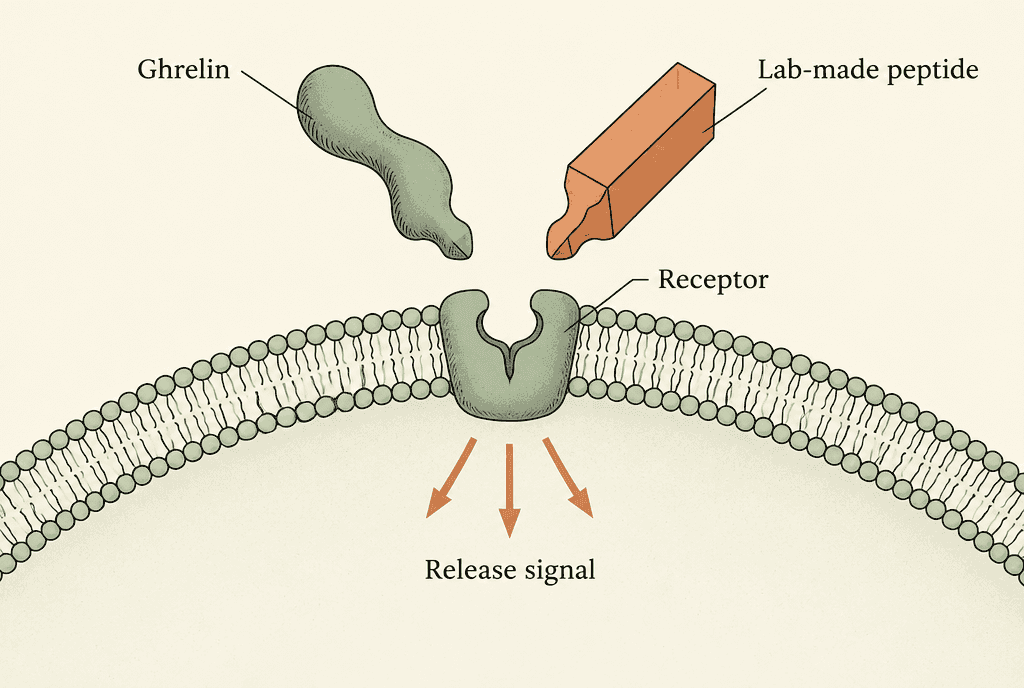
GHRP-2 and GHRP-6 work by fitting the ghrelin receptor, a lock-like site on cells, which prompts the pituitary gland to release growth hormone. In a 1992 study in men, the GHRP-6 signal in blood had a half-life of 20 minutes and a distribution volume of 2.5 litres. Japan's label for pralmorelin, which is GHRP-2, gives a terminal half-life of about 0.42 to 0.69 hours in 18 healthy men.
01The ghrelin receptorContents
Picture a key and a lock. Your body makes its own key, a hormone called ghrelin. The lock is a receptor on cells in your brain and pituitary gland. Two lab-made peptides, GHRP-2 and GHRP-6, are keys cut to fit that same lock, and the hub that covers both explains where they came from.
This page follows that lock-and-key story through the papers that measured it. It sticks to what was measured, in whom, and how. A number from one lab test does not tell you how the molecules behave anywhere else. If the names are new to you, start with what GHRP-2 and GHRP-6 are.
Key facts
| Receptor | Ghrelin receptor (growth hormone secretagogue receptor type 1a) |
|---|---|
| GHRP-6 sequence | His-D-Trp-Ala-Trp-D-Phe-Lys-NH2 (Bowers et al., 1992) |
| GHRP-6 serum half-life, men | 20 minutes, measured as immunoreactive GHRP (Bowers et al., 1992) |
| GHRP-6 distribution volume, men | 2.5 litres (Bowers et al., 1992) |
| Oral activity compared with intravenous | About 0.3% on the authors' calculation (Bowers et al., 1992) |
| Pralmorelin terminal half-life | About 0.42 to 0.69 hours in 18 healthy men (Japanese prescribing information, revised July 2022) |
| Pralmorelin plasma protein binding | 83.1 to 86.0%, measured in vitro (Japanese prescribing information) |
| GHRP-2 half-life in other settings | Not established beyond the Japanese label data above |
How do GHRP-2 and GHRP-6 act on the ghrelin receptor?
GHRP-2 and GHRP-6 attach to the ghrelin receptor. Its formal name is the growth hormone secretagogue receptor type 1a. When a peptide attaches, the receptor passes on a signal, and growth hormone is released. Japan's prescribing label for pralmorelin describes the likely route. The drug is thought to attach to this receptor and to push the pituitary gland to release growth hormone. It is thought to act mainly through the hypothalamus, the brain area just above the pituitary. A 2004 drug profile adds that these peptides copy ghrelin, a natural peptide of 28 amino acids that controls growth hormone release.
Notice the word thought. The label calls this the likely route, based on binding data and animal studies. What happens in animals does not show what the molecule does in a person. The same label records that pralmorelin given into a vein released growth hormone in rats and dogs, and that the response changed with the amount given in each species.
Ghrelin and GHRP-6 are both agonists, which means molecules that switch the receptor on. A 2005 lab study by Holst and colleagues compared how each one binds and signals at that receptor in cells. Sharing a receptor does not make two molecules the same. A cell experiment also cannot show what happens in patients.
What did Bowers and colleagues measure for GHRP-6 in 1992?
In 1992, Bowers, Alster and Frentz gave GHRP-6 by mouth to five healthy men. They also gave it to nine short children whose growth hormone was low to different degrees. To compare, they gave the men GHRP-6 into a vein as well. In the men, growth hormone started to rise at 30 minutes and peaked between 60 and 75 minutes. It then slowly fell back to its starting level between 150 and 180 minutes. By the authors' sums, GHRP-6 by mouth had about 0.3% of the activity of GHRP-6 in a vein. The paper also gives a 20-minute half-life and a 2.5-litre distribution volume for the peptide signal in blood.
Four of the nine children responded in almost the same pattern as the men. In the other five, the growth hormone response was low but measurable in three, and could not be detected in two. The authors wanted to know whether GHRP-6 could work by mouth at all, so most of their numbers are about the oral form.
The paper measured immunoreactive GHRP, which means an antibody test detected the peptide. An antibody test counts anything the antibody recognises. So the 20-minute figure shows how fast that signal fell, not necessarily how fast the whole, unbroken peptide fell. The abstract also reports that after the oral form, GHRP levels in the blood fell more slowly than growth hormone levels. The paper is listed on PubMed.
What is the half-life of GHRP-6 and GHRP-2?
A half-life is the time it takes for the level of a substance in the blood to fall by half. For GHRP-6, the only figure found is 20 minutes. It comes from the 1992 Bowers study in healthy men. It was measured as the antibody signal in blood, after both the oral form and the form given into a vein. For GHRP-2, Japan's pralmorelin label gives a terminal half-life of about 0.42 to 0.69 hours, or roughly 25 to 41 minutes, in 18 healthy men after the drug was given into a vein. These sources give no half-life for any other setting, so no wider estimate is printed here.
A half-life depends on the method, the people and the route. The pralmorelin figure comes from the label's summary of company data, not from a published paper. The label calls it T1/2 beta, the terminal phase. That is the slow, final part of the fall in the blood.
The label also reports that 83.1 to 86.0% of pralmorelin attached to blood proteins in a laboratory test (in vitro). It does not say that this test used the same 18 men. No breakdown product, or metabolite, was found in plasma, the liquid part of blood, after the drug was given into a vein. Over 24 hours, about 2% of the amount given came out in urine unchanged, and about 4% came out as a metabolite. From rat and dog data, the label concludes that most of it leaves the body through bile, a fluid made by the liver.
How long can GHRP-2 and GHRP-6 be detected in urine?
A 2015 anti-doping paper asked how long a lab could find these peptides in urine. One volunteer per peptide received it through the nose, and the team tested the urine. GHRP-2 and two of its breakdown products, GHRP-2 free acid and GHRP-2 (1-3) free acid, were found for up to 47 hours. GHRP-6 mostly left the body unchanged. It was found 23 hours after it was given, and its breakdown products were found for 12 hours. This was one person per peptide, in a method study, not a trial of effects. The authors say detection times depend on each person's metabolism, the form of the product and the route.
A detection window and a half-life answer different questions. The window says how long a lab method can still find a trace. A half-life says how fast the level in the blood falls. The urine paper was written to give sport labs a test method, so its numbers do not describe how the peptides act in the body. Do peptides show up on drug tests covers the wider testing picture.
Evidence limits
Is GHRP-2 different from GHRP-6 in how it works?
Both peptides act at the ghrelin receptor. Beyond that, this page found no head-to-head paper that compares them on appetite, cortisol or anything else. Some websites claim that GHRP-2 causes less hunger, or less release of cortisol, a stress hormone, than GHRP-6. Those claims were not checked against a primary study, so this page states no difference. The measured differences found are narrow. There are separate half-life figures from separate studies. There are also different detection times in one urine paper, which tested one volunteer for each peptide.
Numbers from different studies, in different people, cannot be lined up to rank the two peptides. The 20-minute figure and the 0.42-to-0.69-hour figure came from different methods. So the gap between them is not evidence that one molecule acts differently from the other. For other secretagogues that share part of this story, see what ipamorelin is and what CJC-1295 is.
Comparison
The timing figures found for each peptide, with the method and the people tested. Figures from different studies cannot be compared directly. This table records what was measured; it does not rank the peptides.
| Peptide | Source | What was measured | Who was tested, and the limit |
|---|---|---|---|
| GHRP-6 | Bowers et al., 1992 | Half-life of the peptide signal in blood: 20 minutes; distribution volume: 2.5 litres | Healthy men; an antibody test of the peptide signal |
| GHRP-2 (pralmorelin) | Japanese prescribing information, July 2022 | Terminal half-life of about 0.42 to 0.69 hours after the drug was given into a vein | 18 healthy men; the label's summary of company data |
| GHRP-2 and GHRP-6, urine | Semenistaya et al., 2015 | Last detection in urine after the nasal route: GHRP-2 up to 47 hours; GHRP-6 at 23 hours | One volunteer per peptide; a study of a test method |
FAQ
What receptor do GHRP-2 and GHRP-6 bind?
GHRP-2 and GHRP-6 bind the ghrelin receptor, also called the growth hormone secretagogue receptor type 1a. Japan's label for pralmorelin says the drug attaches to that receptor and pushes the pituitary to release growth hormone, mainly through the hypothalamus.
How long does GHRP-6 last in the body?
The only half-life found for GHRP-6 is 20 minutes, for the peptide signal in the blood of healthy men in a 1992 study. A 2015 urine test found GHRP-6 for 23 hours after one volunteer received it through the nose. These two numbers answer different questions.
Does GHRP-2 have a half-life?
Japan's label for pralmorelin gives a terminal half-life of about 0.42 to 0.69 hours in 18 healthy men after the drug was given into a vein. This page does not establish a half-life in any other setting.
Is oral GHRP-6 as active as the intravenous form?
No. In the 1992 study, GHRP-6 by mouth had about 0.3% of the activity of GHRP-6 given into a vein, by the authors' sums. That figure comes from five men and says nothing about how any other product behaves.
More in this hub
- GHRP-2 and GHRP-6 side effects: what the Japanese label, the FDA and the TGA record
- GHRP-2 and GHRP-6 study findings: what the research measured, and what it did not
- Is GHRP-6 legal in Australia? Poisons Standard, TGA, FDA and WADA records for GHRP-2 and GHRP-6
- What are GHRP-2 and GHRP-6? Two growth hormone secretagogues explained
Citations
4 sourcesHolst B, Brandt E, Bach A, Heding A, Schwartz TW Molecular Endocrinology. 2005;19(9):2400-2411.
doi:10.1210/me.2005-0059Bowers CY, Alster DK, Frentz JM Journal of Clinical Endocrinology and Metabolism. 1992;74(2):292-298.
doi:10.1210/jcem.74.2.1730807Adis Editorial Drugs in R&D. 2004;5(4):236-239.
doi:10.2165/00126839-200405040-00011Semenistaya E, Zvereva I, Thomas A, Thevis M, Krotov G, Rodchenkov G Drug Testing and Analysis. 2015;7(10):919-925.
doi:10.1002/dta.1787
Form Laboratories supplies research-use-only reference material. This article is an educational summary of published third-party literature. It is not medical advice, not a use instruction, and research material is not for human or animal use.