
Compound hub · GHRP-2 and GHRP-6
Is GHRP-2 or GHRP-6 legal in Australia?
GHRP-2 (pralmorelin) and GHRP-6 each have their own entry in Schedule 4 of Australia's October 2026 Poisons Standard, instrument F2026L01327, and each also appears in Appendix D, clause 5. Schedule 4 is the list of prescription-only medicines. No registered product for either was confirmed on the national register of medicines. WADA's 2026 Prohibited List names both for sport. This page records what each body says; it is not legal advice.
01Poisons StandardContents
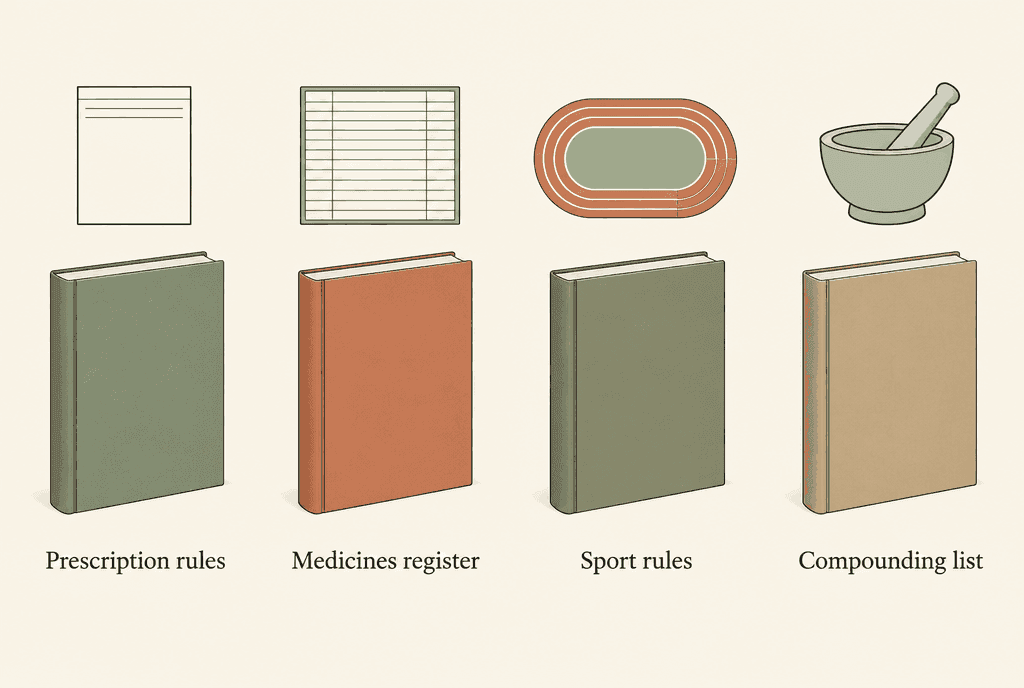
A question like this one usually hides three smaller questions. Can a person buy it? Can a doctor prescribe it? Will an athlete's drug test flag it? Each question belongs to a different authority, so one yes or no cannot answer all three. This page belongs to the GHRP-2 and GHRP-6 hub. It reads the original records and gives the date each one was checked.
A lawyer can advise on what a person may lawfully do. For the science behind these peptides, see what GHRP-2 and GHRP-6 are. For how the scheduling terms work in general, see what Schedule 4 and Appendix D mean.
Key facts
| Australian instrument | Therapeutic Goods (Poisons Standard—October 2026) Instrument 2026, F2026L01327, registered 30 September 2026 |
|---|---|
| GHRP-2 entry | 'PRALMORELIN (GROWTH HORMONE RELEASING PEPTIDE-2 (GHRP-2))': Schedule 4 and Appendix D, clause 5 |
| GHRP-6 entry | 'GROWTH HORMONE RELEASING PEPTIDE-6 (GHRP-6)': Schedule 4 and Appendix D, clause 5 |
| Class entries in the same instrument | Growth hormone releasing peptides, growth hormone secretagogues and growth hormone releasing hormones, each shown with Schedule 4 and Appendix D, clause 5 |
| ARTG | No exact registered product confirmed for either peptide in a search on 16 October 2026; this is not proof of absence (ARTG) |
| TGA advisories read | 13 April 2026 and 7 May 2026; neither names GHRP-2 or GHRP-6 |
| FDA 503B bulks list | Category 2: GHRP-2 (two named routes of administration) and GHRP-6 (FDA list, updated 21 March 2025) |
| WADA 2026 Prohibited List | S2.2.4 names GH-releasing peptides including GHRP-2 (pralmorelin) and GHRP-6; prohibited at all times (WADA 2026 List) |
| Records checked | 16 October 2026 |
Are GHRP-2 and GHRP-6 in the Australian Poisons Standard?
Yes. Australia's October 2026 Poisons Standard, instrument F2026L01327, gives pralmorelin (growth hormone releasing peptide-2, GHRP-2) and growth hormone releasing peptide-6 (GHRP-6) their own entries in Schedule 4. Both entries are also marked with Appendix D, clause 5. Schedule 4 is the part of the Poisons Standard for prescription-only medicines. The GHRP-2 entry is filed under the name pralmorelin, so a search for GHRP-2 alone can miss it. This check read the entries on 16 October 2026. It did not re-read every paragraph of the instrument.
The same instrument also has group entries for growth hormone releasing peptides, growth hormone secretagogues and growth hormone releasing hormones. Each one is marked with Schedule 4 and Appendix D, clause 5. The Appendix D group entries expressly include substances listed separately in Schedule 4. This page does not decide which other substances those group entries reach. That is a question for a lawyer reading the whole instrument.
What the two labels mean is set out in what Schedule 4 and Appendix D mean. The wider Australian peptide law guide covers how the Poisons Standard fits with state and territory law.
What does the TGA say about GHRP-2 and GHRP-6?
The TGA is Australia's medicines regulator. This page read two TGA safety advisories on 16 October 2026, dated 13 April 2026 and 7 May 2026. Neither names GHRP-2 or GHRP-6. The April advisory gives BPC-157, GHK-Cu, TB-500, retatrutide and CJC-1295 as examples of unapproved peptide products. It says such products are not on the Australian Register of Therapeutic Goods (ARTG), the national list of approved medicines. It also says the TGA has not assessed them for safety, quality or effectiveness (TGA, 13 April 2026). No exact registered product for either peptide was confirmed on the ARTG.
That ARTG check has a limit. Near matches, empty results and the choice of search name do not prove that a product is missing. Anyone can search the register for a named product on the TGA's ARTG page. The 7 May 2026 TGA warning is about the risks of importing unapproved peptide products as a group.
A statement about peptides in general is not a statement about these two peptides. The records read for this page name GHRP-2 and GHRP-6 in the Poisons Standard entries. The TGA advisories only cover the wider group of unapproved peptide products. The Western Australian law page covers the state layer.
Is GHRP-2 or GHRP-6 approved as a medicine anywhere?
The only approval found is in Japan. There, pralmorelin hydrochloride, given into a vein, is approved as a diagnostic for growth hormone secretion failure. Its approval number is 21600AMZ00573000, and sales began in February 2005 (Japanese prescribing information, revised July 2022). The sources read do not show an approval for GHRP-6. A Japanese approval does not apply in Australia. It also covers only a diagnostic test, not any other use. The Australian records are a separate set, and the Poisons Standard section above sets them out.
In the United States, the FDA's 503B bulks list, updated 21 March 2025, puts GHRP-2 (for two named routes of administration) and GHRP-6 in category 2. That category is titled bulk drug substances that raise significant safety risks (FDA list). The list is about substances put forward for compounding, which means the preparation of medicines. It is not a product approval. The guide to which peptides are approved in Australia and by the FDA covers the wider picture.
Are GHRP-2 and GHRP-6 banned in sport?
Yes. WADA, the World Anti-Doping Agency, publishes a list of substances banned in sport. Its 2026 Prohibited List, section S2.2.4, names growth hormone-releasing peptides including GHRP-2 (pralmorelin) and GHRP-6. They are prohibited at all times, in and out of competition (WADA 2026 Prohibited List). That entry was read on 16 October 2026. An anti-doping organisation, not this page, decides any athlete's status. Sport rules answer a different question from the medicine rules above. A substance can appear in one record and not in another, so each record is read on its own terms.
A 2015 anti-doping paper measured both peptides in the urine of one volunteer each. It shows that labs have built ways to find them (DOI). Do peptides show up on drug tests explains how that kind of testing works.
Evidence limits
What do these records not tell you?
These records do not say what any person may lawfully do, and this page is not legal advice. A scheduling entry describes a substance. Whether a particular act is lawful depends on who does it, with what authority, and in which state or territory. The ARTG check found no exact registered product, but it cannot prove that none exists. Every record was checked on 16 October 2026, and any of them can change. A lawyer should read the current Poisons Standard and the Therapeutic Goods Act before anyone relies on any of it.
Online sellers often print labels that call a product research material. A label states what the seller intends. The TGA's advisory says unapproved peptide products have not been assessed for safety, quality or effectiveness, whatever the label says (TGA, 13 April 2026).
Comparison
What each body's record says about GHRP-2 and GHRP-6, with the date it was checked. This table records what each body published; it does not say what is lawful.
| Body | Record | What it says | What it does not say |
|---|---|---|---|
| Poisons Standard (October 2026) | F2026L01327, read 16 October 2026 | Separate Schedule 4 entries for pralmorelin (GHRP-2) and GHRP-6, each also in Appendix D, clause 5 | What any person may lawfully do |
| TGA | Advisories of 13 April and 7 May 2026 | Unapproved peptide products are not on the ARTG and have not been assessed; the advisories do not name GHRP-2 or GHRP-6 | Any finding about these two peptides in particular |
| FDA | 503B bulks list, updated 21 March 2025 | Category 2 (significant safety risks): GHRP-2 for two named routes, and GHRP-6 | An approval; the list is about compounding |
| WADA | 2026 Prohibited List, S2.2.4 | GHRP-2 (pralmorelin) and GHRP-6 are named; prohibited at all times | An athlete's status; an anti-doping organisation decides that |
FAQ
Is GHRP-6 a Schedule 4 substance in Australia?
Yes. Australia's October 2026 Poisons Standard lists growth hormone releasing peptide-6 (GHRP-6) as its own Schedule 4 entry, also marked with Appendix D, clause 5 (F2026L01327, read 16 October 2026). Schedule 4 is the schedule for prescription-only medicines.
What is GHRP-2 called in the Poisons Standard?
The Poisons Standard lists GHRP-2 as pralmorelin (growth hormone releasing peptide-2). It is a Schedule 4 entry, also marked with Appendix D, clause 5 (F2026L01327, read 16 October 2026). The entry is filed in alphabetical order under pralmorelin.
Is there a TGA-approved product containing GHRP-2 or GHRP-6?
No exact registered product for either peptide was confirmed on the ARTG in a search on 16 October 2026. The search cannot prove that none exists. Anyone can search the register for a named product on the TGA's ARTG page.
Are GHRP-2 and GHRP-6 prohibited by WADA?
Yes. The WADA 2026 Prohibited List, section S2.2.4, names growth hormone-releasing peptides including GHRP-2 (pralmorelin) and GHRP-6. They are prohibited at all times (WADA 2026 Prohibited List).
More in this hub
- GHRP-2 and GHRP-6 side effects: what the Japanese label, the FDA and the TGA record
- GHRP-2 and GHRP-6 study findings: what the research measured, and what it did not
- How do GHRP-2 and GHRP-6 work? The ghrelin receptor and what the studies measured
- What are GHRP-2 and GHRP-6? Two growth hormone secretagogues explained
Citations
2 sourcesSemenistaya E, Zvereva I, Thomas A, Thevis M, Krotov G, Rodchenkov G Drug Testing and Analysis. 2015;7(10):919-925.
doi:10.1002/dta.1787Adis Editorial Drugs in R&D. 2004;5(4):236-239.
doi:10.2165/00126839-200405040-00011
Form Laboratories supplies research-use-only reference material. This article is an educational summary of published third-party literature. It is not medical advice, not a use instruction, and research material is not for human or animal use.