
Compound hub · LL-37
How does LL-37 work?
Published research describes two separate actions of LL-37. First, LL-37 acts against germs directly, which is called antimicrobial activity. Second, it calls white blood cells to a site through a receptor called FPRL1, now usually called FPR2. A 2000 study measured the second action in human white blood cells and in engineered lab cells. How LL-37 acts in wound healing is not fully understood.
01Two actionsContents
When bacteria get into a cut, your body does two jobs at once. It tries to stop the germs, and it calls more defenders to the spot. Research has linked LL-37, a natural peptide, to both of those jobs.
This page belongs to the LL-37 hub. It keeps the two actions apart, says which cells each one was measured in, and shows where the research stops. For the basics, start with what LL-37 is.
Key facts
| Action 1 | Direct antimicrobial activity (named in De Yang et al., 2000) |
|---|---|
| Action 2 | Leukocyte recruitment through FPRL1 (FPR2) |
| Cells shown to be attracted | Human monocytes, neutrophils and T lymphocytes |
| Other readout | Calcium mobilisation in monocytes and in FPRL1-transfected human embryonic kidney 293 cells |
| Paper | De Yang et al., Journal of Experimental Medicine, 2 October 2000, PMID 11015447 |
| Wound-healing mechanism | Not fully understood (Mahlapuu et al., 2021) |
| Records checked | 16 October 2026 |
How does LL-37 work in the body?
Research on LL-37 separates two actions. The first is a direct attack on germs, called antimicrobial activity. The 2000 paper by De Yang and colleagues treats this action as already known. The second is calling in leukocytes, the white blood cells of the immune system. LL-37 does this through a receptor called FPRL1 on the cell surface. A receptor works like a lock: a matching molecule fits it and passes a signal into the cell. The paper tested the second action in human blood cells and in cells grown in a dish. So these are lab findings, not effects seen in a living person.
The authors write that LL-37 may play a part in innate and adaptive immunity. It would do this by calling neutrophils, monocytes and T cells to places where germs have invaded, through FPRL1, on top of its germ-killing (microbicidal) activity. Note the word may. It is the authors' suggestion from cell experiments, not a measurement in people.
Innate immunity is the fast, general defence you are born with. Adaptive immunity is the slower, targeted defence that learns from past infections. Monocytes and T cells are two more kinds of white blood cell.
What is FPRL1, and what did the 2000 paper show about LL-37?
FPRL1 stands for formyl peptide receptor-like 1. It is a receptor on some white blood cells, and its newer name is FPR2. De Yang and colleagues found that LL-37 is chemotactic for human monocytes. Chemotactic means it makes cells move toward it. LL-37 drew engineered kidney cells that carried FPRL1 in the same way. It also drew neutrophils and T lymphocytes. The team measured calcium mobilisation too: a rise of calcium inside a cell that shows a receptor has been switched on. A molecule that switches on FPRL1 only, called an FPRL1-specific agonist, could blunt that rise.
That last step is the clue that FPRL1 does the work. Think of a doorbell that has just been pressed: press it again straight away and the second ring is weaker. In the same way, a cell that has just responded to one signal on a receptor responds less to a second signal on the same receptor. Scientists call this cross-desensitisation. The paper reports it for LL-37's calcium signal in monocytes, and the authors take it as support for FPRL1 as the receptor.
The engineered cells were human embryonic kidney 293 cells. Researchers had transfected them, which means they added the gene for one receptor. This lets researchers compare cells that carry the receptor with control cells. The rest of the cell is still there. These cells are not a model of a whole body.
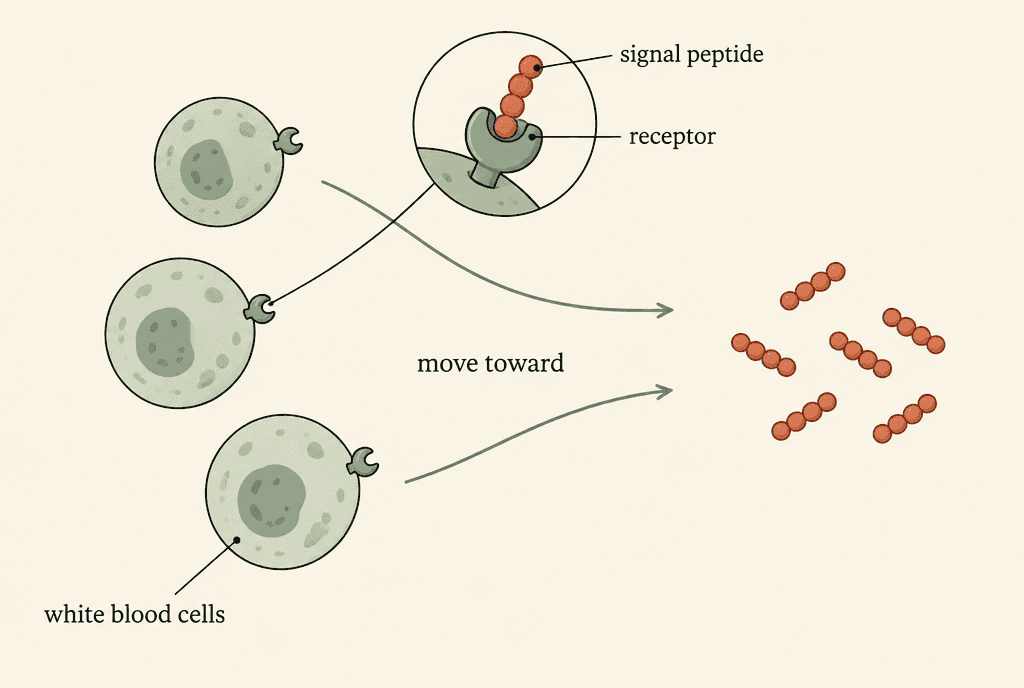
How does LL-37 act against microbes?
The 2000 paper calls LL-37 an antimicrobial peptide. It names germ-killing (microbicidal) activity as one of LL-37's two actions. But the paper studies the other action, calling in white blood cells. So it does not explain in detail how LL-37 acts against germs. The other sources opened for this hub do not settle the physical mechanism either. A mechanism is the step-by-step way something works. This page therefore does not describe one. Readers who want that detail need a study written about how antimicrobial peptides work.
Saying so plainly is part of the job. Many pages repeat one story of how defence peptides damage germs, as if every study had measured it for LL-37. This hub states only what its sources measured.
How does LL-37 relate to wound healing?
The way LL-37 might act in wound healing is not fully understood. The 2021 trial paper by Mahlapuu and colleagues says so in its introduction. It discusses three body processes. Re-epithelialisation is the regrowth of skin cells over a wound. Angiogenesis is the growth of new blood vessels. Inflammation is the body's alarm response. The paper gives these as background ideas about LL-37. The trial did not measure them directly. Naming them does not show that LL-37 has a clinical effect. It also does not show which process explains the trial results.
Healing is a team effort, and the research has not shown which part LL-37 plays in a person. The study findings page covers the two human trials. The early signal in the first trial did not turn into a full-group result in the later trial.
Evidence limits
What has the research on how LL-37 works not shown?
The research on how LL-37 works has not shown what the peptide does in a healthy living person. The 2000 paper used cells grown in a dish, engineered cells and blood cells. Its authors state their conclusion with the word may. The sources opened for this hub do not describe how LL-37 acts against germs. The 2021 trial paper says the wound-healing mechanism is not fully understood. No half-life for LL-37 was found. A half-life is the time it takes for half of a substance to be cleared from the body.
A receptor match in a dish is a starting point. It tells researchers where to look next. It does not tell anyone what happens in a body. The legal and regulatory page shows what regulators have written, and the side effects page shows what is known about safety.
Comparison
Three things the published papers say about how LL-37 works, compared by what was measured, where, and what each paper leaves open. Records read on 16 October 2026.
| Topic | What was measured | Where | What it does not show |
|---|---|---|---|
| Calling in white blood cells (leukocyte recruitment) | Monocytes, neutrophils and T cells moving toward LL-37; calcium mobilisation; cross-desensitisation with an FPRL1-specific agonist | Human cells and FPRL1-transfected human embryonic kidney 293 cells (De Yang et al., 2000) | That the same recruitment happens in a living person |
| Direct antimicrobial activity | Named as a known action; not what the 2000 paper measured | Not measured in the papers opened | The physical mechanism of the antimicrobial action |
| Wound healing | Described as likely involving re-epithelialisation, angiogenesis and inflammation | Background text in a 2021 phase 2b trial paper (Mahlapuu et al., 2021) | Which step LL-37 affects in a person |
FAQ
Does LL-37 kill bacteria?
The 2000 paper describes LL-37 as an antimicrobial peptide with microbicidal (germ-killing) activity. The sources opened for this hub did not measure that activity or describe how it works, so no mechanism is given here.
What does FPRL1 stand for?
FPRL1 stands for formyl peptide receptor-like 1. The name FPR2 is used in the 2022 IUPHAR naming review by Qin and colleagues. The 2000 paper by De Yang and colleagues reported that LL-37 acts through FPRL1 to draw white blood cells toward it in laboratory experiments.
Is the LL-37 wound-healing mechanism understood?
No. The 2021 phase 2b paper says the proposed healing mechanism of LL-37 is not fully understood. It discusses re-epithelialisation, angiogenesis and inflammation as possible processes.
More in this hub
Citations
3 sourcesQin CX, Norling LV, Vecchio EA, et al. British Journal of Pharmacology. 2022;179(19):4617-4639.
doi:10.1111/bph.15919De Yang, Chen Q, Schmidt AP, et al. Journal of Experimental Medicine. 2000;192(7):1069-1074.
doi:10.1084/jem.192.7.1069Mahlapuu M, Sidorowicz A, Mikosinski J, et al. Wound Repair and Regeneration. 2021;29(6):938-950.
doi:10.1111/wrr.12977
Form Laboratories supplies research-use-only reference material. This article is an educational summary of published third-party literature. It is not medical advice, not a use instruction, and research material is not for human or animal use.