
Compound hub · LL-37
Is LL-37 legal in Australia?
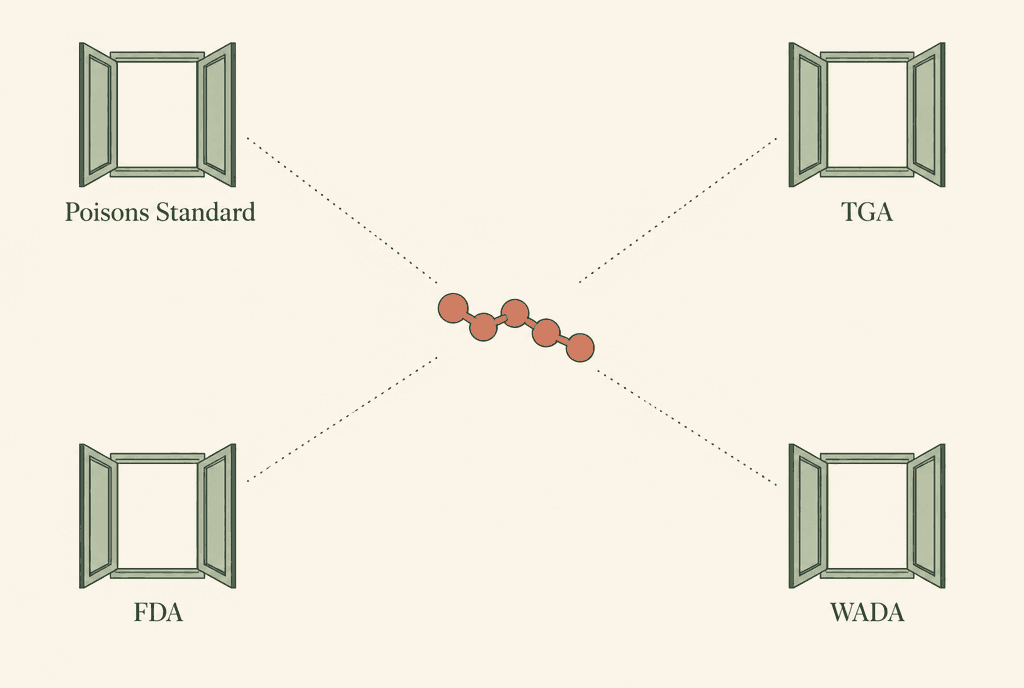
The records read on 16 October 2026 give no simple yes-or-no answer about LL-37. The October 2026 Poisons Standard (F2026L01327) has no LL-37 or cathelicidin entry in its text. The TGA peptide advisory does not name LL-37. The FDA lists cathelicidin LL-37 among withdrawn nominations, with safety concerns. The WADA 2026 Prohibited List does not name LL-37. Each record answers a different question.
01Poisons StandardContents
Medicines law, scheduling rules and sport rules each look at the same molecule. Each one looks in a different way. A name may be missing from one document. That does not mean another document gives permission.
This page belongs to the LL-37 hub. It lists each record that mentions LL-37 or the rules around it. It says what each record states and when it was read. For the molecule itself, see what LL-37 is. This page gives no legal advice.
Key facts
| Poisons Standard | LL-37 and cathelicidin do not appear in the text of the October 2026 instrument, F2026L01327, searched 16 October 2026. Group headings and rules for related substances were not checked |
|---|---|
| TGA | The peptide advisory gives BPC-157, GHK-Cu, TB-500, retatrutide and CJC-1295 as examples. It does not name LL-37 (TGA advisory, read 16 October 2026) |
| ARTG | Not searched for this page |
| FDA | Cathelicidin LL-37 is in the table of bulk drug substances that were nominated and then withdrawn (FDA page, content current as of 22 April 2026) |
| WADA 2026 Prohibited List | LL-37 is not named in the text of the List. The List has been in force since 1 January 2026 (WADA 2026 List) |
| Records checked | 16 October 2026 |
Is LL-37 in the Australian Poisons Standard?
A text search of the October 2026 Poisons Standard found no LL-37, LL37 or cathelicidin. The search ran on 16 October 2026. Its full name is the Therapeutic Goods (Poisons Standard, October 2026) Instrument 2026, F2026L01327. The Poisons Standard is the national list that sorts medicines and poisons into classes. For example, Schedule 4 covers medicines that need a prescription. A missing name is not permission. The document also has group headings, such as one for antibiotic substances. It also has rules that stretch entries to derivatives, which are related substances. This page has not checked whether any of them reaches LL-37. A lawyer would need to check that.
The search covered the main text of the document. The document came from the Federal Register of Legislation. It finds named entries only. What Schedule 4 and Appendix D mean explains the entries that do exist for other peptides.
What has the TGA said about peptide products like LL-37?
The TGA is Australia's medicines regulator. It treats peptide products as therapeutic goods under the Therapeutic Goods Act 1989. It says unapproved peptide products are not on the ARTG. The ARTG is the Australian Register of Therapeutic Goods. It is the national list of approved medicines and devices. The TGA advisory says the TGA has not assessed these products. This covers safety, quality and effectiveness. It gives BPC-157, GHK-Cu, TB-500, retatrutide and CJC-1295 as examples. It does not name LL-37. This hub read the advisory on 16 October 2026.
The TGA's own register search shows whether a given LL-37 product is on the ARTG. This page did not run that search. Nothing here says that any LL-37 product is or is not registered.
What does the FDA say about LL-37?
The FDA lists cathelicidin LL-37 on its page of bulk drug substances. These are substances that may present significant safety risks. It sits in the table of substances that were nominated and then withdrawn. Those substances were once in category 2 of the FDA's interim policies. The people who nominated them later withdrew them. The FDA says compounded drugs that contain LL-37 may cause an immune reaction when given by certain routes. This reaction is called immunogenicity. It also says it lacks enough safety information. A withdrawn nomination is not the same as medicine approval. The table records nomination status and safety concerns. It does not show the approval status of every LL-37 preparation.
Compounding means a pharmacy makes a custom medicine. The page content was current as of 22 April 2026. This hub read it on 16 October 2026. The same page lists findings from lab and animal work. The side effects page covers them with the other safety records.
The page does not say that the FDA has approved any medicine containing LL-37. This page did not search an FDA medicine-approval database.
Is LL-37 banned in sport?
The WADA 2026 Prohibited List does not name LL-37 or cathelicidin anywhere in its text. WADA is the World Anti-Doping Agency. Its 2026 List has been in force since 1 January 2026. This hub searched it on 16 October 2026. Section S0 of the List bans any drug-like substance at all times. This applies when no later section covers it. It also covers any such substance. This means one that no government health regulator currently approves for use as a human medicine. This page did not decide whether LL-37 falls under that wording. It did not decide whether a group entry in a later section covers it. An athlete should ask their anti-doping organisation and not rely on this page.
WADA publishes a new List each year. A later List may differ from the 2026 text. Sport rules are separate from the Poisons Standard and from TGA approval. If a name is missing from the List, that raises a question about definitions. It is not a clearance.
Evidence limits
What do these records not settle?
These records do not settle whether any person may lawfully supply, import or possess LL-37 in Australia. A text search of the Poisons Standard finds named entries only. The document also uses group headings and rules for derivatives. The TGA advisory speaks about unapproved peptide products as a whole group. It does not speak about them one by one. The FDA page is about US pharmacy compounding. WADA rules cover sport, not general law. This page did not read state and territory laws. Each record answers a different question about regulation. No single record gives the full answer.
The guide to peptides and Australian law shows the wider Australian picture. It does so layer by layer.
Comparison
Four records checked for LL-37, each read on 16 October 2026. 'What it does not say' lists what the record leaves open. These are records only. This is not legal advice.
| Body | Record | What it says about LL-37 | What it does not say |
|---|---|---|---|
| Poisons Standard (Commonwealth) | F2026L01327, October 2026 | LL-37 and cathelicidin do not appear in the text of the instrument | That LL-37 is outside group headings or derivative provisions |
| TGA | Peptide advisory, read 16 October 2026 | Treats unapproved peptide products as one group. LL-37 is not named | Whether any LL-37 product is on the ARTG |
| FDA | Safety-risk page, content current as of 22 April 2026 | Lists cathelicidin LL-37 among withdrawn nominations. Names immune reaction and impurity concerns. Says it lacks enough safety information | An approval, a warning letter or an enforcement action |
| WADA | 2026 Prohibited List | LL-37 is not named. The S0 wording covers unapproved substances that no other section addresses | Whether S0 or a class entry reaches LL-37 |
FAQ
Is LL-37 on the Poisons Standard?
No LL-37 or cathelicidin entry was found in the text of the October 2026 instrument, F2026L01327. The check ran on 16 October 2026. That finding covers named entries only. Group headings and rules for related substances were not checked.
Is LL-37 approved by the TGA?
This page did not show whether an LL-37 medicine is approved. It did not search the ARTG. The TGA advisory on unapproved peptide products does not name LL-37. The TGA's ARTG search answers the question for a named product.
Has the FDA approved LL-37?
This page did not search an FDA medicine-approval database. So it does not show approval status. The FDA lists cathelicidin LL-37 among withdrawn nominations. It says it lacks enough safety information.
Is LL-37 on the WADA Prohibited List?
The WADA 2026 Prohibited List does not name LL-37 in its text. Section S0 can apply to an unapproved substance that no later section covers. Athletes should ask their anti-doping organisation about their own case.
More in this hub
Citations
2 sourcesMahlapuu M, Sidorowicz A, Mikosinski J, et al. Wound Repair and Regeneration. 2021;29(6):938-950.
doi:10.1111/wrr.12977Grönberg A, Mahlapuu M, Ståhle M, Whately-Smith C, Rollman O Wound Repair and Regeneration. 2014;22(5):613-621.
doi:10.1111/wrr.12211
Form Laboratories supplies research-use-only reference material. This article is an educational summary of published third-party literature. It is not medical advice, not a use instruction, and research material is not for human or animal use.