
Compound hub · LL-37
What have human studies of LL-37 found?
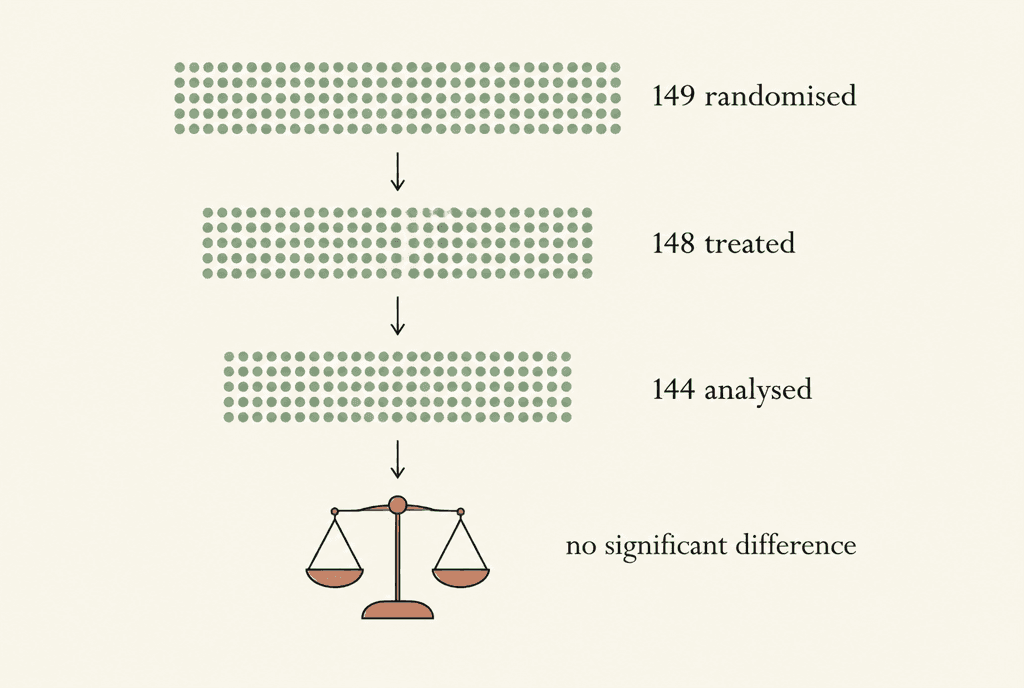
The larger LL-37 trial, a phase 2b study published in 2021, found no significant healing difference in its main analysis. It randomised 149 people, treated 148 and counted 144 in the main efficacy analysis. An earlier first-in-human trial, published in 2014, had 34 participants. Both trials studied venous leg ulcers, which are open sores on the lower leg.
01Human studiesContents
A leg ulcer that stays open for months is a stubborn problem. People who live with one know that a wound can refuse to close even with good care. That is where LL-37 reached human trials, and it is the setting of the two trials on this page.
This page belongs to the LL-37 hub. It puts the two trials side by side. It ties each result to its group, its main measure and its limits, and it says plainly what the 2021 study did not show. For the molecule itself, see what LL-37 is.
Key facts
| Condition studied | Hard-to-heal venous leg ulcers |
|---|---|
| First-in-human trial | Grönberg et al., Wound Repair and Regeneration, 2014; 34 people; PMID 25041740 |
| Phase 2b trial | HEAL LL-37; Mahlapuu et al., Wound Repair and Regeneration, 2021; 149 randomised, 148 treated, 144 in main efficacy analysis; PMID 34687253 |
| Design of both | Randomised, double-blind, placebo-controlled; topical application |
| 2021 full-population result | No significant healing improvement versus placebo |
| 2021 post hoc subgroup | Wounds of at least 10 cm2 at randomisation; a post hoc analysis, not a primary result |
| Sponsor link, 2021 | Promore Pharma employees among the authors; one minority shareholder |
| Records checked | 16 October 2026 |
Have there been human trials of LL-37?
Yes. This hub found two randomised, placebo-controlled trials of LL-37 put on the skin over hard-to-heal venous leg ulcers. Randomised means chance decided who got which treatment. Placebo-controlled means one group got a look-alike with no active ingredient, so the groups could be compared fairly. The first trial, by Grönberg and colleagues, enrolled 34 people in 2014. The second, the phase 2b HEAL LL-37 study by Mahlapuu and colleagues, randomised 149 people and treated 148 in 2021. A venous leg ulcer is an open sore on the lower leg linked to poor blood return through the veins.
Both trials tested a topical preparation, which means one put on the wound surface. The sources opened did not report results from any other kind of trial. They say nothing about LL-37 given by any other route.
These two papers are the ones compared here. They are not a complete list of every LL-37 trial.
What did the 2014 first-in-human trial of LL-37 find?
The 2014 trial enrolled 34 people with hard-to-heal venous leg ulcers and ran in three steps. First came a three-week placebo run-in. Next came a four-week randomised, double-blind treatment phase, where neither patients nor researchers knew who got what. In that phase, LL-37 at one of three concentrations, or placebo, was put on the wound twice a week. Last came a four-week follow-up. The team compared how fast wounds shrank. At the two lower concentrations, the P-values were 0.003 and 0.088. So only one met the usual 0.05 cut-off. The highest concentration did not differ from placebo.
The paper measured a healing-rate constant, a number that describes how fast a wound area shrinks over time. A P-value asks a narrow question: if the treatment made no difference, how unusual would results at least this extreme be? A smaller number means more unusual. By the usual cut-off of 0.05, the first result is below it and the second is not. The authors report no safety concern about local or systemic (whole-body) adverse events in this small study.
With 34 people split across four groups, each group was small. The authors say the aim was to test safety and how the effect changed with concentration. The study was too small to settle an effect on its own.
What did the 2021 phase 2b trial of LL-37 find?
The 2021 HEAL LL-37 trial found no significant healing difference in its main efficacy analysis. This phase 2b trial was double-blind, randomised and placebo-controlled. It studied hard-to-heal venous leg ulcers alongside compression therapy. It had three arms, or groups: two LL-37 concentrations and placebo. It randomised 149 people, treated 148 and counted 144 in the main efficacy analysis. These are three counts for three different stages, so they should not be treated as the same number. The authors gave an overall view on tolerability. That view needs to be read alongside the adverse-event record in the full paper.
The paper's summary gives the people's mean (average) age as 67.6 years. The median ulcer duration, the middle value, was 20.3 months. The mean wound area was 11.6 cm2 at randomisation. These were long-standing wounds, which is what hard-to-heal means here.
Everyone in the trial had compression therapy, a tight bandage that helps blood return from the leg, as part of standard care. Phase 2b is a mid-stage design. It tests whether an early signal holds up in a larger group before a final trial.
Why is the 2021 subgroup result not the main result?
The subgroup result in the 2021 trial came from a post hoc analysis. Post hoc means the researchers chose to look at it after the main result was in, so it is not a primary result. The analysis looked at wounds of at least 10 cm2 at randomisation. It did not replace the main analysis, which was planned in advance. The paper itself calls it an interesting observation that warrants a further study adequately powered for that group, meaning large enough to test it properly. The primary answer for the full group stayed the same: no significant difference.
Imagine slicing a result many ways until one slice looks good. Some slices will look good by chance. That is why researchers treat post hoc findings as a map for the next study, not as a verdict.
The 2014 signal at the lower concentrations did not become a full-group result in 2021. Both facts belong on the page together.
Evidence limits
What have the LL-37 trials not shown?
The two LL-37 papers do not establish effects in healthy people, in other conditions or by other routes. Both tested LL-37 put on the skin over venous leg ulcers. The 2014 paper reported differences in some comparisons. But the 2021 main efficacy analysis found no significant healing difference. Neither paper reports a human plasma half-life for LL-37 supplied from outside the body. The 2021 paper also says some authors worked for its sponsor, Promore Pharma. The company was developing LL-37 under the name ropocamptide. These limits stay part of the study record.
Safety is covered on the side effects page. What regulators have written is on the legal and regulatory page.
Comparison
The two published human trials of LL-37, compared by design, size, people, main result and limit. All figures come from the PubMed abstracts and the open full text read on 16 October 2026.
| Item | 2014 first-in-human trial | 2021 phase 2b (HEAL LL-37) |
|---|---|---|
| Citation | Grönberg et al., Wound Repair and Regeneration, 2014 (PMID 25041740) | Mahlapuu et al., Wound Repair and Regeneration, 2021 (PMID 34687253) |
| People | 34 with hard-to-heal venous leg ulcers | 149 randomised; 148 treated; 144 in main efficacy analysis; hard-to-heal venous leg ulcers |
| Design | Three-week placebo run-in; four-week randomised, double-blind phase with topical application twice a week at three concentrations or placebo; four-week follow-up | Double-blind, randomised, placebo-controlled; two LL-37 concentrations plus placebo, with compression therapy |
| Main result reported | Healing-rate comparisons at the two lower concentrations: P = 0.003 and P = 0.088; no difference at the highest concentration | No significant healing improvement versus placebo in the full study population |
| Other analysis | Not applicable | Post hoc: differences in wounds of at least 10 cm2 at randomisation |
| Safety statement | No safety concern regarding local or systemic adverse events | Authors reported overall tolerability; full text records adverse events |
| Limit | Small groups; a signal-finding study | Post hoc result is not a primary result; authors linked to sponsor |
FAQ
Did the LL-37 phase 2b trial work?
The main efficacy analysis, with 144 participants, found no significant healing difference between LL-37 and placebo. The trial randomised 149 people and treated 148. A post hoc analysis of wounds of at least 10 cm2 does not replace the main result.
How many people have been in LL-37 trials?
The 2014 trial included 34 participants. The 2021 trial randomised 149, treated 148 and included 144 in its main efficacy analysis. These papers are not a complete list of LL-37 trials.
Is LL-37 the same as ropocamptide?
Ropocamptide is the non-proprietary name under which Promore Pharma develops LL-37, according to the conflict-of-interest statement of the 2021 paper. The paper does not state that any other preparation is identical.
Does the 2014 trial prove LL-37 helps wounds close?
No. The 2014 study was a small first-in-human trial of 34 people, and one of its two lower-concentration results had a P-value of 0.088. The 2021 full-population analysis did not confirm a healing improvement.
More in this hub
Citations
2 sourcesGrönberg A, Mahlapuu M, Ståhle M, Whately-Smith C, Rollman O Wound Repair and Regeneration. 2014;22(5):613-621.
doi:10.1111/wrr.12211Mahlapuu M, Sidorowicz A, Mikosinski J, et al. Wound Repair and Regeneration. 2021;29(6):938-950.
doi:10.1111/wrr.12977
Form Laboratories supplies research-use-only reference material. This article is an educational summary of published third-party literature. It is not medical advice, not a use instruction, and research material is not for human or animal use.