
Compound hub · LL-37
What are the side effects of LL-37?
The LL-37 trials on this page do not establish general safety. The 2014 trial summary reported no safety concern in 34 participants. The 2021 full paper records adverse events among 148 treated participants, including some judged possibly related to treatment. The FDA also names unresolved safety concerns for compounded LL-37, meaning LL-37 made up into a medicine by a pharmacy.
01Trial safetyContents
Your body keeps every molecule it makes in balance. A signal that is useful in one small place for a short time can cause trouble in the wrong place or the wrong amount. So safety records for a peptide matter, and a short list of reported events is not proof of safety.
This page belongs to the LL-37 hub. It records what the trials reported, what the FDA wrote, and what is not known. It lists no symptoms from personal stories, because those are not controlled studies. For the trial designs, see the study findings page.
Key facts
| 2014 trial safety statement | No safety concerns regarding local or systemic adverse events; 34 people (Grönberg et al., 2014) |
|---|---|
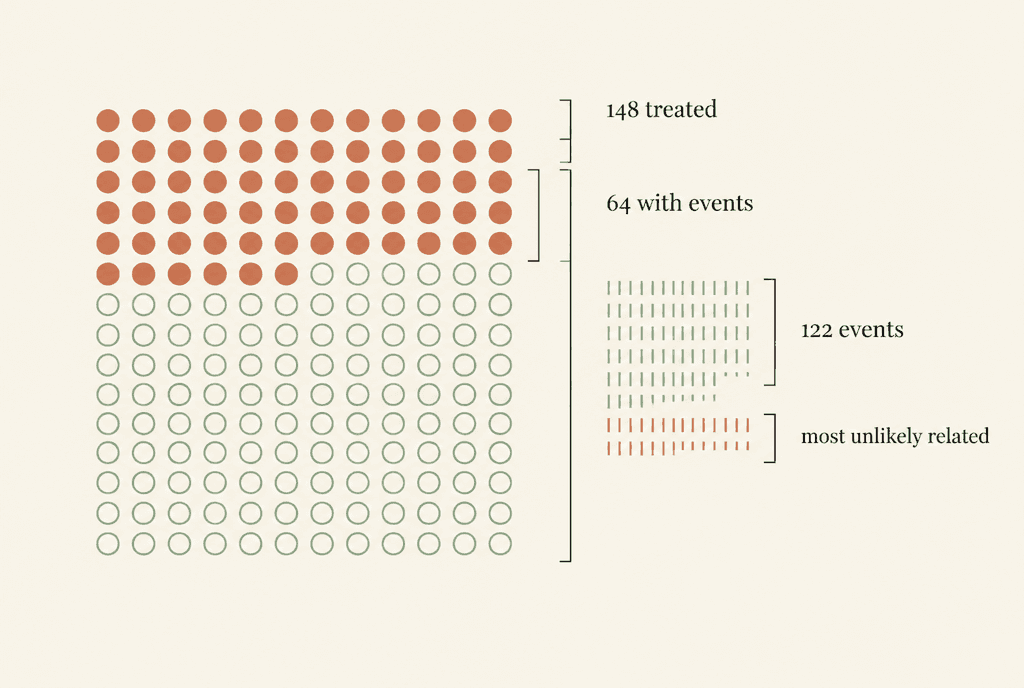
| 2021 trial safety statement | 148 treated participants; 122 adverse events in 64 people; most judged unlikely related (Mahlapuu et al., 2021, section 3.6) |
| FDA safety page | Cathelicidin LL-37 listed in the FDA table of nominated-but-withdrawn bulk drug substances (page content current as of 22 April 2026) |
| FDA risks named | Immunogenicity for certain routes; peptide-related impurities; API characterization |
| FDA nonclinical statement | Nonclinical research findings suggest detrimental effects on male reproduction and that LL-37 can be protumorigenic in some tissues |
| Human data on those two nonclinical findings | None found in the sources opened |
| Records checked | 16 October 2026 |
What did the LL-37 trials report about safety?
The LL-37 trial reports do not establish general safety. The 2014 trial summary reported no safety concerns in 34 participants. The 2021 full paper recorded 122 adverse events in 64 of the 148 treated participants. An adverse event is any health problem during a trial, whether or not the treatment caused it. Most were judged unlikely to be related to treatment. Some were judged possibly related: wound infection and dermatitis (skin inflammation) in the lower-concentration group, and peripheral swelling (swelling in the limbs) in the higher-concentration group. These judgments describe suspected links, not proof that LL-37 caused each event.
The 2021 paper also recorded a possibly related event in the placebo group. It reported 12 serious adverse events, none fatal, in 11 participants. None was judged related to the study treatment. These figures come from section 3.6 of the paper. A limited study cannot rule out rare or delayed harms.
Some of the 2021 authors worked for the sponsor, Promore Pharma. That fact does not make the safety statement wrong. It is why a reader may want independent confirmation.
What does the FDA say about the safety of LL-37?
The FDA lists cathelicidin LL-37 on its page of bulk drug substances that may present significant safety risks. LL-37 sits in the table of substances that were nominated and then withdrawn. The page content was current as of 22 April 2026, and this hub read it on 16 October 2026. The FDA says compounded drugs containing LL-37 may pose a risk of immunogenicity for certain routes of administration. It says they may raise complex problems with peptide-related impurities and with active pharmaceutical ingredient (API) characterization. It also says it lacks enough safety information to know whether the drug would cause harm in humans.
The page is a US statement about pharmacy compounding, which is when a pharmacy makes a customised medicine. It is not an approval, and it is not a warning letter to any seller. The legal and regulatory page explains what withdrawn means on that table.
What do immunogenicity and peptide-related impurities mean?
Immunogenicity is a substance's tendency to make the immune system react against it. A peptide-related impurity is a stray molecule left over from making the peptide. One example is a chain that is too short. Another is a chain with one part changed. API characterization is the work of proving exactly what a substance is. The FDA names immunogenicity and impurities as concerns for compounded LL-37, and it says characterization is complex. The FDA page does not report a case of either problem in a person. It describes possible risks, not events that have been recorded.
The FDA says these risks apply to certain routes of administration, meaning the ways a substance enters the body. The part of the page read for this hub does not say which routes. The 2014 and 2021 trials used a preparation put on the skin and did not examine this question.
What are the nonclinical findings the FDA mentions for LL-37?
The FDA writes that nonclinical research findings suggest harmful effects on male reproduction. It also writes that LL-37 can be protumorigenic in some tissues. Nonclinical means the work was done in cells or animals, not in people. Protumorigenic means a substance may help tumours form or grow. The FDA gives both points as suggestions from nonclinical work. This hub did not open the studies behind them. It found no human data on either point in the records checked. So the size of any risk in people is unknown from these sources.
Cell and animal findings are a warning light for researchers and regulators, not a measurement in a human. They also do not show how large a risk would be. The accurate summary is short: the FDA flagged two areas, and the human evidence on them is not established in the sources opened.
Evidence limits
What is not known about the safety of LL-37?
The sources checked here do not establish long-term safety for LL-37. Both trial papers looked at LL-37 put on the skin over venous leg ulcers. The 2021 full paper records events; it does not prove that harm was absent. The FDA says safety information is still not enough. It flags nonclinical findings about male reproduction and tumour growth, and those findings do not give human risk rates. The papers checked do not report a human plasma half-life for LL-37 supplied from outside the body, so none is given here.
Reported events can be listed, but they must stay tied to the people studied and to the investigators' view of cause. This page records those limits and leaves unknown risk rates blank. See what LL-37 is for the identity facts.
Comparison
Three safety records for LL-37, compared by what was studied, what each record reports and what it leaves open. Records read on 16 October 2026.
| Record | What was studied | What it reports | What it does not show |
|---|---|---|---|
| 2014 trial (Grönberg et al.) | 34 people with venous leg ulcers; LL-37 put on the wound | No safety concerns about local or systemic adverse events | Rare or delayed harms, or safety by other routes |
| 2021 trial (Mahlapuu et al.) | 148 treated people with venous leg ulcers; LL-37 put on the wound | 122 adverse events in 64 people, most judged unlikely related; 12 non-fatal serious adverse events in 11 people, none judged related | That harm was absent |
| FDA safety page | Compounded LL-37; nonclinical research | Immunogenicity risk for certain routes; impurity and API characterization concerns; nonclinical findings on male reproduction and tumour growth | Human data on the nonclinical findings |
FAQ
Are there any known side effects of LL-37?
The 2021 full paper records wound infection, dermatitis and peripheral swelling as possibly related events in LL-37 groups. That is not proof of cause or a general side-effect rate. The FDA says safety information remains insufficient.
Does LL-37 cause cancer?
No human study showing that was found in the sources opened. The FDA writes that nonclinical research findings suggest LL-37 can be protumorigenic in some tissues. That is a statement about cell or animal work, not a finding in people.
Does LL-37 affect fertility?
No human data on fertility were found in the sources opened. The FDA writes that nonclinical research findings suggest detrimental effects on male reproduction.
Is LL-37 safe?
General safety is not established. The 2021 trial recorded adverse events despite its authors' overall view on tolerability. The FDA says it lacks sufficient information to determine whether LL-37 would harm humans.
More in this hub
Citations
2 sourcesGrönberg A, Mahlapuu M, Ståhle M, Whately-Smith C, Rollman O Wound Repair and Regeneration. 2014;22(5):613-621.
doi:10.1111/wrr.12211Mahlapuu M, Sidorowicz A, Mikosinski J, et al. Wound Repair and Regeneration. 2021;29(6):938-950.
doi:10.1111/wrr.12977
Form Laboratories supplies research-use-only reference material. This article is an educational summary of published third-party literature. It is not medical advice, not a use instruction, and research material is not for human or animal use.