
Compound hub · Selank
How do Selank, N-acetyl Selank and amidated forms differ?
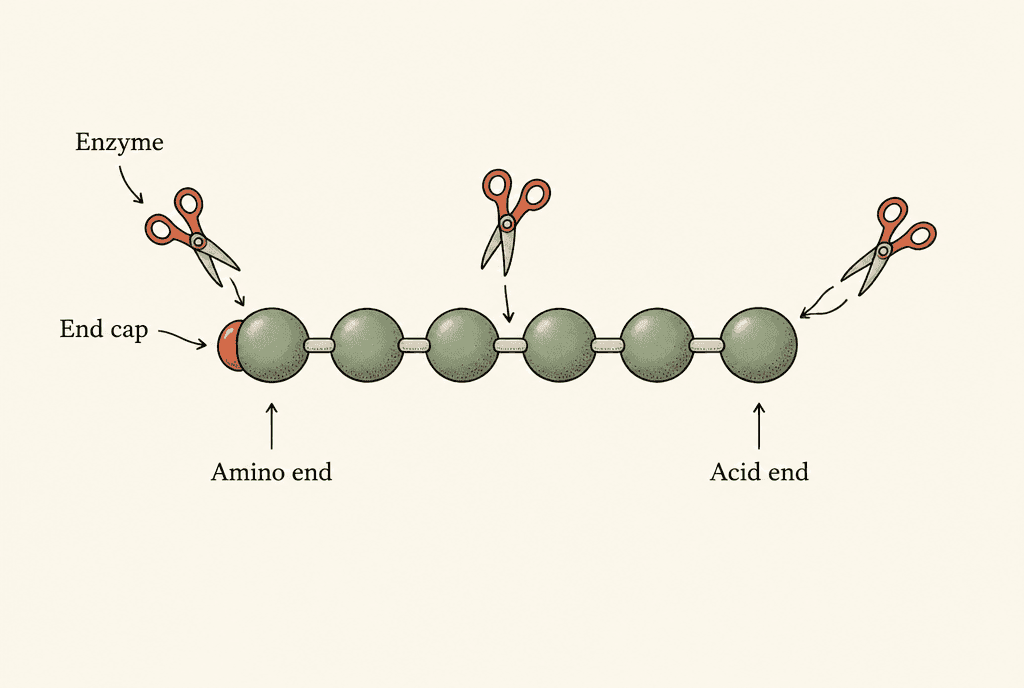
Selank and its modified forms share the same chain of seven building blocks. They differ only at the two ends. N-acetyl means a small chemical cap on the front end, called the amino end. Amidate means a change at the back end, called the acid end. A 2020 chemical analysis by Vanhee and colleagues told Selank, N-acetyl Selank and N-acetyl Selank amidate apart. It did not compare their effects in people.
01The shared chainContents
A train is still the same train when someone hangs a sign on the front carriage. Yet that sign can change how a station handles it. Small protein chains are a little like this. Some enzymes, the body's cutting tools, start their work at the end of a chain. That makes a tiny change at an end an interesting research question. The Selank hub puts these related names in their wider scientific setting.
Key facts
| Parent chain | Thr-Lys-Pro-Arg-Pro-Gly-Pro (Volkova et al., 2016) |
|---|---|
| Short chain notation | TKPRPGP (Vanhee et al., 2020, Table 1) |
| N-acetyl marker | Ac at the amino end |
| Amidate marker | NH2 at the acid end |
| Direct chemical comparison | Vanhee et al., 2020, Table 1 |
| Human comparison of modified forms | Not established in the sources examined on 16 October 2026 |
What does N-acetyl Selank mean?
N-acetyl Selank has an acetyl group attached to the amino end of the Selank chain. An acetyl group is a small chemical group held on by a bond, a bit like the cap on a pen. Its short label is Ac. PubChem, a public chemistry database, writes N-acetyl Selank as Ac-Thr-Lys-Pro-Arg-Pro-Gly-Pro-OH. The OH at the end marks a normal acid end. So N-acetyl on its own does not mean the other end is amidated. This matters when a short name leaves the ending out. N-acetyl Selank and N-acetyl Selank amidate are not interchangeable names.
The acetyl label describes chemistry, not a measured result. A structure record can identify a molecule. It cannot show how that molecule behaves in a person. A familiar parent name does not fill that gap.
What does Selank amidate mean?
Selank amidate means a Selank chain with an amide at its acid end. Chemists write that end as CONH2 instead of COOH. The name alone does not say there is an acetyl group at the amino end. N-acetyl Selank amidate names both changes. Vanhee and colleagues list it as Ac-TKPRPGP-NH2 in their 2020 paper. Their table does not include an amidated-only Selank. So the amidated-only row in the table below explains the name using chemical notation. It does not show that any sample has that structure, or that this form has been tested in living things.
Telling close chemical relatives apart needs evidence. Mass spectrometry and peptide identity explains how measuring a molecule and its broken pieces can answer that question.
Do acetyl and amide ends prove that Selank lasts longer?
No. Acetyl and amide ends do not, on their own, show that a Selank form lasts longer. Proteases are enzymes that cut peptides, a bit like scissors. They can cut at a chain's ends or at bonds in the middle. In 2024, Rozans and colleagues studied modified cell-adhesion peptides, chains that let cells attach to surfaces, with cultured human cells. They found that breakdown depended on the end chemistry and on the cell type. That gives a reason to study end changes. But the chains they tested were not Selank. A result for another chain cannot give a measured lifetime for N-acetyl Selank or its amidated form.
Stability always comes with a setting: stable in which fluid, near which cells, and for how long? A lab test that counts intact peptide also answers a different question from a test of whether a peptide reaches the brain. The sources examined did not compare brain entry for these Selank forms.
Can Selank study findings be transferred to modified analogues?
No. Selank findings do not show the properties of N-acetyl Selank or the amidated forms. The methods part of a paper names the compound it actually tested. In 2016, Volkova and colleagues studied gene activity in rat brain tissue. They used Selank as a diacetate salt. That study did not compare the modified forms. Diacetate names a salt form, a partner chemical that travels with the peptide. N-acetyl names an acetyl group bonded onto the peptide itself. The two words look alike, but they mean different things. A study of the parent compound counts only for the parent, unless the modified form was tested too.
The Selank study findings page covers research on the parent compound. For the modified forms, a chemical identification paper and a biological experiment answer different questions. Identification can show what a sample contains. It cannot show what the sample does.
Evidence limits
What remains unconfirmed about N-acetyl Selank and amidated forms?
The sources examined for this page on 16 October 2026 did not establish how these modified Selank forms compare in people. That covers their effects, their safety, their entry into the brain and how long they last in the blood. Searches for N-acetyl Selank and Selank amidate found chemical identification evidence. They did not confirm any direct comparison in people. This is a limited finding from the papers examined. It does not prove that no other paper exists. A chain diagram cannot fill these gaps. Neither a chemical name nor an end group gives a human measurement of the molecule.
Selank pharmacokinetics explains how scientists measure a compound's movement and breakdown in the body. Reading a certificate of analysis covers another limit: a sample's identity record and clinical evidence do different jobs.
Comparison
How each name is written at its two ends. This is not a ranking. Table 1 of the 2020 paper by Vanhee and colleagues tells apart the parent and both N-acetyl forms. The amidated-only row explains the name; that paper did not test it.
| Name | Amino end | Acid end | Chain notation |
|---|---|---|---|
| Selank | Free | Acid | H-TKPRPGP-OH |
| N-acetyl Selank | Acetyl | Acid | Ac-TKPRPGP-OH |
| Selank amidate only (name interpretation) | Free | Amide | H-TKPRPGP-NH2 |
| N-acetyl Selank amidate | Acetyl | Amide | Ac-TKPRPGP-NH2 |
FAQ
Is N-acetyl Selank the same as Selank amidate?
No. N-acetyl means a change at the amino end. Amidate means an amide at the acid end. A name with both words describes both changes. The full chemical notation makes the difference clear.
Does N-acetyl Selank mean the amidated form?
No. PubChem's record for N-acetyl Selank keeps a normal acid end. A shortened name does not show amidation. The structure record defines which molecule is meant, not a guessed abbreviation.
Is Selank acetate the same as N-acetyl Selank?
No. Acetate describes a salt partner. N-acetyl describes an acetyl group bonded onto the chain. Volkova and colleagues used Selank as a diacetate salt in their 2016 rat study. That wording does not mean N-acetyl Selank.
Is N-acetyl Selank amidate better studied than Selank?
The sources examined do not show that. Chemical identification of the modified form is on record. A direct comparison in people was not confirmed in this page's search on 16 October 2026.
More in this hub
Citations
3 sourcesVanhee C, Francotte A, Janvier S, Deconinck E Drug Testing and Analysis. 2020;12:371-381. Chemical identification and structural comparison, Table 1..
doi:10.1002/dta.2717Volkova A, et al. Frontiers in Pharmacology. 2016;7:31. Selank chain, salt identity and gene-expression research in rats..
doi:10.3389/fphar.2016.00031Rozans SJ, et al. ACS Biomaterials Science & Engineering. 2024;10(8):4916-4926. Terminal chemistry and breakdown of cell-adhesion peptides, not Selank..
doi:10.1021/acsbiomaterials.4c00736
Form Laboratories supplies research-use-only reference material. This article is an educational summary of published third-party literature. It is not medical advice, not a use instruction, and research material is not for human or animal use.