
Hub · Peptide Quality & Verification
Which peptide company is the most trusted?
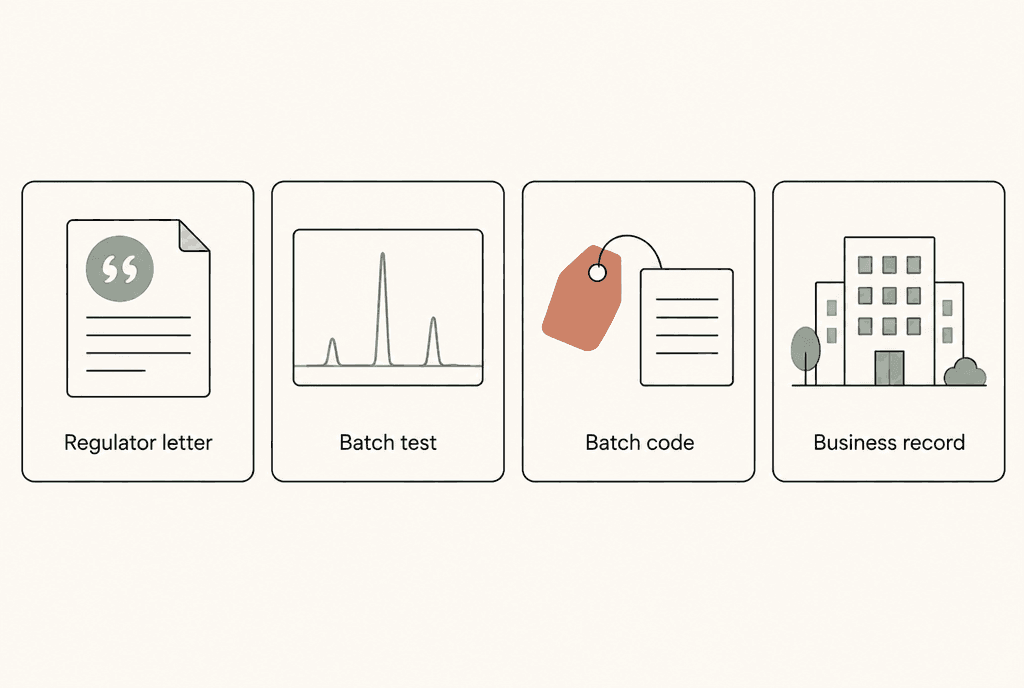
The public records checked here name no most trusted peptide company. A regulator letter records concerns about named products and claims. A lab report records tests linked to a sample or batch. A business register records business details. These records answer separate questions. None measures trust across all peptide companies. This page has not verified any seller.
01Regulator letterContents
A search for a trusted company often returns unlike things. You may see a factory, a medicine business or a research website. Their records can describe very different work. A page that mixes those records can make a narrow fact sound much broader.
The useful question is smaller: what does this record actually show? This guide from Form Laboratories keeps each claim beside its evidence. The quality records hub explains those documents. You can also read How to check an Australian peptide supplier is legitimate?.
Key facts
| Regulator letter | Concerns about the products and claims it names; FDA letter, 31 March 2026 |
|---|---|
| COA | Certificate of analysis: a batch test report; ICH Q7, 2000, section 11.4 |
| Batch code | An identifier linking one batch to its records; ICH Q7, 2000, section 6.5 |
| Business register | Business details, with stated limits; ABN Lookup terms, checked 17 October 2026 |
| Scope | Sources checked 17 October 2026; no seller or batch verified |
What does a regulator letter say about trust?
A regulator letter sets out concerns about the firm it names. It is not a score for every peptide that firm sells. The FDA letter dated 31 March 2026 discusses website claims and named products. FDA is the United States Food and Drug Administration. That letter offers no company trust ranking. Its findings cannot be moved to another seller or an unnamed peptide.
The March regulator letter discusses retatrutide, tirzepatide and a water product. It does not give CJC-1295 a quality score. A search result about CJC-1295 can still link to that letter. That link alone does not change what the letter covers.
The letter also weighs website claims beside research-only labels. A label alone did not settle the agency's view. This source was checked 17 October 2026. It records that letter's findings, rather than every later event.
Can a certificate of analysis establish company trust?
A certificate of analysis, or COA, reports tests for a named batch. A batch means one production run. The ICH Q7 guide lists batch details, test results and result limits. It covers ingredients made for medicines. It gives a useful document benchmark here, rather than proof a seller meets it. A report cannot answer questions about tests that were never done.
Keep the test questions apart. Identity asks which substance is present. Purity asks about the target substance's share under the test method. Amount asks how much target substance is present. One result cannot stand in for all these answers.
A separate issue is who chose the sample. An outside lab can test material chosen by the seller. That leaves the link to other stock untested. How to check a peptide certificate of analysis is genuine? explains checks on the report itself.
What does a matching batch number actually show?
A matching batch number links a label to a named set of records. ICH Q7 calls for a unique batch identifier and batch details on certificates. The match supports the link between those documents. It does not check the test results or confirm who made the material. A copied code could match too. Matching text and verified contents remain separate questions.
Verbeke and colleagues checked research peptides against their stated purity. Their 2015 paper found that some samples fell short. These were peptides studied as messages between bacteria. The study did not survey today's peptide sellers. It shows why a certificate and a fresh test are different evidence.
A genuine report for another batch leaves a gap. So does a matching report whose source cannot be confirmed. Those gaps mean the link is unverified. They do not, on their own, establish what the sample contains.
Does an Australian business number show peptide quality?
An Australian Business Number, or ABN, identifies a business record. It does not report tests on a peptide batch. ABN Lookup's terms also set limits on what registration means. A listing does not guarantee the business will keep trading. It does not even guarantee that someone displaying the number has permission. These terms were checked 17 October 2026. Registration and product evidence remain separate.
The ABN Lookup terms say the service uses details supplied by businesses. They warn that records may be incomplete or out of date. A matching name is useful evidence of the listed identity. It cannot replace a batch report or a separate lab check.
A business number also differs from medicine approval. Australia's medicine regulator is the Therapeutic Goods Administration, or TGA. Its peptide page discusses product regulation and risks. Checked 17 October 2026, that page names no most trusted company.
Why does the largest peptide company depend on the list?
Largest needs a stated measure before the comparison means anything. A factory may report ingredient sales or the space in its equipment. A medicine business may report sales of an approved medicine. A research website describes another kind of supply. These measures cover different work. None is a batch quality test. Size alone cannot settle a claim about company trust.
The annual manufacturing results dated 12 March 2026 separate several sales groups. They list commercial ingredients, clinical development, and research chemicals with specialty products. Clinical development means work on medicines still being studied. The research group covers only part of the business.
A broad company total can therefore include work beyond research peptides. Equipment space measures capacity, meaning room for production. It does not state how much material left the factory. A useful size claim names its measure, scope and period. It still needs separate evidence about any seller's source.
Evidence limits
What remains unknown after these records are checked?
These records do not establish a most trusted peptide company. This page checked published sources, rather than sellers or their stock. It has not confirmed a report, sampled a batch or inspected a business. The cited lab study cannot describe every seller today. The TGA's peptide page warns about unapproved products. Neither business records nor batch paperwork establish that research material is safe for people.
An absent warning letter is not a positive test result. A lab result is not a full company inspection. A missing record leaves that question open. Research material is not a medicine and is not for human or animal use.
What makes a peptide company reputable? explains further limits of supplier testing. The public records reviewed here support narrower claims. They do not supply a measured trust score across companies.
Comparison
Each record supports a different claim. Sources were checked 17 October 2026. No row ranks a company.
| Record | What it can show | What it cannot settle | Source |
|---|---|---|---|
| Regulator letter | Concerns about named products and claims | Quality of an unnamed peptide or another firm | FDA letter, 31 March 2026 |
| COA | Named batch, reported tests and results | Results for tests not done | ICH Q7, 2000, section 11.4 |
| Batch number | Which batch the records describe | Whether the reported contents are correct | ICH Q7, 2000, sections 6.5 and 11.4; Verbeke et al., 2015 |
| ABN record | Business details supplied to the register | Batch quality or permission to display an ABN | ABN Lookup tools Agreement |
| Annual sales report | Sales within stated business groups and period | A research seller's batch quality | Annual manufacturing results, 12 March 2026 |
FAQ
Is there an official most trusted peptide company list?
The official sources reviewed here provide no such ranking. FDA letters record specific concerns. The TGA page explains product regulation and risks. Both were checked 17 October 2026.
Does research use only mean regulator approved?
No. In the March 2026 letter, FDA considered website claims beside that label. A research label did not settle how the products were presented.
Can high purity settle every quality question?
No. A purity result depends on its test method. It cannot replace separate evidence about identity, amount or other untested properties. ICH Q7 lists test results separately.
Does a large factory name establish a seller's source?
A factory name alone leaves that link unverified. ICH Q7 calls for records that trace material to its original maker. A size claim cannot supply those records.
Has this page checked any company's stock?
No. The check on 17 October 2026 covered published sources. It did not include stock sampling, lab confirmation or a business inspection. No company is endorsed here.
More in this hub
Peptide Quality & Verification
- How to read a certificate of analysis (COA)
- How to check a peptide certificate of analysis is genuine
- How to check an Australian peptide supplier is legitimate
- What research grade actually means
- What a batch or lot number lets a researcher verify
- CJC-1295 with DAC vs without DAC: what is the difference?
- Selank vs Semax: are they the same peptide?
- Is NAD+ a peptide?
- How mass spectrometry confirms peptide identity
- How HPLC purity is measured for peptides
- Endotoxin, sterility and purity: three different tests
- TB-500 vs thymosin beta-4: is TB-500 the same molecule?
- What does a peptide cleavage predictor measure?
- What is peptide mass fingerprinting, and what can it identify?
Citations
1 sourcesVerbeke F, Wynendaele E, Braet S, et al. Journal of Pharmaceutical Analysis. 2015;5(3):169–181. Quality evaluation of synthetic quorum sensing peptides used in R&D..
doi:10.1016/j.jpha.2014.12.002
Continue
Explore peptide quality recordsForm Laboratories supplies research-use-only reference material. This article is an educational summary of published third-party literature. It is not medical advice, not a use instruction, and research material is not for human or animal use.