
Compound hub · Retatrutide
What makes a peptide company reputable? How to check a supplier's testing
Judge a peptide company's reputation through records you can check. Look for a batch test report, called a certificate of analysis. It should name the testing lab and explain purity and identity tests. These check the sample's makeup and which peptide it contains. Records can support claims about that sample. High purity or an outside report alone cannot show human safety or rank suppliers.
01Certificate and lotContents
Your body builds peptides from amino acids. These small units also make proteins. Seeing a familiar molecule name online can make you feel reassured. Yet a name and a test result answer different questions. The retatrutide learning hub covers supplier paperwork and the separate evidence from science studies.
Start with one question: which claim does this document support? This page explains that question for readers of Form Laboratories. The same checks apply to any supplier. This page does not rank companies.
Key facts
| COA | Certificate of analysis: a test report linked to a named batch (FDA, ICH Q7, 2016) |
|---|---|
| HPLC | High-performance liquid chromatography: a test that separates a mixture (NIST RM 8327, 2007) |
| Mass spectrometry | Uses signals based on mass and electric charge to assess a molecule's mass (NIST RM 8327, 2007) |
| Source check | 17 October 2026; no single supplier or batch checked |
What should a peptide certificate of analysis identify?
A peptide certificate of analysis should link the material name and batch number to the tests. FDA's ICH Q7 guidance lists a release date, test results, acceptance limits and an authorised signature. Acceptance limits are the bounds used to judge a result. Q7 covers ingredients for medicines. Its guidance offers a useful way to judge documents. It does not show that a research supplier meets that standard. A lot number is a batch tracking code. A report for another lot does not confirm a link to this material.
The guide for these document checks is FDA's ICH Q7 guidance, section 11.4, checked 17 October 2026. How do you read a certificate of analysis (COA)? explains each part of the report.
What does HPLC purity actually measure?
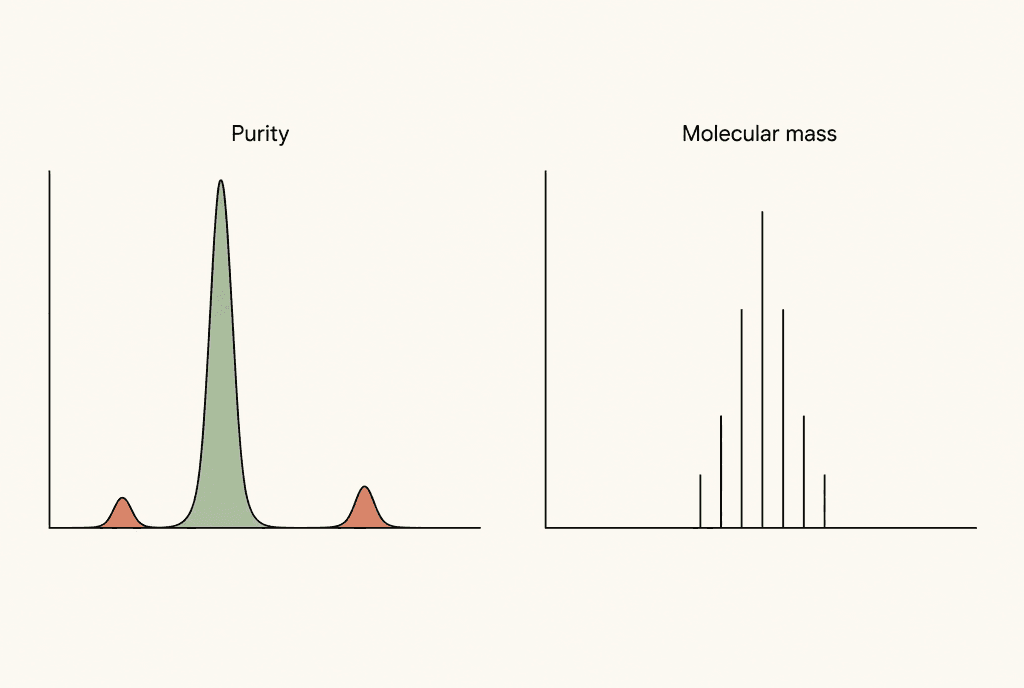
HPLC purity usually means the share of a measured signal linked to the target peptide. HPLC separates a mixture. A detector records signals as peaks on a graph, called a chromatogram. NIST's archived peptide reference report separates peak-area purity from peptide content by mass. Content by mass means how much of the sample's mass is peptide. These measures differ. A large main peak does not show everything in the sample. The test method and detector matter. A percentage alone is incomplete unless you know what was measured.
The NIST peptide reference report was issued in 2007. It shows how measures are defined. It is not a certificate for a supplier's material. Josephs and colleagues compared several ways to measure peptide content. Their paper appeared in TrAC Trends in Analytical Chemistry in 2018. They studied angiotensin I, not retatrutide.
How does mass spectrometry support peptide identity?
Mass spectrometry can support a claim about which peptide is present. This test compares a molecule's measured mass with the mass expected for that peptide. The machine first records signals based on mass and electric charge. NIST's peptide reference report lists measured and calculated masses apart from purity results. A matching mass and a purity result answer different questions. A report should say which tests checked the peptide's identity. A matching mass alone cannot settle questions about its full structure. It also leaves questions about other material in the sample.
Identity asks which molecule is present. How to check an Australian peptide supplier is legitimate covers business checks. These include the Australian Business Number, or ABN, and contact details. Content asks how much is present. Li and colleagues compared ways to measure peptide content across labs. Their paper appeared in Journal of Pharmaceutical and Biomedical Analysis in 2019. They studied oxytocin and checked whether measurements agreed. They did not study a supplier's reputation. What is the molecular formula of retatrutide? gives a worked example of expected mass. You can compare a report's mass result with that value.
What makes an independent laboratory report useful?
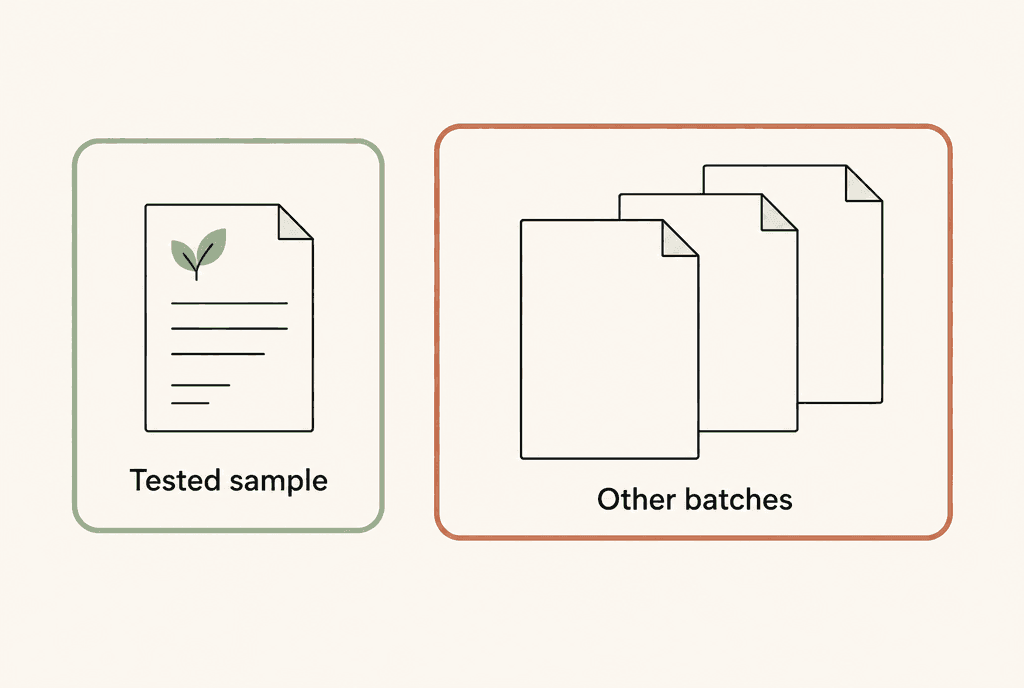
An outside lab report is useful when you can check its details. These include the lab, sample reference and work done. Independent means a separate testing group. It does not tell you who chose the sample. FDA's supplier-quality advice says to know which tests a supplier runs. It also says to keep the original maker's identity clear. That advice covers the supply of ingredients for medicines. For research paperwork, ask whether the evidence links that lab to this sample and lot. A lab logo alone cannot confirm that link.
Find the named lab's contact details through a separate source. Ask if it can confirm the report reference and what it covers. This is a suggested document check. It does not mean this page has confirmed any report is real.
Why can no list settle which peptide company is most trusted?
A trust list cannot confirm every batch from a company. Each result covers a sample under stated tests. Finnrick's method page separates identity, purity and amount. Identity means the substance matches its name. Purity concerns the mixture. Amount means how much is present. These checks need their own results. A company slogan cannot fill a missing test.
The April report also noted seller-sent samples. Who chose the sample matters when judging what a result represents. A seller's selected sample cannot stand for every parcel. This is a limit on what the evidence shows, not a finding about another batch.
Finnrick says its rankings summarise test evidence rather than endorse a company. Its method page was checked 17 October 2026. Our guide to which peptide company is the most trusted explains why the records cannot name a universal winner. This page has not checked a supplier's batches.
Evidence limits
What can supplier testing not show?
Supplier testing cannot show human safety from purity and identity results alone. Each result answers a set question about a sample. A missing test means missing evidence. A test name cannot stand in for its result. Li and colleagues' lab study and Josephs and colleagues' purity work cover test methods. They do not cover health outcomes in people. This page has not checked a supplier or watched samples being taken. It has not checked a specific lot. Research material is not a medicine. It is not for human or animal use. These checks do not endorse a whole company.
The research grade guide separates a label from evidence. What should readers know about peptides in Australia? explains the wider local setting. How do people access retatrutide? covers access. That is a separate question from lab quality.
Comparison
Different records answer different questions. Sources identify the basis for each row; no row ranks a supplier.
| Record | What it records | What remains separate | Source |
|---|---|---|---|
| Lot-linked COA | Named batch and reported test results | Independent confirmation of the document | FDA, ICH Q7, 2016, section 11.4 |
| HPLC peak-area purity | Relative detector signal after separation | Peptide content by mass | NIST RM 8327, 2007 |
| Mass spectrometry | Measured molecular mass | A separate purity result | NIST RM 8327, 2007 |
| Peptide content study | Comparison of content measurement methods | Clinical outcomes | Li et al., 2019; Josephs et al., 2018 |
FAQ
Can one test name identify a reputable peptide company?
No. A test name describes a method. You need the actual report, its link to the sample and its limits. This page offers document checks. It does not rank suppliers.
Is HPLC purity the same as peptide content?
No. The NIST peptide reference report defines peak-area purity and content by mass differently. A certificate needs to say which measure it reports.
Does an independent report verify every lot?
A report covers the sample it names. You need separate evidence to link that result to another lot.
Has this page verified a particular supplier?
No supplier, report or lot was checked for this page. The source check on 17 October 2026 covered the documents cited here. It did not include a business inspection.
More in this hub
- Retatrutide vs Mounjaro vs Ozempic: what's the difference?
- What is the difference between GLP-1 and GLP-3?
- Is retatrutide available in the USA? What the public record says
- How much does retatrutide cost? Is there an approved price?
- What does retatrutide do in the body? The three receptors in the papers
- How are people getting retatrutide? Trials, approval and research supply
- Who should not take retatrutide? What the trial exclusion lists say
- What is replacing tirzepatide? Weight-loss medicines in Phase 3 in 2026
- Retatrutide and type 2 diabetes: what the trials measured
- How long has retatrutide been studied?
- Retatrutide pharmacokinetics: what is the half-life?
- Retatrutide Phase 2 trial: what did the paper find?
- What is the molecular formula of retatrutide?
- NCT05882045: what is the TRIUMPH-3 retatrutide trial?
- NCT05929066: what is the TRIUMPH-1 retatrutide trial?
- Where does tirzepatide come from? Lilly's LY3298176
- SURPASS and SURMOUNT: what the tirzepatide trials measured
- Retatrutide in Australia: is it legal, approved or available yet?
- Retatrutide study findings: what do the clinical trials show?
- Retatrutide side effects: what trials and regulators have recorded
Citations
4 sourcesJosephs RD, Stoppacher N, Daireaux A, et al. TrAC Trends in Analytical Chemistry. 2018;101. Peptide purity value assignment using angiotensin I..
doi:10.1016/j.trac.2017.09.026Li C, Bhavaraju S, Melanson J, et al. Journal of Pharmaceutical and Biomedical Analysis. 2019;166. Multi-laboratory comparison of peptide quantification methods using oxytocin..
doi:10.1016/j.jpba.2018.12.028Finnrick Methodology. Identity, purity, fill accuracy and limits of rankings; checked 17 October 2026.
doi:https://www.finnrick.com/methodologyMarsh S and Davis N The Guardian. Reporting on sample sources, 6 April 2026; checked 17 October 2026.
doi:https://www.theguardian.com/science/2026/apr/06/labs-testing-thousands-of-unregulated-substances-amid-peptide-craze
Continue
Explore the retatrutide evidenceForm Laboratories supplies research-use-only reference material. This article is an educational summary of published third-party literature. It is not medical advice, not a use instruction, and research material is not for human or animal use.